Puerto López and Isla de la Plata
 by Yannick Schroth
Sep 6, 2026
8 min read
by Yannick Schroth
Sep 6, 2026
8 min read
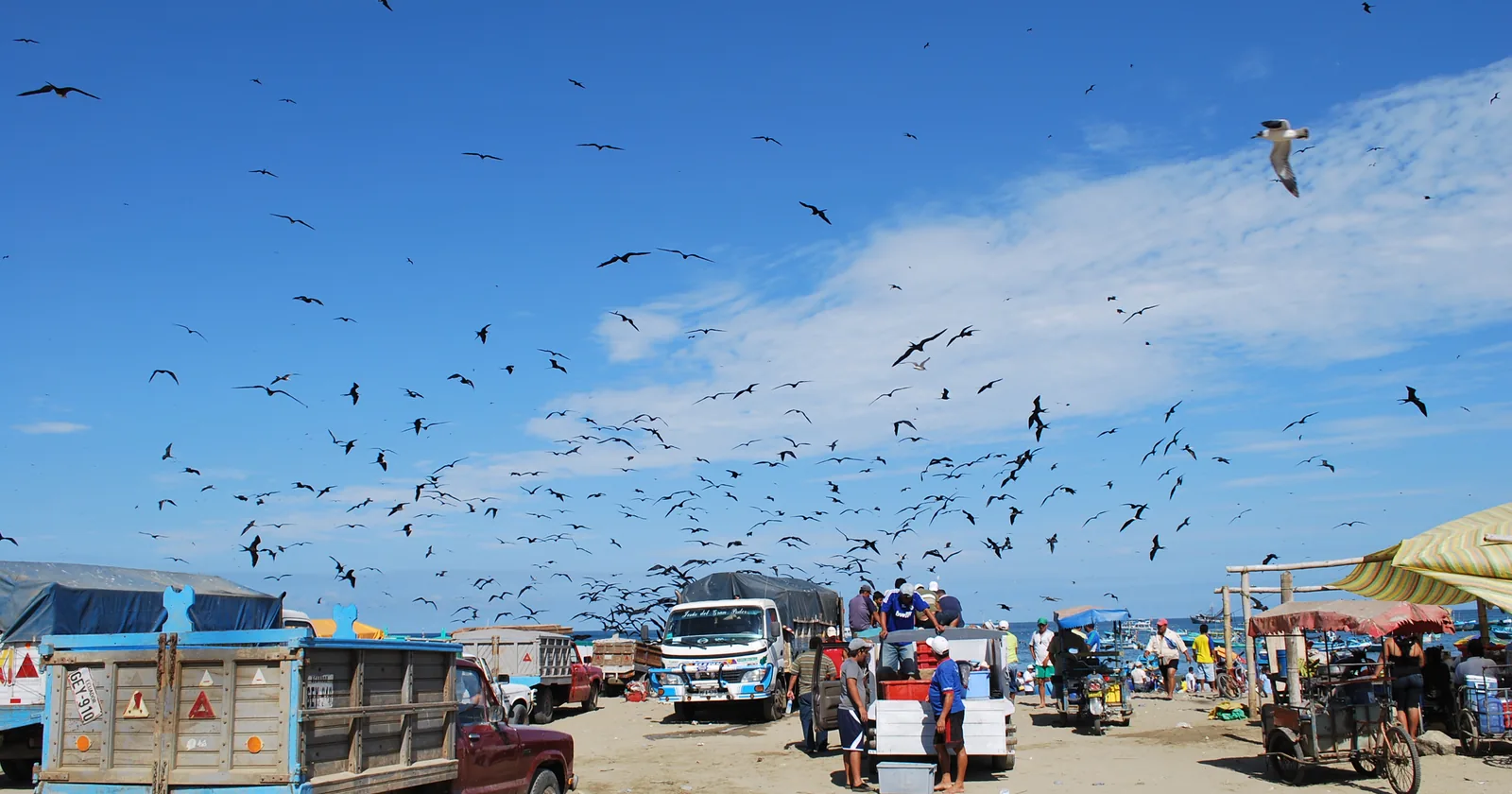
The fish landing at Puerto López, with the frigatebirds that work it. Photo: DickClarkMises, Wikimedia Commons, CC0.

The manta population, and why it is not a rumour
Oceanic mantas, Mobula birostris, are the big ones: about seven meters across, offshore, and listed by the IUCN as Endangered. Where other known subpopulations are estimated at one to two thousand animals, the Ecuador and Peru population runs to over 22,000.
That figure comes from photo-identification, not from an operator's impression: individual mantas were matched by belly spot patterns across thirteen years of images, many donated by visiting divers. The work was led by Fundación Megafauna Marina del Ecuador with the Manta Trust, the Marine Megafauna Foundation and Oregon State University, and published in Marine Ecology Progress Series.
When the manta and humpback seasons overlap
| What | When | Where |
|---|---|---|
| Oceanic manta aggregation | Around August and September | Isla de la Plata, in Machalilla National Park |
| Humpback whales, migrating from Antarctica to calve | June to October, best in July and August | The marine area of Machalilla National Park |
| Seabird colonies, blue-footed boobies, frigatebirds | Year-round | Isla de la Plata, on foot |
So August and September put the biggest manta population on earth and a humpback calving ground in the same boat trip. The park's marine area is described as the most important breeding and calving zone for humpbacks that migrate up from Antarctic waters each year. Outside those months the island is still a fine day out for the birds, and the mantas are somewhere else.
Isla de la Plata: what to expect there
It is a small, dry, uninhabited island about an hour and a half offshore by boat, inside Machalilla National Park, reached on a day trip from Puerto López. It gets called “the poor man's Galápagos” because it carries blue-footed boobies and frigatebirds you can walk past on a trail.
What it is not is a resort. There is nothing to stay in on the island, the trip is a boat out and a boat back, and Puerto López itself is a fishing town with a beach where the catch is landed and the frigatebirds work the trucks. That is a feature if you want the coast without the Riviera, and a problem if you want a dive resort.
Why we have no operator list for Puerto López
Our directories come from three registers that publish a citable page per member: SSI, IKO and VDWS. Between them they carry one entry for Puerto López. That is not a statement about how many dive operations work the town: it is a statement about which registers they belong to, and in Latin America that is mostly not these three.
So there is no directory page here, and this guide says so rather than publishing a list of one and letting it look like the market. Ask any operator you find how many people they put in the water with a manta, and what their distance rule is.
Getting to Puerto López
Puerto López sits on the Ruta del Spondylus, the coastal road through Manabí. The practical approach is a flight to Manta or Guayaquil and a bus or car down the coast. It is a long way from anywhere you were already going, which is a large part of why the largest oceanic manta population on earth is not on more lists.
FAQ: Puerto López, Ecuador
Where is the largest population of oceanic manta rays?
Off Isla de la Plata in Ecuador, reached by boat from the town of Puerto López. Researchers identified more than 2,800 individual oceanic mantas from photographs taken between 2005 and 2018 and estimated the total population at over 22,000, which is more than ten times any other known subpopulation of the species. The study was published in Marine Ecology Progress Series.
When should you go to Isla de la Plata?
August and September, when the oceanic manta aggregation and the humpback whale season overlap. Humpbacks migrate up from Antarctic waters to calve in the marine area of Machalilla National Park from about June to October, with July and August usually the best of it. Outside those months the island is still worth a day for the blue-footed boobies and frigatebirds.
Is Isla de la Plata really like the Galápagos?
It carries some of the same seabirds - blue-footed boobies and frigatebirds you can walk past on a trail - which is why it gets called the poor man's Galápagos. It is a small, dry, uninhabited island about an hour and a half offshore, visited as a day trip. There is nowhere to stay on it and no resort infrastructure.
Sources
- The Ecuador oceanic manta population: more than 2,800 individuals identified from 2005 to 2018, total estimated above 22,000, more than ten times any other known subpopulation. Published in Marine Ecology Progress Series; led by Fundación Megafauna Marina del Ecuador with the Manta Trust, the Marine Megafauna Foundation and Oregon State University. Read 6 September 2026. mantatrust.org
- Oceanic manta, Mobula birostris, listed Endangered by the IUCN. Species assessment summary
- Humpback season and Machalilla National Park: whales migrating from Antarctic waters from about June to October, with the park's marine area described as the key breeding and calving area. As published by Ecuadorian operators and tourism sources. Read 6 September 2026. Whale season and Isla de la Plata
- Our own register reading: SSI, IKO and VDWS hold one entry for Puerto López between them, read 6 September 2026, which is why this page carries no operator list.