Best Cold-Water Surf Destinations for Digital Nomads
 by Yannick SchrothAug 3, 20266 min read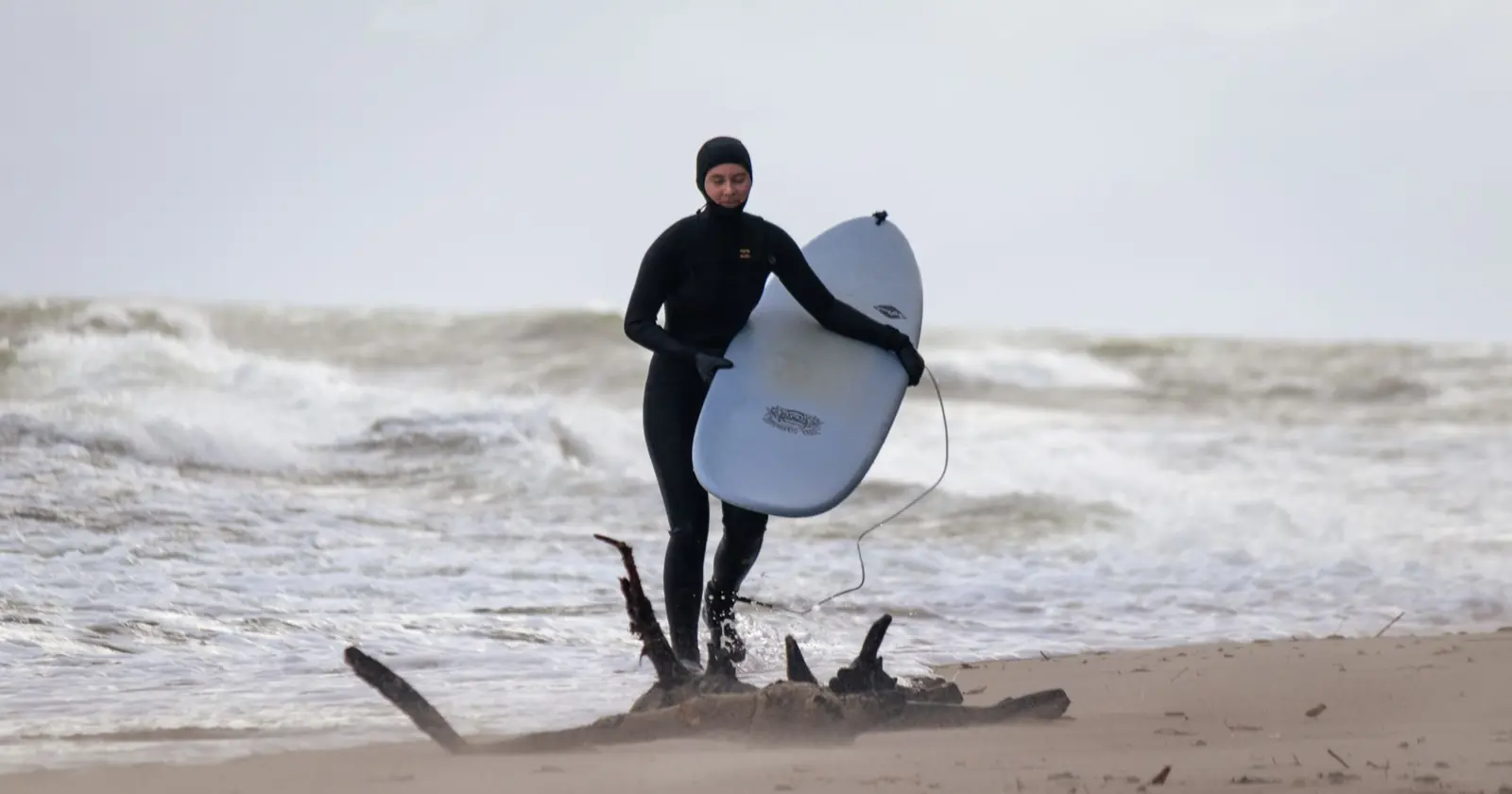
Photo: Jędrzej Koralewski / Pexels.
What cold-water surfing actually asks of you
Cold water changes the ranking completely: a mediocre wave you can surf for two hours in a good wetsuit beats a great wave you leave after twenty minutes. So the places below are weighted for water temperature against wave quality, and heavily for changing facilities, hot water and drying space, which sound trivial until you have done a week without them. Everything here needs real rubber; the linked guide states the thickness.
The number that matters is 15 degrees
Below 15 °C, water is officially cold, and the reason is not comfort. The first thing that happens on immersion is an involuntary gasp reflex: the National Fire Chiefs Council describes it as “an involuntary gasp reflex, causing the person to inhale sharply”, which “can lead to water entering the lungs”, followed by uncontrollable hyperventilation.
That phase is short, the NFCC puts it at 1 to 2 minutes, and it is the part that drowns people, because it happens in the seconds after a wipeout when the instinct is to swim hard. The advice from the RNLI's Float to Live campaign is the opposite: do not fight it, lie back and float until the breathing settles, then swim.
Afterwards comes the slower problem. Cold incapacitation: hands that will not close, arms that will not pull, sets in within roughly 5 to 15 minutes in cold water. That is the real argument for the rubber, the boots and the hood on this page: not comfort, but keeping the window in which you can still get yourself back to the board.
Lofoten
Arctic surf above the Arctic Circle amid dramatic Norwegian scenery, thick wetsuit essential.
Arctic, wildRead the guide → 34°04′S 18°28′E · South AfricaCape Town
Cold Atlantic surf and tidal pools in a world-class city with fast fibre.
Cold, city baseRead the guide → 43°19′N 1°59′W · SpainSan Sebastian
A cool-water Basque city with Zurriola beach break and world-class food.
Cool, city, foodRead the guide → 34°23′S 72°00′W · ChilePichilemu
Chile's surf capital: big, cold lefts at Punta de Lobos, a full wetsuit spot.
Cold, big leftsRead the guide → 39°36′N 9°04′W · PortugalNazare
The world's biggest waves in winter, a spectator town for most and a challenge for experts.
Big-wave, winterRead the guide → 38°58′N 9°25′W · PortugalEriceira
A Portuguese surf reserve that turns powerful and cool in autumn and winter.
Cool autumn swellRead the guide → 43°40′N 1°26′W · FranceHossegor
Europe's surf capital: heavy autumn beach breaks in the French Landes, cool water.
Powerful autumn beach breaksRead the guide → 39°22′N 9°23′W · PortugalPeniche
A Portuguese peninsula with a wave for every wind, best and coolest in the off-season.
Every-wind peninsulaRead the guide → 37°48′S 174°52′E · New ZealandRaglan
A cool-water New Zealand point break, one of the world's longest lefts.
Cool, long leftRead the guide →Picking a cold-water base
- For the wildest scenery: Lofoten's Arctic surf.
- For a real city base: San Sebastian or Cape Town.
- For heavy, world-class waves: Nazare and Pichilemu, for experienced surfers.
15 °C is a definition, not a safety line
The threshold above is the one European water-safety bodies work to, and it is useful for deciding what rubber to pack. It is a poor guide to when the water can hurt you, and the US National Weather Service says so in a sentence worth reading twice: “Cold shock can be just as severe and dangerous from water temperatures of 50-60°F (10-15°C) as it is from water at 35°F (2°C).”
The gasp itself starts far warmer than any list of cold-water destinations would suggest. “Gasping for a breath or rapid breathing from sudden immersion can be triggered by water as warm as 77°F (25°C)”, the same source notes: which is warmer than the summer sea at half the breaks people think of as mild. What changes with temperature is not whether the reflex fires but how long the rest of the sequence gives you. The Weather Service puts the immediate phase at “the first 2-3 minutes or more” of “involuntary gasping, rapid breathing or hyperventilating due to the ‘shock’ of sudden immersion”, and describes the slope plainly: “The impact can be felt within seconds of entering cold water, and the longer the exposure or the colder the water, the more severe the impact can become.”
Two practical consequences for a surf trip, and they are the reason this sits on a destination page rather than a safety one.
- Pick the suit for the sea, not for the forecast. The Weather Service's rule is four words long: “Always dress for water temperature, not for air temperature.” A 20 °C morning over 12 °C water is the classic trap, and it is exactly the pattern at several breaks on this page in spring.
- A mild-sounding destination is not exempt. If 25 °C water can trigger the gasp, then the reflex is not a cold-water problem at all: it is a sudden-immersion problem. The difference on the cold end is how quickly it stops being survivable.
None of that argues against surfing cold water; it argues for treating the first minute as the dangerous one everywhere, and for the thickness, hood and boots that keep the later minutes usable. Learn the float response and the self-rescue with someone qualified, in water, before you need either.
FAQ: Cold-Water Surf Destinations for Nomads
What wetsuit do I need for cold-water surf?
It depends on the spot and season, which the linked guide details. As a rule, cool-water Europe (Portugal, the Basque coast) wants a 3/2mm to 4/3mm, cold spots like Chile and Cape Town a 4/3mm with boots, and Arctic Lofoten a 5/4/3mm or 6mm with hood, boots and gloves.
Are cold-water spots better for avoiding crowds?
Often yes: colder water and tougher conditions thin the crowds, especially outside peak summer. The trade-off is you need the right wetsuit and a higher tolerance for wind and cold, and some of these waves (Nazare, Pichilemu) are for experienced surfers only.
Sources
- Where the hazard actually starts. NOAA National Weather Service, Cold Water Safety: “Cold shock can be just as severe and dangerous from water temperatures of 50-60°F (10-15°C) as it is from water at 35°F (2°C)”; “Gasping for a breath or rapid breathing from sudden immersion can be triggered by water as warm as 77°F (25°C)”; cold water immersion “can trigger involuntary gasping, rapid breathing or hyperventilating due to the ‘shock’ of sudden immersion” during “the first 2-3 minutes or more”; “The impact can be felt within seconds of entering cold water, and the longer the exposure or the colder the water, the more severe the impact can become”; “Always dress for water temperature, not for air temperature”; “Wearing a life jacket significantly increases chances of survival.” weather.gov. Read 13 September 2026.
- What counts as cold water, and what it does to breathing. National Fire Chiefs Council, Be Water Aware: “a temperature below 15ºC is defined as cold water”, the involuntary gasp reflex and hyperventilation that follows, and the effects passing in one to two minutes. nfcc.org.uk. Read 9 September 2026.
- Float to Live. Royal National Lifeboat Institution, on cold water shock and floating on your back until the gasp reflex passes rather than swimming through it. rnli.org. Read 9 September 2026.
- Cold incapacitation. National Center for Cold Water Safety, on the loss of useful movement in the minutes after the shock response ends. coldwatersafety.org. Read 9 September 2026.
- Each entry links to our full guide for that place, and those guides carry the external sources and read dates behind the claims summarised here. They are the place the readings are recorded, not the evidence for them: Lofoten, Cape Town, San Sebastian, Pichilemu, Nazare, Ericeira, Hossegor, Peniche, Raglan.