Garmin Descent vs Suunto: Which Dive Computer to Travel With?
 by Yannick SchrothOct 14, 202611 min read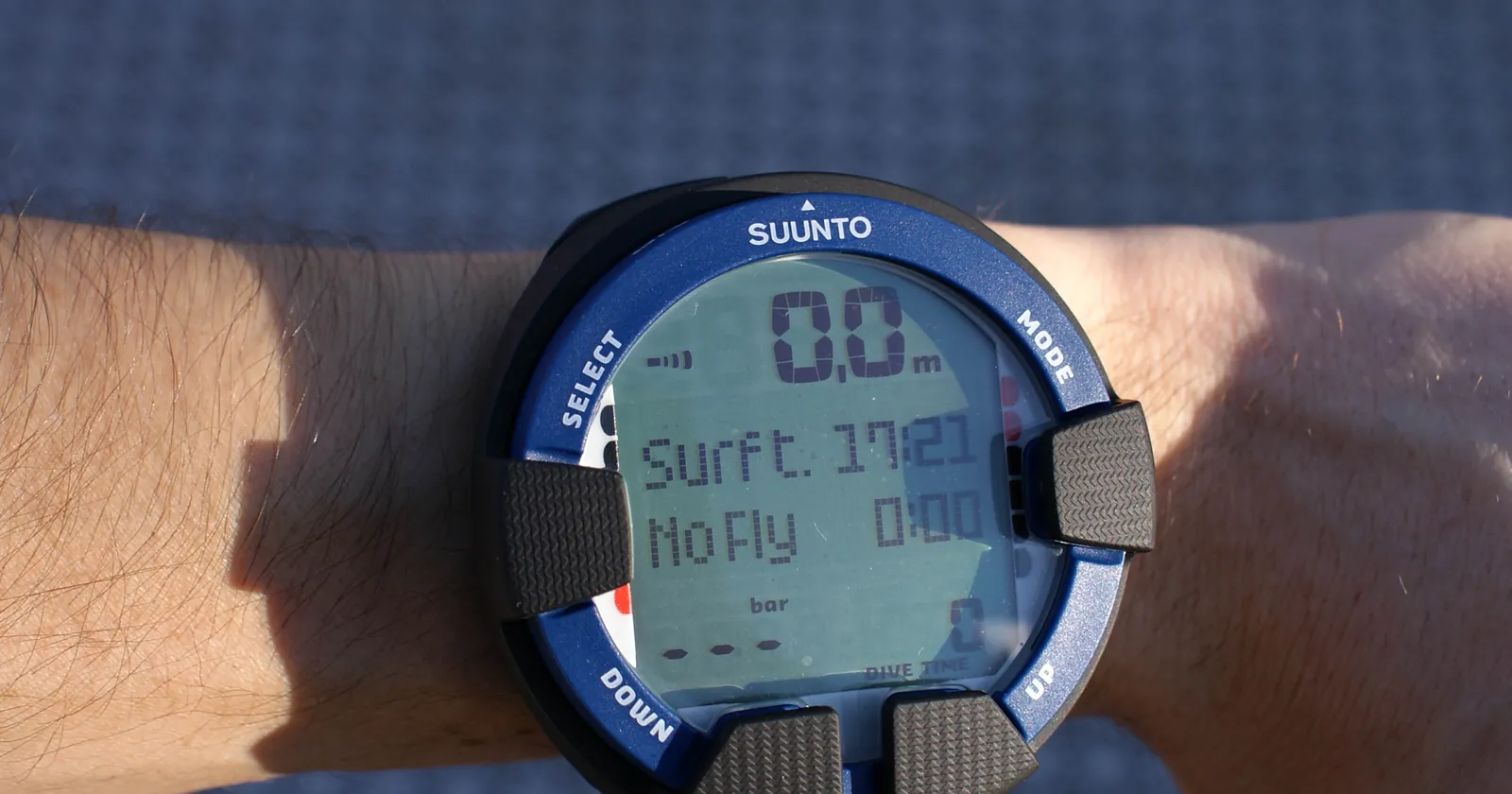
A Suunto Vyper Air on the wrist, October 2010: an older air-integrated Suunto, not one of the models compared here. No freely licensed photo of a Garmin Descent exists. Photo: Thomei08, Wikimedia Commons, public domain, cropped.
Best for
- One watch for diving and daily life, trimix included: Garmin Descent G2 (USD 699.99)
- A smartwatch that shows tank pressure, for less: Suunto Ocean (USD 899) with a Tank POD (USD 439), USD 561.98 under a Descent Mk3i 43 mm with a T2
- A big screen on a strap for under USD 700: Suunto Nautic (USD 699), 3.26-inch AMOLED, rated to 200 m
- The cheapest computer in either range: Suunto Zoop Novo (USD 299); Garmin's lowest price is the G2
| Model | US list price, Oct 2026 | Format and screen | Algorithm | Gases | Air integration | Dive battery | Depth rating |
|---|---|---|---|---|---|---|---|
| Garmin Descent G2 | USD 699.99 | Watch, 1.2" AMOLED | Bühlmann ZHL-16c + GF | Air, nitrox, trimix, CCR, apnea | No | Up to 27 h | 100 m |
| Garmin Descent Mk3 / Mk3i, 43 mm | USD 1,199.99 / 1,399.99 | Watch, 1.2" AMOLED | Bühlmann ZHL-16c + GF | Air, nitrox, trimix, CCR, apnea | Mk3i only, Descent T2 | Up to 30 h | 200 m |
| Garmin Descent Mk3i, 51 mm | USD 1,599.99 | Watch, 1.4" AMOLED | Bühlmann ZHL-16c + GF | Air, nitrox, trimix, CCR, apnea | Yes, Descent T2 | Up to 66 h (40 h with air integration) | 200 m |
| Garmin Descent X30 | USD 749.99 | Wrist unit, 2.4" color LCD | Bühlmann ZHL-16C + GF | Air, nitrox, trimix | No | 10, 30 or 47 h by brightness | 100 m |
| Garmin Descent X50i | USD 1,499.99 | Wrist unit, 3.0" color touchscreen | Bühlmann ZHL-16c + GF | Air, nitrox, trimix, CCR | Yes, Descent T2 | 13, 16 or 20 h by brightness | 200 m |
| Suunto Zoop Novo | USD 299 | Wrist unit, segment display | Suunto RGBM | One gas, up to 50% O2; freedive | No | CR2450 cell, about 1.5 years at 100 dives a year | 80 m |
| Suunto D5 | USD 649 | Watch, color display | Suunto Fused RGBM 2 | Up to 3 gases, nitrox; freedive | Yes, up to 3 Tank PODs | 6 to 12 h | 100 m |
| Suunto Nautic S | USD 549 | Watch, 1.43" AMOLED | Suunto Bühlmann 16 GF | Up to 5 gases, nitrox; freedive | Yes, Tank POD | 40 to 60 h | 80 m |
| Suunto Ocean | USD 899 | Watch, 1.43" AMOLED | Suunto Bühlmann 16 GF | Up to 5 gases, nitrox; freedive | Yes, up to 5 Tank PODs | 40 to 60 h | 60 m |
| Suunto Nautic | USD 699 | Wrist unit, 3.26" AMOLED | Suunto Bühlmann 16 GF | Up to 5 gases, nitrox, trimix | Yes, up to 5 Tank PODs | 80 to 190 h | 200 m |
| Suunto EON Core | USD 649 | Wrist unit, color TFT | Fused RGBM 2 or Bühlmann 16 GF | Up to 10 gases, trimix, CCR (fixed setpoint) | Yes, Tank POD | 10 to 20 h | 80 m |
| Suunto EON Steel Black | USD 994.95 | Wrist unit, color TFT | Fused RGBM 2 or Bühlmann 16 GF | Up to 20 gases, trimix, CCR (fixed setpoint) | Yes, Tank POD | 10 to 20 h | 150 m |
What Garmin Descent and Suunto actually sell for diving in October 2026
Garmin's US dive page lists three families: the Descent G2, the Descent Mk3 in 43 mm and 51 mm, and the Descent X30/X50i, plus the Descent T2 transceiver. The "i" models read tank pressure. No Garmin dive computer costs less than the G2 at USD 699.99.
Suunto's range is wider at both ends. Its US store lists the Zoop Novo (USD 299), the D5 (USD 649), the new Nautic S (USD 549) and Nautic (USD 699), the Ocean (USD 899), and the older EON Core (USD 649) and EON Steel Black (USD 994.95). The two Nautics carry a "New" tag and user guides dated January and February 2026. On 14 October the Ocean showed USD 799 with a USD 100 discount code and the D5 USD 349 with a USD 300 code.
In a Garmin Descent vs Suunto comparison, the fair pairings are watch against watch and screen against screen. That means the G2 against the Ocean or Nautic S, the X30 against the Nautic, and the Mk3i or X50i against an Ocean or EON with a Tank POD.
Suunto Ocean vs Garmin Descent G2: 60 m and nitrox against 100 m and trimix
On paper these two watches look alike. Their depth ratings do not. Suunto rates the Ocean to 60 m under EN 13319. Its manual lists "Exceeding the maximum depth limit of device (60 m)" as one of the events that triggers an algorithm violation. Garmin rates the G2 to 100 m.
The gas lists split the same way. The Ocean's Multigas mode takes up to five "Air or Nitrox mixes, up to NX99"; the manual has no trimix, helium or rebreather setting anywhere. The G2 lists trimix, closed-circuit rebreather (CCR) support and up to 11 deco or backup gases. Both have a freedive mode, and the Ocean's depth meter for freediving also stops at 60 m.
For a reef diver on air or nitrox, none of this bites. For someone planning a trimix course, it ends the Ocean as an option. Within Suunto, the deeper option is the Nautic: rated to 200 m, with trimix in its multi-gas mode. If nitrox is still new to you, our nitrox explainer covers what those mixes do.

Bühlmann on both, unless your Suunto is a D5 or Zoop Novo
Garmin's spec sheets name "Bühlmann ZHL-16c with gradient factors" on every Descent. Suunto runs two different families. The Ocean, Nautic and Nautic S use "Suunto's Bühlmann 16 GF dive algorithm that is based on the Bühlmann ZHL-16C model that we have implemented our own code for", in the Ocean manual's words. The D5 runs Suunto Fused RGBM 2, the Zoop Novo the older Suunto RGBM, and the EON Core and EON Steel Black let you choose either.
Suunto publishes its presets. On the Ocean, Nautic and Nautic S they are Low 45/95, Medium 40/85 (default) and High 35/75, with a custom option. Garmin offers "low/medium/high or custom using gradient factors" and does not print the numbers behind its presets in the September 2026 Descent manuals. A diver who wants a Garmin and a Suunto to agree on no-stop time should set the same custom pair on both. Even then, two independently coded models need not match to the minute.
The EON models are stricter. Their manuals set Bühlmann 16 GF to 30/70 by default and add that "All values other than the default values are out of recommendation." On RGBM the controls are different: the D5 offers five personal settings from +2 to -2 with 0 as default, the Zoop Novo three steps from 0 to 2. Those are not gradient factors, so there is no direct number to set against a Garmin.
Missed a deco stop: Garmin's 24-hour lockout against Suunto's 48 hours
This is where the brands differ most, and Suunto differs from itself. Every current Descent manual describes a deco lockout that "prevents gas dives for 24 hours if you violate a decompression ceiling for more than three minutes." Garmin lets you switch it off in the settings.
Suunto's Bühlmann computers do not lock. The Ocean manual says it "does not lock after you confirm the algorithm deviation trigger alert" and "continues showing the original decompression plan even if the decompression stop is violated". A red warning stays until the stops are cleared or for 48 hours, and the no-fly time after such a dive "is always 48 hours". The Nautic and Nautic S manuals use the same wording.
The RGBM computers go the other way. The D5 manual: "Suunto Fused RGBM 2 algorithm is locked for 48 hours if you omit to take decompression stops for longer than three (3) minutes." The Zoop Novo shows "Er" for the same 48 hours. Diving while locked resets the clock, and neither manual describes a way to turn the lock off. The D5 also locks its decompression calculation for 48 hours after a dive in gauge mode.
No setting makes a missed stop safe. What changes is the cost on a prepaid trip. A locked D5 or Zoop Novo gives you two days without deco information, twice Garmin's penalty, while an Ocean keeps working and leaves the decision to your training.

Suunto Tank POD or Garmin Descent T2: what tank pressure on the wrist costs
The Suunto Tank POD lists at USD 439 and pairs with the Nautic, Nautic S, Ocean, D5, EON Steel, EON Steel Black and EON Core. The Zoop Novo is not on that list. The Ocean and Nautic read up to five cylinders and the D5 up to three. The Nautic and Nautic S add a tank-switch alarm for sidemount, which the Ocean's guide does not list.
Garmin's Descent T2 lists at USD 499.99 and works only with the Mk3i and X50i; the G2 has no air-integration line on its spec sheet. In return the T2 transmits up to 10 m, lets one computer watch up to eight tanks including buddies', and carries Garmin's SubWave diver-to-diver messaging.
Priced as a pair, an Ocean with one Tank POD is USD 1,338. A 43 mm Mk3i with one T2 is USD 1,899.98, so the Suunto route to tank pressure on a smartwatch is USD 561.98 cheaper. A Nautic S with a Tank POD comes to USD 988, a Nautic with one to USD 1,138, and an X50i with a T2 to USD 1,999.98.
Battery service is the Tank POD's catch for travelers. Its guide says: "Do not try to replace the battery by yourself! It should always be replaced by an authorized Suunto Service Center", and sets the interval at "200 dives or two years, whichever comes first". The cell is a 3.6 V half-AA lithium-thionyl chloride type. The T2 runs on a CR123A for up to 100 hours.
Suunto Nautic against the Garmin Descent X30 and X50i: big screens on a strap
Not everyone wants a watch. The Nautic is a strap-mounted unit with a 3.26-inch AMOLED screen at 720 x 382 pixels, a bungee mount and an LED flashlight, and it weighs 227 g with the bungee. It is rated to 200 m, runs Bühlmann 16 GF, takes up to five gases including trimix, and reads two Tank PODs for sidemount. Suunto charges USD 699.
Garmin's X30 costs USD 50.99 more and gives you less screen: 2.4 inches at 320 x 240, a 100 m rating and no air integration, though it does trimix and records GPS entry and exit points. The X50i has a 3.0-inch touchscreen, a 200 m rating, CCR support, air integration and SubWave messaging, at USD 1,499.99.
The Nautic wins on screen per dollar. CCR is the dividing line. The Nautic's manual lists "Air, Nitrox and Trimix mixes" and no rebreather mode, so a CCR diver choosing between these two needs the X50i, or Suunto's own EON models with their fixed-setpoint CCR mode.
Battery life and charging: Suunto Ocean, Nautic and Garmin Descent between dive days
Suunto lists the Ocean at 40 to 60 hours of dive time and "up to 4 days with 3 dives per day" with daily use in between. The G2 lists 27 hours of diving, the 43 mm Mk3 30 and the 51 mm Mk3i 66. The Nautic's spec table gives 80 to 190 hours, while its headline says "up to 120 hours on a single charge"; either way it is the longest-running rechargeable here. The D5 is the short one at 6 to 12 hours.
Both brands use their own chargers. Garmin's is a "proprietary clip charger", and the Ocean manual says "Only use the provided charging cable". Lose one on a boat and a borrowed phone cable will not help, so a spare earns its place in the bag.
The Zoop Novo is the exception, and the sources disagree about it. Suunto's store lists a CR2450 cell, about 1.5 years of life at 100 dives a year, and "User replaceable battery". Its user guide says "Contact an authorized Suunto service center for battery replacement" and that "defects caused by improper battery installation are not covered by the warranty". The manual is the document to follow. Plan a service-center visit, not a corner-shop swap.
Living with a Suunto Ocean or Garmin Descent G2 when you are not diving
Both are full smartwatches. The Ocean lists up to 16 days in smartwatch mode, phone notifications, music controls, sleep and heart-rate-variability tracking, dual-band GPS and 32 GB of free offline maps. Its backlight doubles as a flashlight. Predefined replies to messages work on Android only. The G2 lists up to 10 days, smart notifications, sleep tracking, GPS and Garmin Pay.
Payment is the gap. The Ocean's user guide contains no payment, wallet or contactless feature, so if you want to leave your card at the guesthouse, that tips the choice to Garmin. The Ocean counters with a 1.43-inch AMOLED screen at 466 x 466 pixels and a weight of 99 g on a silicone strap.
Suunto also records an underwater route from GPS, motion sensors and depth. The route is not shown on the watch; it appears in the Suunto app after syncing, and the manual warns it can be compromised in caves, wrecks or with poor GPS. Garmin logs go to the Garmin Dive app. If the watch you already wear is an Apple Watch Ultra, our guide to the Apple Watch Ultra as a dive computer covers what it can and cannot replace.
Repairs abroad: what the Suunto and Garmin Descent warranties cover
Suunto gives a two-year international limited warranty on dive computers and dive transmitters, and five years on the depth sensor. It "is valid and enforceable regardless of the country of purchase", and repairs can be done "in any Suunto authorized service center around the world". The battery, the charging cable and dive accessories carry one year.
One clause matters on a tropical trip. The warranty "is not enforceable" if the product "has been exposed to chemicals including but not limited to sunscreen and mosquito repellents". Rinse the watch and wash your hands before you put it on.
Garmin's US consumer warranty covers non-aviation products "for one year from the date of purchase." That is the US wording; check the terms where you buy. For a nomad who may need a repair far from home, Suunto's two worldwide years are the stronger promise.
Garmin Descent or Suunto for your kind of dive travel
One device for everything, deeper diving included. Take the Garmin Descent G2 at USD 699.99. It does trimix and CCR to 100 m, freediving, and Garmin Pay. Our Garmin Descent vs Shearwater comparison sets it against the Shearwater Peregrine and Tern.
A smartwatch with tank pressure on a recreational trip. The Suunto Ocean with a Tank POD costs USD 1,338, well under a Mk3i with a T2, and never locks you out. Accept nitrox only and a 60 m rating. The Nautic S at USD 549 is the cheaper Suunto watch on the same algorithm, rated to 80 m.
A big screen in the dive bag. The Suunto Nautic at USD 699 gives more screen, more depth and more battery than the Garmin X30. The X50i is the pick only if you dive a rebreather or want SubWave messaging.
The lowest budget. The Suunto Zoop Novo at USD 299 is the only computer here with a list price under USD 500. It takes one gas, has no air integration and locks for 48 hours after a missed stop. Our travel dive computer guide lists the alternatives at that price, and our Shearwater vs Suunto comparison covers the Peregrine against the Suunto range.
Whichever brand you take, sort the cover before the computer: our dive insurance guide shows which policies pay for a chamber.
FAQ: Garmin Descent vs Suunto
Is Garmin Descent better than Suunto for diving?
It depends on the model you compare. The Garmin Descent G2 goes further than the Suunto Ocean underwater: trimix, CCR and a 100 m rating against nitrox and 60 m. The Ocean is the better buy if you want tank pressure on a smartwatch, because an Ocean with a Tank POD costs USD 1,338 against USD 1,899.98 for a Descent Mk3i 43 mm with a T2, as of October 2026.
Does the Suunto Ocean use the same algorithm as the Garmin Descent G2?
Both are Bühlmann ZHL-16C with gradient factors. Suunto calls its version Suunto Bühlmann 16 GF and says it wrote its own code for it. The Ocean's presets are published: Low 45/95, Medium 40/85 (default), High 35/75. Garmin offers low, medium, high or custom but does not print the numbers behind its presets.
How deep can you dive with a Suunto Ocean compared with a Garmin Descent G2?
Suunto rates the Ocean to 60 m under EN 13319, and its manual counts going past 60 m as an algorithm violation. Garmin rates the Descent G2 to 100 m. Among Suunto watches the Nautic S reaches 80 m; the strap-mounted Suunto Nautic is rated to 200 m, the same as the Garmin Descent Mk3 and X50i.
Does a Suunto dive computer lock you out after a missed stop like a Garmin Descent?
Some do. Garmin Descent manuals describe a lockout that prevents gas dives for 24 hours after a ceiling violation of more than three minutes, and it can be switched off. The Suunto Ocean, Nautic and Nautic S do not lock. The Suunto D5 and Zoop Novo lock their RGBM algorithm for 48 hours.
Is the Suunto Tank POD cheaper than the Garmin Descent T2?
Yes. Suunto lists the Tank POD at USD 439 and Garmin lists the Descent T2 at USD 499.99, as of October 2026. The Tank POD works with the Suunto Ocean, Nautic, Nautic S, D5 and EON models. On the Garmin side only the Descent Mk3i and X50i read a T2; the Descent G2 has no air integration.
What is the cheapest Garmin Descent or Suunto dive computer?
The Suunto Zoop Novo at USD 299 on Suunto's US store, as of October 2026. It handles one gas up to 50% oxygen, is rated to 80 m and has no air integration. Garmin's cheapest current dive computer is the Descent G2 at USD 699.99, which is a full smartwatch with trimix support.
Yannick Schroth
Founder of NOMADREEF and a former digital nomad who has based across Asia and Latin America, from Thailand to Peru. This comparison is built from Garmin's and Suunto's own product pages, user guides and warranty terms, not from a hands-on test of each unit. About the author · LinkedIn ↗
Sources
- Garmin dive lineup and US prices. Descent Mk3 "$1,199.99 USD and up", Descent G2 "$699.99 USD", Descent X30/X50i "$749.99 USD and up", Descent T2 Transceiver "$499.99 USD": garmin.com dive computers. Checked 13 October 2026.
- Garmin Descent G2. USD 699.99; "Bühlmann ZHL-16c with gradient factors"; "Trimix support"; "Closed Circuit Rebreather (CCR)"; "up to 11 deco and/or backup gasses"; dive mode up to 27 hours, smartwatch up to 10 days; 100 m; Garmin Pay; "Garmin proprietary clip charger": garmin.com Descent G2. Checked 13 October 2026.
- Garmin Descent Mk3 series. Mk3 43 mm USD 1,199.99, Mk3i 43 mm USD 1,399.99, Mk3i 51 mm USD 1,599.99; "Descent Mk3i: Adds air integration"; 51 mm dive mode up to 66 hours, 40 hours with air integration; 200 m: Mk3 43 mm, Mk3i 43 mm, Mk3i 51 mm. Checked 13 October 2026.
- Garmin Descent X30 and X50i. X30 USD 749.99, 2.4" 320 x 240 LCD, 100 m, trimix, GPS entry and exit; X50i USD 1,499.99, 3.0" touchscreen, 200 m, air integration, SubWave messaging and CCR: Descent X30, Descent X50i. Checked 13 October 2026.
- Garmin Descent T2. "$499.99 USD", "Battery 3 V CR123A lithium", "Up to 100 hours", tank pressure range "Up to 10 m", up to 8 tanks: garmin.com Descent T2. Checked 13 October 2026.
- Garmin owner's manuals, September 2026 editions. Deco lockout "prevents gas dives for 24 hours if you violate a decompression ceiling for more than three minutes", with a setting that "Disables the decompression lockout feature"; conservatism "low/medium/high or custom": Descent G2, Descent Mk3 series, Descent X30, Descent X50i. Read 13 October 2026.
- Garmin US warranty. "free from defects in materials or workmanship for one year from the date of purchase": garmin.com consumer limited warranty. Checked 13 October 2026.
- Suunto US store, dive computers. Zoop Novo USD 299, D5 USD 649, Nautic S USD 549, Nautic USD 699, Ocean USD 899, EON Core USD 649, EON Steel Black USD 994.95, Tank POD USD 439; Nautic and Nautic S tagged "New"; Ocean shown at "$799 ... Save $100" and D5 at "$349 ... Save $300" with discount codes: us.suunto.com dive computers. Checked 14 October 2026.
- Suunto product pages. Ocean: "Maximum operating depth (EN 13319) 60 m", "up to 5 gases (Oxygen 21 - 100%)", "Suunto Bühlmann 16 GF", "Battery life (dive) 40 - 60h", "up to 16 days", 1.43" AMOLED 466 x 466, 99 g, "Phone notifications on the watch"; Nautic: 3.26" AMOLED 720 x 382, "227g / 8 oz (with bungee strap)", 200 m, "Helium", "80 - 190h", "Up to 120 hours on a single charge", LED flashlight; Nautic S: 80 m, "40 - 60h"; D5: "Suunto Fused™ RGBM 2", 100 m, "up to 3 gases", "up to 6-12 h of diving"; Zoop Novo: "Suunto RGBM", "1 gas (Oxygen 21 - 50%)", 80 m, "CR 2450", "User replaceable battery"; EON Core: "Trimix (mixed gas)", "Rebreather (CCR), fixed point", 80 m; EON Steel Black: 150 m, "up to 20 gases", "Suunto Fused™ RGBM 2 Bühlmann 16 GF"; Tank POD compatibility list: Ocean, Nautic, Nautic S, D5, Zoop Novo, EON Core, EON Steel Black, Tank POD. Checked 14 October 2026.
- Suunto user guides. Ocean (2025-02-25): "Suunto's Bühlmann 16 GF dive algorithm that is based on the Bühlmann ZHL-16C model", presets "Low: 45/95 / Medium: 40/85 (default) / High: 35/75", "does not lock after you confirm the algorithm deviation trigger alert", "Exceeding the maximum depth limit of device (60 m)", "Air or Nitrox mixes, up to NX99", "Tank pressure from up to 5 gas cylinders"; Nautic (2026-01-22): "Air, Nitrox and Trimix mixes", same presets and no-lock wording, 200 m limit; Nautic S (2026-02-03): same presets and no-lock wording, 80 m limit; D5 (2023-03-02): "locked for 48 hours if you omit to take decompression stops for longer than three (3) minutes", personal settings +2 to -2; Zoop Novo (2021-07-09): "the RGBM algorithm is locked for 48 hours", "Contact an authorized Suunto service center for battery replacement"; EON Core (4.0, 2025-02-06) and EON Steel Black (3.0, 2023-03-02): Bühlmann 16 GF default "30/70", no lock on Bühlmann: Ocean, Nautic, Nautic S, D5, Zoop Novo, EON Core, EON Steel Black. Read 14 October 2026.
- Suunto Tank POD user guide (2022-01-17). "Do not try to replace the battery by yourself!", "after 200 dives or two years, whichever comes first", "3.6 V 1/2 AA Primary lithium-thionyl chloride": Tank POD guide. Read 14 October 2026.
- Suunto warranty. Dive computers and dive transmitters 2 years, depth sensor 5 years, battery and charging cable 1 year; "valid and enforceable regardless of the country of purchase"; not enforceable after exposure to "sunscreen and mosquito repellents": Suunto warranty terms. Checked 14 October 2026.
- Prices move with promotions and region; the figures here are US list prices as of 13 October 2026 (Garmin) and 14 October 2026 (Suunto). A dive computer is safety equipment: read its manual and dive within your training, not within a comparison table.