Garmin Descent vs Shearwater: Which Dive Computer for Travel?
 by Yannick SchrothOct 13, 202610 min read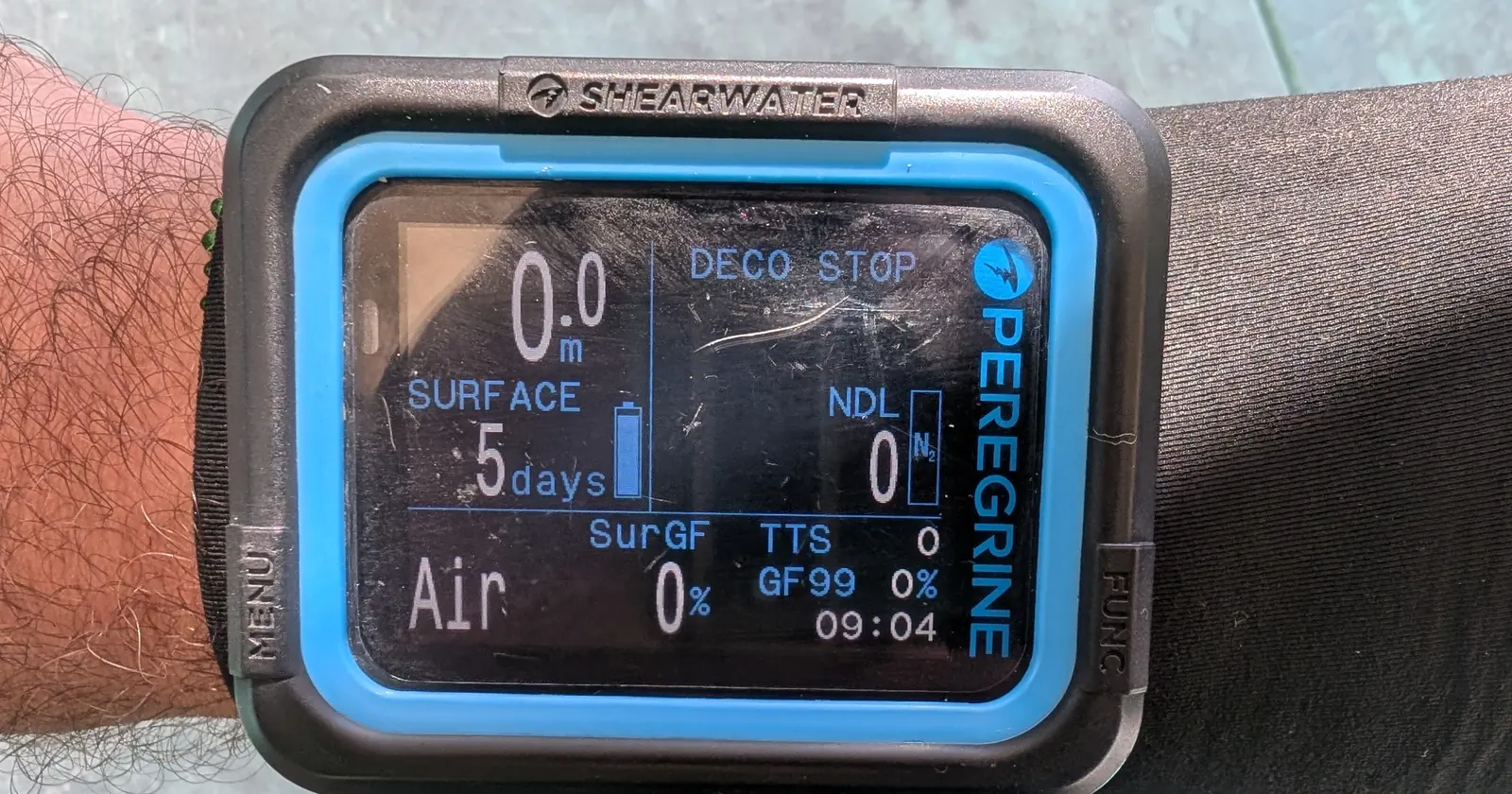
A Shearwater Peregrine on the wrist, the Shearwater side of this comparison; no freely licensed photo of a Garmin Descent exists. Photo: Martin Michlmayr, Wikimedia Commons, CC BY-SA 4.0, cropped.
Best for
- One device on the wrist for the whole trip: Garmin Descent G2 (USD 699.99), or a Descent Mk3i if you want tank pressure too
- The lowest-priced big screen in this comparison: Shearwater Peregrine (USD 580)
- A big screen plus trimix, GPS and a compass without a watch: Garmin Descent X30 (USD 749.99)
- Remote trips and a path into technical diving: Shearwater Perdix 3 (USD 1,295), which runs on one AA cell
| Model | US list price, Oct 2026 | Format and screen | Gas modes | Air integration | Dive battery | Depth |
|---|---|---|---|---|---|---|
| Garmin Descent G2 | USD 699.99 | Watch, 1.2" AMOLED | Air, nitrox, trimix, CCR, apnea | No | Up to 27 h | 100 m |
| Garmin Descent Mk3 / Mk3i, 43 mm | USD 1,199.99 / 1,399.99 | Watch, 1.2" AMOLED | Air, nitrox, trimix, CCR, apnea | Mk3i only, Descent T2 | Up to 30 h | 200 m |
| Garmin Descent Mk3i, 51 mm | USD 1,599.99 | Watch, 1.4" AMOLED | Air, nitrox, trimix, CCR, apnea | Yes, Descent T2 | Up to 66 h (40 h with air integration) | 200 m |
| Garmin Descent X30 | USD 749.99 | Wrist unit, 2.4" color LCD | Air, nitrox, trimix | No | 10, 30 or 47 h by brightness | 100 m |
| Garmin Descent X50i | USD 1,499.99 | Wrist unit, 3.0" color touchscreen LCD | Air, nitrox, trimix, CCR | Yes, Descent T2 | 13, 16 or 20 h by brightness | 200 m |
| Shearwater Peregrine | USD 580 | Wrist unit, 2.2" color LCD | Air, nitrox, 3-gas nitrox | No | Up to 30 h | 120 m |
| Shearwater Peregrine TX | USD 760 | Wrist unit, 2.2" color LCD | Air, nitrox, 3-gas nitrox | Yes, up to 4 transmitters | Up to 30 h | 120 m |
| Shearwater Tern / Tern TX | USD 595 / from USD 805 | Watch size, 1.3" AMOLED | Air, nitrox, 3-gas nitrox, freedive | Tern TX only, up to 4 | Up to 20 h | 120 m |
| Shearwater Teric | From USD 1,199 | Watch size, 1.39" AMOLED | Air, nitrox, trimix, CCR (fixed PPO2), freedive | Yes, up to 4 | Up to 30 h | 200 m |
| Shearwater Perdix 3 | USD 1,295 | Wrist unit, 2.4" AMOLED | Air, nitrox, trimix, CCR (fixed PPO2), freedive | Yes, up to 4 | One AA: up to 60 h on lithium | 260 m |
Garmin Descent and Shearwater models on sale in October 2026
Garmin's US dive page lists three families: the Descent G2, the Descent Mk3 series and the Descent X30/X50i, plus the Descent T2 transceiver and the S1 buoy. The Descent G1 that older buying guides still recommend is not in that lineup any more. The G2 now sits at the entry point. The Mk3 comes in 43 mm (Mk3 or Mk3i) and 51 mm (Mk3i only), and the "i" is the version that reads tank pressure.
Shearwater's own store lists the Peregrine and Peregrine TX, the watch-sized Tern, Tern TX and Teric, and the Perdix 3, which is marked new. The Perdix 2 is still listed from USD 1,195, a hundred dollars under its successor. The list also carries the Petrel 3, the NERD 2 and console versions of the Peregrine; this comparison sticks to the wrist computers a traveler is likely to pack.
So the real pairings for a traveler are the G2 against the Tern or Peregrine, the X30 against the Peregrine, and the Mk3i or X50i against the Teric or Perdix 3.

Bühlmann ZHL-16C on both: Garmin and Shearwater conservatism settings
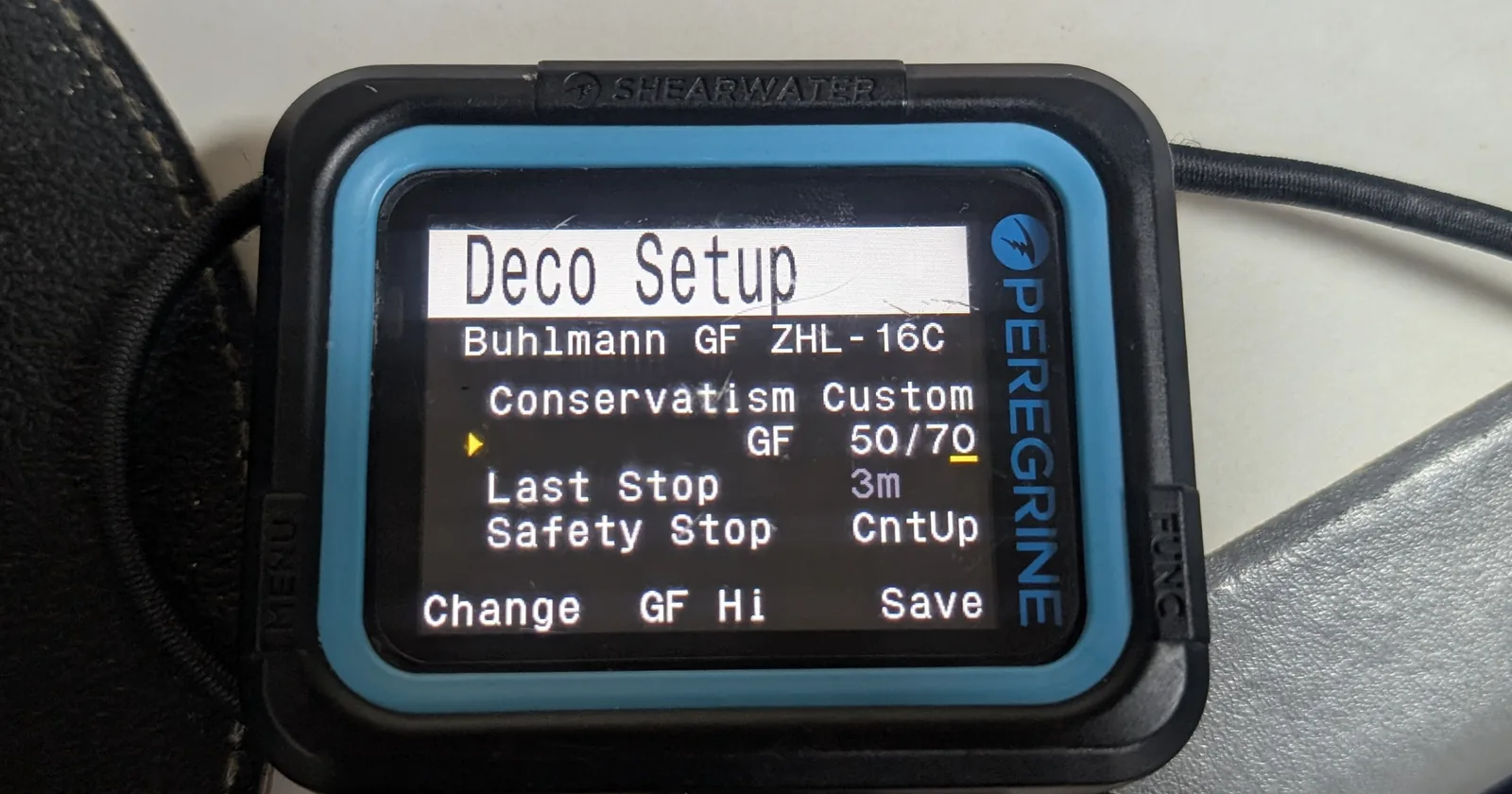
Every computer in the table names the same decompression model. Garmin's spec sheets say "Bühlmann ZHL-16c with gradient factors", and the Peregrine, Peregrine TX, Tern, Teric and Perdix 3 manuals say "Bühlmann ZHL-16C with gradient factors". None of the manuals behind this page offers VPM-B, and the Perdix 3 manual says its deco model menu "will just show ZHL16C+GF". The difference is in what each brand tells you about its presets.
Shearwater prints the numbers. Its current firmware for the Peregrine TX (v102), Tern and Tern TX (v36), Teric (v36) and Perdix 3 sets the recreational presets to Low 50/95, Med 50/85 and High 50/75, with 50/85 as the default. The release notes add that "GF Low does not impact no-deco dives" and that "the default values of GF High are unchanged". The plain Peregrine is the exception: its manual still lists Low 45/95, Med 40/85 and High 35/75, default 40/85, and its latest firmware notes (v89, September 2025) do not change that. For a no-stop reef dive the GF High of 85 is what counts, and it is the same on both.
Garmin's spec sheet offers "low/medium/high or custom using gradient factors", and the manuals warn: "Make sure you understand gradient factors before entering a custom level of conservatism." What neither the September 2026 Descent manuals nor the spec pages print is the pair behind low, medium and high. If you dive next to a buddy on a Shearwater and want your no-stop times to roughly agree, set a custom pair on the Garmin instead of trusting the word "medium".
Deco lockout: where Garmin Descent and Shearwater disagree
This one matters on a dive holiday. All four current Descent manuals describe a deco lockout that "prevents gas dives for 24 hours if you violate a decompression ceiling for more than three minutes." You can switch it off in the settings before a dive. Garmin also restricts the computer after gauge mode: "After diving in gauge mode, the device can only be used in gauge or apnea mode for 24 hours."
Shearwater takes the opposite line. The Peregrine, Peregrine TX and Tern manuals list "No lockout for violating deco stops", and the Perdix 3 manual explains why: "Shearwater's policy is to provide clear warnings that the decompression scheduled was violated, to allow you to make decisions based on your training." Neither approach makes a missed stop safe. A lockout simply ends your diving for the next day on that computer, which on a prepaid liveaboard is a cost you should know about in advance.

Trimix and CCR: what the Garmin Descent G2 does that a Peregrine does not
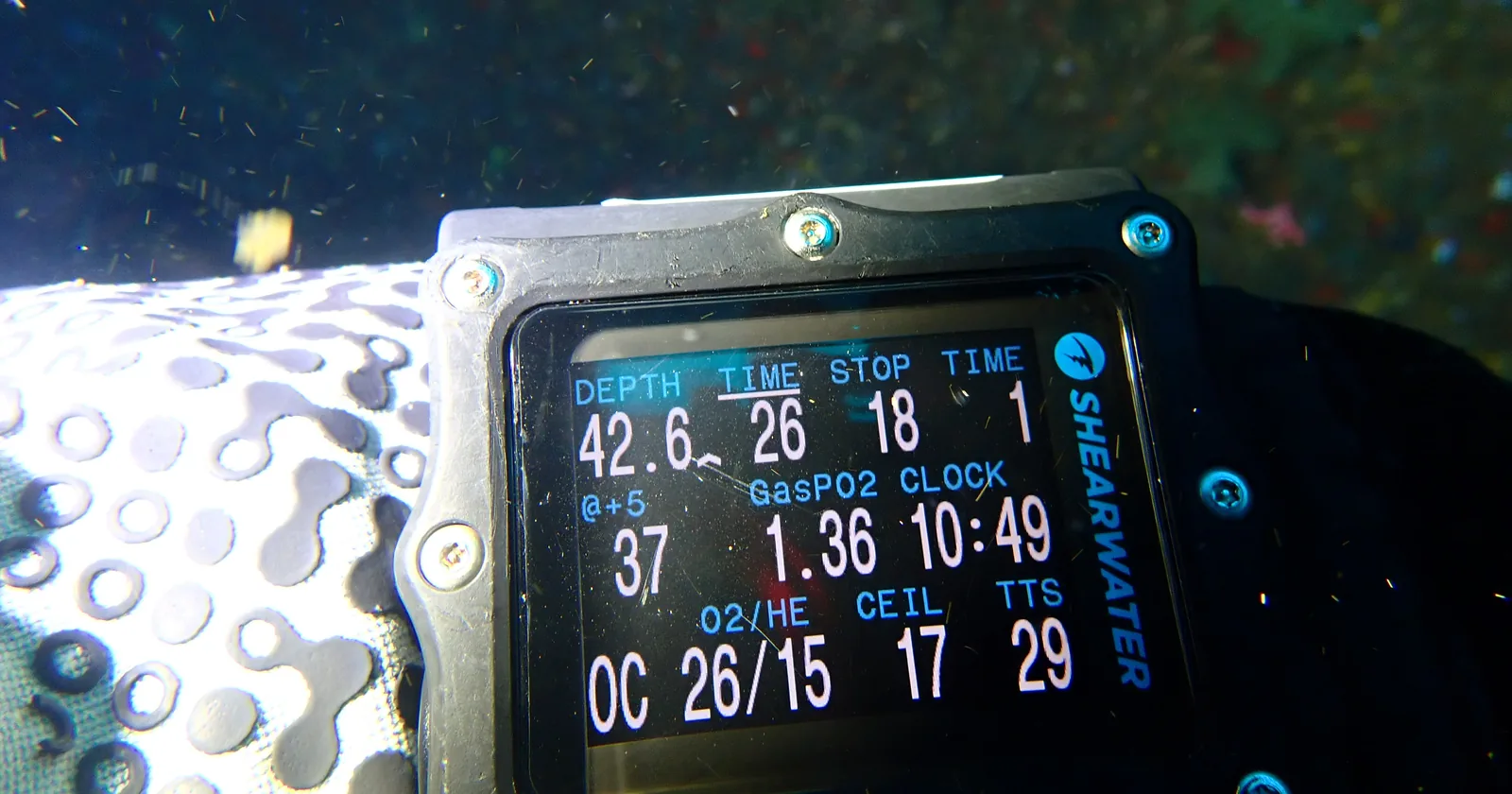
Here Garmin gives more for less. The USD 699.99 Descent G2 lists nitrox, trimix and closed-circuit rebreather (CCR) support, one bottom gas plus "up to 11 deco and/or backup gasses", and apnea modes for freediving and spearfishing. The cheapest Shearwaters, the Peregrine and the Tern, stop at three nitrox gases up to 100% oxygen. The Tern adds a freedive mode; the Peregrine has none.
To get trimix and CCR from Shearwater you step up to the Teric (from USD 1,199) or the Perdix 3 (USD 1,295). The G2's catch is depth. Garmin rates it to 100 m, against 200 m for the Teric and 260 m for the Perdix 3. If trimix is a someday plan, the G2 covers the first course. If it is next year's plan, look at the Teric or Perdix 3 against a Mk3i. For what the gas actually does on a reef dive, our nitrox explainer starts at the beginning.
Air integration: Garmin Descent T2 against the Shearwater Swift
Neither entry model reads tank pressure. The G2 spec sheet has no air-integration line, and Garmin's X30/X50i page gives air integration only to the X50i. On the Garmin side you need a Descent Mk3i or X50i plus a Descent T2 transceiver at USD 499.99. On the Shearwater side the Peregrine TX, Tern TX, Teric and Perdix 3 read a Swift transmitter at USD 400, up to four at once.
The two transmitters are built for different jobs. The T2 runs on a CR123A cell for up to 100 hours, transmits up to 10 m, and lets one computer watch up to eight tanks, buddies included. It also carries Garmin's SubWave sonar messaging between divers. The Swift uses a user-replaceable CR2 cell, lists up to 300 dive hours and a range of 1 m. Shearwater's late-2025 firmware for the Peregrine TX, Tern TX and Teric also reads the newer Swift GPS transmitter.
Priced as a pair, a Peregrine TX with one Swift comes to USD 1,160 and a Tern TX with one Swift to USD 1,205. A 43 mm Mk3i with one T2 is USD 1,899.98, and an X50i with one T2 is USD 1,999.98. Garmin also sells both as bundles with a T2 included, so compare the bundle price on the product page.
Charging a Garmin Descent or Shearwater on a dive trip
Every Descent charges through a "Garmin proprietary clip charger". Lose it on a boat and a borrowed phone cable will not help. Shearwater's rechargeables ship with a wireless charging station (with a USB-C cable on the Peregrine and Tern), and the Peregrine and Teric manuals add that they also charge "on some third party wireless Qi compliant chargers".
The Perdix 3 is the travel outlier. It takes a single AA, "any type", with Shearwater's estimates of up to 60 hours on a 1.5 V lithium cell, 40 on alkaline and 30 on NiMH. In a small dive town with unreliable power, that is the one computer you can keep running from a convenience store.
Runtime per charge differs more than the marketing suggests. The Mk3i 51 mm lists up to 66 hours of diving, or 40 with air integration on. The 43 mm Mk3 lists 30, the G2 27. The X30 lists 30 hours at medium brightness and 10 at high, the X50i 16 and 13. Shearwater lists 30 hours for the Peregrine, Peregrine TX and Teric, and 20 for the Tern. Battery replacement is factory work on both sides: Shearwater calls the Peregrine's cell "factory replaceable" at authorized service centers and gives the Teric's a typical life of five years. Garmin's manuals list a "rechargeable, built-in lithium-ion battery" and its product pages do not describe a replacement service, so ask your dealer before you buy.
A Garmin Descent as your only watch, and what a Shearwater Tern or Teric skips
This is the real case for Garmin. The G2 lists up to 10 days as a smartwatch (4 with the display always on), smart notifications from your phone, Garmin Pay, sleep tracking and GPS. The 51 mm Mk3i stretches that to 25 days and adds maps, music storage and an LED flashlight. You can wear one to a coworking space, pay for lunch with it, and dive with it in the afternoon. Logs sync to the Garmin Dive app, and the rest goes to Garmin Connect.
Shearwater's watch-sized computers are dive computers that tell the time. The Tern's FAQ says it "offers basic watch functionality" and does not include "hybrid smart watch functions". The Teric lists watch faces, alarms, a stopwatch and up to 50 hours in watch mode, with no phone notifications on its spec list. Shearwater logs go to the Shearwater Cloud app, which runs on iOS, Android, Mac and Windows. If you already wear a smartwatch you like, this gap is irrelevant; if that watch is an Apple Watch Ultra, read what the Apple Watch Ultra can and cannot do as a dive computer before buying either. If you want one thing on your wrist, it decides the question.
Warranty: Shearwater's two years worldwide against Garmin's one in the US
Shearwater gives "a worldwide 2-year warranty on all products", and "the warranty lives with the unit, not with the original purchaser", so a second-hand computer stays covered. A battery that falls short of spec inside those two years "will be repaired free of charge". Shearwater also recommends a general service every two years at an authorized service center.
Garmin's US consumer warranty is shorter. Non-aviation products are "free from defects in materials or workmanship for one year from the date of purchase." That is the US wording; check the warranty that applies in the country where you buy. For a nomad, the transferable worldwide warranty is a quiet point in Shearwater's favor.
Shearwater Peregrine vs Garmin Descent X30: two big screens, USD 170 apart
These two answer the same brief: a large color screen on a strap, not a watch. Both screens are 320 x 240 pixels; the Peregrine's is 2.2 inches, the X30's 2.4. The Peregrine costs USD 580, weighs 122 g, is rated to 120 m and charges wirelessly. The X30 costs USD 749.99, weighs 160 g without straps and is rated to 100 m.
For the extra USD 169.99 the X30 adds trimix, surface GPS for marking entry and exit points, a 3-axis compass, smart notifications and a flip-screen mode that moves the buttons. The Peregrine counters with Shearwater's two-year warranty, no deco lockout and wireless charging that also works on some third-party Qi chargers. Neither reads tank pressure. A diver who never plans past nitrox loses nothing by taking the Peregrine; our Peregrine review covers it in more depth.
Shearwater Peregrine vs Garmin Descent G2: dive computer or dive watch
The G2 costs USD 119.99 more than the Peregrine and gives you a different object. Its 1.2-inch AMOLED screen is a little over half the diagonal of the Peregrine's 2.2 inches, which matters in murky water and for anyone who needs reading glasses. In exchange it does trimix, CCR and freediving, and it stays on your wrist all week. The Peregrine stays in the dive bag.
If the G2 replaces a smartwatch you would otherwise buy, it is the cheaper route. If you already own one, the Peregrine buys more screen for less money. Freedivers should note that only the G2 of the two has apnea modes; the rest of their kit is in our freediving gear guide.
Garmin Descent vs Shearwater, by the kind of traveler you are
One device for the whole trip. Take a Garmin. The Descent G2 covers recreational diving, freediving and daily life for USD 699.99. If you want tank pressure on the wrist, the Mk3i is the only current Garmin watch that reads a T2, from USD 1,399.99 in 43 mm.
Dive-only, on a budget. Take the Shearwater Peregrine at USD 580, or the Tern at USD 595 if you prefer a watch-sized unit with a freedive mode. Add the TX versions only if you will buy a Swift. Our Shearwater vs Suunto comparison covers the cheaper Suunto alternatives.
Heading toward technical diving. The Shearwater Perdix 3 (USD 1,295) has the deepest rating here at 260 m, trimix and CCR, no lockout, and a battery you can replace from any shop shelf. On the Garmin side, the Mk3i and X50i do trimix and CCR to 200 m and add buddy tank monitoring through the T2. The G2 is a cheap start, capped at 100 m.
Whichever you buy, cover the diving itself before the computer: our dive insurance guide shows which policies pay for a chamber.
FAQ: Garmin Descent vs Shearwater
Is a Garmin Descent better than a Shearwater dive computer?
Neither wins outright, because both run Bühlmann ZHL-16C with gradient factors. A Garmin Descent G2 or Mk3 is the better buy if you want one smartwatch for the whole trip. A Shearwater is the better buy if you want a dedicated computer, a two-year worldwide warranty and no deco lockout.
Do Garmin Descent and Shearwater use the same decompression algorithm?
Yes, both name Bühlmann ZHL-16C with gradient factors. Shearwater publishes its preset pairs: Low 50/95, Med 50/85 and High 50/75 on current Tern, Teric, Perdix 3 and Peregrine TX firmware. Garmin offers low, medium, high or custom, but its manuals and spec sheets do not print the numbers behind the presets.
Does the Garmin Descent G2 have air integration like the Shearwater Peregrine TX?
No. Air integration on the Garmin side needs a Descent Mk3i or X50i plus a Descent T2 transceiver, listed at USD 499.99. On the Shearwater side the Peregrine TX, Tern TX, Teric and Perdix 3 read Swift transmitters, listed at USD 400, as of October 2026.
Which lasts longer on one charge, a Garmin Descent or a Shearwater?
The Descent Mk3i 51 mm lists up to 66 hours of diving, the longest of the rechargeables. The G2 lists 27 hours, the Peregrine 30 and the Tern 20. The Shearwater Perdix 3 runs on one AA cell, up to 60 hours on a lithium AA, and you can buy another one almost anywhere.
Shearwater Peregrine or Garmin Descent G2 for a newer diver who travels?
The Peregrine (USD 580) has the bigger 2.2-inch screen and is a dive computer only. The G2 (USD 699.99) is a smartwatch with a 1.2-inch screen that you can wear every day. Pick the Peregrine for readability and price, the G2 if you will not pack a second device.
Yannick Schroth
Founder of NOMADREEF and a former digital nomad who has based across Asia and Latin America, from Thailand to Peru. This comparison is built from Garmin's and Shearwater's own product pages, manuals and firmware notes, not from a hands-on test of each unit. About the author · LinkedIn ↗
Sources
- Garmin dive lineup and US prices. Descent Mk3 "$1,199.99 USD and up", Descent G2 "$699.99 USD", Descent X30/X50i "$749.99 USD and up", Descent T2 Transceiver "$499.99 USD": garmin.com dive computers. Checked 13 October 2026.
- Garmin Descent G2. USD 699.99; "Bühlmann ZHL-16c with gradient factors"; "Trimix support"; "Closed Circuit Rebreather (CCR)"; dive mode up to 27 hours, smartwatch up to 10 days; 100 m; "Garmin proprietary clip charger": garmin.com Descent G2. Checked 13 October 2026.
- Garmin Descent Mk3 series. Mk3 43 mm USD 1,199.99, Mk3i 43 mm USD 1,399.99, Mk3i 51 mm USD 1,599.99; "Descent Mk3i: Adds air integration"; 51 mm dive mode up to 66 hours, 40 hours with air integration: Mk3 43 mm, Mk3i 43 mm, Mk3i 51 mm. Checked 13 October 2026.
- Garmin Descent X30 and X50i. X30 USD 749.99, 2.4" 320 x 240 LCD, 100 m, 160 g; X50i USD 1,499.99, 3.0" touchscreen, 200 m, air integration and CCR: Descent X30, Descent X50i. Checked 13 October 2026.
- Garmin Descent T2. "Battery 3 V CR123A lithium", "Up to 100 hours", tank pressure range "Up to 10 m", up to 8 tanks: garmin.com Descent T2. Checked 13 October 2026.
- Garmin owner's manuals, September 2026 editions. Deco lockout "prevents gas dives for 24 hours if you violate a decompression ceiling for more than three minutes"; conservatism and gradient-factor wording; battery tables: Descent G2, Descent Mk3 series, Descent X30, Descent X50i. Read 13 October 2026.
- Garmin US warranty. "free from defects in materials or workmanship for one year from the date of purchase": garmin.com consumer limited warranty. Checked 13 October 2026.
- Shearwater prices. Perdix 3 USD 1,295, Tern TX from USD 805, Peregrine TX USD 760, Peregrine from USD 580, Tern USD 595, Perdix 2 from USD 1,195, Teric from USD 1,199: shearwater.com dive computers. Checked 13 October 2026.
- Shearwater product pages. Peregrine: "Bühlmann ZHL-16C with gradient factors", "up to 30 hours (medium brightness)", "factory replaceable"; Tern: "up to 20 hours", no "hybrid smart watch functions"; Teric: trimix, "CC/BO: Fixed PPO2", "up to 50 hours (watch mode)", "typical battery life is 5 years"; Perdix 3: "Single AA (any type)", 260 m: Peregrine, Peregrine TX, Tern, Tern TX, Teric, Perdix 3. Checked 13 October 2026.
- Shearwater Swift. "$400.00 USD", "CR2 3V Lithium (User replaceable)", "Up to 300 dive hours", "The range is 1m (3ft)": shearwater.com Swift. Checked 13 October 2026.
- Shearwater manuals and firmware notes. Peregrine manual (Doc. 16001-SI-RevB): "Low (45/95) Med (40/85) High (35/75)", default 40/85; Perdix 3 manual Rev B: "Low (50/95) Med (50/85) High (50/75)" and its no-lockout policy; Peregrine TX v102 (10 Nov 2025), Tern v36 (1 Dec 2025) and Teric v36 (2 Dec 2025) notes: Rec presets now 50/75, 50/85, 50/95; Peregrine v89 notes (22 Sep 2025) carry no preset change: Peregrine manual, Perdix 3 manual, Peregrine TX notes, Teric and Tern notes, Peregrine notes. Read 13 October 2026.
- Shearwater warranty and app. "a worldwide 2-year warranty on all products", "The warranty lives with the unit": shearwater.com warranty; Shearwater Cloud "available for Mac, Windows, Android ... and iOS": shearwater.com/cloud. Checked 13 October 2026.
- Prices move with promotions and region; the figures here are US list prices as of 13 October 2026. A dive computer is safety equipment: read its manual and dive within your training, not within a comparison table.