Virgin Islands Diving: The RMS Rhone, St Croix's Walls and Pier, and the Park Rules on Both Sides of the Border
 by Yannick Schroth
Nov 10, 2026
12 min read
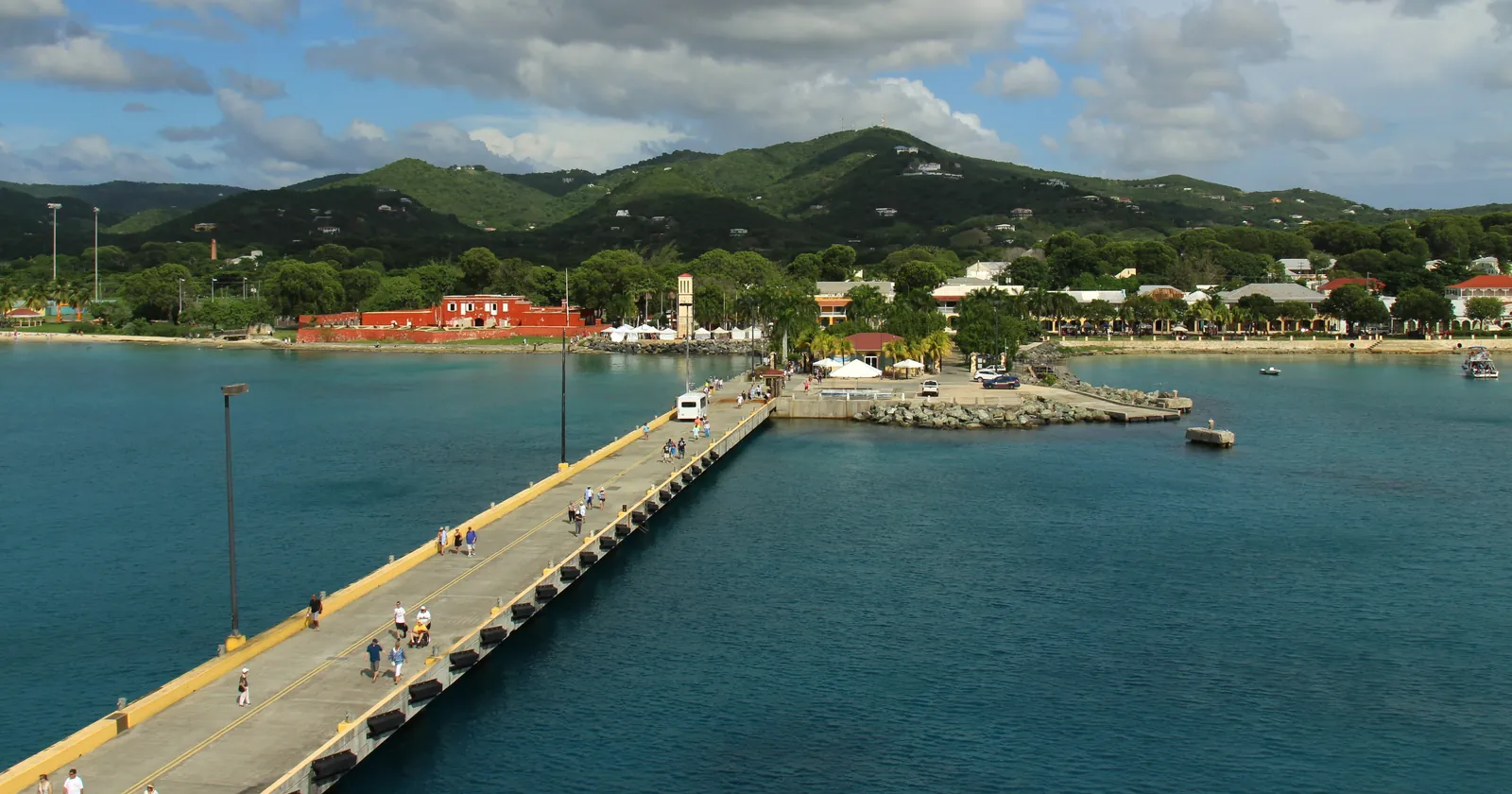
The Frederiksted pier on St Croix. Prayitno, Wikimedia Commons, CC BY 2.0, cropped.

Key takeaways
- The USVI and the BVI are separate jurisdictions: US entry rules and US national park rules on one side, British Overseas Territory immigration and the BVI National Parks Trust on the other
- In Virgin Islands National Park on St John, divers must fly a dive flag and stay within about 30 meters of it, scuba is banned in the Trunk Bay swim area, and spearfishing gear may not even be carried
- The RMS Rhone lies at 6 to 24 meters off Salt Island in a BVI marine park where anchoring and fishing are banned and boats need a National Parks mooring permit
- NOAA's satellite averages put the sea at about 26.1 to 26.3 °C in February and 28.9 to 29.0 °C in September; hurricane season runs from 1 June to 30 November
- A news report says the BVI has no hyperbaric chamber, and we found no official source confirming that one in the USVI is running; dial 911 on either side
Virgin Islands diving: two territories, two rulebooks
The Virgin Islands are split by a border. St Thomas, St John and St Croix belong to the United States, and US immigration law counts the Virgin Islands of the United States as part of the country. Tortola, Virgin Gorda, Jost Van Dyke, Anegada and the smaller cays are a British Overseas Territory with their own immigration department, laws and national parks trust. For a diver that means two sets of marine rules, two emergency systems that both answer on 911, and a customs check every time you cross. Operators on both sides price their dives in US dollars.
The diving itself differs too. St Thomas and St John dive offshore rocks, cays, ledges and wrecks. St Croix has walls that start close to shore and a long town pier. The BVI's best-known dive is a Victorian steamship wreck, and one operator counts more than 60 moored dive sites across the territory.
St Thomas: offshore rocks and wrecks
Aqua Action Dive Center, based at Secret Harbour, describes its boat sites on its own page. French Cap, an uninhabited island about 10 kilometers south of St Thomas, is dived only in calm seas, with one dive in about 27 meters of water and a shallower one to 18 meters on the north-west side. Coral Bowl drops to 24 meters, with a sandy bowl at 17 meters and sea fans near the top at six.
The wrecks are the other draw. Aqua Action says the WIT Concrete, a 107-meter bulk carrier sunk during Hurricane Marilyn and later moved by the Army Corps of Engineers, sits upright in 30 meters off the west end, and that the Miss Opportunity, a former hospital ship of just over 90 meters sunk as an artificial reef in 1985, lies on her side in just over 27 meters and can be reached at 12. The Cartanza Sr., in three pieces at about 12 meters in Buck Island Cove, is a site Aqua Action takes snorkellers to as well. That Buck Island lies off St Thomas and is not the national monument off St Croix.
St John: diving inside Virgin Islands National Park
More than 40% of Virgin Islands National Park is underwater, according to the National Park Service. The park and the Virgin Islands Coral Reef National Monument share one Superintendent's Compendium, signed on 29 June 2026, which sets the diving rules; breaking them can bring criminal penalties under federal regulations.
Scuba and snorkelling are allowed next to beaches and inside the boat exclusion areas, except that no scuba is allowed inside the Trunk Bay boat exclusion area, which the park explains by the number of snorkellers there. Diving is banned in boat channels, shipping lanes and dock areas. In waters open to boats, a diver must fly a dive flag while diving and only then, light it between sunset and sunrise, and stay within a 100-foot (30-meter) horizontal radius of it when on the surface, descending or ascending. Recreational hookah systems are banned, dive scooters need a permit, and underwater lights other than handheld dive lights are prohibited.
Taking anything is tightly limited. The use or possession of spearfishing equipment is banned in the park, and gear may only pass through park waters fully disassembled; the only exception is for trained lionfish removers with permits. The Coral Reef National Monument is a no-take zone apart from bait fishing by cast net and hardnose fishing from designated buoys, fishing is banned in mooring fields and from park moorings, and the list of things visitors may gather excludes empty seashells.
The park charges no entrance fee. Trunk Bay has a $5 amenity fee for anyone 16 or older, card or phone payment only since 1 October 2026. Boats that stay overnight pay $26 a night, for at most seven nights in one bay and 30 nights a year. Orange moorings with a blue stripe are reserved for boats on snorkel or dive trips, and no anchor may be used while on a mooring.
St Croix: the wall, the pier and Buck Island
Sweet Bottom Dive Center at Cane Bay, which says it specialises in small-group shore dives, describes its house reef: coral starts about 70 meters from the beach at three meters, and a near-vertical drop-off begins at about 24 meters, bowls to 61 and then falls away to about 180 meters. At the Davis Bay Wall off the Carambola resort, it says, the top of the wall is at 7.6 meters and slopes at 45 degrees to 55 meters before going vertical.
On the west end, Sweet Bottom calls the Frederiksted pier a macro diving mecca and runs night dives there. It gives it a length of about 460 meters, an average depth of 7.6 meters and 14 meters at the end, with dives that often run over an hour among the coral-covered pilings. Cane Bay Dive Shop sells multi-day packages that combine the Cane Bay wall, reefs, wrecks and the pier.
Buck Island Reef National Monument lies just off St Croix and can only be reached by boat. The National Park Service allows scuba only at two designated scuba moorings, where shallow dives of 9 to 12 meters pass through elkhorn coral formations. Scuba is not allowed in the lagoon or on the underwater trail, where guides take snorkellers in groups of six. The monument is open from 7 a.m. to 5 p.m., charges no entry fee, and bans fishing and collecting of any kind, including shells and coral rubble. Boats may anchor only in the marked area off West Beach, vessels of 12.8 meters or longer may not enter the lagoon, and private boats need no anchoring permit at present.
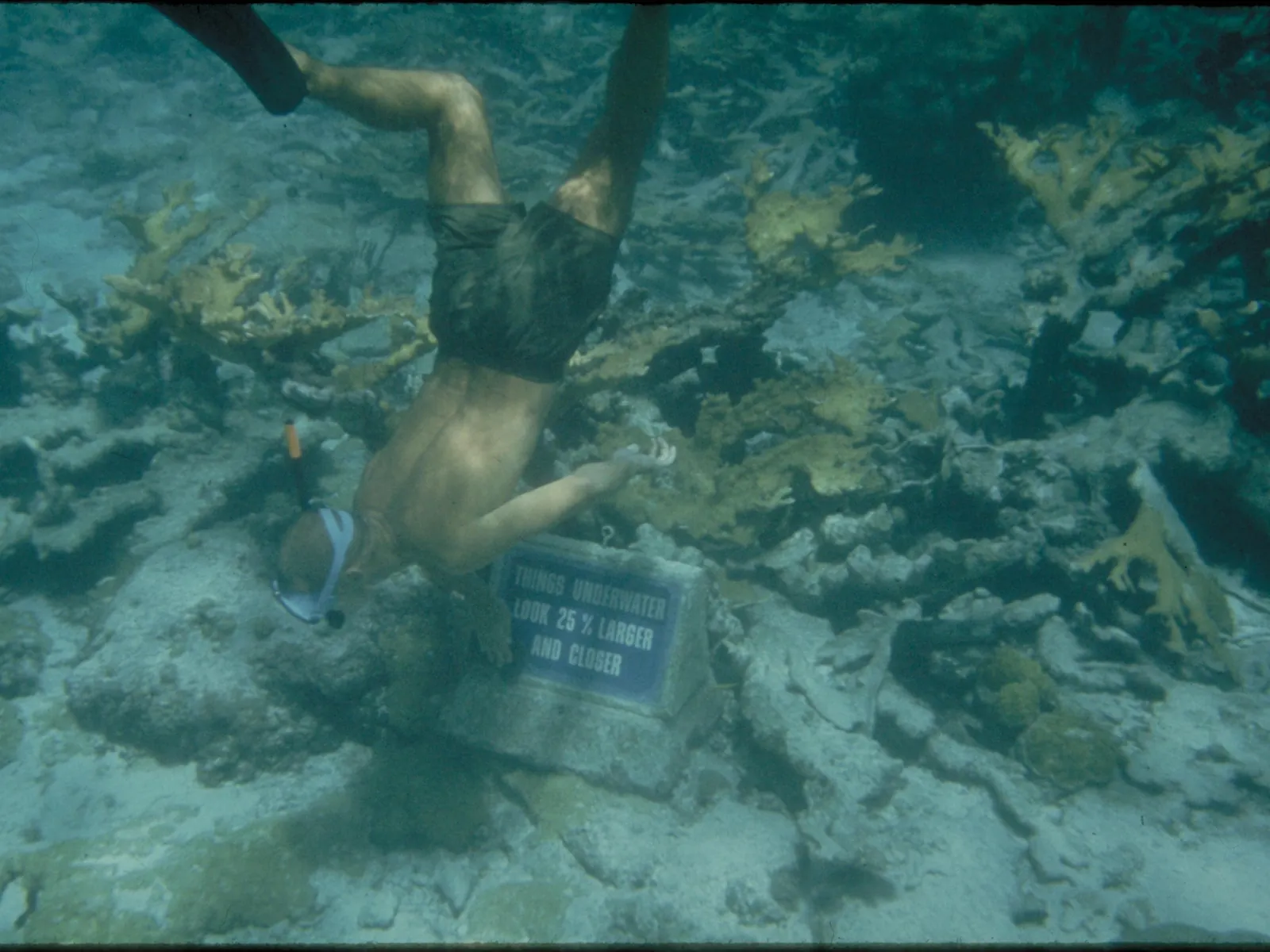
The underwater trail at Buck Island Reef National Monument. NPS staff, Wikimedia Commons, public domain, cropped.

Taking marine life in the US Virgin Islands
Outside the federal parks, territorial law applies. Under the Virgin Islands Code, as published in an unofficial copy by the Department of Planning and Natural Resources, no one may take, harm, sell or export any indigenous species, including live rock, which the law defines as any piece of coral, dead or alive, without a licence or permit. Fines run from $100 to $10,000 per specimen, with up to 60 days in jail. The department's 2018 fishing guide adds that a lobster that has been speared or hooked may not be kept, that recreational fishers may not sell their catch, and that Nassau grouper and three parrotfish species may not be taken at all.
The St Croix East End Marine Park, set up in 2003, has a no-take zone where diving with a flag and snorkelling are allowed but spearfishing and taking conch, lobster or whelk are banned. The park service's 2026 compendium also states that sunscreens containing oxybenzone, octinoxate or octocrylene are prohibited throughout the US Virgin Islands, not only inside the park.
The BVI: the RMS Rhone and its marine park
The Royal Mail Steamer Rhone sank in a hurricane in 1867 and lies in two main parts in Lee Bay off Salt Island, at about 6 to 24 meters, according to the National Parks Trust of the Virgin Islands. The ship was 94 meters long, and the bow section, boilers, engines, prop shaft and propeller are still visible. The marine park around it reaches west to Dead Chest and includes Blonde Rock, Painted Walls and Rhone Reef; the Rhone's anchor lies in 17 meters at Great Harbour on Peter Island.
Dive BVI, which says it has led dives on the wreck since 1975, plans it as two dives: the first at about 23 meters on the bow, the second starting at 21 meters in the midsection and moving past the 4.6-meter propeller. Dive BVI counts more than 60 BVI sites with dive moorings, among them the Kodiak Queen, a 1940 US Navy fuel barge that survived Pearl Harbor and was sunk off Virgin Gorda as an underwater art installation in 2017, and current-swept sites in the Dog Islands. Sail Caribbean Divers lists the Beata, Marie L. and Pat among its other wrecks.
BVI rules: mooring permits, fishing and collecting
Inside the Rhone marine park, anchoring and fishing are banned and boats must use the Trust's mooring buoys with a mooring permit. Across the territory, the Trust says a mooring permit is required by law to use its buoys, bought from a charter company, a dive shop or its Road Town office, or at customs for foreign yachts. Its buoys are day use only, illegal to use overnight, with a 90-minute limit; white buoys are for diving only. The Trust has sold permits online since August 2022, but its permit page shows no fee. Dive BVI says its rates include $10 per diver per day for the National Parks fee and cruising permit, and Sail Caribbean Divers says both fees are included in its rendezvous dives.
The UK Foreign Office, in its travel advice for the BVI, says sport fishing needs a licence, fishing is banned in the marine parks, and using spearguns or scuba equipment to fish is illegal. It also says removing any marine animal, shell or coral, including dead coral, from the BVI without a permit is illegal.
When to dive: sea temperature and hurricane season
NOAA's satellite averages for 1991 to 2020 put the surface at about 26.2 °C south of St Thomas and St John, 26.1 °C between St John and Tortola and 26.3 °C north of St Croix in February and March, the coolest months. The sea warms to about 28.6 °C in August and peaks at 28.9 to 29.0 °C in September and October.
Storms are the real seasonal limit. The US National Hurricane Center gives the Atlantic hurricane season as 1 June to 30 November, with a peak on 10 September and most activity between mid-August and mid-October. In September 2017 two hurricanes struck within two weeks. Hurricane Irma made landfall on Virgin Gorda on 6 September with winds of 155 knots (about 287 km/h); the Hurricane Center's report records four deaths in the BVI and numerous buildings and roads destroyed on Tortola, three deaths in the USVI, catastrophic damage on St Thomas and St John, and damage to about 70% of homes and structures on St Croix. Hurricane Maria passed about 25 nautical miles south of St Croix on 20 September at its peak of 150 knots (about 278 km/h), and St Croix was the most severely affected of the US islands, with marinas and harbours on its south coast severely damaged.
Chambers and emergency numbers
The emergency number is 911 on both sides of the border. The BVI government says its new 911 dispatch system went live on 11 September 2025 and that the 911 centre now runs around the clock; before that, calls between midnight and 7 a.m. went to the fire service. The UK Foreign Office lists 311 for non-urgent police calls and 767 for Virgin Islands Search and Rescue (VISAR) at sea. In the USVI, the planning department's guide lists 911 for all emergencies and the US Coast Guard on VHF channel 16.
Recompression is the weak point. A December 2025 report in Antigua News on a diver treated in Antigua said the BVI has no hyperbaric facility; she was stabilised at Peebles Hospital on Tortola and flown to the Sir Lester Bird Medical Centre after advice from the Divers Alert Network. Sail Caribbean Divers says there is a chamber on St Thomas and another in San Juan, Puerto Rico, but we found no hospital or government page confirming that a St Thomas chamber is operating, let alone staffed around the clock. Ask your operator for its evacuation plan and make sure your dive insurance covers an air transfer.
What a dive costs in the Virgin Islands
Prices for a two-tank boat dive on operators' own pages, read on 10 November 2026, in US dollars:
| Operator | Two-tank boat dive | What is included |
|---|---|---|
| Low Key Watersports, Cruz Bay, St John | $165 | All gear; gratuity extra |
| Aqua Action, Secret Harbour, St Thomas | $150 | Mask, fins, BCD, regulator, tanks, weights; three-diver minimum |
| Dive BVI, Virgin Gorda and Scrub Island | $140 | Tanks, weights, shorty, mask, fins; BCD and regulator $20 extra; park and cruising fees included |
| Sail Caribbean Divers, Tortola | $160 | Gear; park and cruising fees included on rendezvous dives |
For a longer stay, Dive BVI sells ten dives over five mornings for $635 and Sail Caribbean a ten-dive package for $620. On St Thomas, Aqua Action charges $120 for a guided shore dive. We could not read a dive price from any St Croix operator's site; Cane Bay Dive Shop sells its dives through an online booking system and Sweet Bottom asks divers to email for a package.
Getting there and crossing between the territories
The US side has two airports, both run by the Virgin Islands Port Authority: Cyril E. King on St Thomas and Henry E. Rohlsen on St Croix, and both islands also have a seaplane terminal. The port authority lists no airport on St John, which is linked to St Thomas by passenger ferry and by car barges from Red Hook, which the port authority lists at $50 one way or $65 return for non-residents.
Crossing to the BVI is an international trip. Road Town Fast Ferry runs from Charlotte Amalie to Road Town and says there is a US customs office at its Charlotte Amalie dock, while ferries returning to Red Hook must stop at St John first because Red Hook has none. Visitors entering the US under the Visa Waiver Program must arrive on a carrier that has signed an agreement with US Homeland Security. Road Town Fast Ferry, Native Son and Inter-Island Boat Services are on Customs and Border Protection's list of signatory carriers for November 2026. Arriving in the BVI by air or sea costs a $10 environmental and tourism levy, and leaving by ferry a $20 departure tax, according to the UK Foreign Office.
Staying as a remote worker
The US Virgin Islands follow US entry rules. Citizens of the 42 Visa Waiver Program countries can stay up to 90 days for business or tourism with an approved ESTA, and an ESTA does not guarantee entry, which a border officer decides on arrival. The United States has no digital-nomad visa, and we found no US government statement that remote work for a foreign employer is allowed on a visitor stay, so check with CBP before you plan to work from St Thomas.
The BVI sets its own rules. The UK Foreign Office says British citizens can visit visa-free for up to a month, that the Chief Immigration Officer can extend a stay to up to six months for visitors who show enough money, accommodation and plans to leave, and that since 1 January 2025 every traveller must complete an online embarkation card up to 72 hours before arrival. The BVI government's own page on extensions was not readable when we checked, so confirm your nationality's rules with the BVI Immigration Department. News reports in 2021 described a government remote-work scheme called Work in Paradise, but the government's announcement page now returns an error and we found no current official page for it, so do not count on it.
Who the Virgin Islands suit
The Virgin Islands suit a diver who wants a historic wreck, shore walls and warm water in one trip and is happy to follow park rules on flags, moorings and taking nothing. St Croix suits shore divers and night divers, St John divers who want to stay inside a national park, and the BVI those who like boat days and wrecks. They suit less well anyone who needs a confirmed chamber close by, wants to spearfish, or hopes to work remotely on a dedicated visa.
FAQ: Virgin Islands diving
How deep is the RMS Rhone wreck?
The National Parks Trust of the Virgin Islands gives depths of about 20 to 80 feet, or 6 to 24 meters, off Salt Island. Dive BVI plans its first dive at about 23 meters on the bow and the second from 21 meters in the midsection.
Do you need a permit to dive in the British Virgin Islands?
Boats using the National Parks Trust moorings, including those at the Rhone, need a mooring permit, sold by charter companies, dive shops and the Trust. Dive BVI says its prices include $10 per diver per day for the park and cruising permit fees. Anchoring and fishing are banned in the Rhone marine park.
What are the scuba rules in Virgin Islands National Park on St John?
Fly a dive flag while diving, light it at night and stay within 30 meters of it. Scuba is banned in the Trunk Bay swim area, in boat channels and near docks. Spearfishing gear is banned, and the Coral Reef National Monument is a no-take zone.
When is hurricane season in the Virgin Islands?
The US National Hurricane Center gives the Atlantic season as 1 June to 30 November, with a peak on 10 September and most storms between mid-August and mid-October. Hurricanes Irma and Maria hit both territories in September 2017.
Is there a hyperbaric chamber in the Virgin Islands?
A December 2025 news report said the BVI has none and that a bent diver was flown from Tortola to Antigua. A BVI dive operator says there is a chamber on St Thomas, but we found no official source confirming it is operating or open around the clock. Call 911 and your dive insurer.
Note: Conditions, safety guidance and regulations change. Verify current information with official sources, including the dive operator, the park authority and the relevant government department, before you travel or dive.
Founder of NOMADREEF and a former digital nomad. This guide is sourced from the references below; conditions, prices and rules change, so verify current details, and follow qualified local guidance and safety briefings. About the author · LinkedIn ↗
Sources
- Virgin Islands National Park (primary). National Park Service, Superintendent's Compendium, 29 June 2026 (PDF), sections 2.3 and 3.18; fees; marine visitor use information; boating information; snorkeling. Read 10 November 2026.
- Buck Island Reef National Monument (primary). National Park Service, outdoor activities, know before you go, Buck Island lagoon and fees. Read 10 November 2026.
- USVI territorial rules (primary). Department of Planning and Natural Resources, Title 12, chapter 2 of the Virgin Islands Code (unofficial copy), sections 102, 105 and 107; quick reference guide to fishing regulations, 2018 (PDF) and species panel (PDF); marine protected areas. Read 10 November 2026.
- BVI marine parks (primary). National Parks Trust of the Virgin Islands, Dead Chest and RMS Rhone marine park, marine conservation programme, park tickets and marine permit and permits online, 2022; UK Foreign, Commonwealth & Development Office, BVI safety and security. Read 10 November 2026.
- Dive sites (each operator primary for itself). Aqua Action, dive sites; Sweet Bottom Dive Center, diving; Cane Bay Dive Shop, packages; Dive BVI, RMS Rhone and dive sites; Sail Caribbean Divers, daily dive trips. Read 10 November 2026.
- Sea temperature and hurricanes. NOAA PSL, OISST v2.1 monthly long-term means 1991–2020, cells 18.125°N 64.875°W, 18.375°N 64.625°W and 17.875°N 64.875°W, computed for this page; National Hurricane Center, tropical cyclone climatology and tropical cyclone reports on Hurricane Irma (PDF) and Hurricane Maria (PDF) (primary). Read 10 November 2026.
- Emergencies and chambers. Government of the Virgin Islands, 911 system release, 7 October 2025 (PDF) and 911 training release (primary); UK Foreign Office, BVI getting help (primary); DPNR 2018 guide, as above (primary); Antigua News, 19 December 2025 (news report); Sail Caribbean Divers FAQ, as above (operator). Read 10 November 2026.
- Prices (each operator primary for itself). Low Key Watersports; Aqua Action rates and certified dives; Dive BVI rates; Sail Caribbean Divers. Read 10 November 2026.
- Getting there. Virgin Islands Port Authority, home page and ferry and cargo schedules (primary); Road Town Fast Ferry (operator); US Code, 8 U.S.C. 1187; CBP, signatory VWP carriers and list of November 2026 (PDF) (primary); UK Foreign Office, BVI entry requirements (primary). Read 10 November 2026.
- Staying and working (primary). US Code, 8 U.S.C. 1101(a)(38); CBP, Visa Waiver Program and ESTA; UK Foreign Office, BVI entry requirements, as above. Read 10 November 2026.
- Left out. The National Parks Trust's own permit fee, which its permit page does not show; whether a chamber on St Thomas is operating and staffed around the clock; dive prices on St Croix; ferry fares between the territories and details of the BVI's airport; the BVI Immigration Department's own rules on extensions, whose page was not readable; any current BVI remote-work permit; whether US visitor status allows remote work; official assessments of hurricane damage to the reefs; and internet and coworking options.