Seychelles Diving: Mahé's Wrecks and Marine Parks, Whale Shark Season, the Trade Winds and the Silhouette Chamber
 by Yannick Schroth
Nov 10, 2026
12 min read
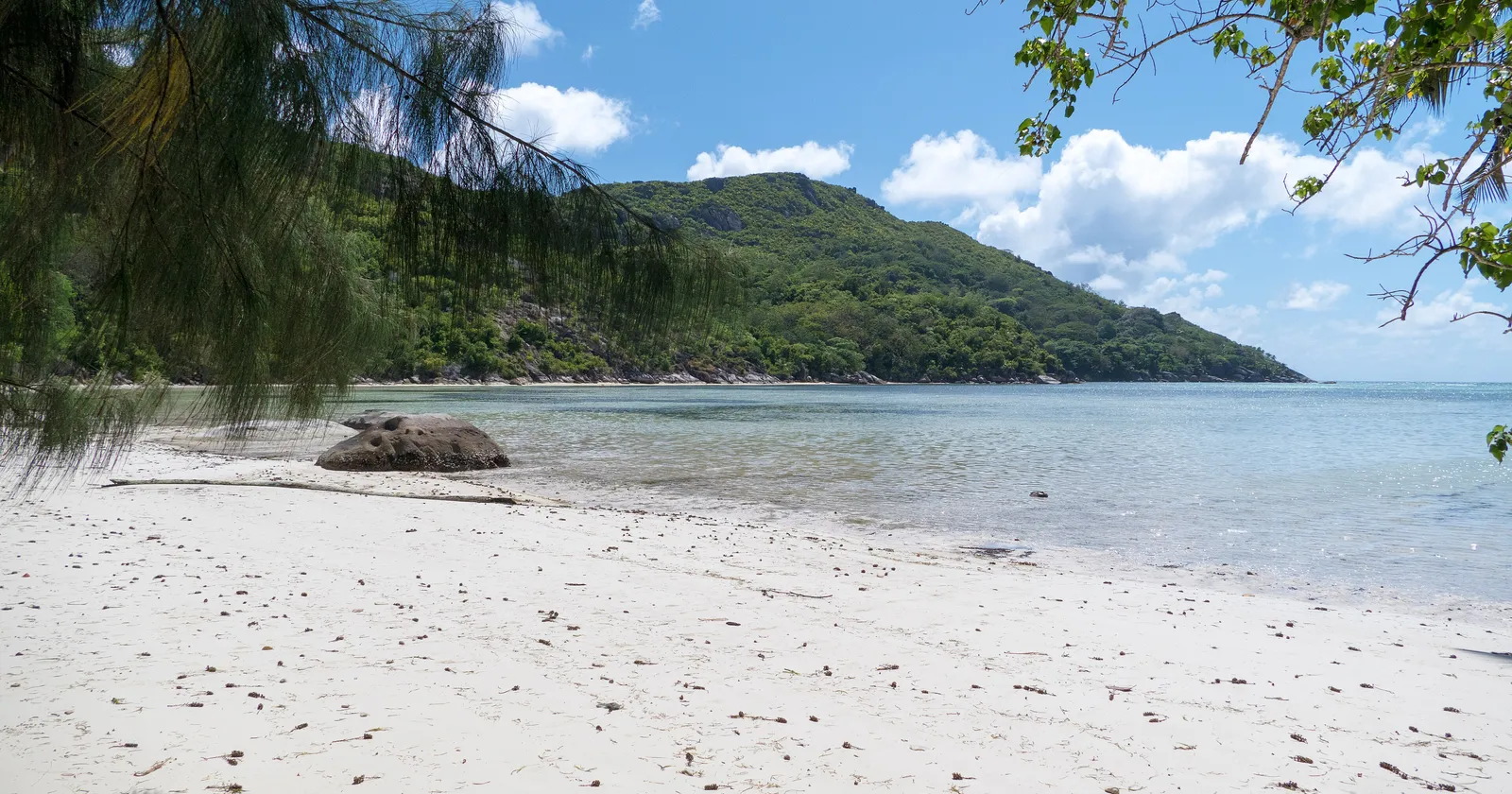
The shore of Baie Ternay Marine National Park, Mahé. So Seychelles, Wikimedia Commons, CC BY 2.0, cropped.

Key takeaways
- Non-residents over 12 pay SCR 200 a day for Ste Anne, Baie Ternay with Port Launay, or Ile Cocos, and SCR 300 for Curieuse; tour operators normally include it, and entering without a ticket costs SCR 600
- The Fisheries Act bans spear-gun fishing, attracting sharks with bait or blood for any activity, and chasing or taking marine mammals; marine parks ban fishing and collecting shells or coral
- The south-east trades peak in July and August with rough seas; April and November are the calm changeover months, and the sea runs from about 26.2 °C in August to 29.8 °C in April
- ResortDoc runs a recompression chamber on Silhouette Island, 23 km from Mahé, and says it offers 24/7 emergency response; we could not confirm independently that it is staffed today
- A free three-month visitor permit can be extended to twelve months for SCR 5,000 per three months, and the government's Workcation programme lets remote workers stay up to a year
Seychelles diving: granite, reefs and a few wrecks
Most diving in the Seychelles happens around the granite inner islands: Mahé, the largest, and Praslin and La Digue to its north-east. Dives are almost all from boats, over granite boulders, coral and seagrass, with a few wrecks off Mahé and a handful of marine parks close to shore. The far outer islands, the Amirantes and Aldabra, are a different trip, reached by liveaboard or expedition ship. Where you base yourself decides what you dive: Beau Vallon on Mahé for the widest choice of sites and shops, Praslin or La Digue for quieter boats and the reefs between them.
Mahé: Beau Vallon, the north-west wrecks and two marine parks
Beau Vallon bay on Mahé's north-west coast is where the island's dive centres cluster. Big Blue Divers, a PADI centre about 500 meters north of the beach, splits its sites by boat time. Its 24 normal-distance sites, including the Twin Barges, the Dredger wreck, Whale Rock and the Baie Ternay marine park, are no more than about 15 minutes away. Another 33, among them Shark Bank, Brissare Rocks and the Ennerdale wreck, take 20 to 45 minutes and are visited only when the sea is calm. Its morning trip with two dives leaves at 9:00 and returns at 13:30, and an afternoon dive leaves at 13:30.
The wrecks have a history. Big Blue says the Ennerdale, a British fleet tanker, struck uncharted rocks on 1 June 1970 and was blown apart because salvage was impossible. The Dredger and the Twin Barges were sunk on purpose in 1989 off Danzilles and Bel Ombre. The Aldebaran, a 28-meter fishing boat confiscated for illegal fishing, was towed out on 11 July 2008 and sunk off Willie's Bay, where Big Blue says it sits upright at 40 meters. That puts it at the deep end of what most recreational divers do; check your training before you book it.
Two of the national marine parks run by the Seychelles Parks and Gardens Authority (SPGA) are part of Mahé's diving. Baie Ternay, 0.80 km² and designated in 1979, lies about 5 km south-west of Beau Vallon with no coastal road access; the SPGA lists seagrass beds, coral reefs and granite boulders, and says whale sharks, dolphins and turtles can turn up. Next to it, beyond Cap Matoopa, Port Launay is the only marine park that can also be reached by land. On the other side of Mahé, Ste Anne Marine National Park covers six islands about 5 km off the coast, ten minutes by boat from Victoria. Created in March 1973, it was the first marine protected area in the Indian Ocean, according to the SPGA. The authority mentions scuba diving around Cerf Island and a dive site at Ile Cachée that can only be used in the north-west monsoon. The turtle nesting beaches on Ste Anne itself are closed to visitors.
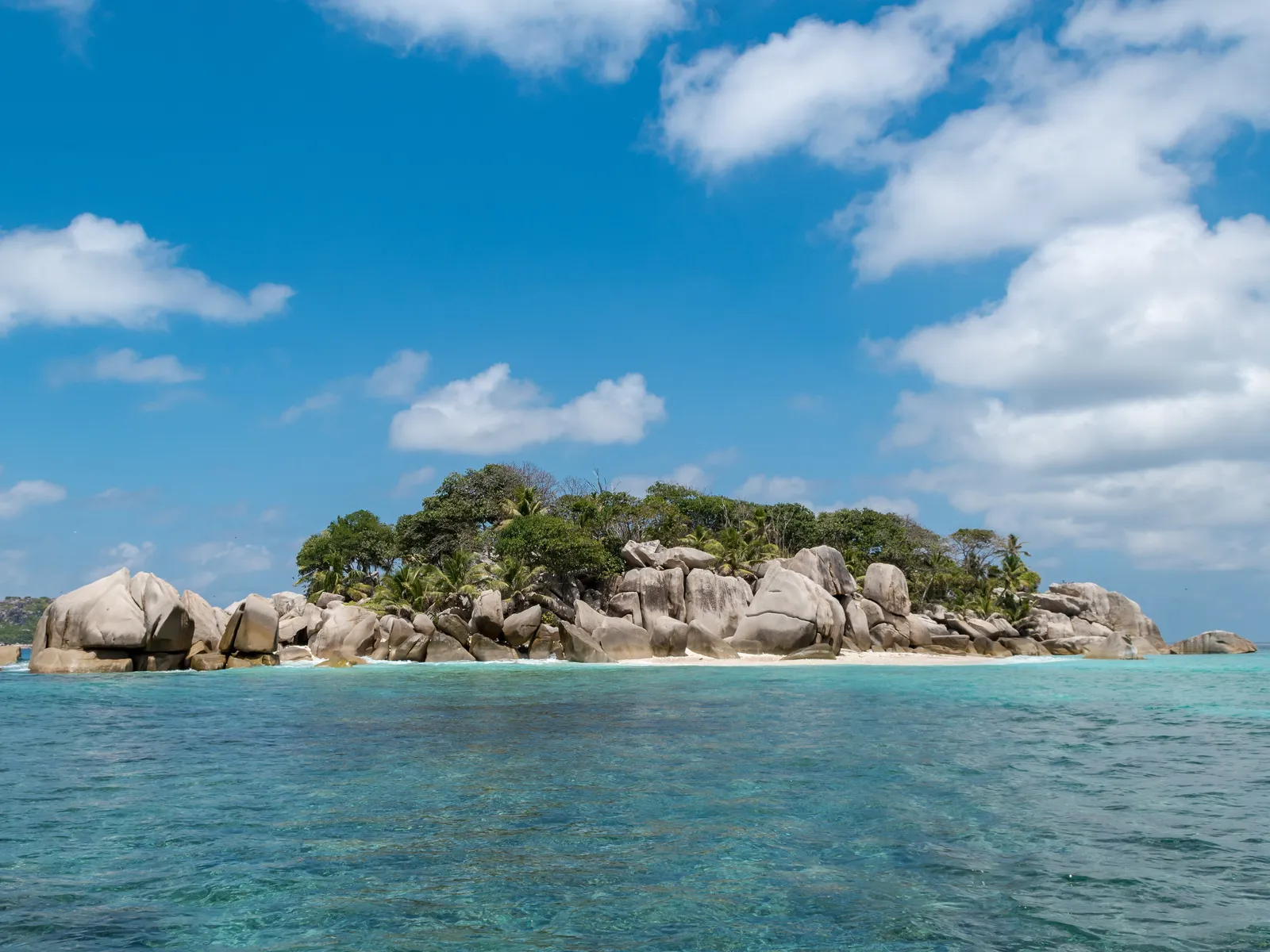
Ile Cocos marine park near La Digue. dronepicr, Wikimedia Commons, CC BY 2.0, cropped.

Praslin, La Digue and the parks between them
Praslin and La Digue have smaller shops and a more relaxed pace. White Tip Divers at Anse Volbert on Praslin says all its dives are guided, without decompression, to about 20 meters at most, and that it picks sites at the last minute depending on the weather. It lists sharks, rays, turtles, barracudas and Napoleon wrasse as possible sightings and adds that "the big ones" are never guaranteed. On La Digue, Trek Divers runs morning, afternoon and full-day trips on an 18-meter boat that carries a medical oxygen station. Big Blue on Mahé also runs day trips to sites off Praslin and La Digue, including Ave Maria, Coco Rocks and Marianne Rocks.
Two marine parks sit in these waters. Curieuse, 2 km off Praslin's north-east coast and designated in 1979, lists snorkelling and diving among its activities; its northern coast, including Anse Badamier, is closed. Ile Cocos, three small islets near La Digue, is known above all for snorkelling, hawksbill turtles and, around August to November, whale sharks, according to the SPGA. Both are reached on trips from Praslin or La Digue.
Outer islands, liveaboards and Aldabra
Beyond the inner islands, diving means a boat you live on. Galatea, a schooner bought in 2010 by the owners of Blue Sea Divers on Mahé, sells inner-island cruises and an outer-islands programme built around the Amirantes group; its page gives no dates or prices. Aldabra, the atoll managed by the Seychelles Islands Foundation (SIF), is open only to vessels that SIF has cleared in advance. SIF's guide for tour operators, last updated in September 2020, says visitors almost always come during the north-west monsoon, and an SIF job notice describes a tourism season from November to April.
Diving at Aldabra is tightly managed. Each dive group needs a very experienced instructor or divemaster from the ship plus an SIF diver, profiles must stay well within no-decompression limits, and baited dives and night dives are not allowed. Only divers with an Advanced Open Water certificate may dive the Main Channel, where SIF warns of strong currents. We found no official landing or diving fee for Aldabra, so ask the ship operator what is included.
Marine park tickets and the rules underwater
Non-residents aged 12 and over need a day ticket for each SPGA marine park: SCR 200 for Ste Anne, SCR 200 for Baie Ternay and Port Launay together, SCR 200 for Ile Cocos and SCR 300 for Curieuse, with a bundle for Ile Cocos and Curieuse at SCR 400. The fees were set by a government regulation in January 2020. Tickets are valid from 8:00 to 17:00, can be bought online or by card from rangers, and the penalty for entering without one is SCR 600. The SPGA says visitors booking through tour operators normally have the fee included, so ask your dive centre whether its price covers it.
Inside the parks, boats must anchor or moor in designated areas, motorised water sports are banned, and nobody may carry a spear gun, fishing gear or fish traps. Visitors may not fish or collect shells, plants, coral or other marine life. In 2023 the SPGA reminded the public that fishing in the parks is illegal under the Nature Reserves and Conservancy Act of 2022, which also makes removing coral or seagrass an offence, and said equipment can be seized.
Outside the parks, the Fisheries Act of 2014 applies across Seychelles waters. It bans using a spear gun for fishing, or carrying one where it looks meant for fishing. It bans attracting sharks by putting fish, blood or bait in the water for any sport, game or activity, with approved research excepted, so baited shark dives are illegal. And it bans killing, chasing or taking any marine mammal. The Marine Conservation Society Seychelles (MCSS) says the whale shark has been formally protected since 2003. Since 2025, marine spatial plan regulations aim to protect at least 30% of the country's waters.
We found no Seychelles law that sets a depth limit, requires dive insurance or prescribes certification for recreational divers. The limits you meet come from the dive centres, such as White Tip's 20 meters, and from your own training. Carry dive insurance that covers chamber treatment and evacuation anyway.
Whale sharks off Mahé's west coast
The MCSS says whale sharks gather along the western coast of Mahé every year, usually between August and November, and that most of them are juvenile males. Its annual monitoring programme runs from 1 August to 31 October, and during that time it runs eco-tours from Beau Vallon bay; bookings go through its whale shark email address. The MCSS has studied the animals for more than 30 years and helped draft the country's whale shark encounter code. Sightings are a season, not a guarantee, and the same months are the windiest of the year.
When to dive: the trade winds decide
The Seychelles Meteorological Authority (SMA) describes two seasons. The south-east trades set in around May, become windy with choppy seas by the end of June, and peak in July and August, when the authority calls the sea "certainly forbidding for amateurs". From June to September the west and north-west coasts are the sheltered side, which suits Beau Vallon. The trades weaken in October. In November the wind drops and swings west, and December to March is the north-west monsoon: the rainy season, with fairly light winds and, in the authority's words, quite pleasant conditions at sea. April is the changeover, with light, variable winds, and the SMA writes that conditions at sea "can't get more pleasant than this".
Cyclones are rarely a direct threat. The SMA says the south-west Indian Ocean cyclone season peaks in January but that storms normally curve south and rarely affect the main granitic islands; a cyclone far to the south can still stir up moderate winds for a couple of days. The season officially ends in April.
The water is warm all year. NOAA's satellite averages for 1991 to 2020, for a grid cell off north-west Mahé at 4.625°S 55.375°E, put the sea at about 28.4 °C in January, 29.8 °C in April, 27.4 °C in June, 26.2 °C in August and 27.8 °C in October. A cell near Praslin and La Digue reads almost the same, 29.9 °C in April and 26.3 °C in August. These are surface figures; Trek Divers includes a 3 mm wetsuit in its prices.
The nearest chamber and emergency numbers
The recompression chamber we could find is on Silhouette Island, about 23 km from Mahé, in a medical centre that the German company ResortDoc runs as part of the island's resort. ResortDoc says the centre has two doctors, a nurse and a chamber technician, offers 24/7 emergency response and has a DAN-certified chamber that it calls the biggest in the Seychelles, suitable for severe accidents. DAN's 2019 profile of the chamber said it was open to divers from other resorts and reachable by boat, and that doctors were on call 24 hours a day; it also said the facility had no advanced medical support at the time. ResortDoc's page is undated, and we could not confirm independently that the chamber is staffed and working today. We found no chamber on Mahé itself.
The tourism department lists 999 or 112 for police, 151 for a medical emergency, 4388000 for the Seychelles Hospital and 4290900 for the coast guard. Before you dive, ask your centre how it would get an injured diver to Silhouette and whether it carries oxygen, and call the DAN hotline as early as you can.
What a dive costs in the Seychelles
Prices on the centres' own pages, read on 10 November 2026:
| Dive centre | Single boat dive | Ten dives | What is included |
|---|---|---|---|
| Big Blue Divers, Mahé | €70 with equipment, €55 with tank and weights only | €640 with equipment, €490 without | Normal-distance boat trip, tank, air, weights; long-distance sites cost extra |
| Trek Divers, La Digue | €70 morning, €65 afternoon | Not listed | Fins, mask, 3 mm wetsuit, guide, snacks and taxes; 4% surcharge on card payments at the office |
Trek Divers charges €130 for two morning dives and sells full-day trips at €100 plus €40 a dive, or €150 plus €40 a dive for long-distance sites. Big Blue's ten-dive packages work out at €64 or €49 a dive. Big Blue's Open Water course costs €357 to €595 and Trek Divers' €520. White Tip Divers on Praslin lists single dives and five- and ten-dive packages, but its page shows no prices. Marine park fees may come on top.
Getting there and moving between islands
International flights arrive at Seychelles International Airport (SEZ). Between the main islands, Cat Cocos, which has run ferries since 1998 and operates five boats, gives crossing times of 1 hour 15 minutes from Mahé to Praslin, 1 hour 10 minutes from Mahé direct to La Digue, and 15 minutes between Praslin and La Digue, with several trips a day. We couldn't confirm Air Seychelles' domestic flights or any ferry fares, so check them when you book. Ste Anne is ten minutes by boat from Victoria, and Port Launay is a 30-minute drive from the capital.
Staying longer: the visitor permit and the Workcation programme
Visitors need no visa, but every traveller needs an approved Travel Authorisation before arrival. The government's own platform charges adults €10 for standard 24-hour processing, €30 for six hours and €70 for one hour, plus bank charges, and a €30 penalty at the airport for anyone who arrives without one. Each authorisation covers one journey.
On arrival you get a visitor's permit if you have an onward ticket, confirmed accommodation and enough money; the immigration department sets the minimum at US$150 a day. The permit is free for the first three months and can be extended in three-month steps to a maximum of twelve months, at SCR 5,000 for each extension, online or at Independence House in Victoria. Any job for a local employer, paid or unpaid, needs a Gainful Occupation Permit.
For remote workers, the Seychelles Workcation Retreat Program on the same platform invites the self-employed, freelancers, company owners and employees to work remotely for up to a year. Applicants need a passport valid for six months, a letter of employment or proof of business, proof of income or funds, medical and travel insurance, an onward ticket and booked accommodation, and a special team reviews each application within up to ten days. When the scheme was launched in 2021, the government paper reported that participants may not work for local clients for pay. We couldn't confirm the fee, so check it before applying. For connectivity, the platform sells tourist SIM packs from Airtel and Cable & Wireless, such as 15 GB with unlimited local calls for 21 days.
Who the Seychelles suits
The Seychelles suits a diver who likes warm water all year, granite landscapes and the occasional wreck, and who can plan around the wind: the calmer months from October to May for the widest choice of sites, or the windy season on Mahé's sheltered north-west coast with a chance of whale sharks. It suits a remote worker who can afford a long stay, since the visitor permit stretches to a year and the Workcation programme is built for it. It suits less well anyone who wants baited shark dives, which are illegal, a confirmed chamber on Mahé, or the outer atolls on a small budget.
FAQ: Seychelles diving
When is the best time to dive in the Seychelles?
The Seychelles Meteorological Authority describes April, with light and variable winds, as the most pleasant month at sea, and calls conditions quite pleasant in November and December. The south-east trades peak in July and August with rough seas, when the west and north-west coasts of Mahé are the sheltered side. The sea stays between about 26 °C and 30 °C all year.
When can you see whale sharks in the Seychelles?
Usually between August and November along the west coast of Mahé, according to the Marine Conservation Society Seychelles. Its monitoring programme and eco-tours from Beau Vallon run from 1 August to 31 October. The Parks Authority also reports whale sharks around Ile Cocos from August to November.
How much is the marine park fee for divers?
Non-residents aged 12 and over pay SCR 200 a day for Ste Anne, Baie Ternay with Port Launay, or Ile Cocos, and SCR 300 for Curieuse. Tour and dive operators normally include it, and entering without a ticket costs SCR 600.
Is there a hyperbaric chamber in the Seychelles?
Yes, on Silhouette Island, about 23 km from Mahé, run by ResortDoc, which says it offers 24/7 emergency response. DAN profiled the chamber in 2019. We could not confirm independently that it is staffed today, and we found no chamber on Mahé.
Can I work remotely from the Seychelles?
Yes. The government's Workcation programme lets remote workers stay up to a year if they show employment or business proof, income, insurance, an onward ticket and accommodation. Otherwise a visitor permit runs three months free and can be extended to twelve months at SCR 5,000 per extension. Working for local clients needs a separate work permit.
Note: Conditions, safety guidance and regulations change. Verify current information with official sources, including the dive operator, the park authority and the relevant government department, before you travel or dive.
Founder of NOMADREEF and a former digital nomad. This guide is sourced from the references below; conditions, prices and rules change, so verify current details, and follow qualified local guidance and safety briefings. About the author · LinkedIn ↗
Sources
- Dive areas and wrecks (each centre primary for itself). Big Blue Divers, home, dive sites and Seychelles diving; White Tip Divers, dive sites; Trek Divers, about; Galatea diving cruises. Read 10 November 2026.
- Marine parks (primary). Seychelles Parks and Gardens Authority: visitor information, ticket prices, Ste Anne, Baie Ternay, Port Launay, Curieuse and Ile Cocos; Official Gazette, S.I. 4 of 2020 on park fees (PDF); SPGA press release as printed by Seychelles Nation, 6 April 2023. Read 10 November 2026.
- Fishing, sharks and protected waters (primary). Fisheries Act 2014 (PDF, via FAOLEX), section 32; Marine Spatial Plan Regulations, S.I. 18 of 2025 (PDF), regulation 3. Read 10 November 2026.
- Whale sharks (primary). Marine Conservation Society Seychelles, whale shark project. Read 10 November 2026.
- Aldabra (primary). Seychelles Islands Foundation, Aldabra tour operator guide, version 4.0, September 2020 (PDF) and tourism officer notice. Read 10 November 2026.
- Season and sea temperature. Seychelles Meteorological Authority, Seychelles climate guide (primary); NOAA PSL, OISST v2.1 monthly long-term means 1991–2020, cells 4.625°S 55.375°E and 4.375°S 55.625°E, computed for this page (primary). Read 10 November 2026.
- Chamber and emergency numbers. ResortDoc, Silhouette medical centre (operator); DAN, RCN bulletin no. 1, April 2019 (PDF) (primary); Tourism Department, emergency and essential numbers (PDF) (primary). Read 10 November 2026.
- Prices (each centre primary for itself). Big Blue Divers, dive packages; Trek Divers, prices 2025–2026; White Tip Divers, fun dives. Read 10 November 2026.
- Getting there (primary). Cat Cocos and its schedule page; airport name from the Seychelles Electronic Border System. Read 10 November 2026.
- Staying and working (primary). Immigration and Civil Status, visitor's permit and visiting Seychelles; Seychelles Electronic Border System, FAQ and Workcation and SIM pages; UK FCDO, entry requirements; launch report in Seychelles Nation, 23 January 2021. Read 10 November 2026.
- Left out. A national depth, insurance or certification rule for divers, which we did not find; whether the Silhouette chamber is staffed today; Big Blue's long-distance supplement and White Tip's prices; Air Seychelles' domestic flights and ferry fares, whose pages were blocked or not published; the Workcation fee, because the programme's own site was unreachable; Aldabra fees; liveaboard dates and prices; and visibility figures.