Sardinia Diving: Six Marine Parks, Six Rulebooks, and a Season from Spring to October
 by Yannick Schroth
Nov 10, 2026
15 min read
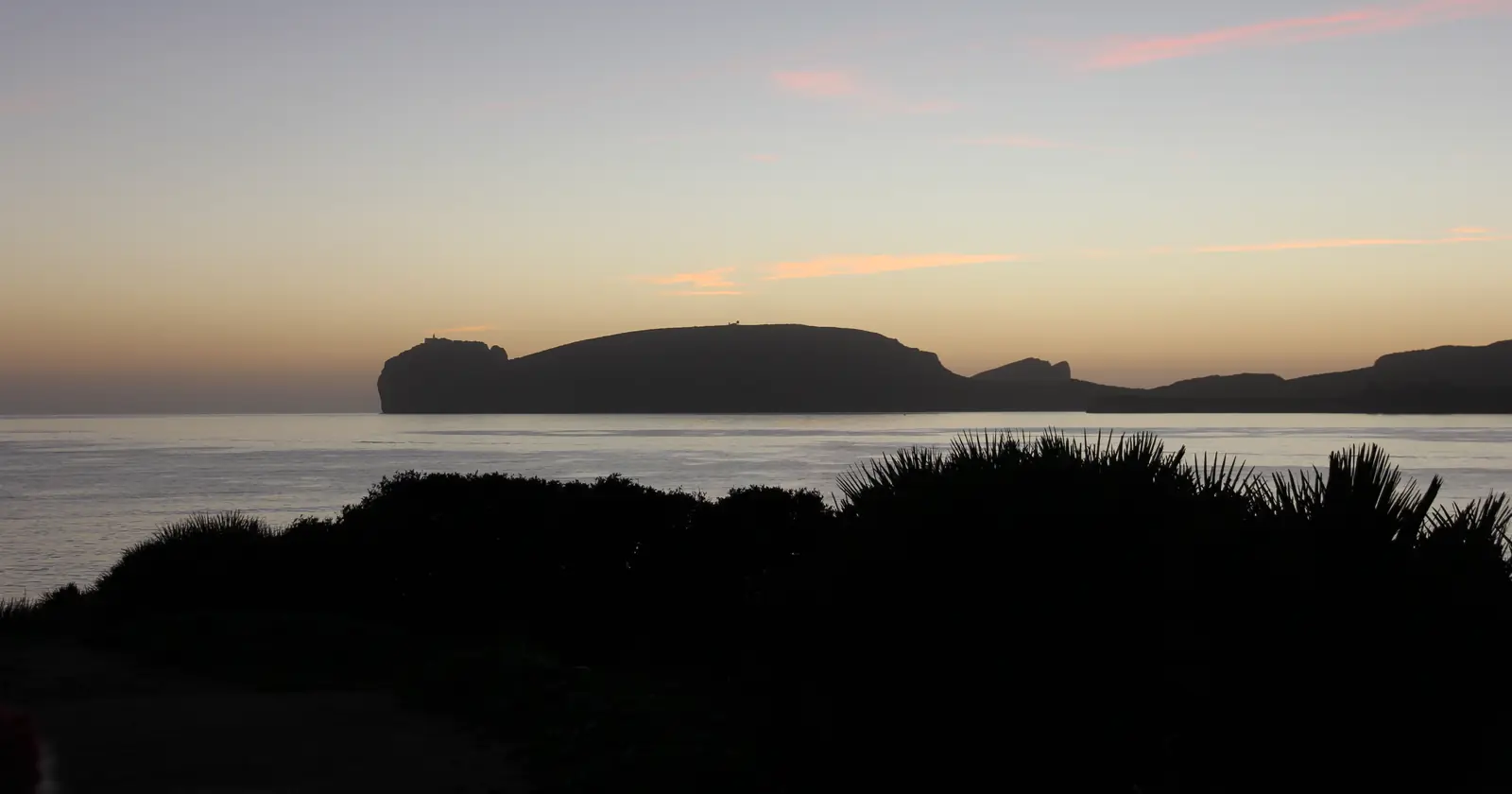
Capo Caccia at dusk, seen from the Alghero side. Gianni Careddu, Wikimedia Commons, CC BY-SA 3.0, cropped.

Key takeaways
- Capo Caccia charges private divers €10 a day, €50 a month or €200 a year, and allows them only with a permit and a second-level certification; Asinara allows no private diving at all
- In the Tavolara marine park, centres pay €1.50 per diver per dive, which shops pass on, and private divers may use zone B only at two sites between 12:00 and 17:00
- Italian rules require a surface marker on at least five meters of line, keep divers within 50 meters of it and boats at least 100 meters away, and forbid spearfishing on scuba
- None of the six centres whose seasons we read opens all year; the water is about 13.5 to 14 °C in February and 25 to 26 °C in August at the surface
- A 2025 decree guarantees daily flights in every month from Cagliari, Olbia and Alghero to Rome and Milan, and Italy's digital nomad visa needs about €28,000 a year in income
Sardinia diving runs through its marine parks, each with its own rulebook
Most of the dives worth travelling for in Sardinia lie inside one of its protected areas, and the first thing to know is that there is no single set of rules. Italy's environment ministry gives each marine protected area a regulation, and each managing body issues a yearly disciplinare on top with sites, limits and fees. In practice they all keep diving out of their strictest zone A, require a second-level certification for divers going without a centre, and make centres hold an authorization. The details differ, and they decide whether you can dive on your own.
| Protected area | Diving without a centre | What it costs |
|---|---|---|
| Capo Caccia – Isola Piana, Alghero | Zones B and C with a permit, second-level card, at most 4 divers, no solo dives, no night dives | €10 a day, €20 a week, €50 a month, €200 a year; residents half |
| Tavolara – Punta Coda Cavallo, Olbia | With a permit; in zone B only at Secca di Punta Arresto and Relitto Omega, 12:00 to 17:00, groups up to 6 | Centres pay €1.50 per diver per dive; no private fee published |
| Capo Carbonara, Villasimius | Zones C and D only with a permit, at most 4 divers, no caves | €25 a day or €400 a year in 2025; not in the 2026 fee table |
| Asinara | Not allowed; only 7 authorized centres | Centres pay €720 a boat a year |
| La Maddalena national park | Scuba banned in zone Ma, allowed in Mb under the 1996 decree | Current rules and tickets not confirmed |
Spearfishing is banned inside the Tavolara, Capo Caccia and Capo Testa areas, and nowhere in a protected area may you take or disturb anything.
Capo Caccia and the Nereo cave: Alghero's cave diving
The protected area at Capo Caccia, managed by the Porto Conte park company, is Sardinia's cave country. Its best-known site, the Grotta di Nereo, opens at the foot of the cliff: Capo Galera, a centre in Fertilia, describes the deepest entrance at about 30 meters, others between 16 and 18, and a loop that closes at about 23 meters before you leave through a window at 18. Alghero Divers gives the main gallery as about 300 meters and the whole system as more than 500. The 2026 rules set limits for guided cave dives: four divers per guide, eight per dive, three dives a day per cave, divers with a second-level card and a guide with a cavern qualification. Private divers need a cavern certification themselves, and a full cave qualification for the Grotta dei Fantasmi. The park allows no night dives and authorizes at most twelve dive centres.
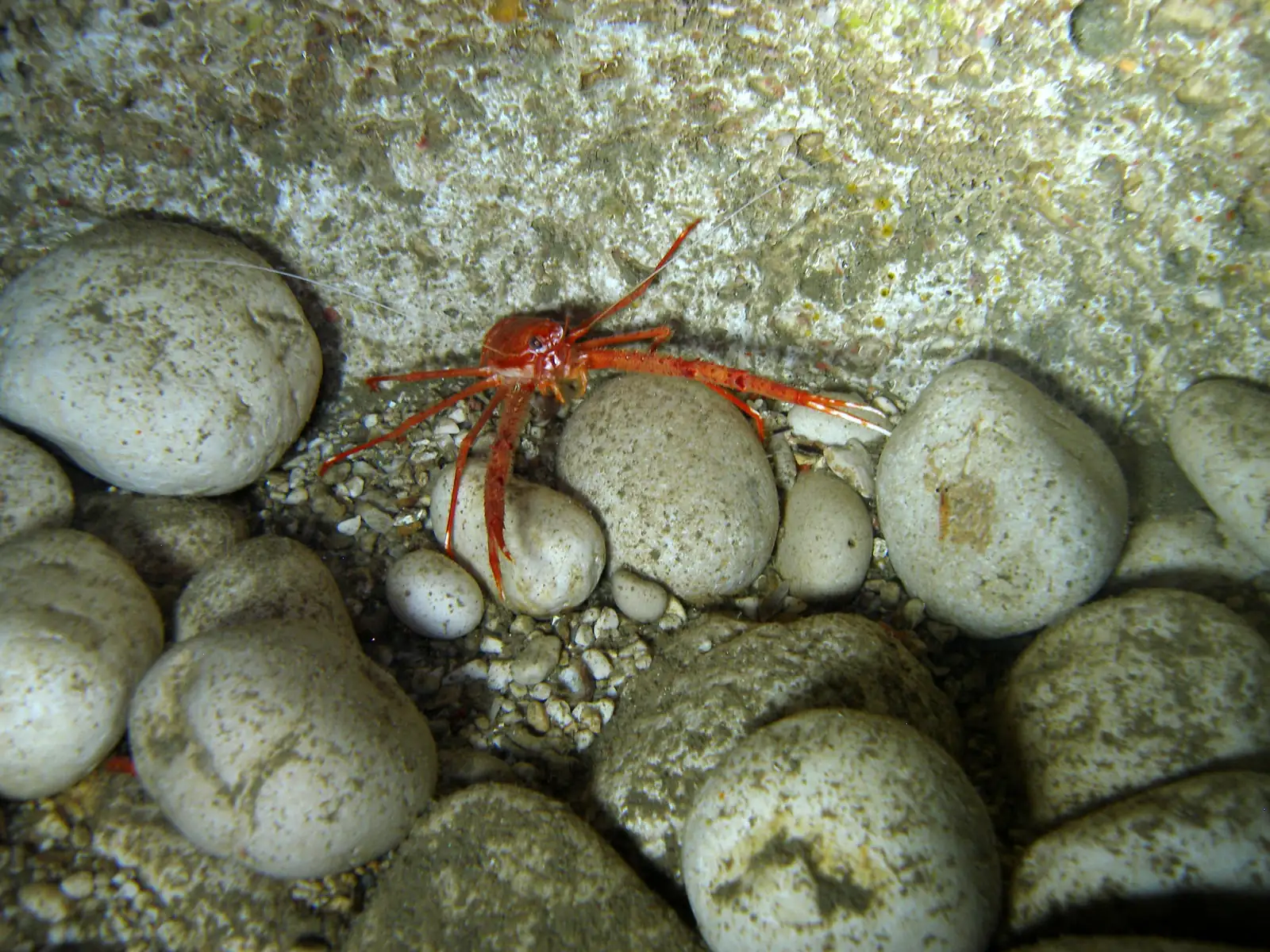
A squat lobster on the floor of the Grotta di Nereo. Marco Busdraghi, Wikimedia Commons, CC BY-SA 3.0, resized.

For a long stay, the fees matter: a private diver pays €10 a day, €20 a week, €50 a month or €200 a year, and people who rent a yearly or seasonal berth in Alghero count as residents and pay half.
Tavolara: Secca del Papa and a park fee of €1.50 a dive
Off Olbia, the Tavolara – Punta Coda Cavallo protected area has the island's most famous shoals. Blu Infinito, a centre at Capo Coda Cavallo, describes Secca del Papa 2 rising from 40 to 42 meters to about 24; Scuba Revolution puts the top of Papa 1 at 15 meters and reserves the site for advanced divers, and Karibu in San Teodoro charges a €15 supplement for it. Secca di Punta Arresto off Molara has spires reaching close to the surface and channels to 27 or 28 meters, and the Relitto Omega lies at 18 meters after sinking in a storm in 1974.
The park's 2025 fee rules charge centres €330 per boat and €1.50 per diver for each dive, which Blu Infinito lists separately on its prices. Centres may bring at most two boats and twelve divers to a site at once, five divers per guide. A private diver can get a permit too, but in zone B only for Punta Arresto and the Relitto Omega, between 12:00 and 17:00, with a second-level card and in groups of at most six. The park publishes no fee for private divers, so ask its office.
Capo Carbonara: Villasimius wrecks and a permit that may have changed
Villasimius in the south-east sits inside the Capo Carbonara protected area, run by the town itself. Its 2017 regulation keeps private divers out of zone B and out of every natural cave, and lets them dive zones C and D with a permit, a second-level diver present and at most four in the group; a private permit may not be used to guide paying divers. The 2025 rules priced that permit at €25 a day, €100 a week, €220 a month or €400 a year. The 2026 fee table no longer lists it, though the payment codes still do, so ask the park whether private permits are still issued before planning on one.
The area's best-known dive is the Egle, a ship of more than 70 meters that Diving Bolla Blu says was torpedoed by the Dutch submarine Dolfijn on 29 March 1943 and lies at about 35 meters. The Secca di Santa Caterina runs from about 12 meters to past 30, in zone A, so only with an authorized centre. A statue of the Madonna del Naufrago stands underwater off the Isola dei Cavoli. If you are looking for the Cristo degli Abissi, that one is at San Fruttuoso in Liguria, not in Sardinia.
Asinara and La Maddalena: the national parks
Asinara, off the north-west tip, is the strictest. Its regulation bans individual and group diving altogether; you dive only with one of at most seven authorized centres, from a support boat, at six divers per guide and 24 dives per site per day across all centres. Centres must operate at least six months a year to keep their authorization. Cala d'Oliva Diving Center and I Sette Mari Tech Dive are among those the park lists.
The La Maddalena archipelago is a national park whose founding decree of 1996 bans scuba diving in its zone Ma, except for research, and allows it in zone Mb, and reserves most dive-centre permits for businesses from La Maddalena. We could not confirm the current rules, tickets or the list of authorized centres, because the park's website did not answer at all on the day we checked. Ask a centre in La Maddalena or Palau before you go. Centres there sell dives around Spargi, Budelli, Caprera and across the strait at the Lavezzi islands on the Corsican side, where Scuba Revolution's Città delle Cernie runs from 16 to 35 meters. At Capo Testa, near Santa Teresa Gallura, the only rules we found are a provisional set that expired at the end of 2023.
Cala Gonone: wrecks and caves for technical divers
The Gulf of Orosei on the east coast has no marine protected area of its own and a different kind of diving. Three Cala Gonone centres agree that the KT12, a wreck in two parts, lies on sand at about 34 meters with its highest point at 24, about 35 to 40 minutes by boat. The Grotta del Bue Marino is a full cave dive, for which Argonauta asks for a full-cave certification. Protec Sardinia charges €45 for a boat dive with tank and weights, the lowest price we found on the island.
Italian rules every diver meets: the buoy, 100 meters and no spearfishing on scuba
Italian boating rules make divers visible. Every diver must be marked by a float carrying the red flag with a white diagonal, visible at 300 meters, or fly it on the support boat; one marker is enough for a group, but each diver carries an inflatable surface marker on at least five meters of line, stays within 50 meters of the marker, and at night shows a flashing yellow light. Passing boats must keep at least 100 meters away. Those are the 2008 implementing rules. Italy amended them in 2024, and we haven't checked whether this part changed.
Recreational spearfishing is allowed only on a breath hold, never with scuba, and spearfishers may not take coral or shellfish. Red coral is reserved for professionals: Sardinia's 2026 decree allows twelve licensed coral divers to take it, only below 80 meters and only from 15 May until 15 October.
When to dive Sardinia: centres open from spring to October
Sardinia is a summer dive destination, and the centres say so. Poseidon at Porto Conte opens from April to October, Blu Infinito at Tavolara from May to October, Area11 in La Maddalena from March to November, Blue Zone at Vignola from 18 May to 23 October in 2026, and Divers Tribe in Villasimius prices its dives from May to October. None of the centres whose own pages we read says it opens all year, so a winter stay means finding a centre first.
NOAA's satellite averages for 1991 to 2020, which we read for six dive areas around the island, put the sea surface at about 13.5 to 14 °C in February, the coldest month, 24.7 to 26.1 °C in August and still about 20.4 to 21.8 °C in October. The east coast and Villasimius run slightly warmer than Alghero and La Maddalena. Those are surface figures; at 25 or 30 meters in summer the water is colder, so bring more neoprene than the surface suggests.
Diving accidents in Sardinia have gone to Cagliari
Chamber cover is the weak spot, and we couldn't read a hospital page on it. According to L'Unione Sarda, the hyperbaric centre at the Ospedale Marino in Cagliari, on the Poetto, has two chambers and takes emergencies, and a health directory describes it as active around the clock and the only one in southern Sardinia. In August 2025 the same paper reported that a diver rescued off Olbia was transferred to Cagliari for treatment, and that the chamber at La Maddalena's hospital was then used only for routine treatments. A private centre in Sassari runs a twelve-place chamber, but we found nothing on whether it takes diving emergencies. In an accident call 112 or 118, and ask your centre how it would get you to a chamber from where it dives. Check that your dive insurance covers the transfer.
What a boat dive costs in Sardinia: €45 to €80
Prices for a single boat dive on the centres' own pages, read on 10 November 2026; most lists carry no year:
| Dive centre | Area | Single boat dive |
|---|---|---|
| Protec Sardinia | Cala Gonone | €45 |
| Sandalia Diving Center | Alghero | €50 |
| Alghero Divers | Alghero | €55, €39 from the tenth dive |
| Karibu | San Teodoro | €55 (2025 list) |
| Blu Infinito | Tavolara | €60 plus €1.50 park fee |
| Sirena Sardinia | Sant'Antioco | €60 |
| Area11 | La Maddalena | €65, plus €10 to €20 for distant sites |
| Divers Tribe | Villasimius | €70 |
| Orso Diving | Poltu Quatu | €80 (2026 list), more for distant sites |
Getting to Sardinia: daily flights to Rome and Milan guaranteed by law
Many of Sardinia's international flights are seasonal, but its links to the mainland are not. A decree of Italy's transport ministry, number 213 of 9 September 2025, imposes public service obligations on the routes from Cagliari, Olbia and Alghero to Rome Fiumicino and Milan Linate from 29 March 2026: every day of every month, at least one flight in each of four time bands. A later decree moved the start of Alghero–Linate to 25 October 2026, according to the ministry's listing. The same decree caps fares at €39 to Rome and €57.20 to Milan, before taxes, for non-residents travelling to Sardinia for work; whether someone working remotely for a foreign employer counts is not clear, so expect to pay the open fare. Ferries from Genoa, Livorno and Civitavecchia run to Olbia and Porto Torres with Moby, Tirrenia and GNV, and Moby crosses from Bonifacio in Corsica to Santa Teresa Gallura. Most dive centres sit at harbours and hotels spread around a large coast, and in our reading a car is the practical way to dive more than one area.
Sardinia for remote workers: Italy's digital nomad visa
Italy has a real visa for this. A decree of 29 February 2024 created a permit for digital nomads, who are self-employed, and remote workers, who are employed. Applicants need an annual income of at least three times the threshold for exemption from health charges, which the Italian consulate in Buenos Aires put at about €28,000 a year, health insurance, proof of housing and at least six months of experience in their work; employees also need a highly qualified profile. The permit is requested at the police headquarters within eight working days of arrival, lasts up to a year and can be renewed, and self-employed holders must open an Italian VAT number. The consulate in Paris lists a visa fee of €116. Without it, non-EU visitors have the usual 90 days in any 180 under the Schengen rules.
For a desk, Regus in Cagliari sells day passes at €25. We found no operator page confirming a coworking space open all year in Olbia or Alghero. Fibre coverage varies by street, and the national maps of AGCOM and Infratel show it address by address.
Who Sardinia suits
Sardinia suits a certified diver with a second-level card who wants caves at Capo Caccia, shoals at Tavolara or wrecks off Villasimius between May and October, and who is happy to dive with authorized centres. It suits a remote worker who qualifies for Italy's nomad visa and can live with a quiet winter. It suits less well anyone who wants to dive all year, to dive independently without permits, or to stay close to a chamber in the north of the island.
Twenty-eight schools on our Sardinia list
Our Sardinia operator list holds 28 businesses outside the Porto Pollo area, read on 9 November 2026: thirteen dive centres published by SSI, two by International Training, among them Protec Sardinia in Cala Gonone, and thirteen kite and windsurf schools from the IKO and VDWS registers. The north coast around Palau and Porto Pollo has its own list. Many Sardinian centres quoted here, such as Capo Galera, Blu Infinito, Area11 and Orso Diving, aren't on this list: they teach under bodies whose registers we can't cite, or they're on the Porto Pollo list. A listing shows that a training body lists a centre. It doesn't show that a marine park has authorized it, and in Sardinia that's what counts.
FAQ: Sardinia diving
Can you dive on your own in Sardinia's marine parks?
Sometimes, with a permit. Capo Caccia allows private divers in zones B and C with a second-level card, at most four together and no solo dives, for €10 a day or €200 a year. Tavolara allows private permits but limits zone B to two sites in the afternoon. Asinara allows no private diving at all, and Capo Carbonara's 2026 fees no longer list a private permit.
When is the diving season in Sardinia?
Roughly April or May to October. The centres whose seasons we read open between March and May and close between October and November, and none says it opens all year. The sea surface averages about 13.5 to 14 °C in February and 25 to 26 °C in August.
How deep is the Nereo cave dive at Capo Caccia?
The deepest entrance is at about 30 meters and others open at 16 to 18 meters; the usual loop closes at about 23 meters. In the Capo Caccia marine park, cave dives go with authorized centres, four divers per guide, and private divers need a cavern certification.
Where is the hyperbaric chamber in Sardinia?
Diving emergencies have been treated at the Ospedale Marino in Cagliari, which news reports and a health directory describe as running around the clock. In 2025 the chamber in La Maddalena was reported as taking routine treatments only. Call 112 or 118 in an accident.
Is the Christ of the Abyss in Sardinia?
No. The Cristo degli Abissi is at San Fruttuoso in Liguria. Sardinia has its own underwater statues, among them the Madonna del Naufrago off the Isola dei Cavoli near Villasimius.
Note: Conditions, safety guidance and regulations change. Verify current information with official sources, including the dive operator, the park authority and the relevant government department, before you travel or dive.
Founder of NOMADREEF and a former digital nomad. This guide is sourced from the references below; conditions, prices and rules change, so verify current details, and follow qualified local guidance and safety briefings. About the author · LinkedIn ↗
Sources
- Capo Caccia (primary). Parco di Porto Conte, disciplinare 2026 (PDF), articles 3, 7 and 20, and authorized centres (list dated 2019). Read 10 November 2026.
- Tavolara (primary). Regulation, DM 3 December 2014 (PDF), articles 16 and 17; disciplinare 2025 (PDF); fee regulation of 5 December 2025 (PDF), article 10; permits and spearfishing. Read 10 November 2026.
- Capo Carbonara (primary). Regulation, DM 12 May 2017 (PDF), articles 16 and 17; disciplinare 2025 (PDF) and 2026 (PDF). Read 10 November 2026.
- Asinara (primary). Regulation (PDF), articles 12 and 13; disciplinare 2026 (PDF); authorized operators. Read 10 November 2026.
- La Maddalena and Capo Testa. DPR of 17 May 1996 (PDF) on the La Maddalena zones (primary); the park's own site did not respond on 10 November 2026. Capo Testa, provisional disciplinare 2023 (PDF), expired. Read 10 November 2026.
- Dive sites (each centre primary for itself). Capo Galera, Grotta di Nereo; Alghero Divers; Blu Infinito; Scuba Revolution; Karibu; Diving Bolla Blu; the KT12 triangulated across Protec Sardinia, Bluforia and Argonauta. Cristo degli Abissi: italia.it. Read 10 November 2026.
- Italian diving rules (primary). DM 29 July 2008 no. 146, article 91, in the 2008 text; DPR 2 October 1968 no. 1639, articles 128-bis, 129 and 130, in a consolidated edition; Regione Sardegna, red coral decree of 24 April 2026 (PDF). Read 10 November 2026.
- Season and water. Seasons on the centres' own sites: Poseidon, Blu Infinito, Area11, Blue Zone, Divers Tribe. NOAA PSL, OISST v2.1 monthly long-term means 1991–2020, read at six grid cells for this page. Read 10 November 2026.
- Chambers (news reports and a directory; no hospital page could be read). L'Unione Sarda, 6 July 2017, 24 August 2025 and 6 June 2022; QSalute, Ospedale Marino. Read 10 November 2026.
- Prices (each centre primary for itself). Protec Sardinia, Sandalia, Alghero Divers, Karibu, Blu Infinito, Sirena Sardinia, Area11, Divers Tribe and Orso Diving. Read 10 November 2026.
- Getting there. Ministero delle Infrastrutture e dei Trasporti, decree 213 of 9 September 2025 (PDF) (primary); the start date of Alghero–Linate from the listing of decree 22 of 16 February 2026, which we did not open. Ferries: Moby, Tirrenia, GNV. Read 10 November 2026.
- Staying and working (primary). Decree of 29 February 2024, Gazzetta Ufficiale no. 79, articles 1 to 6; Italian consulates in Buenos Aires and Paris; Regulation (EU) 2016/399, article 6; Regus Cagliari (operator); AGCOM broadband map. Read 10 November 2026.
- The 28 listings. Twenty-eight entries on the Sardinia operator list, from the SSI, International Training, IKO and VDWS registers, read 9 November 2026.
- Left out. La Maddalena's current rules and tickets; Capo Carbonara's 2026 private permit; a private-diver fee at Tavolara; a hospital's own statement on the Cagliari chamber; how often the maestrale blows, for which we found no primary statistic; which ferry routes run all year; the depth of the Madonna del Naufrago, given only by secondary sites; and whether the 2024 amendment changed the marker-buoy article.