Nosy Be Diving: Juvenile Whale Sharks, a Tanikely Ticket and a Chamber to Phone First
 by Yannick Schroth
Nov 4, 2026
15 min read
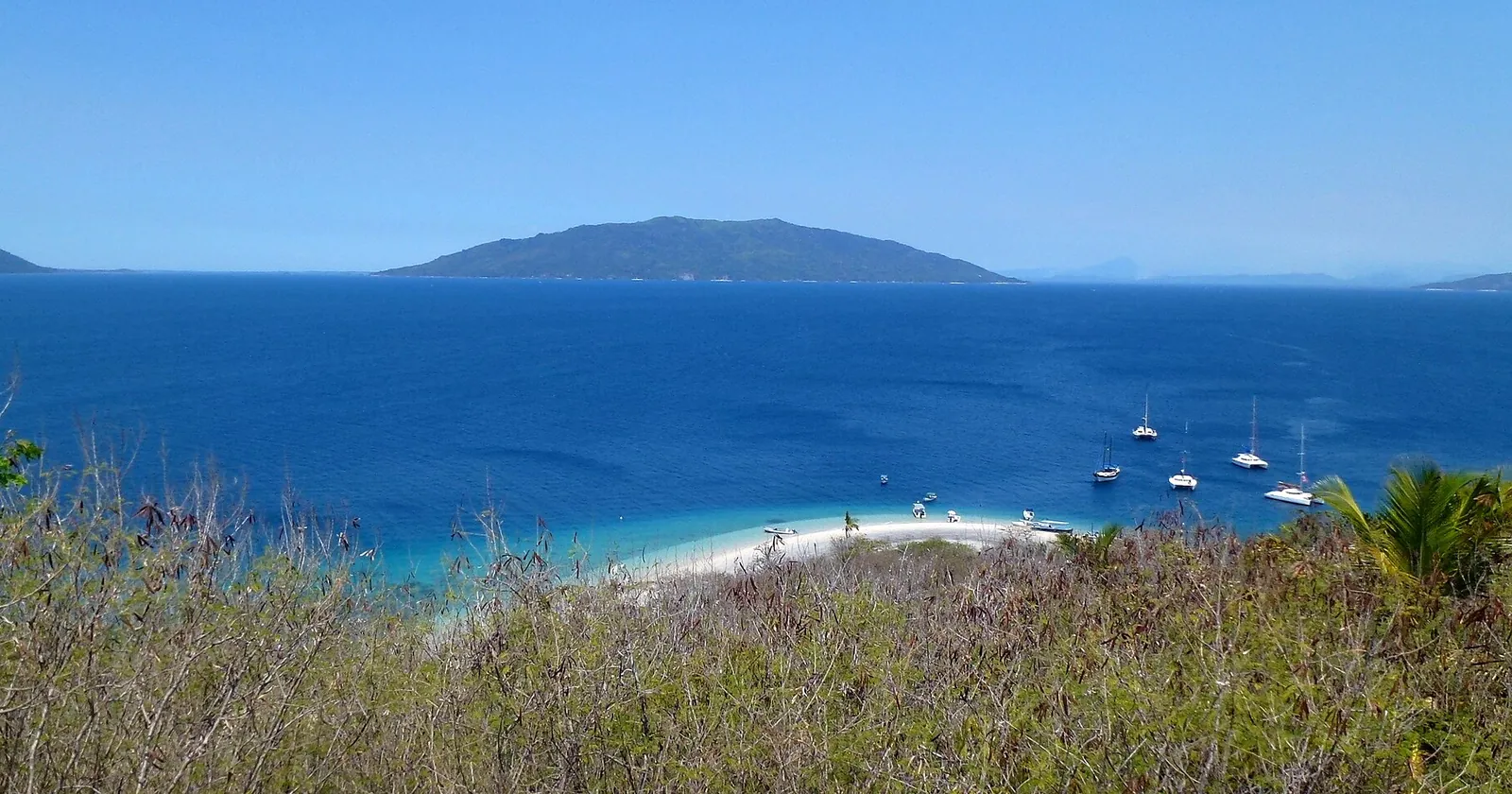
Yachts off the sand spit at Nosy Tanikely, with Nosy Komba behind, uploaded 30 November 2013. Photo: Hiroki Ogawa, Wikimedia Commons, CC BY 3.0, cropped.

Key takeaways
- Researchers logged 408 whale sharks off Nosy Be, September to December, all immature, with a mean stay of 7.2 days
- Humpbacks overwinter here from July to October
- Foreign adults pay 40,000 ariary to enter Nosy Tanikely, and the park site bans sunscreen outright
- The island's chamber dates from July 2015, and FCDO says complex cases are flown to Mauritius, South Africa or Réunion
- A Madagascar visa now starts at 30 euros, and recent travel through DR Congo, Kenya or Nigeria can bar you from entry
Nosy Be's whale sharks are all juveniles, and they stay about a week
Most Nosy Be diving trips get sold on whale sharks, so start with the research. The Madagascar Whale Shark Project ran 405 boat surveys from September to December, 2015 to 2019, and photo-identified 408 individuals in the bay between Nosy Be, Nosy Sakatia and the Ampasindava peninsula. Every one was immature. They measured 3 to 8 meters, and 82% of the sexed sharks were male.
Their stay is short. Movement modeling gave a mean residence of 7.2 days, and 72% of the identified sharks were seen only once in five seasons. A mark-recapture model put the total at 681 sharks, with a range of 608 to 763. Book two weeks rather than a long weekend.
Nearly all encounters (98%) were sharks foraging on bait fish at the surface, alongside mackerel tuna and terns. Stella Diamant, the project's lead, told Divernet that her team freedives for photo IDs because the sharks swim so fast while hunting. Expect short drops from a boat and a hard swim. This is morning work, since the surveys ran from about 8 am to noon because of strong afternoon winds.
By the same Divernet account, conditions shift. September has blue water, 30 meters of visibility and rough wind. Around mid-November the water warms, the wind drops and plankton blooms cut visibility, while sharks gather in larger numbers. You trade clear water for more animals, just as cyclone season opens.
A photo match against Mozambique and other Indian Ocean sites found no overlap, so these are not the sharks lost off Inhambane, where sightings fell 79% from 2005 to 2011. The Tofo diving guide covers that coast, and the whale shark destinations list compares the others.
Swimming with Nosy Be's whale sharks sits awkwardly with the 2023 rules
Boats are the known hazard here. Of the 408 sharks, 30% carried external scars and 19% had scars likely caused by vessel strikes, including seven amputations from clear propeller strikes.
A voluntary code arrived in 2016. The 2021 paper gives its core: 6 knots within 150 meters of a shark, a 15-meter minimum between boat and shark, and the motor in idle if a shark comes closer. It was then being written into law. SharkProject says the code entered an interministerial decree in February 2023, and Malagasy press cites order 33626/2023, presented in early 2024.
Here the sources stop agreeing. L'Express summarized the order's charters this way: boats of at most 500 horsepower carrying about 20 people, no night trips, no feeding, and it is "formally forbidden" to swim or touch animals during observations. The 100-meter distance and one-hour limit it lists are for an adult whale. Yet the regional tourism office still advertises swimming with whale sharks. The whale and shark rules may simply differ, since the code above assumes swimmers.
Newsmada reports that operators under the order need a license C, a navigation permit and insurance. Ask to see them, then ask what the boat does inside 150 meters. A captain who cannot answer has told you enough.
Humpbacks pass Nosy Be from July to October; Omura's whales are the rarer prize
Humpbacks are the safer bet for a boat ride between dives. A 2024 paper in Biology calls Nosy Be a known breeding area for the southwest Indian Ocean population, there from July to October. One whale-watching vessel, 27 July to 13 October 2018, met humpbacks on 68 of 75 trips. That is one vessel in one year.
Then there is the rarer animal. In 2015, Salvatore Cerchio's team published the first genetically confirmed field record of living Omura's whales, from this coast: 44 groups on the shallow shelf, with frequent lunge feeding. The species is "probably non-migratory" in the authors' words. That does not mean bookable all year. Their surveys ran about a month a year between July and December, from 2012 mostly around 50 km southwest of Nosy Be. Treat a sighting as luck.
Reef sharks have their own paper. Working with Manta Diving, a 2024 study identified 23 grey reef sharks at a site called Mokarran, at 15 to 30 meters, all female and six probably pregnant, and it asks whether this is a nursery. The whale watching list has alternatives.
Nosy Tanikely is the easiest Nosy Be diving, and the ticket comes first
Nosy Tanihely, as the authorities spell it, is a 10-hectare islet about 8.5 km from Hell-Ville, in a 340-hectare park created in 2011. A 2002 survey counted 154 fish and 110 coral species, plus green and hawksbill turtles. Protection shows: a 2022 PLoS ONE baseline found 42 to 70% coral cover at Nosy Be's unfished stations.
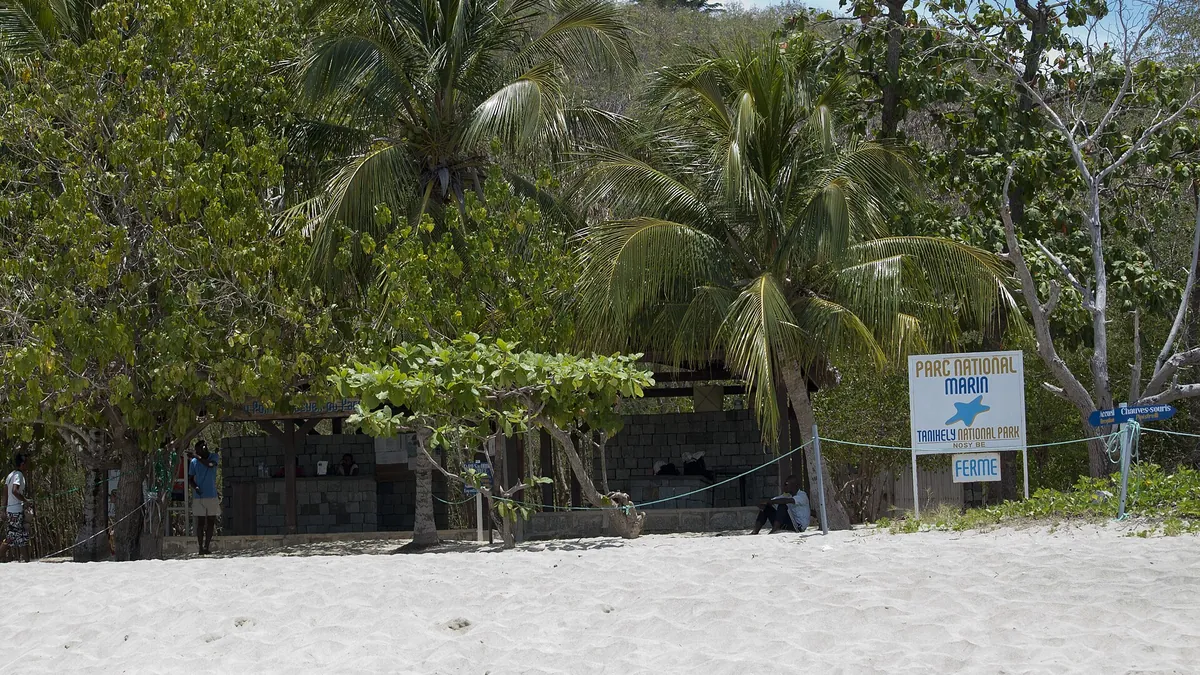
Foreign adults pay 40,000 ariary and children aged 6 to 12 pay 4,000, according to both Madagascar National Parks and the park site. One center quotes that as 10 euros per diver on top of the dive price, and the same center's site page still says 20,000 ariary, so watch for stale figures. Hours are 7 am to 4 pm daily.
Sort the ticket before the boat leaves. L'Express reported access by online booking only from 1 August 2025, with QR tickets and about 250 bookings a day. The park site says tickets come through its platform or its Hell-Ville office.
The rulebook is short and strict. Banned in the park: all fishing and spearfishing, taking any shell, coral, plant or animal, pets, weapons and littering. Operators must use the park's fixed moorings and stop clients standing on the reef. Penalties run from expulsion and five times the tariff to prosecution.
One line needs your attention: "L'utilisation de crèmes solaires est totalement prohibée." The park site bans sunscreen outright, while the national parks page says to bring organic sunscreen. Pack a rash guard and a hat, and you satisfy both; the travel wetsuit and rashguard guide helps. Published depths run 12 to 20 meters (national parks) or 1 to 23 (one center).

The better Nosy Be diving lies offshore, and tides decide the day
The most detailed public site list comes from a single center, Scuba Nosy Be, so read these depths as its description rather than a survey.
| Site | Depth | What the center says |
|---|---|---|
| Licornes | 13–19 m | Coral plateau |
| Rosario | 14–19 m | Easy small drift, whale shark season |
| Arches de Sakatia | 19–24 m | Rock with three small arches |
| Wrecks | 26–29 m | Four small and medium wrecks; visibility can be average |
| Shark Point | 18–50 m | Wall, reef sharks, often 20–40 m visibility |
| Banc de l'entrée extérieur | 18–60 m+ | 23 km out, 50 minutes, rising tide only |
Several outer walls work only on a rising tide, and the national parks page gives a 3-meter tidal range at Tanikely, so tide tables can rearrange your week. Inner bay sites often have poor visibility. The center's most candid line concerns Manta Point: after 16 years here, it cannot give you a manta season.
Scuba Nosy Be lists 45 euros for one dive and 70 for two with tank and weights, or 50 and 80 with full gear, as of November 2026.
Farther Nosy Be diving trips change the risk. Nosy Iranja is 1 hour 30 by boat. The Radama islands are at least 5 hours by fast catamaran, and the center says that there, with a signed waiver, it can attempt in-water recompression. Read that as a statement of distance.
Cyclones and rain set the Nosy Be diving calendar from November to April
The FCDO and Canada's travel advisory both date the cyclone season November to April, and Canada adds a rainy season across the same months. It also warns that El Niño is expected to strengthen into 2027, raising the likelihood of severe storms. Madagascar National Parks records gusts above 200 km/h in cyclones at Tanikely, and a dry period of May to November.
This risk has names. The 2022 reef baseline lists Enawo in 2017 and Belan in 2019 as major cyclones with potential impact at Nosy Be, without quantifying the damage. Whale shark season and storm season overlap in November and December, so insure the trip for it.
Nosy Be diving stays warm. The 2024 shark paper, citing SeaTemperature.org and NASA data, gives a mean of 28.1°C, from 25.5 in August to 30.5 in February, and tagged whale sharks spent most of their time in 27.5 to 30°C. Those reef researchers dived monthly but skipped the rainy periods of January and February. One center calls April to November the ideal window.
Does the island function in the off-season? The park says it is accessible all year, and flights keep running. Your center and its boat are the open question. Email before booking January to March.
Nosy Be has a hyperbaric chamber, so phone it before you trust it
This question should decide your Nosy Be diving trip. Life for Madagascar, the Italian charity behind it, announced that the chamber at its Vita e Armonia medical center in Ambatoloaka became fully operational on 10 July 2015, working to shared protocols with DAN Europe and DAN Southern Africa.
The newest evidence is much thinner. Scuba Nosy Be's 2026 site says there is a chamber on the island less than 3 km from its base, and that DAN trained its staff as hyperbaric operators and attendants. We found no hospital, ministry or DAN page giving the chamber's status in 2026.
So ask your center three things before paying: who is on call for the chamber this week, when it last treated someone, and how much oxygen the boat carries.
If it cannot treat you, you leave. The FCDO says hospitals in Antananarivo handle routine operations only, and that for complex surgery patients are flown to Mauritius, South Africa or Réunion. Canada calls facilities "extremely limited" outside the capital and warns that medical transport is very expensive, often paid up front. Réunion's health agency, in a 2023 working document, lists CHU Sud in Saint-Pierre as its authorized hyperbaric center, with 3,591 sessions in 2021.
Call 117 from a mobile or 17 from a landline and ask for an ambulance, the FCDO says, and then your insurer. Aqua Diving requires DAN cover before you travel. Read the evacuation clause in your policy against the dive insurance comparison. The FCDO also lists malaria and dengue, and calls tap water unsafe.
Flights into Nosy Be run daily from Addis, but the domestic carrier is mid-rebuild
Fascene Airport (NOS, ICAO code FMNN) is run by Ravinala Airports. On Wednesday 4 November 2026, its board showed departures to Milan Malpensa on Neos, Addis Ababa on Ethiopian, two Madagascar Airlines flights to Antananarivo, and Arkia to Tel Aviv. Its directory also lists Air Austral, Airlink, LOT and Bulgaria Air, without schedules. Check those, because a listed carrier may be seasonal.
Ethiopian is the backbone. AeroRoutes and a trade report both give seven weekly flights from 6 July 2026. That lets you reach Nosy Be diving without touching Antananarivo.
The domestic leg needs more slack. Madagascar Airlines flies ATR 72s from Antananarivo in 1 hour 40 to 45 minutes. It was due to take back the Air Madagascar name on 31 October 2026, though the board still used the old one four days later, and Air Journal describes a carrier still in recovery proceedings with fragile operations. Do not connect to an onward flight the same day.
Overland means about 14 hours by road from Antananarivo to Ambanja, then a boat from Ankify. The FCDO warns of armed robbery on main roads and advises against bush taxis. It also names Nosy Be, Ankify and Ambanja among places with violent robberies on isolated beaches.
Madagascar's visa for Nosy Be costs 30 euros now, and Ebola rules can stop you
Older guides quote a free short stay with a 10-euro fee, and the FCDO page still describes that. The official portal shows higher rates, and it says the online and arrival prices match:
| Stay | Euros | US dollars |
|---|---|---|
| 1–15 days | 30 | 35 |
| 16–30 days | 35 | 41 |
| 31–60 days | 40 | 47 |
| 61–90 days | 50 | 59 |
Long stays have a catch. The portal says the eVisa covers single-entry tourist stays up to 60 days, and that you extend up to 90 days at an immigration office. It speaks of tourism only and says nothing about remote work, so a working stay is your own judgment call. The FCDO asks UK passports for 6 months' validity and 2 blank pages.
Check your route now. Updated on 3 November 2026, the FCDO says that if you have been in or transited DR Congo, Kenya or Nigeria in the last 21 days, you may not be allowed to enter, because of the Ebola outbreak. A Nairobi connection could end your Nosy Be diving trip.
Working remotely from Nosy Be is a bet on a single connection
The sourced picture is thin. A 2023 report lists Nosy Be among towns on Orange's Wifiber home service, and Starlink began commercial service in Madagascar in June 2024. We have no speed test, outage record, rent figure or coworking address for the island that we would print.
Treat Nosy Be diving as a trip with some email, not a month-long base. Book somewhere that shows you a speed test first, and keep client calls off boat days. The FCDO warns that political rallies can close roads.
Nosy Be's whale sharks will not keep a fixed date, and the hospitals are thin
A 7.2-day mean stay cannot promise a whale shark on a fixed day. January and February are a poor bet on fixed leave. A condition that needs a real hospital nearby changes the sums, and so does refusing evacuation cover.
Wreck specialists will find small wrecks at 26 to 29 meters and little else. Remote workers who need documented bandwidth should compare the Mauritius diving guide. Beginners do well here.
The 12 Nosy Be dive center entries on our operator list
The Nosy Be operator list holds 12 entries, read on 21 September 2026: 11 from the SSI register and 1 Green Fins digital member, self-evaluated rather than assessed. Blue Wave appears twice, so that is 11 brands. Freedive Nosy Be is a freediving school, and Sakatia Lodge files under Hell-Ville. Eight publish a website.
A listing proves affiliation on a date. It does not show who teaches, how the boats run or whether a center is open this season, and which registers can be read sets out those limits.
FAQ: Nosy Be diving
When is whale shark season in Nosy Be?
September to December. That is the window the Madagascar Whale Shark Project surveyed from 2015 to 2019, and tagged sharks fit it too. The sharks seen were all immature, 3 to 8 meters long, and most were feeding on bait fish at the surface. The mean stay was 7.2 days, so no single week is promised.
Is there a hyperbaric chamber on Nosy Be?
Yes, one opened on 10 July 2015 at the Vita e Armonia medical center in Ambatoloaka, working to DAN Europe and DAN Southern Africa protocols. A local dive center's 2026 site still describes it as open and within 3 km of its base. No hospital or government page confirms its status, so ask your center who runs it this week.
How much does it cost to dive Nosy Tanikely?
Foreign adults pay 40,000 ariary and children aged 6 to 12 pay 4,000, on top of the dive. Madagascar National Parks and the park site agree on the foreign rates. One Nosy Be center quotes the entry as 10 euros extra per person. Tickets come through the park's platform or its Hell-Ville office.
What is the best month for Nosy Be diving?
October is the strongest compromise. It falls in the whale shark window, overlaps the last humpbacks and comes before the cyclone season opens in November. One local center names April to November as its best window, with clearer water. Researchers working a Nosy Be reef skipped the rainy periods of January and February.
How do you fly to Nosy Be?
Fascene Airport, code NOS, takes direct Ethiopian flights from Addis Ababa daily since July 2026, and Neos from Milan appeared on the board on 4 November 2026. Madagascar Airlines flies from Antananarivo in about 1 hour 45 minutes. The airport's directory also lists Airlink and Air Austral, so check their current schedules.
Do I need a visa to dive in Nosy Be?
Yes. Madagascar's visa portal charges 30 euros for up to 15 days, 35 for 30 days and 40 for 60 days, with 50 listed for 61 to 90 days. Online and arrival prices match. Its eVisa is for tourism only and tops out at 60 days. Extensions to 90 days happen at an immigration office.
Note: Conditions, safety guidance and regulations change. Verify current information with official sources, including the dive operator, the park authority and the relevant government department, before you travel or dive.
Founder of NOMADREEF and a former digital nomad. This guide is sourced from the references below; conditions, prices and rules change, so verify current details, and follow qualified local guidance and safety briefings. About the author · LinkedIn ↗
Sources
All read 4 November 2026.
- Whale shark population (primary research). Diamant et al. 2021, Aquatic Conservation 31: 3492–3506, on 405 surveys, 408 sharks, 82% male, 3.0–8.0 m, 7.2-day residence, 681 (608–763), scarring, the 2016 code and morning survey times. Full paper (PDF), MarAlliance copy. Summaries of Diamant et al. 2018 (Endangered Species Research, published 17 May 2018) on photo matching, tags, temperature and the second hotspot: X-Ray Magazine and Oceanographic Magazine.
- Season conditions and team methods (secondary, quoting the project lead). Divernet, "Where the whale sharks are". Her remark there that Omura's whales can be seen all year is not used; the published surveys cover July to December only.
- The observation order (secondary). Order 33626/2023 as reported by Newsmada (license C, permit, insurance) and L'Express de Madagascar, February 2024 (boat limits, swimming, 100 m and one hour). February 2023 date: SharkProject. The order's text was not reached; another press report gives the number as 33636. Whether swimming with whale sharks is lawful under the final text is unverified, needs human check. Swim marketing: Office Régional du Tourisme de Nosy Be.
- Whales and reef sharks (primary research). Humpbacks, Biology 2024; Omura's whales, Cerchio et al., Royal Society Open Science 2015; grey reef sharks, Biology 2024, also the source of the water temperature figures, which it credits to SeaTemperature.org and NASA.
- Reefs (primary research). Baseline of Madagascar's coral assemblages, PLoS ONE 2022, for coral cover, park dates and the named cyclones.
- Nosy Tanikely (primary). Official park site for rates, hours, rules, sanctions and the sunscreen ban; Madagascar National Parks page and tariff sheet (PDF); Indian Ocean Commission case study (PDF) for the 2011 creation date and 340 hectares; L'Express, August 2025 on online booking. The sources conflict on sunscreen, on online-only tickets and on the depth range; each is reported as stated.
- Dive sites and prices (operator statements). Scuba Nosy Be: Nosy Be and Sakatia sites, Komba and Tanikely sites, prices, Mitsio season. Second view on sites, seasons and insurance: Aqua Diving, home page and diving page. These are one or two businesses' own words and not a survey.
- The chamber. Opening announcement (primary for its own facility): Life for Madagascar, 5 August 2015. Current mentions (operator statements): Scuba Nosy Be home page and safety page, which give less than 3 km and 2 km. Status in 2026 is unverified, needs human check. Réunion: ARS La Réunion working document, version of 18 April 2023 (PDF).
- Government travel advice (primary for each government's own advice). FCDO: safety and security, health, entry requirements and update notice, still current on 4 November 2026; passport rules are for UK passports. Government of Canada, Madagascar.
- Flights. Nosy Be airport, primary: home page, departures for 4 November 2026 and airline directory. Ethiopian: AeroRoutes and ATTA. National carrier: Air Journal, 15 September 2026 and ATTA, 23 September 2026. Domestic timing: FlightMapper, MD 321. ICAO code: Wikipedia.
- Visa (primary). Madagascar eVisa portal: rates, FAQ, home page on arrival prices. The portal names evisamada.gov.mg as its official address; that address would not complete a certificate check on 4 November 2026, so these pages were read at the evisamada-mg.com address the portal uses for contact. The FCDO's 15-day free stay with a 10-euro fee conflicts with the portal; the portal is used.
- Internet (secondary). Digital Business Africa on Orange Wifiber and Ecofin Agency on Starlink.
- The operator entries. Twelve entries on the Nosy Be operator list, compiled 21 September 2026 from the SSI register and Green Fins. Limits are on which registers can be read.
- Left out. An SSI blog note that whale sharks and mantas appear from May to October, which conflicts with the research window. Coworking, rent, speed and power figures, for lack of a source worth printing. The cyclones of 2026, because no page read tied them to Nosy Be. The 2015 chamber phone numbers, because their age could cost time in an emergency.