Kenting Diving: The Park’s Open Sites, the Operator Rule and an Outlet Without Its Reactors
 by Yannick Schroth
Sep 25, 2026
13 min read
by Yannick Schroth
Sep 25, 2026
13 min read
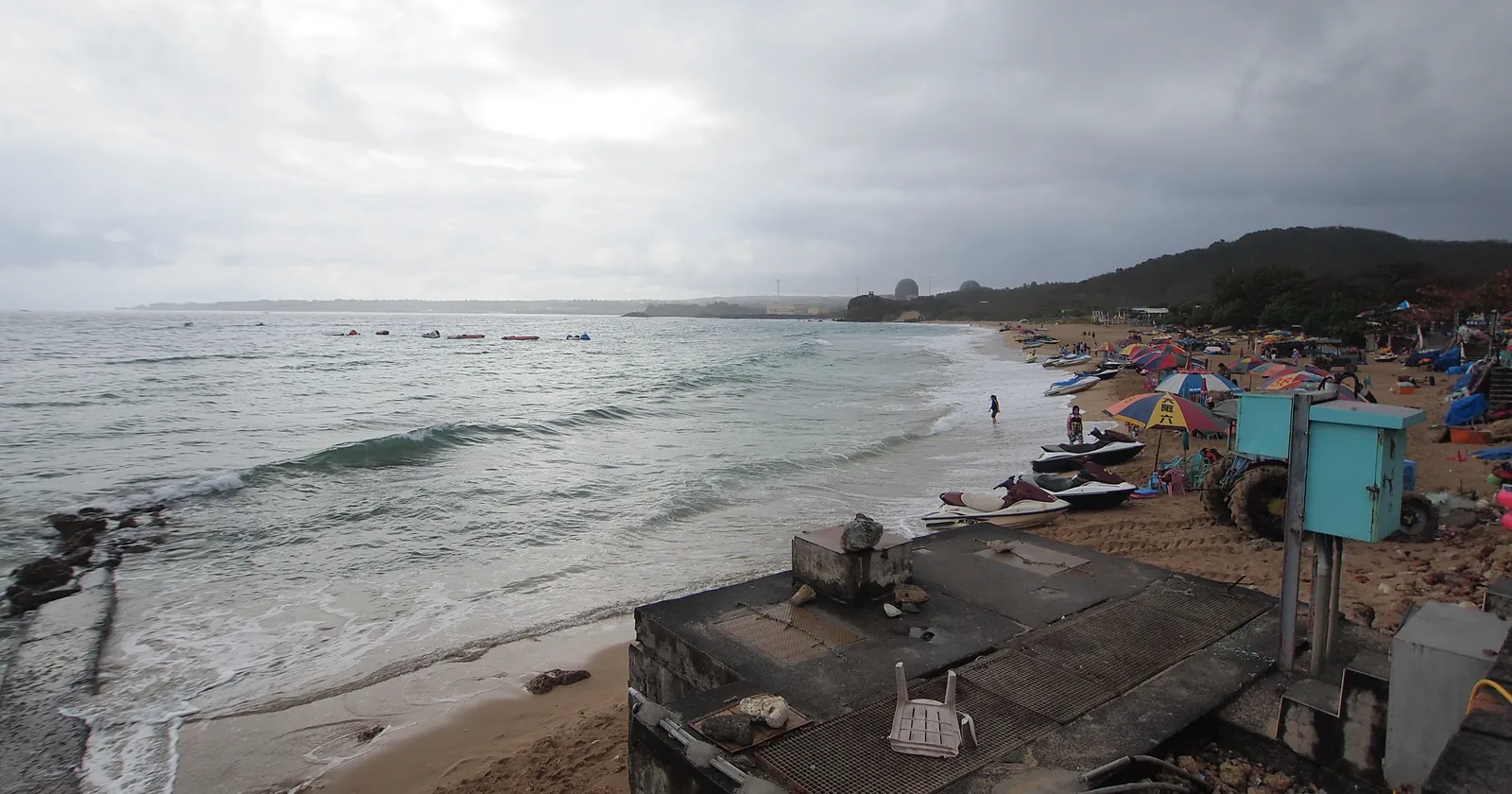
Nanwan Bay, with the Maanshan plant on the headland. Photo: rheins, Wikimedia Commons, CC BY 3.0.

Key takeaways
- The park’s recreation page, updated 28 July 2026, opens by saying visitors shall do the listed water activities through operators and not privately
- Daytime shore diving is open at eight named areas within 200 meters of shore; boat dives use 15 named moorings, and boats may not drop anchor
- Taiwan’s national rules require a certification for scuba and freediving and a companion who knows the dive area, and they cap an instructor at eight scuba divers
- Five marine ecological protection areas, about 715 hectares by the park’s figures, need the park’s permission to enter
- The outlet is usually described as 2 to 3°C warmer, but loggers on its corals in 2022 and 2023 read 0.42°C above Wanlitong on average; Unit 2 stopped on 17 May 2025, and a restart plan was approved on 24 September 2026
Kenting National Park says visitors dive through an operator
The dive sites around Kenting lie in the waters of Kenting National Park, and the park, not the county, runs them. Taiwan’s Water Recreation Activities Management Regulations make that explicit: where an activity takes place inside a national park, the managing authority is the park itself, and it can only fine people once it has announced that the regulations apply.
Kenting has done that. Its rules page carries an announcement applying the Ministry of Transportation and Communications’ regulations and, since 28 July 2026, a revised announcement titled “restricting the types, areas, times and conduct of water recreation in Kenting National Park”. That title copies the wording of article 36 of the Act for the Development of Tourism, which is where the park’s power to restrict comes from.
The recreation page updated the same day starts with a sentence most visitors never read. The park applies a cap on numbers to the listed sea activities, and “visitors shall do them through operators and may not do this kind of activity privately”. Snorkeling, day and night shore diving, freediving and boat diving are the first four items on that list.
Read it exactly as written. The sentence covers the whole list, and the list also contains swimming, so it reads like a statement of policy rather than a clause drafted for divers alone. The binding text is the 28 July announcement, which sits in a PDF this guide could not open. What is certain is the penalty behind any restriction the park announces.
Article 60 of the tourism act, in the current text as amended on 28 November 2025, fines anyone who ignores a management authority’s restrictions on type, area, time and conduct NT$10,000 to NT$50,000 and bans the activity. When the breach is commercial the fine rises to NT$50,000 to NT$200,000. An operator who skips the compulsory liability insurance faces NT$30,000 to NT$150,000.
Where Kenting diving is allowed: eight shore areas and 15 boat moorings
The park does not leave the map open. Daytime shore diving is permitted within 200 meters of shore at eight named areas: Wanlitong, Hongchaikeng, Hejie, Shanhai, the outlet (Chushuikou), the west side of the Houbihu harbor channel, Tiaoshi and Chuanfanshi (Sail Rock). Snorkeling has its own list of eleven areas, and daytime freediving is limited to seven: Wanlitong, Hejie, Hongchaikeng, Baisha, the outlet, Tiaoshi and Chuanfanshi.
Boat diving is a daytime activity inside a 100 meter radius of 15 named moorings. Among them are the Hejie wreck, the Houbihu soft coral area, the two outlet sites, Dulijiao, the Shuangfeng blue hole, the slope at Dalaogu and the fault at Xiaolaogu. The boat flies a dive flag and has to tie on to the anchored buoy already placed at the site. The park’s wording is that it “may not drop its own anchor”.
That mooring rule sits on top of a park-wide one. Item 13 of the list of prohibited acts in Kenting National Park, last amended by the Ministry of the Interior on 8 July 2025, bans anchoring on coral or coral reef anywhere in the park, dive boat or not.
Night shore diving is open at three areas only: the outlet, Wanlitong and the west side of the Houbihu channel, within 100 meters of shore. The night window closes at 10 pm. After that, an activity plan has to be submitted to the park first, and the park publishes a night-dive application form next to its rules. Our night diving guide covers the skills side.
One practical conflict is settled by the same page. Jet skis operate between 300 meters and 1 kilometer from shore, outside the 200 meter band where shore divers are, and article 13 of the national regulations forbids jet skis from sharing the same time and place as diving or swimming.
Taiwan’s rules for Kenting diving: a certificate, a local companion, eight divers per instructor
The national rulebook is short. The current text of the Water Recreation Activities Management Regulations, as amended on 16 April 2024, has a diving section of six articles. Article 16 defines diving as snorkeling, scuba and freediving. Article 17 says anyone who scuba dives or freedives shall hold a certificate for that activity issued by a domestic or foreign diving organization.
Article 18 is easy to misquote as a guide requirement. The text says something narrower: a scuba diver or freediver shall be accompanied by a person familiar with the dive area who meets article 17. That person needs a certification and local knowledge, not a guiding license. Every diver also has to set a dive flag in the area and carry a surface marker buoy, lift bag or freediving float.
Article 19 then binds whoever takes customers out. An instructor holding a domestic or foreign instructor rating may lead at most eight scuba divers, or four freedivers, rising to six with an assistant who is certified under article 17. A snorkel leader needs a training certificate and may take ten. The operator has to confirm each diver’s certification by a signed statement.
The briefing is also written into law. It must cover the time limit, the maximum depth, the direction of the current, the bottom structure, the danger areas and the conservation rules, and it should remind divers to consider their health. If a diver will not follow the briefing, the regulation says the dive stops.
Boats carry their own duties. Article 20 requires a boarding platform or ladder and a waterproof mobile phone with satellite positioning for the instructor. Under article 21 the skipper checks the radio before leaving, raises the dive flag when divers enter the water, and stays in the dive area until everyone is back. If a diver is overdue, the skipper calls for help and searches, and may not leave before support arrives.
Two details matter when booking. None of articles 16 to 21 contains an exception for a try dive or a course, so ask how the operator handles article 17 for an uncertified first dive. And article 10 sets the liability insurance an operator must carry: NT$3 million per person for bodily injury and NT$24 million per accident.
Five marine ecological protection areas in Kenting need the park’s permission to enter
The National Park Act divides a park into five kinds of zone. One of them, the ecological protection area, is the only kind that article 19 closes to entry: anyone going in needs the permission of the park headquarters. Kenting has five of them at sea, each a band running along the coast.
The park describes them one by one. The first runs west of Dapingding, from the Checheng–Hengchun boundary south to Wanlitong, 300 meters wide and 195.64 hectares. The second covers the water from the headland left of Baisha beach to the east side of Maobitou, 87.96 hectares, with a broad platform at about 10 meters dominated by soft corals.
The third stretches from Chuanfanshi to Shadao, 118.81 hectares, where the reef front ends between 15 and 25 meters. The fourth runs south of Fengchuisha past Longkeng to the west side of Eluanbi, 205.78 hectares. The fifth lies off the Houbihu intake, 106.78 hectares, and the park says it has high live coral cover and hosts research and coral restoration work.
Wanlitong is where the boundary bites. The park’s notice for it is titled, in translation, “Wanlitong marine ecological protection area: no entry without permission”. It says decades of recreation and harvesting sharply reduced marine life there, and that part of Wanlitong’s water became a protection area in the plan review of 2018.
A community patrol has watched it since 24 September 2023. The violations it reports most are entering without an application, catching animals and picking up coral rock, shells or sea sand. Signs mark the protection area at each entrance. Since Wanlitong is also one of the open shore-dive areas, ask the operator where the line runs before you walk in.
Catching, collecting, feeding and anchoring are banned across Kenting
Visitors often hear Kenting’s rules summed up as “don’t touch the coral”. The texts use different verbs, and they reach further. Article 13 of the National Park Act bans hunting animals and catching fish anywhere in any national park, along with polluting the water and any other act the park authority prohibits.
Kenting’s own list of prohibited acts adds the rest. Item 2 bans picking up, taking, selling or displaying shells, shell sand, coral reef rock and other rock specimens, unless you can prove they came from outside the park. Item 10 bans feeding wild animals, which covers the fish at a snorkel stop, and releasing or abandoning animals. Item 13 is the anchoring ban.
A diver who settles on the reef is not named in any of these items. A diver who breaks a piece off, carries it out or buys it is. Read together, the texts come down to three habits: take nothing out, feed nothing, and let the boat use the buoy.
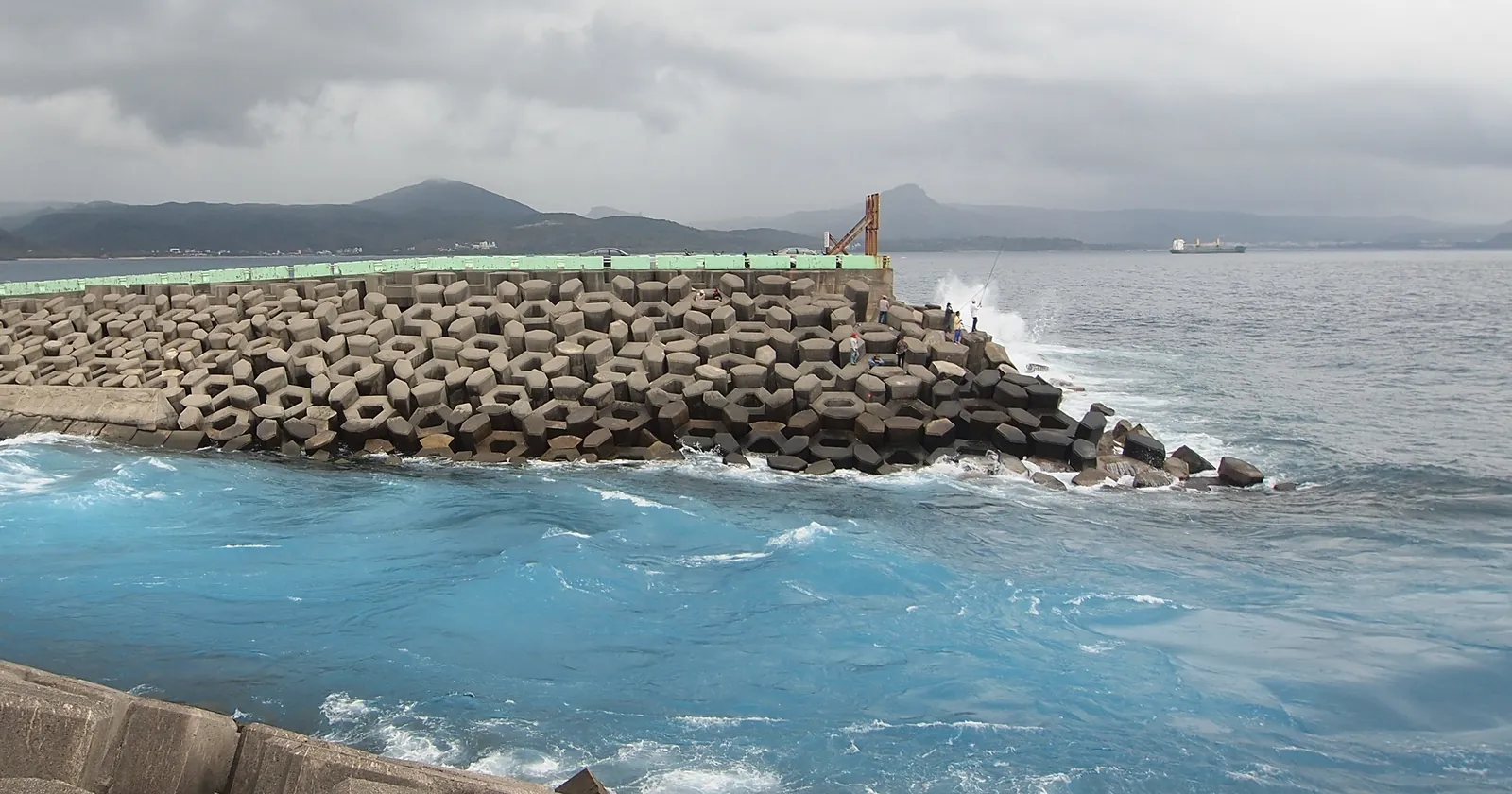
Cooling water leaving the Maanshan plant in February 2012, years before the shutdown. Photo: rheins, Wikimedia Commons, CC BY 3.0.

The Kenting outlet dive site and the reactors that stopped in May 2025
The outlet appears on the park’s lists for day shore dives, night dives, freediving and boat dives alike. It sits where the Maanshan nuclear power plant, on the west side of Nanwan Bay, released its cooling water. A 2014 study in PeerJ, citing earlier work, put the average water temperature there 2.0 to 3.0°C higher than at other reef sites in Kenting. A near-shore current and the tides trap the warm water and carry it south-west inside the bay.
The warm layer was shallow. The same study found the effluent confined to the water column above 3 meters, with no temperature effect below 7 meters. Corals at 3 meters were dominated by heat-tolerant Symbiodinium clade D, while corals at 7 meters, even at the outlet, carried clade C like the rest of Kenting.
The community changed with it. At 3 meters in 1986, Acropora made up 24.20 percent of total cover and Montipora 33.69 percent. By 2010 Acropora had fallen to 0.70 percent, Galaxea had risen to 21.20 percent, and Seriatopora and Stylophora were not detected at all.
The famous figure deserves a closer look. A 2026 paper in Scientific Reports repeats the 2 to 3°C in its introduction, then reports its own loggers, fixed beside coral colonies from February 2022 to October 2023, while the plant was still running. They averaged 27.82°C at the outlet and 27.44°C at Wanlitong, a difference of 0.42°C. What stood out was the swing: the daily range was larger at the outlet in most months.
All of that describes a running plant. Taiwan’s Nuclear Safety Commission records that Unit 1’s operating license expired on 27 July 2024, and Unit 2’s on 17 May 2025, when it was taken down that afternoon and entered decommissioning the next day, with its fuel moved to the spent fuel pool.
The story has not ended there. Taipower applied for a license renewal on 27 March 2026, and on 24 September 2026 the commission approved its restart plan. The commission stresses that this is one step: Taipower still has to carry out the plan, report the results and finish safety checks on aging, radiation and seismic risk.
So the outlet today is a reef shaped by decades of warm discharge, with the reactors off. No published temperature record from after the shutdown turned up for this guide, so treat any claim that the water there is still warmer with care.
Nanwan Bay in Kenting runs about 24°C in winter and 29°C in summer
The 2014 study gives the bay’s averages: sea surface temperature of 29.0°C in summer and 24.0°C in winter. The source of the water changes with the season, the Kuroshio Current in winter and a South China Sea current in summer. That five-degree gap is the difference to plan a wetsuit around.
Averages hide the part that surprises divers. At the outlet site, the same study reports daily swings of 8 to 10°C lasting about six hours, caused by upwelling from internal tides and waves generated in the Luzon Strait. Wanlitong, on the west coast, is the site researchers use as the stable comparison, because it has neither the discharge nor those abnormal fluctuations.
Summer peaks are real too. A survey of 11 Kenting sites from August 2015 to April 2017 logged a maximum of 31.2°C in August 2016, against an average summer maximum of 28.8°C for 2007 to 2016. Recreational divers reported local bleaching in shallow water that year, and the park relayed the reports.
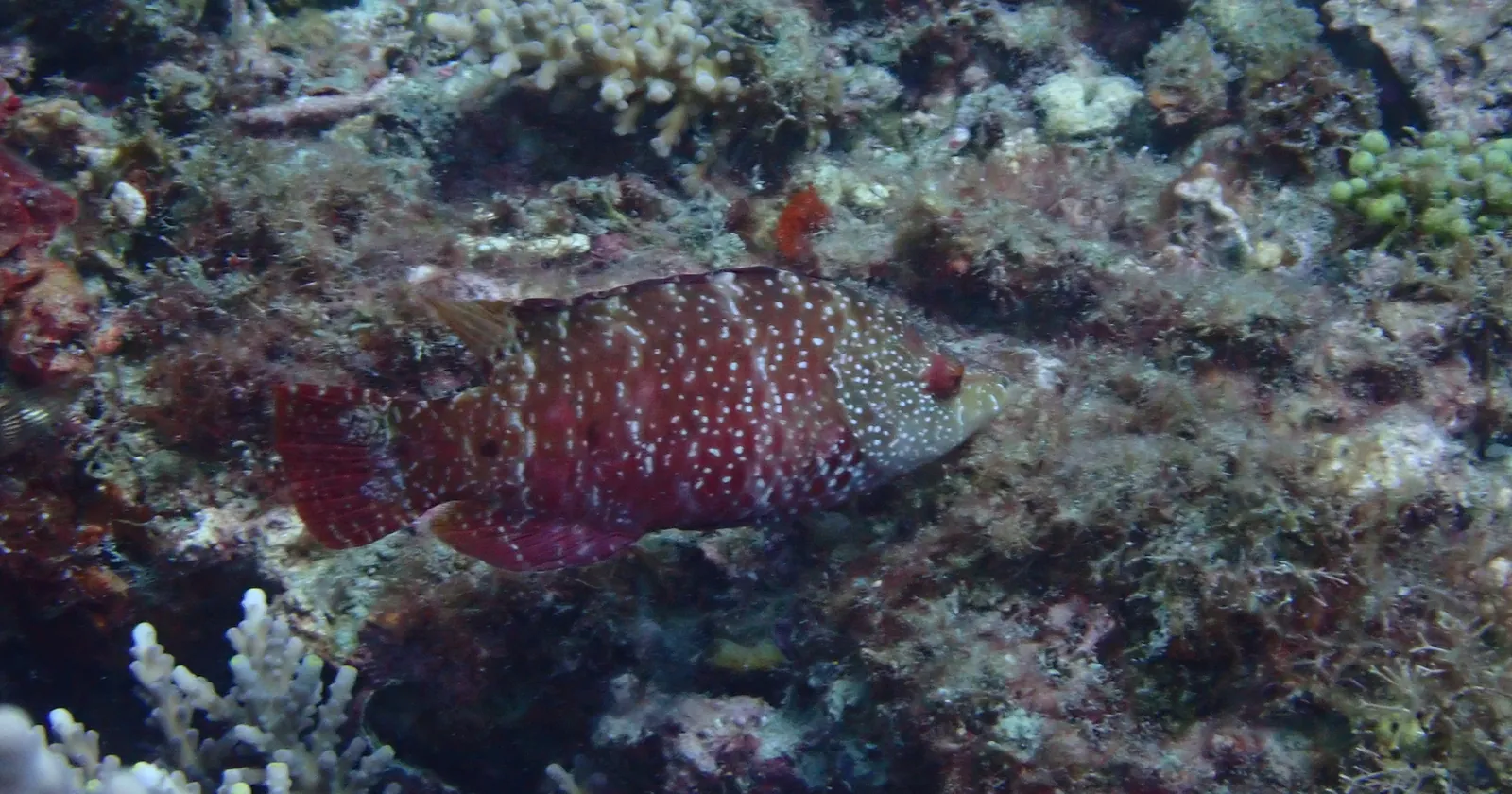
A snooty wrasse over algae-covered reef in the soft coral area beside the Houbihu outlet, April 2022. Photo: Lu i-chi (呂一起), Wikimedia Commons, CC BY 4.0.

Typhoons, not heat, left the clearest mark on Kenting reefs in 2015 to 2017
Seven typhoons passed during that 21-month survey, and five of them cooled the water. The authors concluded that the repeated storms lowered the thermal stress of the 2015 to 2016 El Niño and may have spared Kenting the worst of it. They also broke things. Turf algae dominated the surveyed reef throughout, averaging 38.3 percent, and macroalgae cover rose by 60 percent in a single year, from 11.4 percent in April 2016 to 18.3 percent in April 2017.
The same paper links the low cover of branching coral families, Acroporidae and Pocilloporidae, to earlier bleaching such as the 1998 mass event, and to the typhoons that arrive every year. Divers who expect table corals will find fewer here than the photos suggest. The park runs its own reef health checks with staff and volunteers at 13 sites, recording coral cover and indicator species.
Spawning gives the reef its other calendar. In Nanwan Bay the hammer coral Fimbriaphyllia ancora, growing at about 10 meters, spawns in late April or May. A 2024 study in Communications Biology followed 26 colonies there and found that about 70 percent changed sex every year after spawning, for at least three to four years running.
Kenting closes shore and boat diving at 1.5 meter waves
The wave rule is in the prohibited-acts list, item 15, and it is graded by activity. When waves stay at 1.5 meters or higher and red flags are set on the shore, snorkeling, shore diving and boat diving are banned, along with non-powered floats. Swimming stops at 1 meter, jet skis at 2 meters. When the park lies inside a typhoon warning area, the shore, the sea and the listed scenic spots close completely.
The park’s emergency page gives 119 as the first number and 112, then 9, when reception is poor. It lists three hospitals in Hengchun: Hengchun Christian Hospital (08-8892293), Hengchun Nanmen Hospital (08-8894568) and Hengchun Tourism Hospital (08-8892704). It names no recompression chamber, and this guide could not confirm one from a hospital’s own page, so ask your operator where a bent diver is taken before the first dive.
For reef damage or poaching, the park’s conservation hotline is 0800-885996 and the national park police are on 08-8861331. The dive insurance guide explains what a policy should cover for evacuation from a place like this.
Kenting dive centers listed by SSI and Green Fins: 14 businesses
The Kenting operator list holds 14 businesses, read on 21 September 2026. Thirteen are dive centers published by SSI in its register of affiliated centers. One is a Green Fins digital member, which means a self-evaluation and no assessment in person. Eight of the 14 publish a website.
SSI’s register lists freediving programs for seven of its 13 Kenting centers and extended range programs for three, which says what a center is rated for, not what runs this season. Most are filed under Pingtung County, the register’s town field, which is not always where a business operates.
None of this is a license. The park refers to the business plans it approves for water recreation operators, but its rules page does not post a list of them. Ask an operator for its approval and its insurance before you pay. Which registers can be read sets out what each source can and cannot tell you.
FAQ: scuba diving in Kenting
Can you shore dive in Kenting without a dive shop?
The park's recreation page, updated on 28 July 2026, says visitors shall do the listed sea activities through operators and may not do them privately, and shore diving is on that list. Separately, article 18 of Taiwan's Water Recreation Activities Management Regulations requires every scuba diver or freediver to be accompanied by a certified person who is familiar with the dive area.
Where can you scuba dive in Kenting?
Daytime shore diving is allowed within 200 meters of shore at eight areas: Wanlitong, Hongchaikeng, Hejie, Shanhai, the outlet, the west side of the Houbihu channel, Tiaoshi and Chuanfanshi. Boat dives use 15 named moorings, each with a 100 meter radius, and boats must tie on to the anchored buoy instead of dropping anchor.
Is the nuclear power plant outlet in Kenting still warm?
Its reputation rests on a figure of 2 to 3 degrees Celsius above other Kenting reefs, with the warm layer above 3 meters. Loggers on outlet corals in 2022 and 2023, with the plant running, averaged 27.82 degrees against 27.44 at Wanlitong. Unit 1's license expired on 27 July 2024 and Unit 2 was shut down on 17 May 2025. A restart plan was approved on 24 September 2026, with further steps still to come.
What is the water temperature for diving in Kenting?
In Nanwan Bay the average sea surface temperature is about 29 degrees Celsius in summer and 24 in winter. A survey logged a peak of 31.2 degrees in August 2016. At the outlet site, internal tides from the Luzon Strait can swing the temperature by 8 to 10 degrees within a day.
Can you night dive in Kenting?
Yes, from shore only, at three areas: the outlet, Wanlitong and the west side of the Houbihu channel, within 100 meters of shore. The night window ends at 10 pm. After that, an activity plan has to be submitted to the park, which publishes a night-dive application form with its rules.
Note: Conditions, safety guidance and regulations change. Verify current information with official sources, including the dive operator, the park authority and the relevant government department, before you travel or dive.
Founder of NOMADREEF and a former digital nomad. This guide is sourced from the references below; conditions, prices and rules change, so verify current details, and follow qualified local guidance and safety briefings. About the author · LinkedIn ↗
Sources
- Where diving is allowed, and the operator sentence (primary). Kenting National Park Headquarters, recreation page “玩在‧墾丁”, dated 28 July 2026 (民國115年7月28日): the opening sentence “本處針對下列海域遊憩活動進行總量管制,遊客應經由業者進行,不得私自從事該類遊憩活動” (the park applies a cap on numbers to the following activities; visitors shall do them through operators and may not do them privately); the fifteen listed activities, snorkeling, day and night shore diving, freediving and day boat diving among them, and swimming; the eleven snorkeling areas and eight daytime shore-dive areas within 200 m; night shore diving at the outlet, Wanlitong and the west side of the Houbihu channel within 100 m, until 22:00, with an activity plan after that; seven freediving areas; fifteen boat-dive moorings with a 100 m radius, dive flag on the boat, and “潛水船需繫繩於公告地點已錨定之浮球上,不可另行拋錨錨定”; jet skis between 300 m and 1 km from shore. ktnp.gov.tw, 玩在‧墾丁. Read 25 September 2026.
- The park’s rules index (primary). Kenting National Park Headquarters, “海(水)域遊憩相關規範”: the Kenting National Park water recreation management scheme in the version approved by the Ministry of the Interior in June 2025 and announced on 20 August 2025; the announcement applying the Ministry of Transportation and Communications regulations; the revised announcement “墾丁國家公園限制水域遊憩活動之種類、範圍、時間及行為” of 28 July 2026; the night-dive application form. ktnp.gov.tw, rules index. Read 25 September 2026. Gap: the documents themselves are served from ws.ktnp.gov.tw, which refused every connection from this guide’s location on that date, so the text of the 28 July 2026 announcement, the June 2025 scheme and the fine schedule were not read. The site lists above are taken from the park’s own web page, not from the announcement.
- The prohibited acts (primary). “墾丁國家公園區域內禁止事項”, as last amended by Ministry of the Interior notice 台內園字第11412802951號 of 8 July 2025: item 2 on shells, shell sand and coral reef rock; item 10 on feeding wild animals and releasing animals; item 13, “禁止下錨於珊瑚(礁)體上”; item 15 on typhoon-warning closures and the wave and wind thresholds, including “持續浪高一點五公尺以上,並於岸際插設紅旗警示者,禁止非動力浮具下水活動、浮潛、岸潛及船潛等潛水活動”. ktnp.gov.tw, 國家公園法裁罰及相關禁止事項. Read 25 September 2026.
- The national diving rules (primary). 水域遊憩活動管理辦法 (Water Recreation Activities Management Regulations), current text as amended on 16 April 2024 (民國113年4月16日), read in full to article 29: article 4 on national parks as the managing authority and the announcement requirement; article 10 on liability insurance; article 13(3) separating jet skis from diving and swimming; articles 16 to 21, the diving section, including article 17 on certification, article 18 on the dive flag, buoyancy equipment and a companion “熟悉潛水區域且符合前條規定之人員”, article 19 on ratios of eight scuba divers, four or six freedivers and ten snorkelers, the signed statement and the briefing, article 20 on boat ladders and satellite-positioning phones, and article 21 on the skipper’s duties. law.moj.gov.tw, K0110024. Read 25 September 2026.
- The enabling act and its fines (primary). 發展觀光條例 (Act for the Development of Tourism), current text as amended on 28 November 2025 (民國114年11月28日): article 36 on restricting the types, areas, times and conduct of water recreation and on compulsory liability insurance; article 60 on fines of NT$10,000 to NT$50,000, NT$50,000 to NT$200,000 when commercial, and NT$30,000 to NT$150,000 for missing insurance. law.moj.gov.tw, K0110001. Read 25 September 2026.
- The National Park Act (primary). 國家公園法, current text as amended on 8 December 2010: article 12 on the five kinds of zone; article 13 banning hunting animals, catching fish and polluting water in a national park; article 19, “進入生態保護區者,應經國家公園管理處之許可”. law.moj.gov.tw, D0070105. Read 25 September 2026.
- The five marine ecological protection areas (primary). Kenting National Park Headquarters, pages 海生一 to 海生五: boundaries, habitat notes and areas of 195.64, 87.96, 118.81, 205.78 and 106.78 hectares. The total of about 715 hectares is our sum of the park’s figures. 海生一, 海生二, 海生三, 海生四, 海生五. Read 25 September 2026. The plan page confirms that the zoning rules of the fourth plan review (保護利用管制原則) took effect on 14 November 2018 and that a fifth review was put on public display as a draft from 29 January 2026; neither PDF could be opened (see source 2), so the zone-by-zone wording of those rules is not quoted here. ktnp.gov.tw, plan documents.
- Wanlitong (primary). Kenting National Park Headquarters, “萬里桐海域生態保護區 非請勿入”: the change of part of Wanlitong’s water into a marine ecological protection area in the 2018 (民國107年) fourth plan review; the community patrol set up on 24 September 2023; the violations it finds; signs at each entrance; hotline 0800-885996 and park police 08-8861331. ktnp.gov.tw, Wanlitong notice. Read 25 September 2026. The park’s reef health checks at 13 sites: 本處長期執行珊瑚礁體檢工作.
- Emergency numbers (primary). Kenting National Park Headquarters, “急難救助緊急聯絡資訊”: 119, 112 then 9, the three Hengchun hospitals and their numbers. ktnp.gov.tw, emergency contacts. Read 25 September 2026. Gap: no recompression chamber is named here. The pages of hospitals in Pingtung and Kaohsiung that describe hyperbaric units refused automated requests on 25 September 2026, so no chamber location is given.
- The plant’s status (primary). Nuclear Safety Commission: Unit 1’s license expiring on 27 July 2024 and decommissioning from 28 July 2024 (notice 7172); Unit 2’s license expiring on 17 May 2025, the shutdown that afternoon and decommissioning from 18 May 2025 (notice 7370); Taipower’s license renewal application of 27 March 2026 (notice 7552); approval of the restart plan on 24 September 2026 and the steps still to come (notice 7675). Read 25 September 2026.
- The outlet reef (peer-reviewed). Keshavmurthy S, Meng PJ, Wang JT, Kuo CY, Yang SY, Hsu CM, Gan CH, Dai CF, Chen CA (2014), Can resistant coral-Symbiodinium associations enable coral communities to survive climate change? A study of a site exposed to long-term hot water input, PeerJ 2: e327: outlet 2.0 to 3.0°C above other Kenting reef sites; the warm water trapped and carried south-west in Nanwan Bay; effluent confined above 3 m and no effect below 7 m; daily fluctuations of 8.0 to 10.0°C for about 6 h from internal-tide upwelling generated at the Luzon Strait; Nanwan sea surface temperature of 29.0°C in summer and 24.0°C in winter; Kuroshio water in winter and South China Sea water in summer; clade D at 3 m and clade C at 7 m; the 1986 and 2010 assemblages at 3 m. doi:10.7717/peerj.327. Read 25 September 2026.
- The outlet against Wanlitong (peer-reviewed). Lin YY, Uchida T, Shinzato C, Kuo CY, Keshavmurthy S, Yang SY, Wang JT, Chen CA, Lin MF (2026), Transcriptional responses of reef-building coral Leptoria phrygia to localized thermal anomalies, Scientific Reports 16: the outlet 2 to 3°C warmer with larger fluctuations, a pattern persisting over 30 years; Wanlitong without heated discharge and more stable; temperatures logged February 2022 to October 2023. doi:10.1038/s41598-026-50231-9. Read 25 September 2026. The year the discharge began is given as 1984 in the 2014 paper, as 1985 in this one, and as both 1984 and 1985 in another 2026 paper by overlapping authors (doi:10.1038/s41598-026-48835-2), so this guide gives no start year.
- Heat, typhoons and algae (peer-reviewed). Ribas-Deulofeu L, Denis V, Château PA, Chen CA (2021), Impacts of heat stress and storm events on the benthic communities of Kenting National Park (Taiwan), PeerJ 9: e11744: 11 sites surveyed August 2015 to April 2017; seven typhoons, five with measurable cooling; a maximum of 31.2°C in August 2016 against an average maximum of 28.8°C for 2007 to 2016; local shallow bleaching reported by recreational divers and relayed by the park; turf algae averaging 38.3 percent; macroalgae from 11.4 to 18.3 percent between April 2016 and April 2017; low cover of Acroporidae and Pocilloporidae linked to earlier bleaching such as 1998 and to annual typhoons. doi:10.7717/peerj.11744. Read 25 September 2026.
- Spawning (peer-reviewed). Shikina S, Tsai PH, Chiu YL, Chang CF (2024), The stony coral Fimbriaphyllia (Euphyllia) ancora’s reproductive strategy involves a sex change every year, Communications Biology 7: 1093: colonies at about 10 m in Nanwan Bay; spawning in late April or May; about 70 percent of 26 colonies changing sex every year for at least three to four consecutive years. doi:10.1038/s42003-024-06799-x. Read 25 September 2026. No general coral mass-spawning date for Kenting is given here, because none was found at a primary source.
- Operator business plans (primary). Kenting National Park Headquarters, notice of 26 May 2026 asking water recreation operators to run their own emergency drills “依本處核定經營計畫書” (according to the business plans approved by the park), listed on the park’s home page. Read 25 September 2026.
- The 14 businesses. Fourteen dive businesses on the Kenting operator list, read 21 September 2026: thirteen published by SSI in its register of affiliated centers, one a Green Fins digital member on self-evaluation. Eight of the 14 publish a website; SSI lists freediving programs for seven of its 13 centers and extended range for three. The register’s town field records where a body files a business, not necessarily where it operates, and the limits of each source are set out on which registers can be read.