Iceland Diving: Silfra's Dry-Suit Rules, Davíðsgjá, the Strýtan Hot-Water Chimneys and What a Dive Costs
 by Yannick Schroth
Nov 10, 2026
12 min read
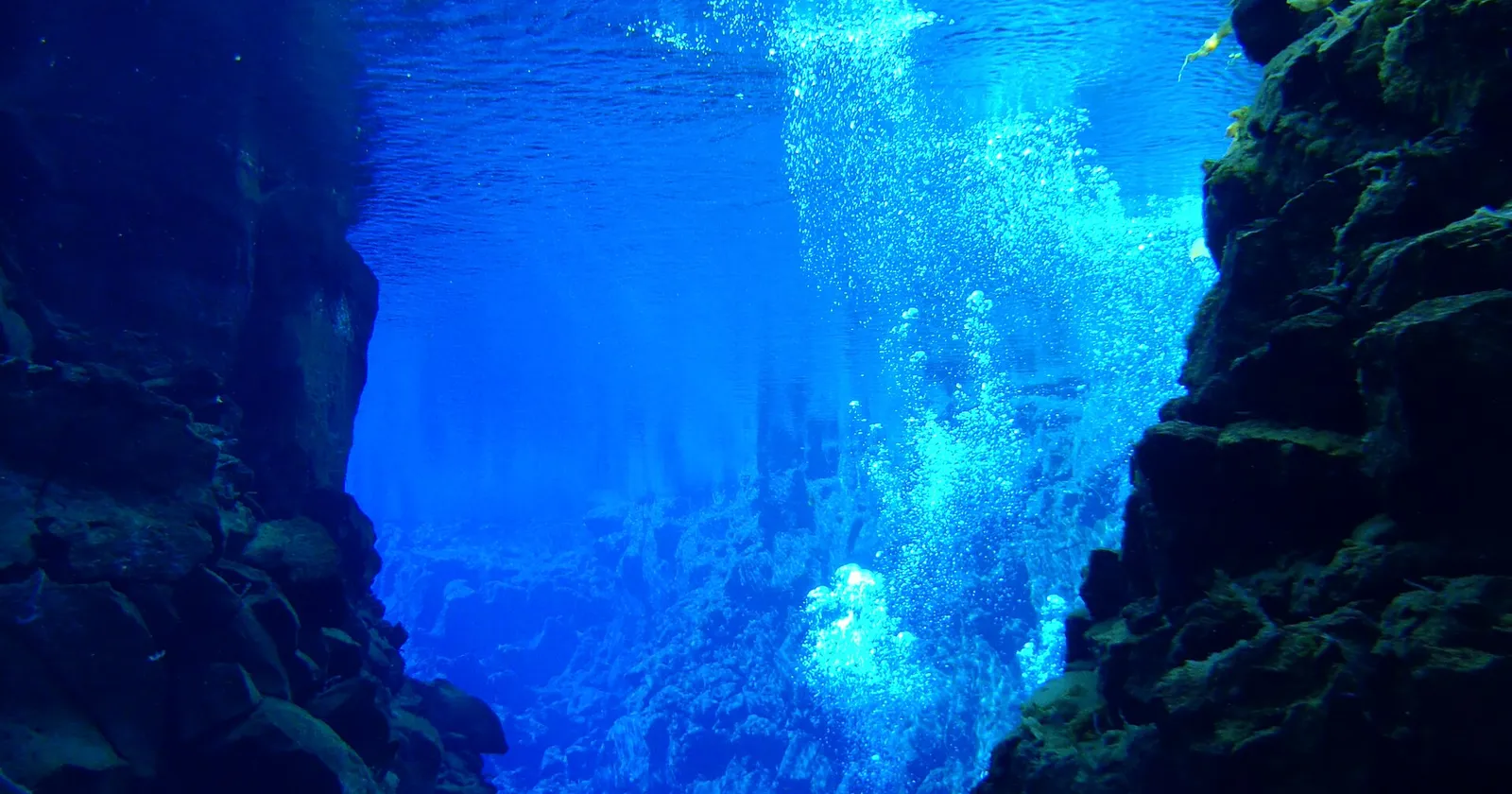
Inside the Silfra fissure, Thingvellir National Park. Thomei08, Wikimedia Commons, public domain, cropped.

Key takeaways
- Diving in Thingvellir National Park is allowed only in Silfra and Davíðsgjá; every Silfra dive must be registered and costs ISK 1,500 per person
- Silfra rules: dry-suit certificate or ten dry-suit dives in two years, no wetsuit scuba, no solo diving, no caves, 18 meters maximum, three divers per guide
- Silfra's water holds at about 2 to 4 °C all year; the sea off Reykjanes averages about 5.3 °C in March and 11.1 °C in August
- Strýtan and Arnarnesstrýtur in Eyjafjörður are protected hot-water chimneys you may dive but not touch; Strýtan dives must be reported to Akureyri harbour the same day
- Iceland repealed its long-term visa in May 2026, and the short-term permits that replace it do not cover remote work
Iceland diving: a fresh-water fissure first, the sea second
Most Iceland diving happens in fresh water. Thingvellir National Park, on UNESCO's World Heritage list since 2004, allows diving in only two fissures, Silfra and Davíðsgjá, and needs the park warden's consent for any other. The park calls Silfra one of the best dive sites in Iceland, and says many consider it world class, because of the visibility in its clear groundwater. Silfra is also busy: a 2019 report for the park counted 61,681 snorkellers and divers between November 2017 and October 2018, and found that in 2017 only about 8% of Silfra's visitors were divers. The sea is the second chapter. Tour operators dive the kelp off the Reykjanes peninsula in summer, and in the north, the hot-water chimneys of Eyjafjörður near Akureyri are protected natural monuments that you can dive with a local centre.
Silfra: the dive between the plates
Thingvellir sits where the North American and Eurasian plates meet, and as the land sinks and pulls apart, fissures open and groundwater runs through them, the park's report says. The 2019 carrying-capacity report, written by EFLA for the park, gives the fissure a depth of 59 meters, water that stays at about 2 to 4 °C, and visibility that can exceed 150 meters. It puts the clarity down partly to low nitrogen, which keeps algae in the water short-lived. DIVE.IS says the water is meltwater from the Langjökull glacier, filtered through lava for 30 to 100 years, and that you can drink it during the dive.
The dived area is small. DIVE.IS measures the rift at about 600 by 200 meters and splits it into four parts: the Big Crack, Silfra Hall, the Cathedral and the shallow Lagoon. You enter by a metal staircase onto a submerged platform and leave by an exit platform in the Lagoon; leaving anywhere else is not allowed except in an emergency. DIVE.IS gives the average dive depth as about 10 meters and the dive time as 30 to 45 minutes; Arctic Adventures says it dives at 7 to 12 meters. Then comes the walk back with your gear, which operators put at 250 to 400 meters. A cave beside the entrance pool goes to at least 63 meters, DIVE.IS says, and both it and the tunnel known as "the toilet" are off limits.
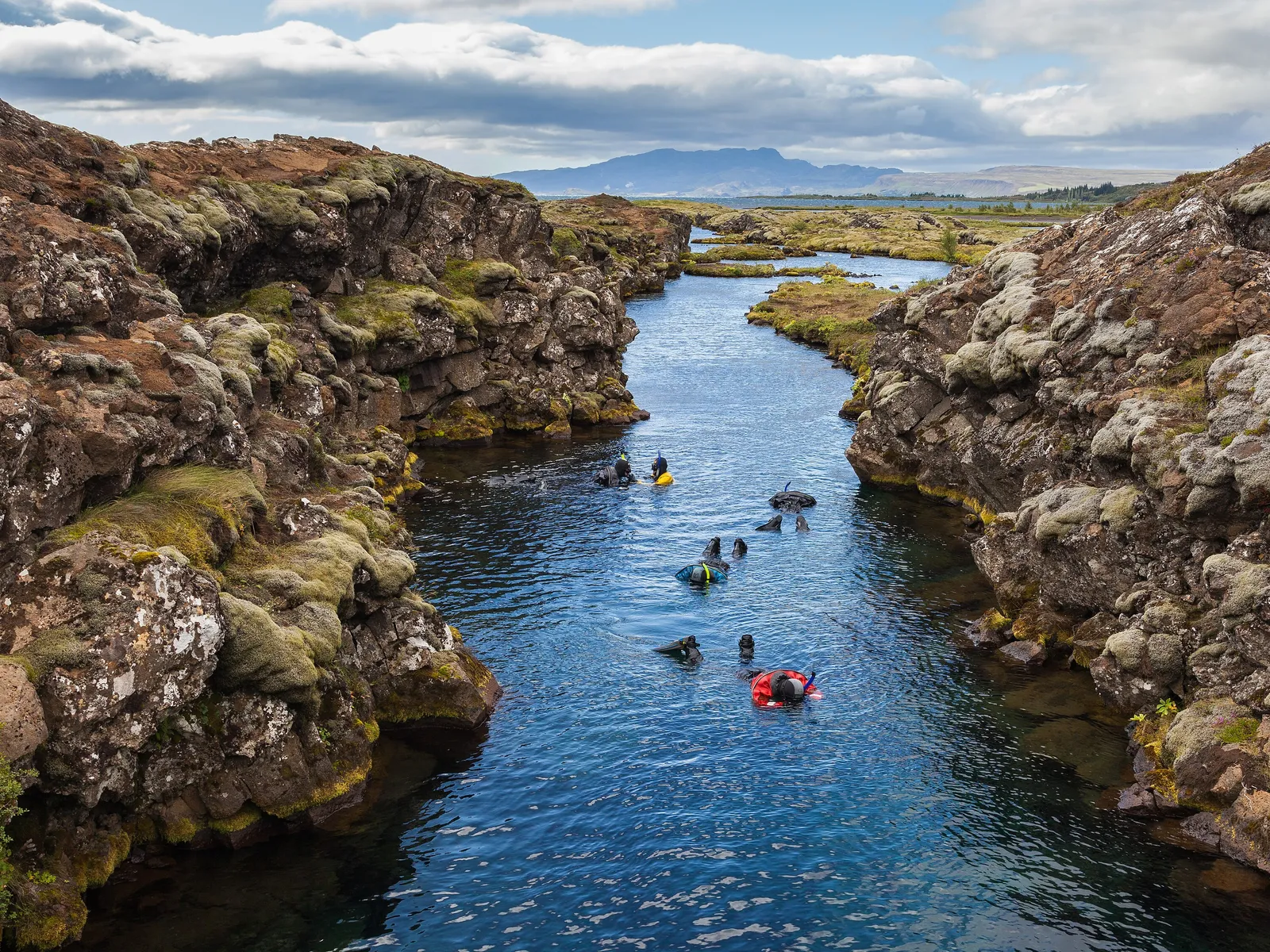
Snorkellers in the Silfra canyon. Diego Delso, Wikimedia Commons, CC BY-SA 4.0, cropped.

The rules at Silfra: dry suit, 18 meters, three divers per guide
Three layers of rules apply. The park's diving page sets the basics for the park: you need dry-suit certification or at least ten dry-suit dives in the last two years, scuba in a wetsuit is not allowed, and no one may dive alone, dive into caves or go deeper than 18 meters. Divers dive entirely at their own risk, and companies are fully responsible for the people they guide.
The detail sits in instructions issued in 2013 by the Icelandic Maritime Administration, now the Icelandic Transport Authority (Samgöngustofa), and amended in 2017. They cap Silfra at three divers per guide and one guide per six snorkellers, and they allow only eight divers at a time at the shallows marked on their map. Diving into caves, passages and tunnels is banned. Proof of dry-suit experience must be a dry-suit certificate or a written record of ten dry-suit dives in the last two years, confirmed by a recognised instructor or agency. Independent divers need an internationally recognised autonomous diver card at the ISO 24801-2 level, which DIVE.IS equates with Open Water. Guides must be at least 20 and hold a dive-leader rating and first-aid training, and operators must have oxygen on site. No one may swim above divers, and only people who can swim may dive or snorkel.
Iceland's Diving Act of 2018 adds an age floor: recreational divers must be 17 or older. Operators set their own limits on top. DIVE.IS asks divers aged 60 or older for a doctor's signature on its medical form and accepts divers from 150 to 200 centimeters and 45 to 120 kilograms; Arctic Adventures sets its minimum age at 18 and requires divers to follow instructions in English. Breaking the park's rules can be reported to the police, the warden can impose a temporary diving ban, and serious breaches carry fines or prison under the park law.
Fees, registration and parking at Thingvellir
Every dive and snorkel in Silfra must be registered, whether you come with a company or on your own. The park's fee rules, in force since 1 January 2024, charge ISK 1,500 per person for each dive, snorkel or freedive in Silfra. Tour prices from DIVE.IS and Arctic Adventures include it. Independent divers register on the park's website or at the Leirar service centre or the Hakið visitor centre, accept a liability waiver and pay the fee. The park provides no diving equipment.
If you drive, parking at P5 Valhöll, the car park nearest Silfra, costs ISK 1,000 for a car with up to five seats. The fee covers all the park's paid car parks for the day.
Davíðsgjá: the other fissure
Davíðsgjá lies further east in the park, out in the lake. The park says you have to swim some distance to reach it, that it is shallow near land and opens up further out. DIVE.IS, which runs it as a second dive after Silfra, describes a walk-in entry and a shallow swim, water usually a little warmer than Silfra, visibility that depends more on the weather, and trout joining divers because the top of the fissure is about 7 meters down. DIVE.IS gives the maximum depth of its dive there as 21 meters; the park's diving page says no one may dive deeper than 18 meters in the park, so plan for 18. The two sites are about ten minutes apart by car.
Strýtan and Arnarnesstrýtur: hot springs on the seabed of Eyjafjörður
In the north, Iceland's environment minister made the hydrothermal chimneys on the floor of Eyjafjörður a natural monument in 2001. The protection notice puts them on a seabed of about 65 meters, with one rising to about 33 meters below the surface and the other to about 15. The 2003 management plan measured the outflowing fresh water at up to 72 °C and estimated the total flow at about 100 liters a second. The rules are short. You may dive down and look, but not touch or damage the chimneys. You must report a dive to the Akureyri harbour authorities the same day. Boats may not anchor inside the protected circle, 200 meters in radius, and divers are told to descend by the buoy line.
A second group, Arnarnesstrýtur, north of Arnarnesnafir, has been protected since 2007. Its notice describes chimneys up to 10 meters tall at 25 to 45 meters, bans all fishing in the 101-hectare area, allows diving at the marked buoy and bans anchoring. Strýtan Dive Center at Hjalteyri runs both as a two-dive day trip by zodiac. It asks for Advanced certification, dry-suit certification or ten dry-suit dives, at least 25 logged dives and a dive in the last six months. DIVE.IS calls Strýtan a site for advanced divers only and warns that currents can be strong.
Ocean dives and other sites: Garður, Bjarnagjá, El Grillo
Tour operators sell a few more sites, mostly in summer. At Garður on the tip of the Reykjanes peninsula, DIVE.IS enters from the shore or down a ladder from the pier into kelp forest with wolffish and flatfish. Bjarnagjá, also on Reykjanes, is an 18-meter lava ravine of mostly fresh groundwater with some sea influence, and DIVE.IS warns it can be cancelled at short notice because of volcanic activity on the peninsula. In the east, the British tanker El Grillo, sunk in Seyðisfjörður on 10 February 1944, lies at about 45 meters with its highest point at 28, according to DIVE.IS, which currently does not dive it because of an oil spill in the area. DIVE.IS also lists the Nesgjá fissure in the north as not running until further notice.
When to dive Iceland: Silfra all year, the rest in summer
Silfra is dived all year, and DIVE.IS runs it daily. The company says it has all its sites available from April to October, but from November to March only Silfra and occasionally Davíðsgjá, because of road closures, ice and unsafe conditions. It also says summer brings more people to Silfra, while winter is calmer but harder on the surface, with weather and cold. The 2019 report for the park found that accidents and incidents at Silfra happen more often in winter and are linked to long waits and bad weather, and that more of them happen out of the water than in it.
Light is the other limit. The same report's table gives Silfra about four hours of daylight in December and January and twenty in June. Statistics Iceland publishes the Met Office's 1981 to 2010 wind normal for Reykjavík: 6.1 meters a second in February and 4.2 in July, so winter is both darker and windier.
The sea is cold but not as cold as Silfra in summer. NOAA's satellite averages for 1991 to 2020 put the surface off Garður at about 5.3 °C in March and 11.1 °C in August. At the mouth of Eyjafjörður the range is about 2.7 °C in March to 9.0 °C in August. Those are open-water surface figures, not readings from inside the fjord or at depth.
Safety, the chamber and emergencies
The 2019 report counted five fatal diving accidents in Silfra since 2010. In an emergency, call 112. The hyperbaric chamber we found is at Landspítali University Hospital in Fossvogur, Reykjavík, on the second floor, E-2, at Áland 6. The department's page lists a diving doctor on call around the clock on +354 543 1007 and says the chamber is on call 24 hours a day. Its emergency guidance says to call 112 or go to the nearest emergency department, say it is a diving accident, and let the emergency department bring in the diving doctor.
There is a caveat. The hospital took over the service fully in January 2026, after running it with a partner company since 1993, and on 14 January it announced a safety audit and maintenance, with delays to scheduled treatment. We found no later notice saying all treatment had resumed, so ask your operator what its plan is. The 2013 Silfra instructions size the oxygen operators must carry on a 50-minute wait for emergency services to reach Thingvellir. Check that your dive insurance covers Iceland.
What a dive costs in Iceland
Prices on the operators' own pages, read on 10 November 2026, with equipment and the Silfra fee included:
| Operator and trip | Price |
|---|---|
| Arctic Adventures, one Silfra dive | from ISK 33,990 |
| DIVE.IS, one Silfra dive, meet on site | from ISK 35,999 |
| DIVE.IS, one Silfra dive with Reykjavík pick-up | from ISK 43,999 |
| DIVE.IS, Silfra and Davíðsgjá, two dives | ISK 69,999 |
| DIVE.IS, dry-suit course and Silfra dive, two days | from ISK 99,980 |
| Strýtan Dive Center, Strýtan and Arnarnesstrýtan, two dives | ISK 65,000 |
DIVE.IS charges ISK 59,999 for its Garður ocean dive tour and ISK 65,000 for its own Strýtan day trip. It fills tanks with air only, in 12-liter DIN cylinders, and does not cater for nitrox or rebreathers.
Getting to Silfra
You land at Keflavík. The Flybus to the BSÍ terminal in Reykjavík takes 45 minutes and leaves 40 minutes after each landing, and Strætó runs regular public buses between the airport and the capital area, according to the airport operator Isavia. From Reykjavík, DIVE.IS puts Silfra at about 50 minutes by car. We could not confirm a scheduled public bus to Thingvellir, so most people either rent a car or book a tour with pick-up from Reykjavík; DIVE.IS needs at least two passengers to run its transfer. For Strýtan, the dive centre is in Hjalteyri on Eyjafjörður; DIVE.IS describes the site as not far from Akureyri.
Iceland as a remote-work base
Visa guides describe a long-term visa for remote workers that Iceland used to grant, and the government page for it no longer loads. That route has closed. On 13 May 2026 the Directorate of Immigration announced that, with the new Visa Act No. 37/2026, the provision on long-term visas had been repealed and visa work had moved to the Ministry for Foreign Affairs. The short-term residence permits that replace it cover stays of more than 90 and up to 180 days, but the July 2026 rules limit them to visiting a close family member or coming as an artist, scientist or athlete. Remote work is not on that list. Iceland is a Schengen state, so a remote worker without another right to stay is left with Schengen short stays of under 90 days, with a visa where their nationality needs one. We did not research internet speeds or coworking.
Who Iceland diving suits
Iceland suits a certified diver who wants one extraordinary dive more than a long list of them: Silfra's clarity and geology, in a shallow, guided, strictly managed fissure that runs all year. It suits divers with dry-suit experience, or those willing to take a dry-suit course first, and experienced cold-water divers who will travel north for Strýtan in summer. It suits less well anyone who wants warm water, deep dives past 18 meters at Thingvellir, cheap repeat diving, or a months-long remote-work stay without another right to live there.
FAQ: Iceland diving
Do you need a dry-suit certification to dive Silfra?
You need either a dry-suit certificate or written proof of at least ten dry-suit dives in the last two years, confirmed by a recognised instructor or agency. Scuba diving in a wetsuit is banned in Silfra. If you have neither, DIVE.IS sells a two-day dry-suit course with a Silfra dive, or you can snorkel instead.
How cold is the water in Silfra?
About 2 to 4 °C all year, according to a 2019 report for Thingvellir National Park. Tours include the dry suit and other equipment. The sea around Reykjanes is warmer, about 5 °C in March and 11 °C in August on NOAA's averages.
How deep can you dive in Silfra?
No deeper than 18 meters. The fissure itself reaches 59 meters, but caves, tunnels and overhead environments are banned, and operators say a typical dive averages about 10 meters and lasts 30 to 45 minutes.
How much does it cost to dive Silfra?
Guided single dives start at ISK 33,990 with Arctic Adventures and ISK 35,999 with DIVE.IS on their own sites, read on 10 November 2026, including equipment and the park's ISK 1,500 fee. Pick-up from Reykjavík costs extra.
Is there a hyperbaric chamber in Iceland?
Yes, at Landspítali University Hospital in Fossvogur, Reykjavík, which lists a 24-hour diving doctor on +354 543 1007. The hospital announced a safety audit and maintenance in January 2026, and we found no later notice that all treatment had resumed. In an emergency call 112.
Note: Conditions, safety guidance and regulations change. Verify current information with official sources, including the dive operator, the park authority and the relevant government department, before you travel or dive.
Founder of NOMADREEF and a former digital nomad. This guide is sourced from the references below; conditions, prices and rules change, so verify current details, and follow qualified local guidance and safety briefings. About the author · LinkedIn ↗
Sources
- Thingvellir National Park (primary). Park pages on diving, diving terms and registration, parking and licensing; EFLA, carrying-capacity report for Silfra (PDF), 2019, published by the park. Read 10 November 2026.
- Diving rules (primary). Official Gazette: park diving rules 214/2013; fee rules 1571/2023 (PDF), articles 1 and 2; Maritime Administration instructions 165/2013, articles 2, 4, 5 and 6, and Samgöngustofa's amendment 207/2017; Diving Act 81/2018 as published (PDF), articles 9 and 16. Read 10 November 2026.
- Eyjafjörður chimneys (primary). Environment Agency: protection notice 249/2001 (PDF), management plan, 2003 (PDF) and protection notice 510/2007 for Arnarnesstrýtur (PDF). Read 10 November 2026.
- Dive sites (each operator primary for itself). DIVE.IS on Silfra, Davíðsgjá, Strýtan, Garður, El Grillo, Nesgjá and its FAQ; Arctic Adventures, Silfra dive; Strýtan Dive Center on Strýtan and its day tour. Read 10 November 2026.
- Season and weather. NOAA PSL, OISST v2.1 monthly long-term means 1991–2020, cells 64.125°N 22.875°W and 66.125°N 18.375°W, computed for this page (primary); Statistics Iceland, average wind speed at selected stations, Reykjavík normal 1981–2010, data from the Icelandic Met Office (primary). Read 10 November 2026.
- Chamber and emergency number (primary). Landspítali, Hyperbaric and Dive Medicine Department, emergency recompression, and news of 14 November 2025 and 14 January 2026. Read 10 November 2026.
- Prices (each operator primary for itself). DIVE.IS diving tours and Silfra tour; Arctic Adventures; Strýtan Dive Center. Read 10 November 2026.
- Getting there. Isavia, Keflavík Airport public bus service (primary); Strætó, route system (primary); drive time from DIVE.IS (operator). Read 10 November 2026.
- Staying and working (primary). Directorate of Immigration, visa services transferred to the Ministry for Foreign Affairs, 13 May 2026, and new residence and work permit rules, July 2026; Ísland.is, do you need a visa. Read 10 November 2026.
- Left out. Icelandic Met Office pages, which did not load for us, so no air-temperature normals or storm-season text; a park list of licensed Silfra operators, which the park does not publish; confirmation that Landspítali's chamber is back in full service; the depth rule and any fee at Davíðsgjá beyond the park's general 18-meter limit; an official source on the El Grillo oil spill; a scheduled bus to Thingvellir; any permit that now covers remote work; and internet and coworking.