Hong Kong Diving: Sai Kung's Coral Islands, Hoi Ha Wan, Tung Ping Chau and the Marine Park Rules
 by Yannick Schroth
Nov 10, 2026
12 min read
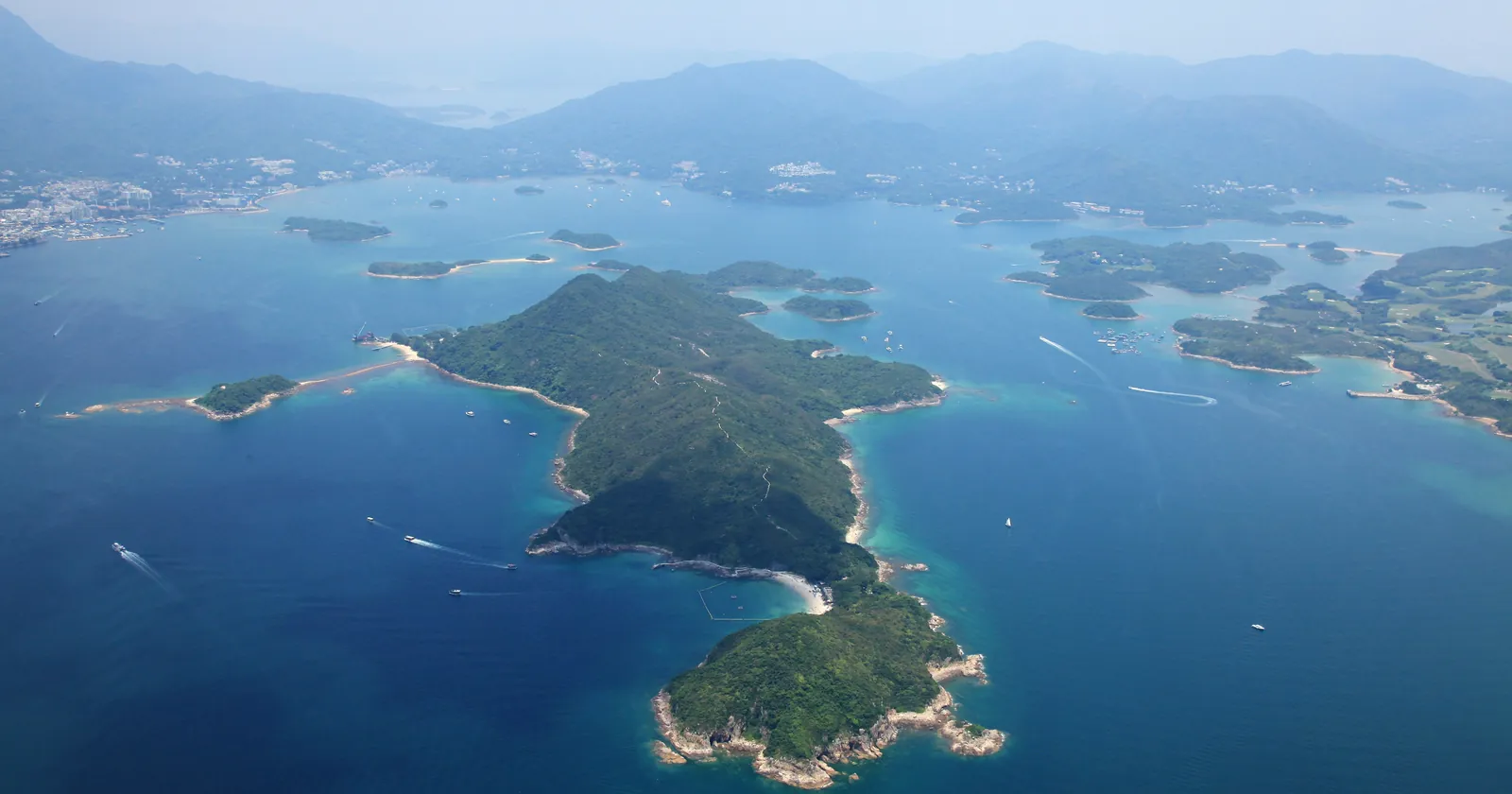
Sharp Island and Pak Sha Chau in Port Shelter, off Sai Kung. Geographer, Wikimedia Commons, CC BY-SA 4.0, cropped.

Key takeaways
- The coral is in the east: the government's 2025 reef survey covered 36 sites from Tung Ping Chau to the Ninepins, and 12 of them had more than half their bottom covered in hard coral
- Scuba needs no permit in Hong Kong's eight marine parks, but fishing, collecting and even carrying a speargun are banned there, with fines up to HK$25,000 and a year in prison; the Cape D'Aguilar reserve is closed to divers
- NOAA's satellite averages east of Sai Kung run from 19.6 °C in January to 28.6 °C in July and August; the Observatory says July to September are the most likely typhoon months
- Two shops publish a boat-day price with lunch: HK$560 to HK$650 at Blue Point Diving and HK$680 to HK$720 at Divemate, read on 10 November 2026
- Hong Kong has no digital-nomad visa; visitors may not take any employment, and the Immigration Department does not say whether remote work for a foreign employer counts
Hong Kong diving: coral in the east, not the harbour
Hong Kong has about 1,640 square kilometres of sea, and its two sides are very different. In the west, the Pearl River estuary shapes the water; in the east, seasonal currents and the monsoon do, which the Agriculture, Fisheries and Conservation Department (AFCD) gives as the reason Hong Kong mixes tropical and temperate life, corals included. Divers go east. Hong Kong waters hold 84 hard coral species from 28 genera, plus 67 kinds of soft corals and gorgonians and six black corals, according to the AFCD's 2025 reef survey summary.
Where Hong Kong divers dive
The government's own diving page names Shelter Island, Sharp Island, Chek Chau (Port Island), the Ninepins, Tung Ping Chau, Hoi Ha, Crescent Island and Pak Lap Tsai among the best sites, and tells divers to ask experienced locals about hazards before trying a new one. It also warns that visibility can drop very quickly with tide and wind, and that currents run at some sites.
The best evidence for what lies underwater comes from Hong Kong Reef Check, the annual survey the AFCD coordinates with more than 1,300 volunteer divers. In 2025 it covered 36 sites from June to October, from Tung Ping Chau in the north to the Ninepins in the south, ten of them inside marine parks. Hard coral covered between 15.6 and 84.7 percent of the bottom. The highest figure was Coral Beach in Hoi Ha Wan, and the site table puts Sharp Island North at 77.5 percent, Sharp Island East at 52.2, Bluff Island at 71.3, A Ma Wan on Tung Ping Chau at 70.8, Shelter Island at 48.2, the Ninepins at 30.2 and Port Island at 17.5. Most of the groupers, wrasses, sweetlips and snappers turned up in Port Shelter, the eastern waters and Tung Ping Chau.
Port Island has had a hard time: the AFCD reports coral damaged by bioerosion there and at Wong Chuk Kok Hoi, a restoration study by the University of Hong Kong in 2020 and 2021, and signs of recovery since. Bleaching is the other pressure. The AFCD records large-scale bleaching in 2022 and 2024, and minor, localised bleaching at seven sites in 2025, three of them at Tung Ping Chau and one at Coral Beach.
Divemate, one of the shops, gives a little detail on its own trips: the East Ninepins are about an hour by its boat from Sam Ka Tsuen pier in Yau Tong, and its Little Garden site lies at about 14 meters between South and North Ninepin, usually with current, so it recommends experienced divers and a surface marker for each. No official source we read gives depths for the other sites.
Boat days and shore entries
The shops whose prices we could read sell local fun diving as boat days. Both shops quoted below include the boat fee, tanks, weights and lunch in one price, and Divemate's terms add that some of its sites are only for divers with at least 60 logged dives and their own compass. Shore diving exists but is less documented: at Hoi Ha Wan the AFCD keeps a zone off the coast closed to motor boats specifically to protect divers and snorkellers from collisions. We found no official list of shore entry points.
The government's diving advice is plain: do not dive from a boat that is not flying the "A" flag, do not dive in shipping routes, do not dive alone, and deploy a surface marker buoy before you ascend. Around Sai Kung, the AFCD has also set up six no-anchoring areas, each marked by four yellow coral buoys, at Bluff Island, Port Island, Sharp Island West and East, South Ninepin and Shelter Island.
Marine parks and the marine reserve
Hong Kong's Marine Parks Ordinance dates from 1995 and its regulation from 1996. There are now eight marine parks and one marine reserve, 8,517 hectares in all. The three that matter most to divers are in the north-east: Hoi Ha Wan (260 hectares) and Yan Chau Tong (680), both designated in 1996, and Tung Ping Chau (270), designated in 2001. The others are Sha Chau and Lung Kwu Chau, The Brothers, Southwest Lantau, South Lantau, and North Lantau, the largest at 2,400 hectares, designated in November 2024.
The AFCD says visitors may enter all eight parks and swim, snorkel, scuba dive and paddle without a permit, and that the parks are open all year. Boats must stay under 10 knots and anchor only in the marked mooring sites, and green mooring buoys near the coral let small boats tie up without anchoring. Hoi Ha Wan also has a zone closed to inboard engines to keep big boats off its shallow corals. A permit is needed for things like anchoring outside the mooring sites, which costs HK$180 an event and must be requested eight working days ahead, or for competitions and commercial filming; recreational diving is not on the AFCD's permit list.
The marine reserve is different. Cape D'Aguilar, about 20 hectares at the south-eastern tip of Hong Kong Island, has been protected since 1996, and the AFCD states that swimming, diving and any boating are prohibited there.
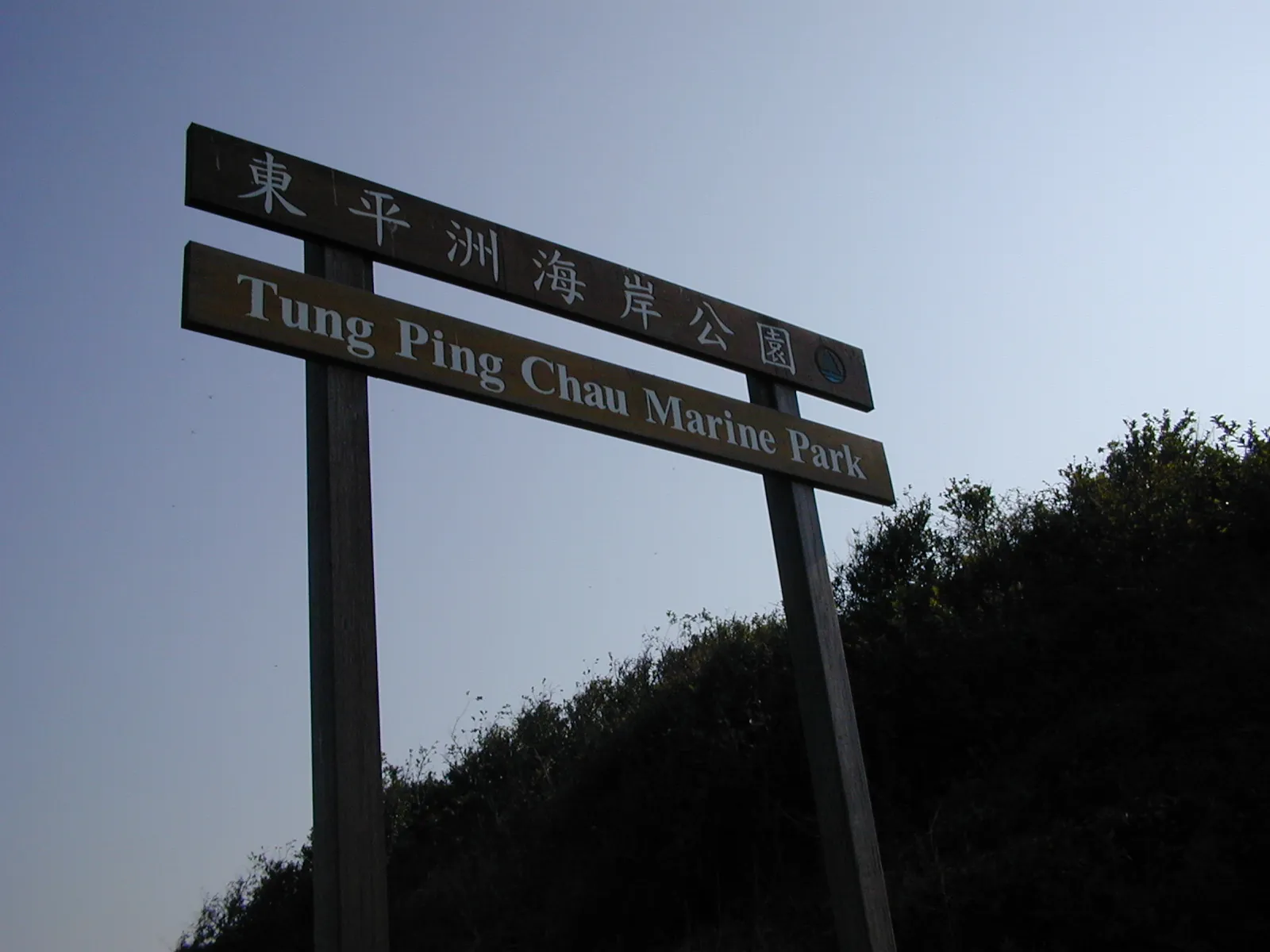
The marine park sign on Tung Ping Chau. Minghong, Wikimedia Commons, CC BY-SA 3.0.

Fishing, spearguns and coral
Inside the marine parks, the AFCD's list of banned activities starts with fishing, hunting, collecting or possessing any wild animal or plant or part of one, and includes carrying any net, line, trap or speargun. Digging sand, turning over boulders and taking shells, even empty ones, are also banned, as are jet skis, littering and unauthorised commercial or group activities. Taking an animal or plant without a permit carries a maximum fine of HK$25,000 and a year in prison, according to the government's announcement of a 2023 prosecution at Hoi Ha Wan.
Commercial fishing has been banned since April 2020 in Hoi Ha Wan, Yan Chau Tong, Tung Ping Chau and Sha Chau and Lung Kwu Chau, after a two-year transition; only people who already lived nearby keep fishing permits there. Tung Ping Chau also has core areas where all fishing is banned. Outside the parks, stony, black, blue, fire and lace corals are listed under the endangered species law, so possessing them, dead or alive, is restricted anywhere. We couldn't check the rules on spearfishing outside the parks, so ask a shop before you bring a speargun.
When to dive: water temperature, rain and typhoons
NOAA's satellite averages for 1991 to 2020, for the cell centred at 22.375°N 114.375°E over Port Shelter and Sharp Island, put the sea at about 19.6 °C in January, 19.7 °C in February, 20.8 °C in March, 22.9 °C in April and 25.8 °C in May. It peaks at 28.6 °C in July and August, holds 28.2 °C in September, and falls to 26.5 °C in October, 23.6 °C in November and 20.8 °C in December. The grid is coarse: its quarter-degree cells over Tolo Harbour, Hoi Ha and Tung Ping Chau are counted as land, so sheltered bays may run warmer or colder, and these are surface values. Divemate rents both 3 mm and 5 mm wetsuits.
The Hong Kong Observatory describes November and December as many people's favourite months, with sunshine and pleasant breezes. About 80 percent of the year's rain falls from May to September, with June and August usually the wettest. Tung Ping Chau, at about 1,400 millimetres a year, is the driest place in the territory, against more than 3,000 near Tai Mo Shan.
Tropical cyclones can strike from May to November, and July to September are the most likely months. From 1956 to 2024 an average of 5.9 a year came close enough for the Observatory to raise warning signals; in 2024 there were seven.
Typhoon signals and your dive day
The Observatory's signals tell you whether a dive day will happen. Signal No. 1 means a tropical cyclone is within about 800 kilometres and may affect Hong Kong. No. 3 means strong wind of 41 to 62 km/h is blowing or expected, with gusts that may exceed 110 km/h. No. 8 means gale or storm force wind of 63 to 117 km/h, and No. 10 means hurricane force, 118 km/h or more. Divemate's terms show how shops use them: a trip goes ahead under signal No. 1, a thunderstorm warning or a yellow or red rainstorm warning, but is cancelled and rescheduled if No. 3 or higher, or a black rainstorm warning, is up or expected within two hours of the meeting time.
Chamber and emergencies
In an emergency, dial 999 for police, fire or ambulance; people with speech or hearing impairments can send an SMS to 992. The government says that in Hong Kong a diving accident must first be assessed by a doctor in a hospital accident and emergency department, which then plans any recompression.
Pamela Youde Nethersole Eastern Hospital runs the Hospital Authority's first hyperbaric oxygen therapy centre, inside its accident and emergency department, which provides 24-hour emergency care. The centre opened in September 2018 and treats both emergency and planned cases; when it opened, the Hospital Authority listed decompression illness among the emergency conditions it covers. Its page does not say the chamber itself runs around the clock, so we could not confirm 24/7 recompression; the hospital's number is 2595 6111. The Hospital Authority also mentioned in 2018 an older chamber run by the Fire Services Department on Stonecutters Island; we could not confirm whether it still treats recreational divers. Make sure your dive insurance covers hyperbaric treatment.
The government also recommends a dive medical every five years up to age 40, every three years after 40 and every two after 60.
What diving in Hong Kong costs
Prices for a local boat day on the shops' own pages, read on 10 November 2026:
| Dive centre | Weekday | Weekend or public holiday | Full gear rental |
|---|---|---|---|
| Blue Point Diving | HK$560, unlimited dives | HK$560 for two dives, HK$650 unlimited | HK$200 |
| Divemate | HK$680 | HK$720 | HK$300, no computer |
Both include the boat, tanks, weights and lunch. Divemate says its price does not include a dive guide, charges HK$150 for a tank of 32 percent nitrox, and dates its list to 1 June 2026; Blue Point adds a surcharge for remote sites. For courses, Blue Point charges HK$4,380 for SSI Open Water, Divemate HK$4,500 with about three hours of pool sessions and four sea dives over two days, and We Love Ocean HK$4,500 for SDI Open Water including gear, pool entry and boat fees. A Divemate try-dive day with one dive costs HK$1,300.
Freediving and pool training
Freediving is taught locally too: Blue Point lists SSI Freediving Level 1 at HK$4,500 and Level 2 at HK$4,000. Scuba courses start in a pool, as the government's diving page advises; Divemate's Open Water course includes about three hours of confined-water training and We Love Ocean's price includes the pool entry fee. We could not confirm which public pools accept scuba or freediving sessions, or at what fee.
Getting to the dive sites
Hoi Ha Wan is reached by green minibus No. 7 from Sai Kung Town to Hoi Ha Village, which the AFCD recommends over driving, since cars need a permit to pass the Pak Tam Chung barrier. Tung Ping Chau has no public transport; a kaito ferry run by Tsui Wah leaves Ma Liu Shui pier on Science Park Road at 9:00 on Saturdays, Sundays and public holidays, with a second Saturday sailing at 15:30, and returns at 17:15. The round trip costs HK$100, according to the Transport Department. Boat dives start from piers chosen by each shop, such as Divemate's at Sam Ka Tsuen in Yau Tong.
Hong Kong as a remote-work base
Hong Kong has no digital-nomad visa. The Immigration Department's list of visa schemes covers talent, employment, investment, study, training and working holidays, but nothing for remote workers. Visitors may stay without a visa for a period set by nationality: 180 days for British citizens, 90 days for citizens of the US, Germany, France, Spain, Italy, Ireland, the Netherlands, Australia, Canada, Japan and many others, 30 for South Africans and 14 for Indians, according to the department's table updated in August 2026. You must show enough money to live without working and an onward ticket.
The condition that matters is in the Immigration Regulations: a visitor may not take any employment, paid or unpaid, or establish or join a business, and a breach can bring a fine of up to HK$50,000 and two years in prison. The department lists business activities visitors may do, such as meetings, contracts and trade fairs, but it does not say whether working remotely for a foreign employer counts as employment. We could not find an official answer, so check with the department before you plan to work from Hong Kong. Citizens aged 18 to 30 of the 13 countries in Hong Kong's working-holiday scheme, including the UK, Germany, France, Australia and Canada, can get a visa that allows short-term work, within national quotas.
Who Hong Kong diving suits
Hong Kong suits a diver who is in the city anyway, for a stopover or a working holiday, and wants weekend boat days among coral-covered islands an hour or so from town, with lunch on board. It suits someone interested in coral science, since Reef Check recruits volunteer divers every summer. It suits less well anyone who needs reliably clear water, since the government warns visibility can drop quickly, anyone who cannot move a dive day when a typhoon signal goes up, or a remote worker who wants a clear legal basis for a long stay.
FAQ: Hong Kong diving
Is there good diving in Hong Kong?
There is real coral diving in the east. The government's 2025 reef survey covered 36 sites from Tung Ping Chau to the Ninepins and found more than half the bottom covered in hard coral at 12 of them, with Coral Beach in Hoi Ha Wan at 84.7 percent. Visibility can drop quickly with tide and wind.
Do you need a permit to dive in Hong Kong's marine parks?
No. The AFCD says visitors may scuba dive, snorkel and swim in all eight marine parks without a permit. Fishing, collecting and carrying spearguns are banned there, and the Cape D'Aguilar marine reserve is closed to swimming, diving and boating.
How warm is the sea in Hong Kong?
NOAA's satellite averages for 1991 to 2020 east of Sai Kung give about 19.6 °C in January and 28.6 °C in July and August, with 23.6 °C in November. These are surface values from a coarse grid.
When is typhoon season in Hong Kong?
The Hong Kong Observatory says tropical cyclones may strike from May to November, most likely from July to September. On average 5.9 a year needed warning signals between 1956 and 2024, and shops usually cancel dives once signal No. 3 is up.
Can I work remotely in Hong Kong on a visitor visa?
Hong Kong has no digital-nomad visa, and visitors may not take any employment, paid or unpaid, or join a business. The Immigration Department does not say whether remote work for a foreign employer counts, so ask the department before relying on it.
Note: Conditions, safety guidance and regulations change. Verify current information with official sources, including the dive operator, the Hong Kong Observatory and the relevant government department, before you travel or dive.
Founder of NOMADREEF and a former digital nomad. This guide is sourced from the references below; conditions, prices and rules change, so verify current details, and follow qualified local guidance and safety briefings. About the author · LinkedIn ↗
Sources
- Dive sites and diving safety (primary). GovHK, Useful Tips on Diving, last revised August 2024. Read 10 November 2026.
- Corals and Reef Check (primary). AFCD, Hong Kong Reef Check 2025 results summary, December 2025, and Are corals protected in Hong Kong? Read 10 November 2026.
- Marine parks and reserve (primary). AFCD, The facts, marine parks FAQ, marine parks management, marine parks permits, fisheries management and Cape D'Aguilar Marine Reserve. Read 10 November 2026.
- Penalties (primary). Information Services Department, AFCD press release of 27 April 2023; Environmental Protection Department, legislation and penalty table. Read 10 November 2026.
- Sea temperature. NOAA PSL, OISST v2.1 monthly long-term means 1991–2020, cell 22.375°N 114.375°E, computed for this page (primary). Read 10 November 2026.
- Climate and typhoons (primary). Hong Kong Observatory, Climate of Hong Kong; Tropical Cyclones in 2024, table 1.4, meaning of signals and table 4.5, annual numbers 1956–2024. Read 10 November 2026.
- Chamber and emergency number (primary). GovHK, Getting emergency help; Hospital Authority, PYNEH accident and emergency and 2018 newsletter on the HBOT centre. Read 10 November 2026.
- Shops (each primary for itself). Divemate, price list, courses, dive sites and terms; Blue Point Diving, Hong Kong diving, scuba courses and freediving courses; We Love Ocean, SDI Open Water. Read 10 November 2026.
- Getting there (primary). AFCD, transport to marine parks and Tung Ping Chau ferry; Transport Department, kaito ferry services. Read 10 November 2026.
- Staying and working (primary). Immigration Department, visit visa requirements, permissible activities for visitors, Working Holiday Scheme and list of services. Read 10 November 2026.
- Left out. The law texts themselves, because Hong Kong's legislation site blocks automated readers; rules on spearfishing and collecting outside the marine parks; depths and visibility at most sites; whether the Eastern Hospital chamber runs around the clock and whether the Stonecutters Island chamber still treats divers; public pools open to scuba and freediving; airport and Airport Express details; internet speeds and coworking fees.