Busan Diving: Pool Training, Shore Sites from Gijang to Dadaepo, and Korea's Night-Dive Ban
 by Yannick Schroth
Nov 10, 2026
12 min read
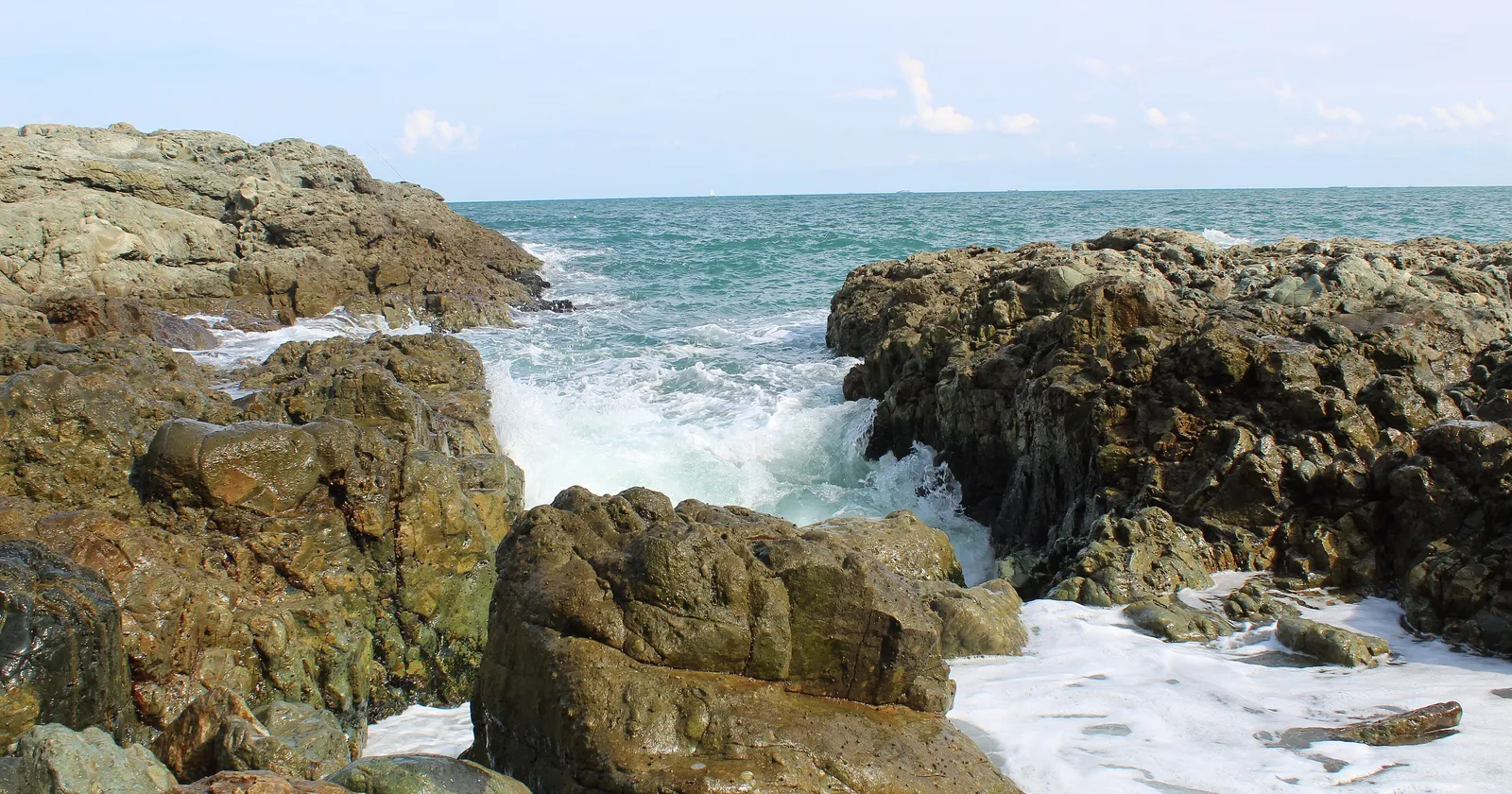
The rocky shore at Oryukdo, one of the coastal stretches Busan's divers use. Suchan1905, Wikimedia Commons, CC BY-SA 4.0, cropped.

Key takeaways
- Most Busan dive businesses are training centres built around pools; sea dives are shore entries, short boat trips or weekend trips up the coast
- Korea's underwater leisure law bans diving from 30 minutes after sunset to 30 minutes before sunrise unless you carry a light, wear a light-emitting vest or marker and dive with an instructor or are one
- Non-fishers may only take sea life with mask, snorkel, suit, fins, knife and whistle, so collecting anything on scuba is illegal, with fines up to ₩10 million
- NOAA's satellite averages put the sea off Busan at about 13.8 °C in February and March and 26.3 °C in August; cold upwelling can drop the Gijang coast to 14.5 °C in June
- Korea's digital-nomad visa became permanent on 30 June 2026; outside the Seoul region, applicants under 35 need one year's average income, about ₩52.4 million
Busan diving: a training city with a coast
Most of the dive businesses in Busan are schools rather than boat operators. They teach in pools through the week, one of them in its own, and take students to the sea at weekends. That shapes what a visiting diver gets: good training infrastructure, a cold-water coast with real sites, and few shops that publish a fun-dive price for a walk-in diver. Plan to contact a school, not to book a boat online.
Where Busan divers dive
Busan City's own magazine printed a list of local dive areas in 2020, written by an instructor trainer: the Gijang coastline from Jukseong-ri to Hakri; Baegunpo and the Oryukdo coast in Nam-gu; the tetrapods by the Gwangalli waterside park; the Yeongdo coast from Korea Maritime University to Taejongdae's Gamji beach, with the islet of Saengdo; Songdo beach and the underwater wall at Amnam Park; and the islets of Namuseom and Namhyeongjeseom off Dadaepo. Namuseom lies about 3.2 kilometers from Dadaepo port and Namhyeongjeseom about 17, so both are boat dives; the rest are reached from the coast. The same article calls Busan a year-round sea where the warm Kuroshio current meets cold water from the north.
We couldn't find depths or visibility for these sites from any Busan school or official source. The article only says Namhyeongjeseom is almost unaffected by runoff from the Nakdong River.
Some schools leave the city for their sea days. Busan Scuba Academy keeps weekends for dive tours, and every tour album on its site that names a place went to Guryongpo, near Pohang up the east coast, apart from one trip to Tongyeong in 2016; its newest album is from 2021. SUMDIVE says it runs domestic tours and more than ten trips abroad a year. Sea World Dive Center in Sasang-gu sells its Open Water course with four beach dives, or two beach and two boat dives, without naming the sites. Drop The Diving, a freediving school, has a seasonal sea centre in Gijang and says it works with the local fishing-village cooperative.
The pools: North Port and Sajik
The deepest pool is at North Port Marina, run by the Busan Port Authority, which calls its 24-meter diving pool the deepest in the Yeongnam region. A weekday session of two and a half hours costs ₩33,000 and one of five hours ₩53,000; two and a half hours at the weekend cost ₩55,000. A try-dive costs ₩120,000 alone or ₩100,000 each for two or more. The first tank is included and each further one costs ₩10,000. Since October 2026 the pool runs three sessions a day and must be booked online. Divers with an Advanced card or higher may enter with a buddy; below that, only with an instructor, and the pool asks for a three-minute stop at three to five meters after a 24-meter dive.
The city's Sajik indoor pool has opened its diving pool to scuba divers since 2018. A session costs ₩12,000, applications go in by email at least three days ahead, there is no rental, certified divers come in pairs with an original card, and uncertified divers only with an instructor, five at most per instructor.
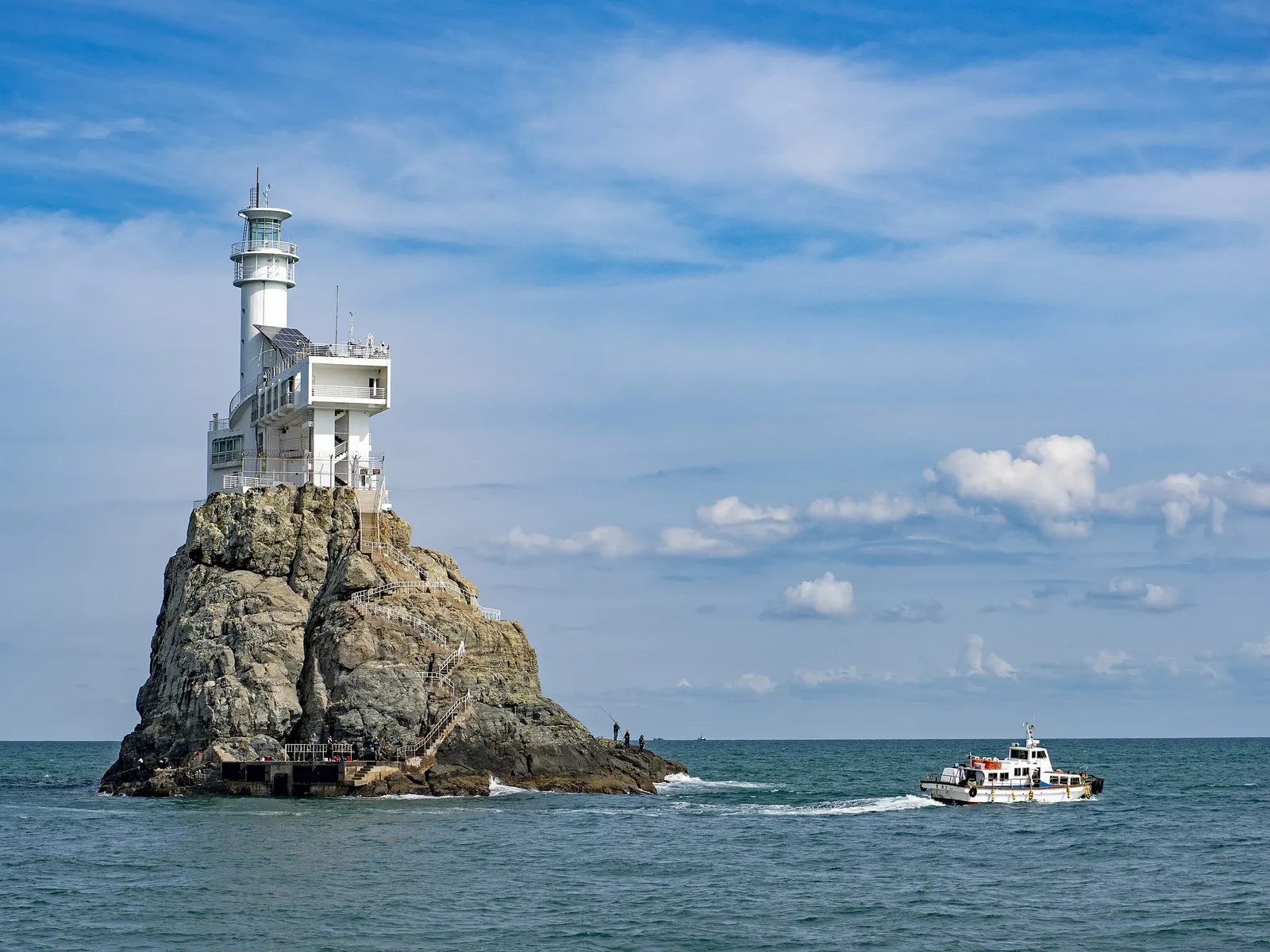
The lighthouse islet at Oryukdo. Busan Metropolitan City, Wikimedia Commons, KOGL Type 1, cropped.

Korea's diving law: night ban, harbours and reporting
Scuba in Korea falls under the Act on the Safety and Promotion of Underwater Leisure Activities, not the Water Leisure Safety Act, which covers boats and boards on the surface. Its text in force since 23 April 2026 bans anyone from diving between 30 minutes after sunset and 30 minutes before sunrise. The exception needs all three of the ministry's conditions: a searchlight or similar light, a light-emitting vest or marker, and a safety person such as an instructor alongside, unless the diver is a qualified instructor. The fine is up to ₩1 million.
A dive ten nautical miles or more from the port of departure or the coastline must be reported to the police or Coast Guard; we found no general duty for individual divers to register. Coast Guard station chiefs and city districts can declare no-dive zones, and separate maritime traffic law bans scuba in harbour and fishing-port waters the Coast Guard designates, unless it gives permission. We could not find Busan's current designations, so ask your school which entry points are allowed. Boats must keep out of a dive area marked with the international dive flag or a surface buoy; a shore diver without one gets no such protection.
For businesses, the same law has required registration with the Korea Coast Guard since April 2026, and a teaching business needs at least one instructor for every five divers. It sets no insurance duty for individual recreational divers, though both Busan pools require instructors to carry proof of insurance.
Taking sea life is off limits on scuba
Korea's fisheries law lets non-fishers gather sea life only with certain gear, and its decree lists exactly six pieces of underwater equipment: mask, snorkel, wetsuit and hood, fins, dive knife and whistle. Tanks, regulators and BCDs are not on it, so picking up an abalone, sea cucumber or octopus while on scuba is illegal, as is selling anything a non-fisher catches. The penalty is a fine of up to ₩10 million, and Busan's Coast Guard has caught divers doing it at Amnam Park and Yeongdo, according to press reports. From 1 April 2027, the law also lets cities and districts set times and places by their own ordinance.
Namuseom and Namhyeongjeseom are marine ecosystem protected areas, numbers 8 and 7. The marine ecosystem law bans catching, collecting or damaging listed species in such areas; it does not list diving itself as banned.
When to dive Busan: water temperature and typhoons
NOAA's satellite averages for 1991 to 2020 put the sea off Busan at about 15.0 °C in January, 13.8 °C in February and March, 16.7 °C in May, 23.4 °C in July and 26.3 °C in August, falling to 24.8 °C in September, 22.0 °C in October and 19.5 °C in November. The last ten years ran warmer: NOAA's finer Coral Reef Watch series averages 27.1 to 27.4 °C for August across three cells off the city between 2016 and 2025. These are surface figures and say nothing about the water at depth.
The satellite cells also miss the cold-water upwelling that hits the east coast in summer. On 17 June 2025, Korea's fisheries science institute reported cold water from Samcheok to Gijang, with 14.5 °C at Busan's Jangan, according to two news reports of its release; the satellite cell off Haeundae read 19.0 °C that day. The reverse also happens: in August 2023 a typhoon broke up the cold water and the institute issued a high-temperature advisory with 27.0 °C at Gijang.
Korea's weather agency puts the normal number of typhoons affecting the country at 3.4 a year, with 1.0 in July, 1.2 in August and 0.8 in September. The German Foreign Office warns of typhoons and heavy rain especially from July to September. No Busan school we read says what suit it uses in winter; at 14 °C, ask before you book.
Chamber and emergencies
Hana Hospital on Dadae-ro in Saha-gu, near Dadaepo, runs medical hyperbaric chambers at two to three atmospheres, one for eight people and one for one, and lists decompression sickness and gas embolism among the conditions national health insurance covers there. Its page does not say whether the chamber takes divers around the clock, so confirm it on 051-266-2600 before you rely on it. In an emergency call 119, which since 2016 also takes the Coast Guard's old 122 calls; 112 is the police.
What diving in Busan costs
Only one Busan school we read publishes its course prices, and none publishes a fun-dive price.
| Sea World Dive Center, Sasang-gu | Price |
|---|---|
| Try-scuba in the pool | ₩80,000 |
| Open Water, group, four beach dives | ₩700,000 |
| Open Water, group, two beach and two boat dives | ₩800,000 |
| Open Water, one to one | ₩900,000 |
| Advanced, three beach and two boat dives | ₩700,000 |
Sea World says a foreign instructor on its staff teaches scuba and first aid in English, and it offers students from outside Busan, foreign visitors included, a free guest room at the centre. Read 10 November 2026.
Getting to Busan
Gimhae International Airport is Busan's own. On 10 November 2026 its schedule listed 173 international departures to 41 destinations, all in East and Southeast Asia plus Guam, from Fukuoka and Osaka to Bangkok, Cebu, Da Nang and Bali; there were no direct flights to Europe or North America, so long-haul travellers connect through Incheon or a third country. An airport limousine to Haeundae and Gijang costs ₩9,500 and one to Seomyeon ₩6,000, card only. KTX trains from Seoul take about two and a quarter to two and three-quarter hours by press and timetable sites; we could not read Korail's own timetable. Metro Line 1 has run to Dadaepo Beach since 2017, which puts the Namuseom boat side on the subway.
Busan as a remote-work base
Korea's digital-nomad visa, F-1-D, moved from pilot to permanent status on 30 June 2026. It is for foreigners employed by a company abroad, with at least a year in the same field, who are 18 or older. The income bar is a multiple of the previous year's income per head, and Busan counts as outside the capital region: one times, ₩52.41 million, for applicants aged 18 to 34, and one and a half times, ₩78.62 million, from 35, against 1.5 and 2 times for the Seoul region. To use the lower bar you must show you will stay outside it, with a lease of at least a month or a booking. The visa needs medical insurance of at least ₩100 million, lasts a year and can be extended to three, and bars local work. One Korean consulate already gives a slightly higher income base, ₩52.57 million, so check yours.
For shorter stays, travellers from the 22 countries on Korea's K-ETA exemption list, including Germany, the UK, the US, France and Spain, need no travel authorization until 31 December 2026; other EU citizens, such as Irish or Portuguese travellers, do. Germans may stay up to 90 days without work. Busan City runs workation centres for remote workers: one opened by Busan Station in 2023, according to two news reports, and another at Songdo beach in February 2026, by the city's own release; we could not read their fees. KT recorded the fastest real-world 5G download in the government's 2025 test, 1,030 Mbps, according to three news reports.
Who Busan suits
Busan suits a remote worker who wants a big, well-connected Asian city with pool training on tap and cold-water shore diving at weekends, and who is happy to arrange dives through a school in Korean or by message. It suits less well anyone who wants walk-in boat dives with prices online, warm water in winter or night dives without an instructor. For diving on Jeju, see our Jeju diving guide.
Ten businesses on our Busan list
Our Busan operator list holds 10 businesses: eight published by SSI in its register of affiliated centres and two, Deep Dive Crew and Dive Story, by International Training, the company behind SDI and TDI, read on 10 November 2026. Only four have a website in the register, and two of those lead nowhere: Dive Story's address is a parked page and Jmj Diving School's a dead Cyworld club link. Drop The Diving is a freediving school, and Busan Scuba Academy's own site names PDIC-SEI, not SSI. Sea World and SUMDIVE, quoted above, are not on the list, because PADI publishes no register we can cite entry by entry. A register entry says a training body lists a business; it does not say that business is registered with the Coast Guard, which the law now requires.
FAQ: Busan diving
Can you scuba dive in Busan?
Yes. Busan has shore sites from the Gijang coast past Oryukdo and Taejongdae to the Amnam Park wall, and boat dives to the islets of Namuseom and Namhyeongjeseom off Dadaepo. Most local schools train in pools and dive the sea at weekends, some on trips up the coast to Guryongpo.
How cold is the sea in Busan?
NOAA's 1991 to 2020 satellite averages give about 13.8 °C in February and March and 26.3 °C in August at the surface. In early summer, cold upwelling can make the Gijang coast much colder than the satellite figures: 14.5 °C at Jangan on 17 June 2025, according to news reports of the fisheries institute's release.
Is night diving allowed in Korea?
Only with conditions. Korea's underwater leisure law bans diving from 30 minutes after sunset to 30 minutes before sunrise unless you carry a light, wear a light-emitting vest or marker and dive with an instructor or are one. The fine is up to ₩1 million.
Can divers take abalone or sea cucumber in Korea?
Not on scuba. Non-fishers may only use mask, snorkel, wetsuit, fins, dive knife and whistle to gather sea life, and may not sell what they take. Breaking that rule carries a fine of up to ₩10 million.
Is there a hyperbaric chamber in Busan?
Hana Hospital in Saha-gu, near Dadaepo, runs an eight-person and a one-person chamber and treats decompression sickness under national health insurance. Its page does not say whether it is staffed around the clock, so call 051-266-2600 to check. The emergency number is 119.
Note: Conditions, safety guidance and regulations change. Verify current information with official sources, including the dive operator, the Coast Guard and the relevant government department, before you travel or dive.
Founder of NOMADREEF and a former digital nomad. This guide is sourced from the references below; conditions, prices and rules change, so verify current details, and follow qualified local guidance and safety briefings. About the author · LinkedIn ↗
Sources
- Dive areas (primary). Busan Metropolitan City, city magazine article on Busan diving, 28 July 2020, by an instructor trainer. Read 10 November 2026.
- Schools (each primary for itself). Busan Scuba Academy, tour albums; Sea World Dive Center, about, Open Water, Advanced and guest room; Drop The Diving; SUMDIVE on PADI's locator. Read 10 November 2026.
- Pools (primary). Busan Port Authority, North Port Marina prices and rules; Busan Metropolitan City, Sajik diving pool. Read 10 November 2026.
- Diving law (primary). Korean Law Information Center: Underwater Leisure Act, articles 2, 8, 9, 12, 14 and 15, with its decree and rule, articles 4, 6 and 9; Water Leisure Safety Act; Maritime Traffic Safety Act, article 33. Read 10 November 2026.
- Sea life and protected areas (primary). Fisheries Resources Management Act, articles 18 and 65, and its decree, article 7-2; Marine Ecosystem Act, article 27. Enforcement in Busan from press reports in Kuki News and KPI News (secondary). Read 10 November 2026.
- Sea temperature. NOAA PSL, OISST v2.1 monthly long-term means 1991–2020, cell 34.875°N 129.125°E, and NOAA Coral Reef Watch, CoralTemp v3.1 daily, three cells, 2016–2025, both computed for this page (primary). Cold water in June 2025 from SBS Biz and twig24 reporting the fisheries institute (triangulated); Ministry of Oceans and Fisheries, 7 August 2023 (primary). Read 10 November 2026.
- Typhoons (primary). Korea Meteorological Administration, press release of 2 October 2026; German Foreign Office, Korea travel advice. Read 10 November 2026.
- Chamber and emergency numbers (primary). Hana Hospital, hyperbaric medicine; Ministry of Public Safety and Security, 26 October 2016. Read 10 November 2026.
- Getting there. Korea Airports Corporation, Gimhae airport, its international schedule for 10 November 2026 and limousine buses (primary); Metro Line 1 to Dadaepo from Busan Ilbo and Seoul Shinmun (triangulated). Read 10 November 2026.
- Staying and working. Ministry of Justice, press release of 7 July 2026 on the digital-nomad visa (primary); Korean consulate in Dallas, visa notice (primary, conflicting figure); K-ETA notice and the Korean embassy in Spain, exempt countries (primary); Busan Metropolitan City, workation release (primary); 5G test results from Dailian, Newsis and News Tomato (triangulated). Read 10 November 2026.
- The ten listings. Ten entries on the Busan operator list, from the SSI register and the International Training register, read 10 November 2026.
- Left out. Depths and visibility at Busan's sites, which no source we read gives; a fun-dive price from any Busan school; the Coast Guard's current harbour and no-dive designations around Busan; whether Hana Hospital's chamber runs around the clock; the K-ETA exemption after 2026; workation and coworking fees; and Korail's own KTX timetable.