Goa Diving: Grande Island, a Monsoon Rule Without Dates and Netrani Next Door
 by Yannick Schroth
Sep 24, 2026
13 min read
by Yannick Schroth
Sep 24, 2026
13 min read
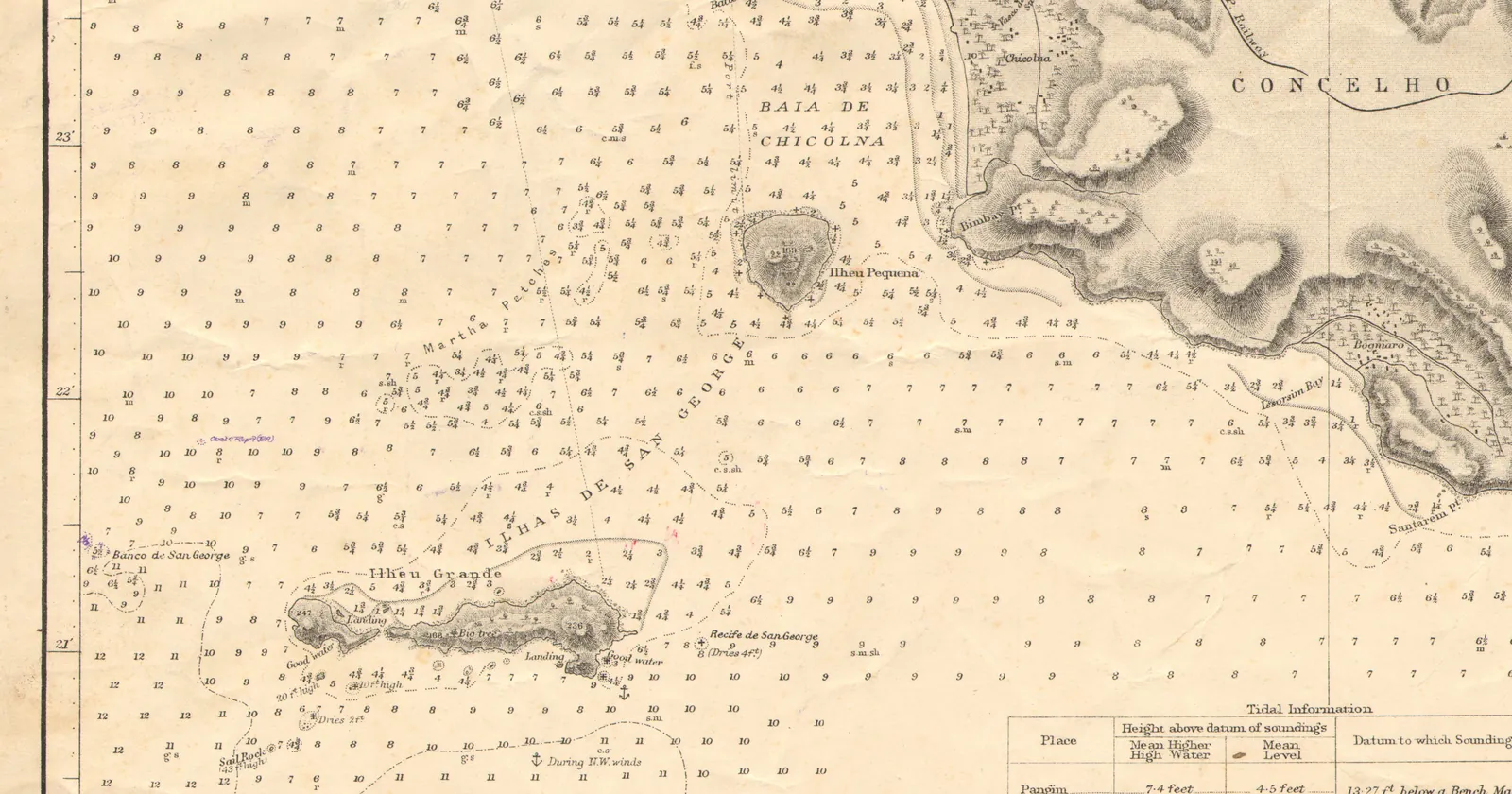
Ilheu Grande, now Grande Island, at the foot of Admiralty Chart No. 492 (surveyed 1881, new edition 1942); soundings in fathoms, not for navigation. Chart: United Kingdom Hydrographic Office, Wikimedia Commons, public domain.

Key takeaways
- Since Act 7 of 2011, Goa's tourist trade law defines a water sports operator to include scuba diving, and section 19A bars the business in a notified tourist area without registration
- For scuba, the Department of Tourism's 2022 document list asks for an inspection report from the National Institute of Water Sports or an approved agency, at every renewal
- The water sports policy bans activity in “monsoons” and names no dates; the June to September window people quote is not in its text
- At Navy Bay and Shelter Cove on Grande Island, live coral averaged 41.16 percent, with Turbinaria dominant and an invasive encrusting sponge attacking two coral genera
- Netrani Island is in Karnataka, 19 km off Murudeshwar; the state's tourism page calls it a restricted naval area where public landing is strictly prohibited
Scuba diving is named in Goa's tourist trade law, and the certificate lasts one year
Goa regulates dive shops through a tourism law rather than a diving act: the Goa Registration of Tourist Trade Act, 1982, which the state amended by Act 7 of 2011, dated 10 June 2011. The amendment inserted a definition that most visitors never see: a “water sports operator” means a person operating boats, parasailing, jet skis, kayaking, canoeing, rafting, scuba diving, etc., to tourists, and includes a water sports equipment dealer.
Section 19A then does the work. No person shall, in a tourist area, carry on the business of a water sports operator unless registered under the Act, and a tourist area is whatever the government notifies as one in the Official Gazette. Section 19C makes the certificate valid for one year from the date of issue. Section 22 sets the penalty for trading without it at a fine of up to Rs 1,00,000.
The paperwork is specific to diving. On the Department of Tourism's registration form, Form XIV, scuba diving is activity code 05 and kite surfing code 04. An order of 2 August 2022, issued to cut documents across the tourist trades, kept one requirement that applies only to divers: an inspection report for scuba diving operations by the National Institute of Water Sports or an approved agency, for new registrations and renewals alike.
The same order keeps insurance of Rs 2.00 lakh per passenger and crew member, vessel insurance and life-saving certificates from the institute. Clause 20 of the state's water sports policy says the registration certificate shall be available on board at all times. That gives a visitor a simple test before paying: ask to see it, and check the year printed on it.
The system is not new. Scuba diving already sat on the state's fee table in the 2003 watersports guidelines, at Rs 1,000 per piece of equipment. The policy text counts 602 registered water sports operators and 17 cruise vessels, without saying on which date that count was taken.
Goa's water sports policy bans the monsoon but never gives its dates
A common version, repeated on operator sites, says water sports are officially suspended from June to September under the policy, and one Goa operator's safety page gives the daily hours as 6:30 a.m. to 6:30 p.m. The rule is looser on the season and stricter on the hours.
The Policy for regulation of Water Sports in Goa, published in the Official Gazette, Series I No. 34, on 19 November 2020, puts it in clause 24(a): “No watersports activities shall be carried on in unsafe weather conditions, monsoons, period of storm, or any such period banned or notified by the competent authority.”
There is no start date and no end date in that sentence. The 2005 watersports rules made under the Goa Tourist Places (Protection and Maintenance) Act take the same route from the other side: rule 3(xiv) allows an operator to work “only during one fair season”, and rule 2(b) defines the fair season as a season as specified by the Captain of Ports. The calendar, in other words, belongs to the port authority and not to the policy.
The only date range written into the Act itself is for something else entirely. Clause 2(kk) defines the tourist season for beach shacks as 1 October to 15 June. The Act does not apply those dates to boats or divers.
What the weather service offers is a normal, not a rule. The India Meteorological Department puts the normal monsoon onset over Panjim at 7 June, on its 1961 to 2019 base, unchanged from the older normal. Its two 2020 publications give different figures for the normal withdrawal over Panjim, so this page quotes none. On hours, clause 24(a) says activities on beaches and inland waters run from 8.00 a.m. to 6.30 p.m. or before sunset, whichever is earlier, which is not the 6:30 a.m. start that circulates.
The one monsoon exception people cite is gone as well. A Captain of Ports notification of 5 July 2023 had allowed limited monsoon water sports in sheltered inland waters, the Mandovi, Chapora, Zuari and Sal rivers and the Nerul, Sinquerim and Dona Paula bays. In July 2026 the state told the High Court of Bombay at Goa it would rescind it, and it did. It never covered open sea diving.
Two surveyed Grande Island sites off Goa averaged 41 percent live coral
Grande Island appears on the chart above as Ilheu Grande, one of the Ilhas de San George, south-west of the Mormugao headland and across the water from Bogmalo. The 1942 edition marks two landings, “good water”, a “big tree” and, off its eastern end, the Recife de San George, a reef it records as drying at four feet.
A recent survey shows what lives there now. A team from the CSIR-National Institute of Oceanography in Goa published what it describes as the first coral reef maps in India built by underwater 3D photogrammetry, in a 2026 Springer volume on monitoring coastal ecosystems. At Grande Island they surveyed two sites, Navy Bay and Shelter Cove, with permanent monitoring stations and photo mosaics of the transects.
The numbers are specific. Turbinaria was the dominant coral and total live coral cover came to 41.16 percent, plus or minus 18.77. Dead coral with algae covered 13.3 percent, and sand, gravel and coral rubble made up 44.65 percent of the transects. The wide spread in the live cover figure is itself information: cover changes a lot from one transect to the next.
One finding is a warning. The authors recorded Cliona, which they describe as a coral-killing invasive encrusting sponge, attacking Turbinaria and Favites. Even so, they call the Grande Island reefs relatively well maintained next to their second survey area, Palk Bay in Tamil Nadu, where they found colonies toppled, likely by anchor dragging, and plastic cement bags lying over live coral.
Before you book, ask which recompression chamber the operator's emergency plan names. We found no official source listing one in Goa that is open to recreational divers, and a page that cannot cite a chamber should not guess at one. Our dive insurance guide covers what an evacuation clause needs to say.
Late in the 2022 monsoon, shelf water around Goa's Grande Island turned anoxic
The monsoon closure is usually explained by waves. The chemistry around the island gives a second reason. A 2024 paper in Marine Environmental Research by Shirodkar and colleagues starts from a known fact about this coast: the western Indian shelf upwells during the southwest monsoon, and the upwelling deoxygenates and acidifies the water below the surface.
Measurements made late in the 2022 monsoon found shelf waters around Grande Island at 21.3 to 26.1°C, with dissolved oxygen from 0 to 4.9 mL per liter and pH on the total scale from 7.506 to 7.927. At the extreme, the water was completely without oxygen, with sulfide building up to 5.9 micromoles per liter at 17 meters, well within recreational diving depth.
It is not only a monsoon story. The same paper describes a separate episode in April 2017, during the dry season, with high temperature and low oxygen and pH, presumably tied to a plankton bloom. And in October 2022 the aragonite saturation state, a measure of how easily corals build their skeletons, sat between about 1.2 and 1.8.
The authors draw the contrast themselves. Unlike the offshore coral site of Angria Bank, Grande Island experiences extreme seasonal changes in its water chemistry. The paper does not measure visibility, so it cannot tell you what a given dive looks like. It does tell you that the water over this reef changes sharply with the season, and that the late monsoon is when measured oxygen reached zero.
Suzy's Wreck at Goa's Grande Island has no agreed sinking date
The wreck dive at the island is known as Suzy's Wreck, generally identified as the SS Rita, a cargo ship. The trouble begins with the facts. One Goa dive site guide says the ship is said to have sunk around the 1950s near the south-west face of Grande Island, and puts the wreck between 5 and 12 meters.
A news feature describes it as sinking sometime in the 1960s while carrying rail tracks from Gujarat to Goa, and places it at 13 to 14 meters in the Zuari river near the island. Because the two accounts disagree on the decade, the depth and even the water it lies in, this page gives none of them as fact.
No official record of the sinking turned up in any source we could open, and the chart above predates it. What the published accounts do agree on is the use: a shallow wreck in a sheltered spot at the island, used for training. Anyone wanting more should read the wreck diving list for coasts built around deeper hulls.

Netrani is Karnataka's dive, not Goa's, and landing on it is prohibited
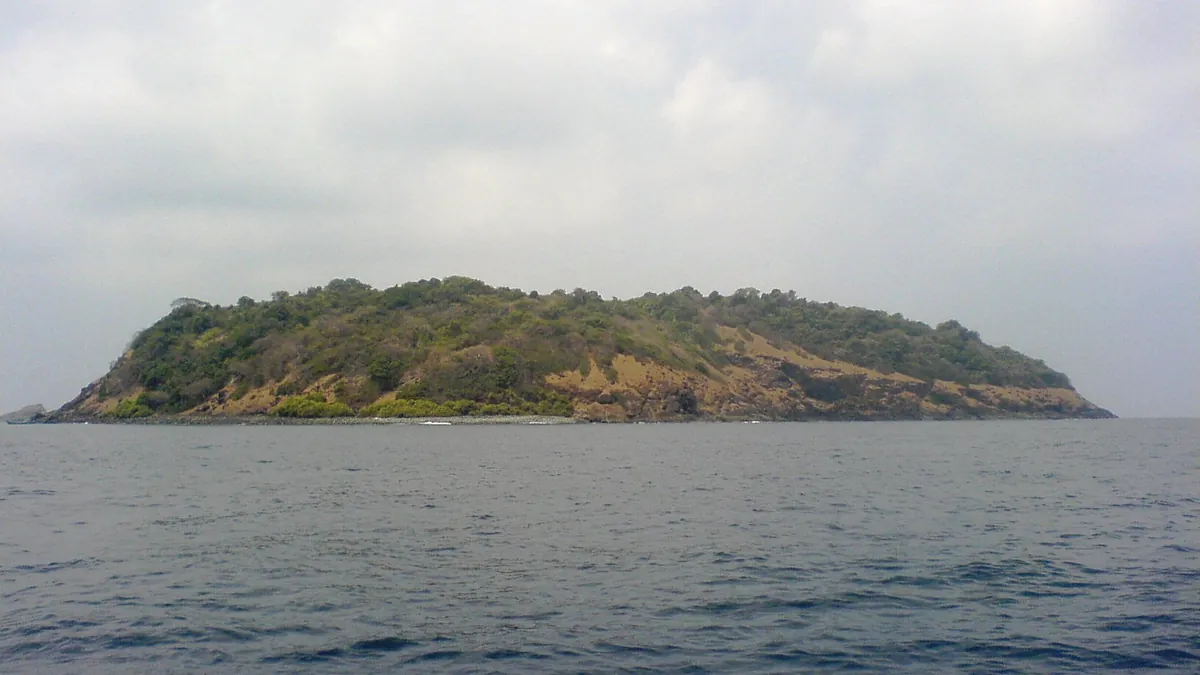
Netrani Island, also called Pigeon Island, is not in Goa. Karnataka Tourism places it 19 kilometers from Murudeshwar in the Arabian Sea, with boats and dives booked from that town. Goa's registration rules reach its own notified tourist areas, so a Goa shop running a Netrani day works in another state's water.
Karnataka's page is plain on two points. The island is uninhabited and “serves as a restricted naval area where public landing is strictly prohibited”, so every dive is from a boat. And the season it gives is November to May, with the instruction to plan strictly outside the monsoon. It quotes visibility of 15 to 30 meters, depending on the weather.
That contradicts Wikipedia's entry for the island, which says diving there is popular between June and September. The state that promotes the dive says the opposite, and its version matches what the monsoon does to the shelf water at Grande Island. Plan Netrani for the dry months, and confirm with the operator that it runs trips from Murudeshwar that season.
Goa's corals are CRZ-I A, and its turtle clause keeps motorboats off the shore
The national rule over this water is the Coastal Regulation Zone Notification, 2019, published as G.S.R. 37(E) on 18 January 2019. It reaches the water and the bed from the low tide line out to the 12 nautical mile territorial limit. Within that, CRZ-I A, the most critical class, lists corals and coral reefs by name, beside mangroves, sand dunes and protected areas.
Annexure I is blunter than the classification. Destruction of coral and coral reefs and their surroundings is a prohibited activity, and all coral is to be protected except small quantities needed for research. Active, live reefs, once identified and delineated, “shall be declared and notified” as ecologically sensitive areas under the Environment (Protection) Act 1986, and no detrimental activity is to be taken up in or around the coral.
The list of what counts as detrimental is concrete: mining, effluent and sewage discharge, dredging, ballast water discharge, ship washings, construction, and fishing other than traditional non-destructive fisheries. For a diver it translates simply. Do not take coral, do not stand on it, and treat the anchor question as yours to ask.
Goa's own policy adds a clause aimed at turtles. Clause 23 says no powered watercraft like jet skis, speed boats and motorized boats shall be permitted in sea waters close to the shore, because they would drive away turtles that stay in shallow water for weeks before landing to nest. Sail boats, windsurfing and kite surfing may be permitted. The clause does not say how close is close.
A foreign dive instructor in Goa needs a work visa and the state's approval
This is the section a nomad with an instructor card should read twice. Clause 9 of the water sports policy says no foreigner shall be permitted to work as an operator or instructor or as a partner without a valid work visa and the approval of the Government of Goa. That is two separate conditions, and the second is the state's, not the immigration service's.
Clause 21 sets the training bar for everyone. Operators shall employ only well trained personnel certified by the National Institute of Water Sports or another reputed institute the Department of Tourism specifies, trained for emergencies and rescue, with their character verified by the local police station. Their names and qualifications go to the department, which issues photo identity cards to be displayed at all times.
The consequences are stated too. Under clause 11, an operator who causes death or grievous injury to a tourist through neglect is debarred for three years, on top of any criminal liability. Under the 2005 rules, a breach can bring a fine of up to Rs 5,000 and suspension of registration. For freedivers, the freediving safety guide covers the buddy rules that no permit replaces.
Seven Goa watersports businesses sit in the SSI and IKO registers
Our Goa operator list holds 7 watersports businesses, read on 24 September 2026. Six are dive and freediving centers published by SSI in its register of affiliated centers, and one is a kite school published by IKO, filed under Morjim. Four of the seven publish a website in the register.
Freediving is unusually visible here. SSI rates four of its six Goa centers for Freediving, and one of them, FreeDive India, also for Mermaid and freediving instructor training; its own site offers freediving courses from Level 1 to Instructor and no scuba. The register files one center under Mormugao, the headland opposite Grande Island, and one under Mumbai, Maharashtra, which is where it is filed and not necessarily where it dives.
An SSI or IKO listing is not the Goa registration described at the top of this page. The register records affiliation with a training body on the date read, nothing about the boat, the teaching or whether a center is open this season, and absence from it means nothing. The Department of Tourism certificate is a separate document; ask for both. Which registers can be read explains the limits of each source, and the freediving destinations list puts Goa beside the alternatives.
Note: Conditions, safety guidance and regulations change. Verify current information with official sources, including the dive operator, the Department of Tourism, the Captain of Ports and the relevant government department, before you travel or dive.
FAQ: scuba diving in Goa
When is the diving season in Goa?
No Goa rule gives dates. The state’s water sports policy bars activity during monsoons without defining them, and the 2005 watersports rules limit operators to a fair season specified by the Captain of Ports. The India Meteorological Department puts the normal monsoon onset over Panjim at 7 June. Late in the 2022 monsoon, researchers measured water with no oxygen at all around Grande Island. Ask your operator which date its season opens.
Where do you dive in Goa?
Mostly around Grande Island, which the old Admiralty chart names Ilheu Grande, one of the Ilhas de San George off the Mormugao headland. A CSIR-National Institute of Oceanography team surveyed two reef sites there, Navy Bay and Shelter Cove. Suzy’s Wreck, usually identified as the SS Rita, lies at the island too. Netrani Island is in Karnataka, 19 km off Murudeshwar, outside Goa’s rules.
Do dive centers in Goa need a license?
They need a registration. The Goa Registration of Tourist Trade Act names scuba diving in its definition of a water sports operator, and section 19A bars that business in a notified tourist area without registration. The certificate lasts one year and has to be on board. For scuba, the 2022 document list adds an inspection report from the National Institute of Water Sports or an approved agency. Trading unregistered carries a fine of up to Rs 1,00,000.
Can a foreigner work as a dive instructor in Goa?
Not without two approvals. Clause 9 of Goa’s water sports policy says no foreigner shall be permitted to work as an operator, instructor or partner without a valid work visa and the approval of the Government of Goa. Clause 21 adds that staff must be certified by the National Institute of Water Sports or another institute the Department of Tourism specifies, with their character verified by the police.
How healthy is the coral at Grande Island?
At the two sites surveyed, Navy Bay and Shelter Cove, live coral averaged 41.16 percent, plus or minus 18.77, with Turbinaria the dominant coral. Dead coral with algae covered 13.3 percent, and sand, gravel and rubble 44.65 percent. The authors found an invasive encrusting sponge, Cliona, attacking Turbinaria and Favites, but called the island’s reefs relatively well maintained next to Palk Bay in Tamil Nadu.
Founder of NOMADREEF and a former digital nomad. This guide is sourced from the references below; conditions, prices and rules change, so verify current details, and follow qualified local guidance and safety briefings. About the author · LinkedIn ↗
Sources
- Scuba in the tourist trade law (primary). The Goa Registration of Tourist Trade Act, 1982 (Act 10 of 1982) and Rules, 1985, as amended, compilation published by the Department of Tourism: the list of amending acts including Act 7 of 2011 (10 June 2011, Official Gazette Series I No. 11 of 16 June 2011); section 2(k) defining a tourist area as one notified in the Official Gazette; section 2(kk) defining the tourist season for shacks as 1 October to 15 June; section 2(nn), inserted by Act 7 of 2011, defining a water sports operator as a person operating boats, parasailing, jet skis, kayaking, canoeing, rafting, scuba diving, etc., to tourists; section 19A on registration in a tourist area; section 19C on the one-year certificate; section 19D on refusal; section 22 on the fine of up to Rs 1,00,000 for trading without registration. Department of Tourism, Tourism Trade Act and Rules (PDF). Read 24 September 2026.
- The registration form (primary). Form XIV, Application for Registration of New Water Sports Activities / Renewal of Existing Water Sports Activities, with the activity codes 04 Kite surfing and 05 Scuba Diving and equipment code 06 Scuba Diving. Department of Tourism, Form XIV (PDF), linked from the department's water sports forms page. Read 24 September 2026.
- The documents a scuba operator files (primary). Department of Tourism order No. NS/3(865)2022-DT of 2 August 2022 on reduced documents under Ease of Doing Business: for water sports registration, insurance of Rs 2.00 lakh per passenger and crew members, vessel insurance, life-saving technique certificates from the National Institute of Water Sports, and item 13, an inspection report for scuba diving operations by NIWS or an approved agency, only in case of scuba diving activity, required for new registration and renewal. Department of Tourism, EoDB order (PDF). Read 24 September 2026.
- The water sports policy (primary). Department of Tourism notification N5/3[577]/20-DT, Policy for regulation of Water Sports in Goa, Official Gazette Series I No. 34 of 19 November 2020: the count of 602 registered water sports operators and 17 cruise boats given without a date; clause 9 on foreigners working as operator, instructor or partner; clause 11 on three-year debarment; clause 20 on the certificate on board and one-year validity; clause 21 on training, police verification and photo identity cards; clause 23 on powered watercraft near the shore and nesting turtles; clause 24(a) on hours of 8.00 a.m. to 6.30 p.m. or before sunset and on no activity in unsafe weather, monsoons, storms or notified periods. Official Gazette extract (PDF). Read 24 September 2026.
- The fair season and the 2003 fee table (primary). Notification No. 6/4(59)2005-DT, the Goa Tourist Places (Protection and Maintenance) (Boat Rides / Parasailing and Watersports activities) Rules, 2005: rule 2(b) defining the fair season as a season specified by the Captain of Ports; rule 3(xiv) limiting operation to one fair season; rule 5 on the fine of up to Rs 5,000. Rules 2005 (PDF). The Goa boat rides and watersports activities guidelines, 2003, Official Gazette Series I No. 12 (Extraordinary No. 3) of 23 June 2003, with scuba diving at Rs 1,000 per equipment: guidelines 2003 (PDF). Read 24 September 2026. The Captain of Ports’ own site returned HTTP 403 to every request on that date, so its current fair season dates and its circular on stopping water sports on designated beaches were not read: gap, needs human check.
- The monsoon normals (primary). India Meteorological Department, New Normal Dates of Onset/Progress and Withdrawal of Southwest Monsoon over India, 2020, Table 1: Panjim, Goa, normal onset 7 June on the 1961 to 2019 base and 7 June on the 1901 to 1940 base. IMD press release (PDF). The press release gives the normal withdrawal over Panjim as 14 October (new) against 10 October (existing), while the detailed IMD report of 15 May 2020 (PDF) lists 30 September and 14 October for the same station. Because the two disagree, no withdrawal date is given on this page. Read 24 September 2026.
- The end of the inland monsoon exception (secondary, triangulated). The 5 July 2023 notification, published 7 July 2023, allowing limited monsoon water sports in sheltered inland waters, the state’s statement to the High Court of Bombay at Goa that it would be rescinded, and its withdrawal in July 2026, reported by three independent outlets: The Navhind Times, digitalgoa and The Week. Triangulated: the notification itself sits on the Captain of Ports’ site, which could not be read. Read 24 September 2026.
- The version this page corrects (secondary). A Goa operator’s safety page stating that watersports are officially suspended during the monsoon (June to September) and giving fixed operating hours of 6:30 am to 6:30 pm: Atlantis Watersports, Is it safe to do watersports in Goa. Read 24 September 2026.
- The reef at Grande Island (primary). Nanda SS, Chatragadda R, Dalvi N, Rokkarukala S, Kumar AA (2026), Establishing Baseline Data and Monitoring Strategies for Coral Reefs in the Grand Island, Goa, and Palk Bay, Tamil Nadu, Through 3D Photogrammetry, in Monitoring Coastal Marine Ecosystems Under Climate Change, Springer, Cham, pp. 169–204: Navy Bay and Shelter Cove surveyed; Turbinaria dominant; live coral cover 41.16 ± 18.77 percent; dead coral with algae 13.3 ± 5.77 percent; sand, gravel and coral rubble 44.65 ± 14.33 percent; the invasive encrusting sponge Cliona on Turbinaria and Favites; Palk Bay’s toppled colonies and cement bags; Grande Island’s reefs relatively well maintained by comparison. doi:10.1007/978-3-032-09137-6_7 (abstract). Read 24 September 2026.
- The water over the reef (primary). Shirodkar G, Uskaikar H, Naqvi SWA, Pratihary A, Hussain A, Shenoy DM, Gauns M, Manikandan B, Manjrekar S, Patil A (2024), Seasonally varying biogeochemical regime around the coral habitats off central west coast of India, Marine Environmental Research 196: 106427: upwelling on the western Indian shelf during the southwest monsoon; late-monsoon 2022 values around Grande Island of 21.3 to 26.1°C, oxygen 0 to 4.9 mL L⁻¹ and pHT 7.506 to 7.927; complete anoxia with sulfide up to 5.9 µmol L⁻¹ at 17 m; the April 2017 episode; aragonite saturation of about 1.2 to 1.8 in October 2022; the contrast with Angria Bank. doi:10.1016/j.marenvres.2024.106427 (abstract). Read 24 September 2026.
- The island on the chart (primary). United Kingdom Hydrographic Office, Admiralty Chart No. 492, Enseada da Agoada and Baia de Mormugao, surveyed 1881, published 1884, new edition 1942: Ilheu Grande among the Ilhas de San George, two landings, “good water”, “big tree”, and the Recife de San George marked as drying 4 feet. Scan on Wikimedia Commons. Not current and not for navigation. Read 24 September 2026.
- Suzy’s Wreck (secondary, conflicting). A Goa dive site guide placing the SS Rita’s sinking around the 1950s near the south-west face of Grande Island at 5 to 12 m: Scubalov, Suzy’s Wreck; a news feature placing it in the 1960s, carrying rail tracks from Gujarat, at 13 to 14 m in the Zuari river near the island: Knocksense. Read 24 September 2026. The sources disagree, so the date, depth and dimensions of the ship are left out: gap.
- Corals under the coastal rules (primary). Ministry of Environment, Forest and Climate Change, Coastal Regulation Zone Notification 2019, G.S.R. 37(E) of 18 January 2019: the CRZ reaching the water and bed to the territorial limit of 12 nautical miles; CRZ-I A listing corals and coral reefs; Annexure I, paragraph 1.2, on the prohibition of destruction, notification of live reefs as ecologically sensitive areas and the list of detrimental activities. Gazette of India text, reproduced by the Odisha Coastal Zone Management Authority (PDF). Read 24 September 2026.
- Netrani Island (primary for the state’s position). Karnataka Tourism: 19 km from Murudeshwar; restricted naval area where public landing is strictly prohibited; best time November to May, strictly outside the monsoon; visibility 15 to 30 m depending on weather. Karnataka Tourism, Scuba Diving and Snorkelling at Netrani Island. The contrary June to September season: Wikipedia, Netrani Island (secondary). Read 24 September 2026. The Karnataka High Court’s orders on Navy target practice at the island are known here only from newspaper reports that refused automated requests on that date, so the court history is left out: gap, needs human check.
- Recompression. No primary source naming a recompression chamber in Goa open to recreational divers was found. A lead pointing to a Navy facility could not be confirmed, and the one hyperbaric clinic called Jeevanti that surfaced is in Navi Mumbai. No chamber is named on this page: gap.
- The seven businesses. Seven watersports businesses on the Goa operator list, read 24 September 2026: six published by SSI in its register of affiliated centers and one kite school published by IKO in its register of affiliated schools. Four of the seven publish a website in the register; SSI rates four centers for Freediving and one of them also for Mermaid and freediving instructor training; one center is filed under Mormugao and one under Mumbai, Maharashtra. The register’s town field records where a body files a business, not necessarily where it operates, and the limits of each source are set out on which registers can be read.