Gili Trawangan Diving: The Daily Park Ticket, Three Core Zones and the Sites Around Them
 by Yannick Schroth
Sep 25, 2026
14 min read
by Yannick Schroth
Sep 25, 2026
14 min read
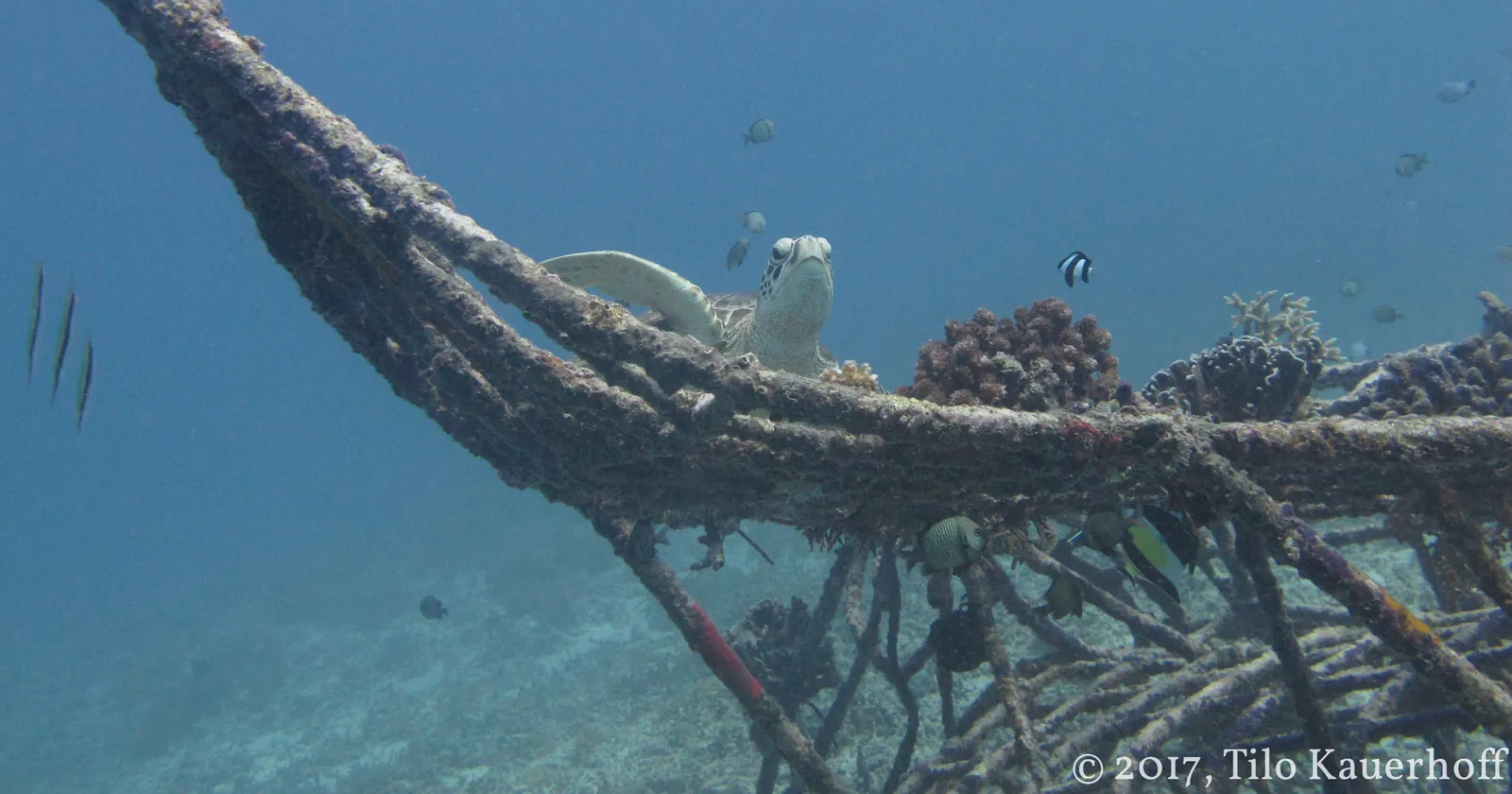
Photo: Tilo Kauerhoff (Tilonaut), Wikimedia Commons, CC BY 3.0. Cropped.
.jpeg)
Key takeaways
- Minister’s Decree 34 of 2022 revoked the 2009 designation and set the area at 2,268.59 hectares, with a core zone of 101.95 hectares split across the three islands
- Regulation 31 of 2020 lists water tourism as not permitted in a park’s core zone or its other zones, and permitted with conditions in the limited-use zone, including a local guide
- The Gilis are a Category B area, so the state ticket is Rp100,000 a day for a foreign visitor, or Rp500,000 for a year, plus Rp15,000 a day per scuba set
- The Gili Eco Trust contribution on many dive bills goes to a foundation and appears in neither the tariff regulation nor the 2025 rules on using conservation areas
- The 2023 management plan rates current as moderate to very strong at several sites, and calls Bounty Wreck the sunken parts of a pier rather than a ship
Gili Trawangan diving has been under the fisheries ministry since 2009
The reefs were not always a fisheries matter. The decree that made these waters a national marine conservation area, KEP.67/MEN/2009, signed on 3 September 2009, cites a handover record of 4 March 2009 transferring nature reserve and nature conservation areas from the Department of Forestry to the Department of Marine Affairs and Fisheries. It named the area a Taman Wisata Perairan, a marine tourism park, of about 2,954 hectares, and spelled the first island “Gili Ayer”.
That decree is no longer the one in force. Minister’s Decree 34 of 2022, set on 23 May 2022, declares the waters around Gili Air, Gili Meno and Gili Trawangan the Kawasan Konservasi Pulau Gili Air, Gili Meno, dan Gili Trawangan, managed as a Taman di Perairan, a park in the waters, of 2,268.59 hectares. Its sixth clause revokes the 2009 decree, and its preamble gives the reason: the area’s size and zoning had changed.
One detail is worth knowing if you look the decrees up yourself. The ministry’s legal database still lists the 2009 decree as in force and dates it to 8 March 2009, while the signed text carries 3 September 2009 and the 2022 decree says in its own words that the old one is “dicabut dan dinyatakan tidak berlaku”, revoked and declared no longer valid. The decree is the one to go by.
The 2022 decree hands management to the directorate general responsible for marine spatial management. On the water that means its technical unit in Kupang, long known as BKKPN Kupang, whose ministry information pages now carry the name Balai Pengelolaan Kelautan Kupang. “Gili Matra”, the ministry’s shorthand, simply joins the three island names. Where to live while you dive here is covered in the Gili Islands base guide, and whether to base here or on Bali’s east coast in Amed vs Gili; this page repeats neither.
Since 4 October 2024 the same water carries a second, international label. IMO resolution MEPC.396(82) designates the Nusa Penida Islands and Gili Matra Islands in Lombok Strait as one Particularly Sensitive Sea Area, and its four Gili corner points are exactly the outer boundary points of the 2022 decree. The protective measure attached to it is the Lombok Strait traffic separation scheme for ships, so it changes nothing about a dive; it is the reason the Gilis and Nusa Penida now share an instrument while being managed apart.
Three core zones around Gili Trawangan, Meno and Air are closed to recreational diving
The 2022 decree divides its 2,268.59 hectares three ways. The core zone covers 101.95 hectares, the limited-use zone 2,003.64 hectares, and 163.00 hectares are “other zones”: a rehabilitation zone of 46.43 hectares, a zone for buildings and marine installations of 56.69 hectares and a port and mooring zone of 59.88 hectares. The decree’s map draws the core zone as three patches, off the west coast of Gili Trawangan, off the north-west of Gili Meno and off the south-west of Gili Air.
What you may do in each zone is set by Regulation 31 of 2020 on managing conservation areas. Its annex tabulates activities zone by zone for a park-category area, and for kegiatan pariwisata alam perairan, nature tourism in the water, the entries read: core zone, not permitted; limited-use zone, permitted with conditions; other zones, not permitted. Research is the one use listed as permitted with conditions in all three. The rehabilitation and harbor zones are closed to tourism by the same row of the table, not only the core.
The conditions sit in the same annex. Water tourism must take place in the tourism subzone of the limited-use zone, at the locations designated for each activity, with the required permit, with safety equipment suited to the activity, and by people with the ability the activity demands. It must be “accompanied by a local tour guide or the conservation area manager”, and visitor numbers may not exceed the area’s carrying capacity.
On the published coordinates, the Trawangan core zone is a strip of the island’s west coast. The management plan’s entry and exit points put Shark Point just north of it and Sunset Reef, sold as Manta Point, just south of it, so two named west-side sites bracket water where no recreational dive is permitted. Ask where the boundary runs before a drift carries you along that coast.
Off Gili Meno the overlap looks direct. The plan gives the entry point of Meno Wall, one of its priority dive sites, as 8°20′30.4″ S, 116°03′04.6″ E. Plotted against points 11 to 18 of the decree, which outline the Gili Meno core zone, that point falls inside the polygon, about 140 meters from its nearest corner. That is a calculation from two published coordinate tables, not a statement by the park authority, and the plan’s table swaps its latitude and longitude headings. Ask your operator where a Meno Wall dive starts.
Two numbers do not agree. Indonesia’s submission annexed to the IMO resolution describes the Gili Matra core zone as 94.81 hectares of water and “a no-entry zone”; the decree gives 101.95 hectares, and the regulation is written as a list of permitted and prohibited activities rather than an entry ban. This page follows the decree. The zoning is enforced against other water sports too: on 8 May 2025 the Kupang unit told five jet-ski businesses in Senggigi that the zoning rules bar jet skis inside the area.
The Gili Trawangan park ticket is Rp100,000 a day for foreign divers, not once per stay
The charge dive shops add to the bill is a state entry ticket, the karcis masuk, and it is non-tax state revenue priced by Government Regulation 85 of 2021. Its annex has two bands. In a Category A area the daily ticket is Rp200,000 for a foreign visitor and Rp20,000 for an Indonesian; in Category B it is Rp100,000 and Rp10,000. The annual ticket is Rp1,000,000 for a foreigner in Category A and Rp500,000 in Category B.
Which band applies is set elsewhere. The directorate general’s 2024 technical guidance on issuing these tickets works an example for this park and states that, under Director General’s Decree 12 of 2024 amending Decree 7 of 2017, “TWP Gili Matra masuk dalam Kategori B”: Gili Matra is Category B. Its sample group of ten foreign snorkelers on 27 February 2024 pays Rp1,000,000 in tickets, ten at Rp100,000.
The unit in the regulation is per person per day. Several shops describe it as a one-off: one Trawangan dive center’s price page says all divers pay “a one-off Marine Park fee of IDR 100.000”. The rulebook version is a daily ticket, and at Category B rates the annual ticket costs the same as five daily ones. For six or more days in the water in a year, the annual ticket is cheaper.
The ticket is compulsory. Regulation 7 of 2025 on using conservation areas, set on 28 February 2025, requires every person carrying out nature tourism in a conservation area to hold one of its listed permits, the entry ticket among them, and exposes anyone without one to administrative sanctions. Water transport and customary or religious rituals are the listed exemptions. Tickets are issued through the ministry’s SEAPARK system, and the application asks for nationality and a valid identity document.
Equipment is priced on top. The same annex charges Rp15,000 a day per scuba set, Rp10,000 per snorkel set, Rp20,000 per underwater camera and Rp35,000 per underwater video camera. A tourist boat for fewer than 50 passengers costs Rp2,000,000 a day, but the guidance exempts boats named in the business license of an operator licensed for water-tourism services, and does not charge the ticket to that operator’s crew and guides. That is where an operator’s license shows up in your price.
The pandemic rate no longer drives the guidance. Regulation 35 of 2021 set the entry ticket at 25 percent of the tariff until six months after the end of the Covid-19 emergency response period as determined by the government, and the 2024 guidance calculates at the full rate.
The Gili Eco Trust charge on a Gili Trawangan dive bill is not a state fee
The second line many shops add goes to a foundation. The same Trawangan price page lists “a Gili Eco Trust funding of IDR 50.000” next to the park ticket. The Gili Eco Trust, Yayasan Ekosistem Gili Indah, traces its origin to reef damage in the 1997 to 1998 El Niño and to dynamite and cyanide fishing.
In 1999 local fishermen set up SATGAS to patrol the waters around the three islands, and the islands’ main dive shops then founded the trust to support it; its pages date that to 2000 on one page and 2001 on another.
Neither the 2021 tariff regulation nor the 2025 regulation on using conservation areas mentions it. The trust itself says it “relies on donations, grants and money we earn through our conservation and education projects”, and its donation page names mooring buoys, Biorock reef restoration, beach clean-ups and animal clinics among the uses. Paying it supports that work. Whether it is added to your bill is the dive shop’s pricing, not a requirement of Indonesian law.
Biorock on Gili Trawangan: what has been measured, and where
Biorock is the restoration method the trust is known for: steel frames carrying a low-voltage current, on which limestone minerals grow and to which corals are attached. On its own pages the trust counts 200 Biorock reef structures and dates the project to 2004. Those are the trust’s figures, and the photograph at the top of this page shows a green turtle resting on one of the frames.
The peer-reviewed record for this island is thinner than the reputation. A 2022 review in Frontiers in Marine Science by Thomas Goreau, who coined the name Biorock, uses Gili Trawangan for its photographs of healing: broken coral fragments collected one afternoon had polyps “fully expanded” after one night on an electrified mesh, and damaged tissue was regrowing after three and eight months in 2021. Those are observations, not measurements.
The one growth measurement in the same paper, corals growing 4.01 times faster than controls, comes from Pemuteran on Bali, and the paper itself calls it an underestimate because the controls also sat in the electrical field. The paper discloses that its author is chief scientist of Blue Regeneration, which it says holds the copyright on Biorock, and president of the Global Coral Reef Alliance. It also cites a 2012 book chapter on the Gili Trawangan project by Bakti and colleagues, which this guide did not read.
The management plan treats Biorock Reef Garden off Gili Trawangan as an ordinary dive site: fringing reef, hard coral cover of 10 to 20 percent, visibility of 5 to 10 meters, moderate current, suitable for all levels, and a ceiling of 366 divers a day, which it sets at half of the site’s computed carrying capacity.
Gili Trawangan dive sites in the 2023 management plan, from Shark Point to Deep Halik
Director General’s Decree 62 of 2023, set on 1 December 2023, adopts a management plan for 2023 to 2042, and it is the official document that describes the dive sites by name. It picks ten priority sites for high dive traffic, popularity and, at some, suspected reef decline from tourism: Shark Point and Glenn Nusa Wreck, Halik Reef, Sunset Reef, Bounty Wreck, Meno Wall, Turtle Heaven, Meno Slope, Shallow Turbo, Hans Reef and Air Wall. It then describes eight more.
Off Gili Trawangan, Shark Point runs to 25 meters; below 20 meters the plan records whitetip and blacktip reef sharks sheltering in crevices, and bumphead parrotfish schooling around the full moon. Halik Reef slopes to about 20 meters and is used for drift dives, with a deeper part to 40 meters for advanced divers. Deep Turbo, north-east of the island, drops from 16 to 32 meters. Deep Halik reaches about 45 meters, and the plan recommends it for Advanced divers at minimum.
Two names promise more than the text does. Sunset Reef, sold as Manta Point, averages 15 meters, and the plan says manta rays are “sometimes” found there in the rainy season from December to March. Bounty Wreck, off Gili Meno, is in the plan’s words not a shipwreck at all but sunken parts of a pier structure, to a maximum of 15 meters. It is a good dive, just not a wreck.
Current is what the plan repeats most. It rates it moderate to strong at Deep Turbo, Shallow Turbo and Deep Halik, and moderate to very strong at Simon’s Reef, Meno Corner, Mirko’s Reef and Air Slope, with water around 28°C. Simon’s Reef, north of Gili Meno, averages 25 to 40 meters, where the plan says divers usually use nitrox, and it is for Advanced divers. The drift diving guide covers what that kind of water asks of you.
Divers share the limited-use zone with small-scale fishing, and the plan says the two are divided “by agreement and by a time mechanism” because several dive spots overlap fishing grounds. The park’s own monitoring logged 900 water-tourism activities against 150 fishing activities in 23 rounds between February and December 2015, and 116 against 270 in 42 rounds between January and November 2020, the year tourism stopped.
.jpeg)
Where turtles turned up in the 2020 Gili Trawangan survey
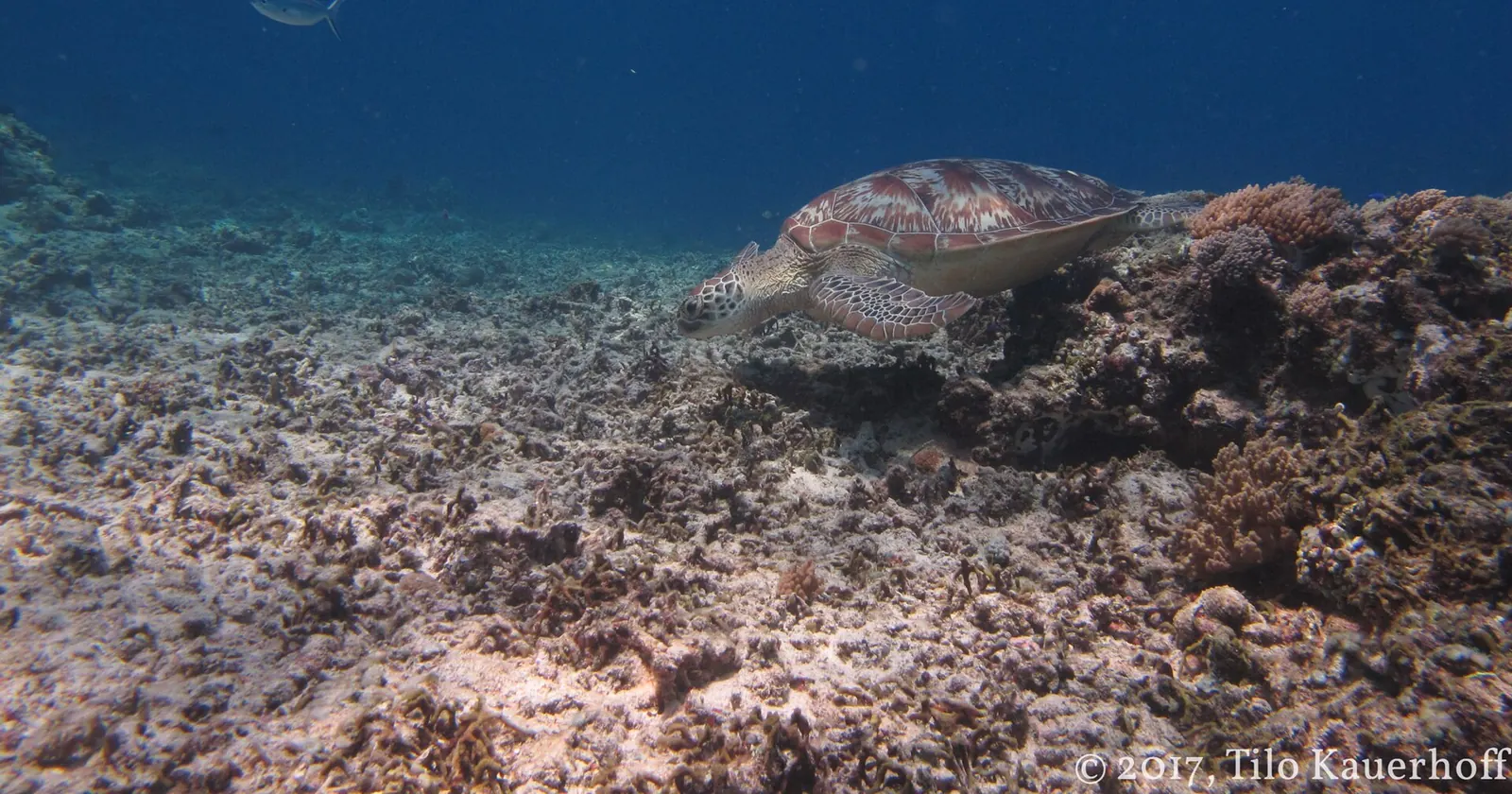
The park unit surveyed turtles in April, July and November 2020 and recorded 61 sightings of two species, green turtle and hawksbill, at 14 observation sites. Turtle Heaven, north of Gili Meno, accounted for 35 of them; Shark Point off Gili Trawangan for one. The turtles were at 5 to 15 meters, green turtles outnumbered hawksbills, and the survey built a photo-identification set of 48 images. The plan lists turtles under protected marine life.
Indonesia’s submission to the IMO names Gili Meno as the favorite of the three for nesting and feeding, because seagrass covers more than half its circumference. It puts seagrass at 58.5 hectares across the islands, 32.83 of them at Meno, and coral reef at 696.09 hectares, 287.02 of them around Gili Trawangan. On land, the trust’s Proyek Penyu project tracks nesting turtles and monitors nests until the hatchlings reach the sea.
The written rules that touch turtles are about behavior around them. Regulation 31 of 2020 bars water tourism that damages the ecosystem or endangers protected species, and tells boats to slow down and change course when a protected species crosses their path. The turtle swimming guide compares other places where the same etiquette applies.
Gili Trawangan divers: two hyperbaric chambers published on Lombok
Two public hospitals on Lombok publish a hyperbaric chamber on their own sites. RSUD Kabupaten Lombok Utara, in Tanjung, in the North Lombok regency that the Gilis belong to, lists a hyperbaric chamber among its services. RSUD H. Moh. Ruslan in Mataram describes hyperbaric oxygen as the main therapy for diving illness, naming decompression sickness and arterial gas embolism, and prices a US Navy Table 5 treatment for foreign patients at Rp2,598,750.
Neither page says whether the chamber is staffed around the clock. That is a question for your operator’s emergency plan and your insurer’s assistance line before the first dive, not after it; the dive insurance guide covers what a policy has to include for evacuation and chamber time.
Gili Trawangan dive operators: 22 listed, two assessed in person by Green Fins
The Gili Trawangan operator list holds 22 dive businesses, read on 21 September 2026. Twenty are published by SSI in its register of affiliated centers. Two are Green Fins members assessed in person within the last 12 months: Divine Divers as a Certified Gold Member and Gili Conservation Dive Center as a Certified Silver Member. Twenty-one of the 22 publish a website.
The list reaches beyond the island. Of the 20 SSI entries, the register’s town field names Gili Trawangan for four and Gili Air for four; the rest are filed under North Lombok, Lombok, Pemenang, Mataram, the province or the village of Gili Indah. SSI rates seven for Freediving and three for Extended Range, which describes the listing, not a course running this season.
Whether an operator holds the business license that exempts its boats from the daily boat charge is worth asking directly. Which registers can be read sets out what each source can and cannot prove.
FAQ: scuba diving on Gili Trawangan
How much is the marine park fee for diving Gili Trawangan?
The state entry ticket for a Category B conservation area, which is what Gili Matra is, costs Rp100,000 per foreign visitor per day and Rp10,000 per Indonesian under Government Regulation 85 of 2021. A foreign visitor can buy an annual ticket for Rp500,000 instead, the price of five daily ones. Scuba sets brought into the area are charged Rp15,000 a day each.
Is the Gili Eco Trust fee mandatory?
Not in law. The only conservation charge in the 2021 tariff regulation and the 2025 regulation on using conservation areas is the state entry ticket. The Gili Eco Trust is a foundation that says it relies on donations, grants and income from its projects, and dive shops that add its Rp50,000 line do so as their own pricing.
Can you dive in the core zones around the Gili Islands?
Not for recreation. Regulation 31 of 2020 lists nature tourism in the water as not permitted in the core zone and in the other zones of a park, and permitted with conditions only in the limited-use zone, where it must be accompanied by a local guide or the area manager. The 2022 decree puts the core zone at 101.95 hectares, off the west coast of Gili Trawangan, north-west Gili Meno and south-west Gili Air.
Where are you most likely to see turtles around Gili Trawangan?
In the park unit's 2020 survey, Turtle Heaven north of Gili Meno produced 35 of the 61 turtle sightings recorded at 14 sites, while Shark Point off Gili Trawangan produced one. The turtles were green turtles and hawksbills, seen at 5 to 15 meters, with green turtles the more common of the two.
Where is the nearest recompression chamber to Gili Trawangan?
On Lombok. RSUD Kabupaten Lombok Utara in Tanjung lists a hyperbaric chamber among its services, and RSUD H. Moh. Ruslan in Mataram describes hyperbaric oxygen as the main therapy for decompression sickness and prices a US Navy Table 5 treatment for foreign patients at Rp2,598,750. Neither page says whether its chamber is staffed around the clock.
Note: Conditions, safety guidance and regulations change. Verify current information with official sources, including the dive operator, the park authority and the relevant government department, before you travel or dive.
Founder of NOMADREEF and a former digital nomad. This guide is sourced from the references below; conditions, prices and rules change, so verify current details, and follow qualified local guidance and safety briefings. About the author · LinkedIn ↗
Sources
- The conservation area, its size and its zones (primary). Keputusan Menteri Kelautan dan Perikanan Nomor 34 Tahun 2022 tentang Kawasan Konservasi Pulau Gili Air, Gili Meno, dan Gili Trawangan di Provinsi Nusa Tenggara Barat, set 23 May 2022: diktum KESATU and KEDUA on the declaration and management as a “Taman di Perairan”; KETIGA on 2,268.59 ha, a core zone of 101.95 ha, a limited-use zone of 2,003.64 ha and other zones of 163.00 ha (rehabilitation 46.43 ha, buildings and marine installations 56.69 ha, port and mooring 59.88 ha); KEEMPAT with Lampiran I (boundary and zone coordinates) and Lampiran II (map); KELIMA on the directorate general for marine spatial management; KEENAM revoking KEP.67/MEN/2009. The Meno Wall overlap is a point-in-polygon calculation for this page: the plan’s entry point for Meno Wall tested against core-zone points 11 to 18 of Lampiran I, taken in the order listed. Kepmen KP 34/2022 (PDF, 10 pages, JDIH KKP) and JDIH record. Read 25 September 2026.
- The 2009 designation and the handover from forestry (primary). Keputusan Menteri Kelautan dan Perikanan Nomor KEP.67/MEN/2009, signed 3 September 2009: the handover record BA.01/Menhut-IV/2009 and BA.108/MEN.KP/III/2009 of 4 March 2009 from the Department of Forestry to the Department of Marine Affairs and Fisheries; designation as Taman Wisata Perairan Pulau Gili Ayer, Gili Meno, dan Gili Trawangan of about 2,954 ha. KEP.67/MEN/2009 (PDF, JDIH KKP). The JDIH record shows the status “Berlaku” and the date 8 March 2009, which the signed text and the 2022 revocation contradict. Read 25 September 2026.
- What is permitted in each zone (primary). Peraturan Menteri Kelautan dan Perikanan Nomor 31/PERMEN-KP/2020 tentang Pengelolaan Kawasan Konservasi, set 22 September 2020, promulgated 9 October 2020 (Berita Negara 2020 No. 1165): Lampiran, table A, row 11 (“Kegiatan pariwisata alam perairan”) for a taman: core zone “Tidak Diperbolehkan”, limited-use zone “Diperbolehkan dengan Syarat”, other zones “Tidak Diperbolehkan”; row 5 on research; table B, item 11, conditions 1 to 13, including the tourism subzone, the local guide or manager, ability, safety equipment and carrying capacity; shipping conditions on slowing and changing course for protected species. Permen KP 31/2020 (PDF, 58 pages, JDIH KKP), listed as in force on its JDIH record. Read 25 September 2026.
- The dive sites, currents, turtles and monitoring (primary). Keputusan Direktur Jenderal Pengelolaan Kelautan dan Ruang Laut Nomor 62 Tahun 2023 tentang Rencana Pengelolaan Kawasan Konservasi Pulau Gili Air, Gili Meno, dan Gili Trawangan Tahun 2023–2042, set 1 December 2023: section 2.2.2.2 on the April, July and November 2020 turtle survey (61 sightings, 14 sites, Turtle Heaven 35, Shark Point 1, 5 to 15 m, 48 identification photos); section 2.5 on monitoring in 2015 and 2020; section 3.4.2 on dive spots overlapping fishing grounds; table 23 and sections 3.4.4.1 to 3.4.4.19 on the ten priority sites and the entry and exit points, depths, current, visibility, the 28°C water, Bounty Wreck as sunken pier structures, mantas at Sunset Reef in December to March, Simon’s Reef and nitrox, and the Biorock Reef Garden ceiling of 366 divers a day. Kepdirjen PKRL 62/2023 (PDF, 133 pages, JDIH KKP). The JDIH record titles the plan “2023 – 2024”; the decree itself says 2023 to 2042. Read 25 September 2026.
- The ticket prices (primary). Peraturan Pemerintah Nomor 85 Tahun 2021 tentang Jenis dan Tarif atas Jenis Penerimaan Negara Bukan Pajak yang Berlaku pada Kementerian Kelautan dan Perikanan, 19 August 2021: Pasal 7 on categories A and B; Lampiran, item XI.B, daily and annual tickets (Category A Rp200,000 and Rp20,000 a day, Rp1,000,000 a year for foreigners; Category B Rp100,000 and Rp10,000 a day, Rp500,000 and Rp50,000 a year) and equipment brought in (tourist boat under 50 passengers Rp2,000,000, underwater camera Rp20,000, underwater video Rp35,000, scuba set Rp15,000, snorkeling set Rp10,000, each per unit per day). PP 85/2021 with its annex (PDF, 170 pages, KKP). The 24-page copy on JDIH KKP carries the body and elucidation without the tariff annex, so the tariffs were read on annex pages 126 to 129 of this copy. Read 25 September 2026.
- Gili Matra as Category B, and who pays for what (primary). Keputusan Direktur Jenderal Pengelolaan Kelautan dan Ruang Laut Nomor 71 Tahun 2024 tentang Petunjuk Teknis Penerbitan Izin Kegiatan Penelitian, Pendidikan dan Pariwisata Alam Perairan di Kawasan Konservasi Nasional: section 3.3.3 on the tickets, the exemption for crew and guides of businesses licensed under KBLI 91039 and for tourist boats named in that license; section 3.4.3(a), the worked example for TWP Gili Matra of 26 February 2024, citing Kepdirjen PKRL 12/2024 amending Kepdirjen PRL 7/2017 for Category B. Kepdirjen PKRL 71/2024 (PDF, SEAPARK). Kepdirjen PKRL 12/2024 itself was not read, so the category rests on this guidance and not on the categorizing decree. Read 25 September 2026.
- The ticket is compulsory (primary). Peraturan Menteri Kelautan dan Perikanan Nomor 7 Tahun 2025 tentang Pemanfaatan Kawasan Konservasi, set 28 February 2025: Pasal 2(1) and (2) requiring a permit, entry ticket included, for nature tourism; Pasal 2(3) exempting water transport and customary and religious rituals; Pasal 2(5) on administrative sanctions; Pasal 19 and 20 on the ticket, the equipment it covers and the application; Pasal 30 revoking Permen KP 47/PERMEN-KP/2016. Permen KP 7/2025 (PDF, SEAPARK) and the ministry’s JDIH announcement. The SEAPARK copy leaves the promulgation date blank. Read 25 September 2026.
- The pandemic rate (primary). Peraturan Menteri Kelautan dan Perikanan Nomor 35 Tahun 2021, promulgated 7 September 2021: Pasal 7(1) and (2) setting a 25 percent tariff on entry tickets and equipment until six months after the end of the Covid-19 emergency response period as determined by the government. Permen KP 35/2021 (PDF, SEAPARK) and JDIH record. The government determination that ended the emergency period was not traced, so this page does not state the date the reduced rate ended. Read 25 September 2026.
- The IMO designation (primary). Resolution MEPC.396(82), adopted 4 October 2024, Designation of the Nusa Penida Islands and Gili Matra Islands in Lombok Strait as a Particularly Sensitive Sea Area: annex 1, table 2 (the four Gili Matra points, identical to the outer boundary in Lampiran I of Kepmen KP 34/2022); annex 2, paragraphs 1.5 and 1.6 (coral reef 696.09 ha, 287.02 ha at Gili Trawangan; seagrass 58.5 ha, 32.83 ha at Gili Meno; Gili Meno as the favored nesting and feeding island); annex 3, paragraph 1.3 (a core zone of 94.81 ha described as a no-entry zone); annex 4 (the traffic separation scheme). The annexes reproduce Indonesia’s submission MEPC 82/12. MEPC.396(82) (PDF, IMO). Read 25 September 2026.
- The managing unit and the jet-ski ban (primary). Ministry information pages of the Kupang unit: “Pembinaan dan Sosialisasi Larangan Operasional Jetski di Kawasan Konservasi Gili Matra”, on the 8 May 2025 visit to five jet-ski businesses in Senggigi under the zoning of Kepdirjen PKRL 62/2023. PPID Balai Pengelolaan Kelautan Kupang and the unit’s page on state revenue, headed Balai Pengelolaan Kelautan (BPKel) Kupang. The regulation renaming the unit was not read. Read 25 September 2026.
- What one Trawangan dive center bills (primary for its own prices). “All divers are required to pay a one-off Marine Park fee of IDR 100.000 and a Gili Eco Trust funding of IDR 50.000.” Trawangan Dive, fun diving prices. One operator’s wording, quoted as such. Read 25 September 2026.
- The Gili Eco Trust in its own words (primary for its own claims). Its history, SATGAS in 1999, the dive shops founding the trust in 2000, the Biorock project from 2004 and the description of the method: Reef Restoration; founded in 2001 and the 1997 to 1998 El Niño: Our Story; reliance on donations, grants and project income, and the uses listed: Donate; 200 Biorock reef structures and Proyek Penyu: home page. Read 25 September 2026.
- Biorock in the literature (primary, peer-reviewed review). Goreau TJF (2022), Coral Reef Electrotherapy: Field Observations, Frontiers in Marine Science 9: 805113, a review article published 12 May 2022: figure 4, the Gili Trawangan photographs of broken fragments after one night of electrical stimulation and of healing tissue on 23 February and 4 June 2021; figure 3, the Pemuteran, Bali measurement of Biorock corals growing 4.01 times faster than controls, described there as an underestimate; the conflict-of-interest statement; reference 1, Bakti et al. (2012), Biorock Reef Restoration in Gili Trawangan, North Lombok, Indonesia, CRC Press, not read for this guide. doi:10.3389/fmars.2022.805113. Read 25 September 2026.
- The hyperbaric chambers (primary). RSUD Kabupaten Lombok Utara, Hyperbaric Chamber, Jl. Tioq Tata Tunaq, Tanjung; RSUD H. Moh. Ruslan Kota Mataram, Hyperbaric Chamber, with the tariff for US Navy Table 5 for foreign patients of Rp2,598,750. The Gilis’ regency is taken from the ministry’s 25 June 2025 notice signed at the village hall of Gili Indah, Gili Air, North Lombok. Neither hospital page states opening hours for the chamber. Read 25 September 2026.
- The 22 businesses. Twenty-two dive businesses on the Gili Trawangan operator list, read 21 September 2026: twenty published by SSI in its register of affiliated centers, two Green Fins members read from the Green Fins member register. The register’s town field records where a body files a business, not necessarily where it operates; the limits of each source are set out on which registers can be read.
- Gaps. The forestry-era designation of 2001 that secondary sources cite was not read at its source, so this page dates the ministry’s role from the 2009 handover only. The turtle protection status in national wildlife law was not read at its source and is not stated. No fact on this page is triangulated; every figure comes from the single primary source named for it.