Galapagos Diving: Day Boats from Santa Cruz, Liveaboards to Wolf and Darwin, and the Park's Fees and Rules
 by Yannick Schroth
Nov 10, 2026
12 min read
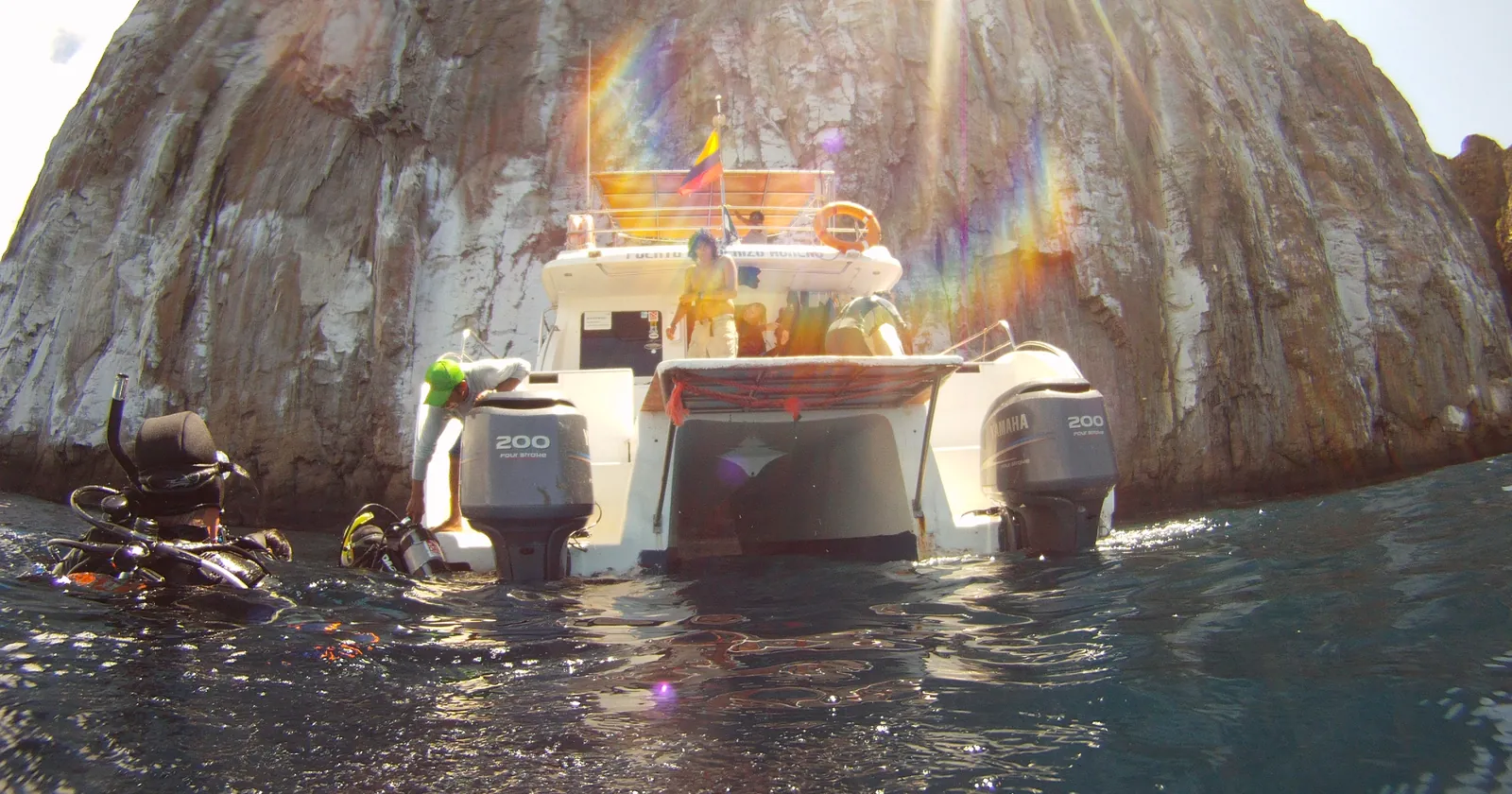
Divers and their boat at Kicker Rock, off San Cristóbal. MusikAnimal, Wikimedia Commons, CC BY-SA 4.0, cropped.

Key takeaways
- Day boats from Puerto Ayora rotate through central sites such as Gordon Rocks, North Seymour, Mosquera, Daphne, Santa Fe and Floreana; Wolf and Darwin are dived from liveaboards
- Most foreign tourists over 12 pay a $200 park fee each time they enter, collected at the Galápagos airports, plus a $20 Transit Control Card bought at Quito or Guayaquil airport
- Galápagos law caps tourists at 60 days a year, requires private health insurance and bars any gainful activity; it has no residence category for remote workers
- NOAA's averages put the sea off Santa Cruz at about 21.8 °C from August to September and 26.8 °C in March, and Wolf and Darwin two to three degrees warmer
- Aggressor names a chamber in Puerto Ayora and says it is open 24 hours; we could not confirm that with the health ministry. The emergency number is 911
Galapagos diving: two ways to do it
Everything under the water here belongs to the Galápagos Marine Reserve, which by law covers all the sea within 40 nautical miles of the archipelago's baselines. The park's management plan lists the recreational dive sites island by island, from Gordon Rocks and Punta Carrión off Santa Cruz to León Dormido and Five Fingers off San Cristóbal, Cabo Marshall and Roca Redonda off Isabela, and the far northern islands of Wolf, with La Ventana, La Banana, El Derrumbe and Shark Bay, and Darwin, with El Arco and El Arenal. Diving is licensed in two separate forms: the daily dive tour and the liveaboard dive tour, each needing its own park operating licence. Which one you choose decides which of those sites you can reach.
The dive centres we found on the islands, with prices from their own websites, are in our Galápagos list.
Day boats from Santa Cruz, San Cristóbal and Isabela
Puerto Ayora on Santa Cruz is where the day-dive shops we could read are based. Academy Bay Diving runs a fixed weekly rota: Floreana's Punta Cormorant with Enderby or Champion on Mondays, Santa Fe on Tuesdays, North Seymour Canal and Mosquera South on Wednesdays, Gordon Rocks on Thursdays and Sundays, Mosquera and Daphne on Fridays, and North Seymour Point with Mosquera North on Saturdays. Its boats leave at 7 in the morning and are back at about 3 in the afternoon, with two dives, all equipment including 5 and 7 mm wetsuits and a hood, and lunch.
Gordon Rocks is the dive most people come for and the one shops are most careful about. Scuba Iguana puts it about an hour east of Santa Cruz and takes only Advanced divers with at least 25 dives, or similar experience, whose last dive was within twelve months; it warns of very strong currents and few visual references. Academy Bay says the site can have strong currents, advises against making it your first dive day, and reserves the right to cancel if its guides judge you not ready. If you plan several days, build up to it.
San Cristóbal and Isabela also have day diving. San Cristóbal's best-known site is León Dormido, or Kicker Rock, on the park's list; Isabela's include Isla Tortuga and Roca 4 Hermanos. We found prices for these only on resale sites, not on any local shop's own page, so ask the shops directly.
Liveaboards to Wolf and Darwin
Wolf and Darwin lie far north of the central islands, and every trip to them we found is a liveaboard. The operators describe schooling hammerheads, Galápagos and silky sharks, and seasonal whale sharks there. Galapagos Sky's seven-night cruise leaves from San Cristóbal and spends three full days at the two islands: four dives at Wolf including a night dive, four at Darwin, then two at Darwin and one more at Wolf, for 18 dives in the week. It calls Darwin's main site The Pillars, the former arch, and says the islands' cliffs rule out any landing. Explorer Ventures' Humboldt Explorer and Tiburon Explorer spend three to four days there, five on ten-night trips.
These are not beginner trips. Galapagos Sky recommends 50 to 100 open-water dives and experience in current, gives typical depths of 20 to 30 meters and warns of negative back-roll entries from small boats. Explorer Ventures says its itinerary is best for divers with at least 100 logged dives.
Itineraries differ by boat. Galapagos Sky says it visits Wolf and Darwin on every trip, all year. Aggressor's guest guide, updated in August 2026, says its Galapagos Aggressor III follows the park's approved seasonal schedule and goes to Darwin and Wolf from June to December, focusing on Roca Blanca, Cowley and Cabo Marshall from January to May. If the northern islands are the point of your trip, check the dates of the boat you book.
The park's rules for divers
The Galápagos National Park Directorate sets the rules, and it issued new rules in 2026. Its January 2024 visitor rules, the last version we could read in full, allow visits only with a guide qualified and authorized by the park, require at least two meters' distance from animals, camera gear included, and ban touching or feeding them, using flash, or taking sand, coral or shells. Those rules end diving at 17:00 and allow night diving from 18:00 to 22:00 at designated sites, and they restrict sunscreens containing oxybenzone and octinoxate. New rules signed in August 2026 and published in September make an accredited naturalist guide compulsory, according to a legal publisher and two Ecuadorian news outlets; we could not find the new text on the park's site, so we cannot say whether the dive hours changed.
A 2008 park resolution set one naturalist guide for every eight divers on scuba dives in the reserve. We could not confirm it is still in force. The tourism regulation, as the park quotes it in its 2026 permits, bans motorized diving equipment, underwater scooters and spearfishing for tourists. Only artisanal commercial fishing is allowed in the reserve.
Dive operators need a park licence for their modality, and Galápagos law gives preference to companies based in the islands and formed mainly by permanent residents. Guiding tourists at visitor sites without a park licence is an offence under the same law. Because the visitor rules allow visits only with a park-authorized guide, visitors cannot dive the reserve on their own.
North-west of the reserve, Ecuador created the Hermandad Marine Reserve by decree in January 2022: 60,000 square kilometers of open ocean, half of it closed to all extraction and half open to fishing except longlines. It is open ocean rather than a dive area; the park's management plan says its no-take half protects migration routes and feeding areas of threatened marine species.
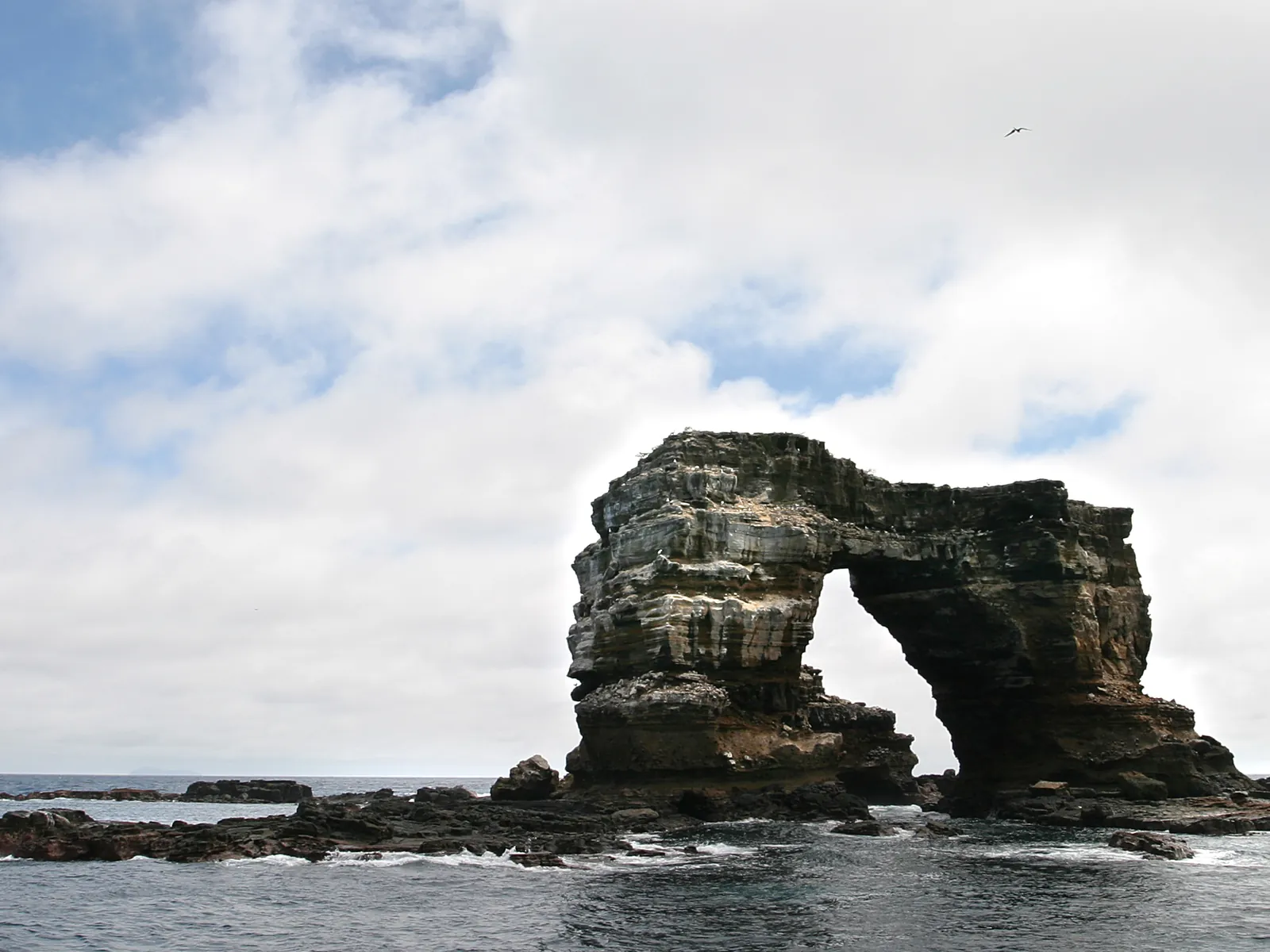
Darwin's Arch in 2003; Galapagos Sky now calls the site The Pillars, the former arch. refractor, Wikimedia Commons, CC BY 2.0, cropped.

Fees and paperwork on arrival
Galápagos' government council raised the park entry fee for foreign tourists over 12 from $100 to $200 with effect from 1 August 2024; children under 12 pay $100, nationals of Andean Community and Mercosur countries $100, and Ecuadorians and foreign residents of Ecuador $30. Under-twos are exempt. The park's 2026 collection rules say the fee is paid each time a tourist enters the province, at the park's counter in the airports, in US dollars cash, by card or by transfer; no other currency and no traveller's cheques.
Before that, at Quito or Guayaquil airport, you buy the Transit Control Card from the government council for $20, again per trip. The council tells travellers to show ID and a return ticket, to pre-register online, and to arrive three hours before the flight. The card is checked on entry and exit. Galápagos law also requires foreign tourists to have private health insurance before they arrive.
When to dive: two seasons and the water by month
Local shops describe two seasons. Academy Bay calls January to May the warm, rainy season with water of 24 to 28 °C and sharp thermoclines, and June to November the cold, misty Humboldt season with 19 to 23 °C. It warns that thermoclines, usually at 12 to 18 meters, can bring the water down to 13 °C at depth. Galapagos Sky calls December to May manta season and June to November whale shark season; it says whale sharks are frequently seen at Darwin from June to November, while Explorer Ventures gives July to November. These are operators' observations, not official counts.
NOAA's satellite averages for 1991 to 2020, which we computed for five cells, show the same pattern at the surface:
| Month | Off Puerto Ayora, Santa Cruz | Off Puerto Baquerizo Moreno, San Cristóbal | Wolf | Darwin |
|---|---|---|---|---|
| January | 24.7 °C | 24.8 °C | 26.1 °C | 26.2 °C |
| March | 26.8 °C | 26.7 °C | 27.3 °C | 27.5 °C |
| May | 24.9 °C | 24.9 °C | 26.1 °C | 26.4 °C |
| July | 22.6 °C | 22.7 °C | 24.6 °C | 24.9 °C |
| September | 21.8 °C | 22.0 °C | 24.5 °C | 24.8 °C |
| November | 22.6 °C | 22.9 °C | 24.8 °C | 25.0 °C |
The coolest months off Santa Cruz are August and September, at about 21.8 °C, and the warmest is March. The cell off Puerto Villamil on Isabela runs slightly cooler still in the cold season, about 21.4 °C in September. Wolf and Darwin stay above 24 °C all year. All of these are surface figures; at depth, below a thermocline, the water can be much colder. We found no storm-season statement from Ecuador's weather or navy oceanographic services that we could read.
Chamber and emergencies
Ecuador's emergency number is 911. The ECU 911 service coordinates police, fire, the health ministry and the Red Cross through that single number, free from any phone, around the clock.
For decompression illness, Aggressor's guest guide names the Protesub chamber, part of the SSS recompression network, in Puerto Ayora, and says it is open 24 hours. Academy Bay says a modern recompression chamber is available and works as a Divers Alert Network referral center. We could not reach Ecuador's health ministry to confirm either statement, so treat the 24-hour claim as the operator's. The liveaboards charge for it: Galapagos Sky adds a $35 chamber fee, which it calls a donation that does not cover any treatment, and Explorer Ventures bills a chamber support fee. Galapagos Sky requires every guest to hold dive-accident insurance. Wolf and Darwin are the farthest dive sites from Puerto Ayora, so check that your dive insurance covers evacuation as well as treatment.
What diving the Galápagos costs
Prices on the operators' own pages, read on 10 November 2026, in US dollars per person:
| Operator | Trip | Price |
|---|---|---|
| Academy Bay Diving, Puerto Ayora | Day trip, two dives, gear and lunch | from $250 |
| Humboldt Explorer (Explorer Ventures) | 7 nights, July 2026 to June 2027 | $6,395 |
| Tiburon Explorer (Explorer Ventures) | 7 nights, July 2026 to June 2027 | $7,395 |
| Galapagos Sky | 7 nights, 2026 and 2027 | $7,495 to $7,795 |
| Galapagos Sky | 10 nights, 2026 and 2027 | $8,890 to $9,290 |
Academy Bay says a week of daily dives saves nearly 15%. On the liveaboards, the park fee, the transit card, the chamber fee and the domestic flight come on top; Galapagos Sky includes nitrox, Explorer Ventures charges for it, and Explorer Ventures bills solo travellers who want their own cabin 80% extra. Humboldt Explorer's seven-night price rises to $6,495 from July 2027.
Getting to the Galápagos
All visitors fly from mainland Ecuador. Seymour airport on Baltra, run by ECOGAL, lists Avianca and LATAM as its airlines, plus two air-taxi services. The park counted 71% of first-half 2026 arrivals at Baltra and 29% at San Cristóbal, plus 42 tourists on private flights to Isabela. Galapagos Sky, whose cruises start in San Cristóbal, tells guests that Avianca flies there non-stop from Guayaquil and from Quito with a stop in Guayaquil. Baltra is the airport for Puerto Ayora and the day boats; San Cristóbal for its own town and the boats that start there. Allow for the three-hour check-in the government council asks for.
The Galápagos as a remote-work base
This is where the islands are hard. Galápagos has its own residence law, separate from mainland Ecuador's immigration rules. A tourist, Ecuadorian or foreign, may stay at most 60 days in a year, counted from the first entry, with no extension, and may not carry out any gainful activity in the province; overstaying leads to a sanction procedure and, if needed, removal. Temporary residence there is limited to listed groups such as spouses of residents, public servants, employees of island companies, sponsored researchers and volunteers. There is no category for remote workers, and we found no official guidance on whether working online for a foreign employer counts as gainful activity, so do not assume it is allowed.
Ecuador itself has a digital-nomad residence visa. We could not open the foreign ministry's site. Several visa guides and the government's procedure listing, as shown in search results, give the income bar as three basic wages a month from a foreign source; with the 2026 basic wage at $482, according to four Ecuadorian news reports, that is $1,446. Check with a consulate before you apply. The visa does not change the Galápagos rules, which apply to Ecuadorians too. Galapagos Sky says phones with international roaming generally work on San Cristóbal and Santa Cruz; we found no official internet figures.
Who Galápagos diving suits
Galápagos diving suits an experienced diver who wants big animals in current and can pay for a week on a liveaboard to Wolf and Darwin, or a diver with a few weeks who bases in Puerto Ayora and works up to Gordon Rocks on day boats. A remote worker can fit both into the 60-day tourist limit and spend the rest of the year on the mainland; for diving there, see our Puerto López guide. It suits less well a new diver who wants calm, warm water, anyone who wants to dive without a guide, or a nomad who wants to settle on the islands for months.
FAQ: Galapagos diving
Can you dive Wolf and Darwin on a day trip?
No trip we found does it. Wolf and Darwin are dived from liveaboards, which spend three to five days there on seven- and ten-night cruises. Day boats from Puerto Ayora dive central sites such as Gordon Rocks, North Seymour, Mosquera, Daphne and Santa Fe.
How much is the Galapagos National Park fee?
For foreign tourists over 12 it is $200, in force since 1 August 2024, and it is paid each time you enter, at the park counter in the Galápagos airports. Children under 12 pay $100. You also need a $20 Transit Control Card, bought at Quito or Guayaquil airport before the flight.
When is the best time to dive the Galapagos?
Operators describe a warm season from about December or January to May, with calmer water around 24 to 28 °C, and a cool season from June to November, around 19 to 23 °C, when they report more whale sharks. NOAA's averages put the surface off Santa Cruz at 21.8 °C in August and September and 26.8 °C in March.
Is there a hyperbaric chamber in the Galapagos?
Aggressor names the Protesub chamber in Puerto Ayora on Santa Cruz and says it is open 24 hours; Academy Bay says a chamber works as a DAN referral center. We could not confirm this with Ecuador's health ministry. In an emergency call 911.
How long can a tourist stay in the Galapagos?
At most 60 days a year, counted from the first entry and not extendable, under the Galápagos special-regime law. Tourists may not carry out gainful activity, and the law has no residence category for remote workers.
Note: Conditions, safety guidance and regulations change. Verify current information with official sources, including the dive operator, the park authority and the relevant government department, before you travel or dive.
Founder of NOMADREEF and a former digital nomad. This guide is sourced from the references below; conditions, prices and rules change, so verify current details, and follow qualified local guidance and safety briefings. About the author · LinkedIn ↗
Sources
- Marine reserve, residence and stay limits (primary). Ley Orgánica de Régimen Especial de la Provincia de Galápagos, Registro Oficial 520 of 11 June 2015 (PDF, FAOLEX copy), articles 40 to 44, 49, 58 and 65. Read 10 November 2026.
- Dive sites and modalities (primary). Galápagos National Park Directorate, management plan 2014 (PDF), table 14; Ministry of Environment, Acuerdo Ministerial 086 of 13 August 2018 (PDF). Read 10 November 2026.
- Park rules (primary). Galápagos National Park Directorate, visitor rules, Resolución 0000007 of 29 January 2024 (PDF); Resolución 0037 of 12 May 2008 (PDF), article 5; Resolución MAE-DPNG/DUP-2026-0035-RM (PDF), quoting article 35 of the tourism regulation. The 2026 visitor rules as summarised by Lexis, Primicias and Vistazo (secondary). Read 10 November 2026.
- Hermandad Marine Reserve (primary). Galápagos National Park Directorate, Hermandad management plan (PDF). Read 10 November 2026.
- Fees and transit card (primary). Government Council of Galápagos, Resolución 002-CGREG-24-02-2024 (PDF) and transit card questions and answers; Galápagos National Park Directorate, fee collection rules, Resolución MAE-PNG/DIR-2026-0010-RM (PDF) and fee table (PDF). Read 10 November 2026.
- Sea temperature. NOAA PSL, OISST v2.1 monthly long-term means 1991–2020, cells 0.875°S 90.375°W (Santa Cruz), 0.875°S 89.625°W (San Cristóbal), 1.125°S 90.875°W (Isabela), 1.375°N 91.875°W (Wolf) and 1.625°N 92.125°W (Darwin), computed for this page (primary). Seasons as described by Academy Bay Diving, Galapagos Sky and Explorer Ventures (operators). Read 10 November 2026.
- Chamber and emergency number. ECU 911 (primary); Aggressor, Galapagos Aggressor III guest guide (PDF), updated 17 August 2026; Academy Bay Diving FAQ; Galapagos Sky FAQ (operators). Read 10 November 2026.
- Dive trips and prices (each operator primary for itself). Academy Bay Diving, day trips; Scuba Iguana, Gordon Rocks; Explorer Ventures, pricing; Galapagos Sky, cruise rates. Read 10 November 2026.
- Getting there. ECOGAL, Seymour airport airline directory (primary); Galápagos National Park Directorate, visitor report, first half of 2026 (PDF) (primary); Galapagos Sky, flight information (operator). Read 10 November 2026.
- Staying and working. Galápagos residence and stay rules from the special-regime law above (primary). The 2026 basic wage from Primicias, El Diario, Vistazo and El Universo (triangulated). Read 10 November 2026.
- Left out. The full text of the August 2026 visitor rules, including dive hours and guide ratios; official confirmation of the Puerto Ayora chamber and its hours, since Ecuador's health ministry site refused connections; the digital-nomad visa terms from the foreign ministry, which also refused connections, and Ecuador's visa-free stay length; day-dive prices from San Cristóbal and Isabela shops' own pages; a storm-season statement from Ecuador's weather or navy services; and official hammerhead and whale shark seasons, which we have only from operators.