Fethiye Diving: Göcek’s Closed Box, Gemiler Island and a Plane at 257 Meters
 by Yannick Schroth
Sep 25, 2026
15 min read
by Yannick Schroth
Sep 25, 2026
15 min read
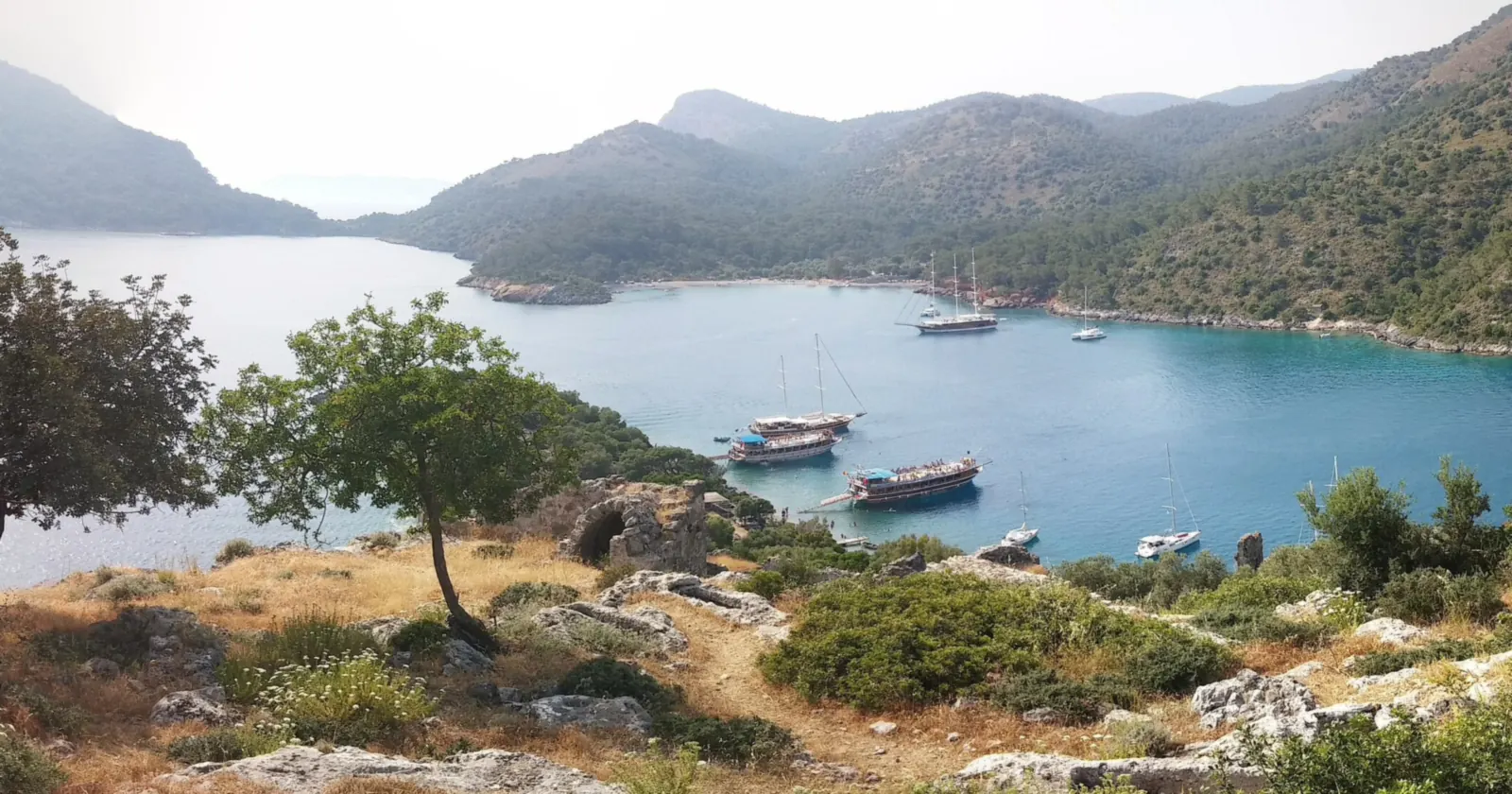
Gemiler Island, photographed from the island on 17 May 2015 at 36°33′14″N 29°04′04″E, inside the corners of closed box A8. Photo: Cobija, Wikimedia Commons, CC0 1.0, cropped.

Key takeaways
- Decision 2016/8743 closes five boxes on this coast, A6 to A10, to all but scientific diving, from the west shore of the Gulf of Göcek to Yedi Burun
- Box A6 is the same five-cornered area that the 2010 Göcek bay rules already closed to diving, and it takes in Sarsala and the Hamam cove
- The 1990 sport diving regulation sets 30 meters, 42 in training, bans decompression dives and requires a foreign diver to dive with a Turkish guide diver
- The Air France Constellation that ditched off Fethiye on 3 August 1953 was imaged by the Turkish Navy in 2018 at 257 meters
- Fethiye beach is a breeding beach for loggerhead and green turtles, and Muğla announced a ban on hand-feeding turtles in April 2026
Fethiye and Göcek waters sit inside a protected area declared on 12 June 1988
The sea off Fethiye and Göcek lies inside one designation. The Fethiye-Göcek Special Environmental Protection Area (Özel Çevre Koruma Bölgesi) was determined and declared by Council of Ministers decision 88/13019 of 12 June 1988. The environment ministry’s nature directorate files it under Muğla province and Fethiye district, lying at the foot of Mendos Dağı on the eastern edge of the inner gulf.
Its own description of the water is a list of names a diver will hear on the boat. Göcek bay is given as the most characteristic of the small coves. The Ölüdeniz lagoon at Belceğiz is described as calm. The islands spread west and north-west of Fethiye bay are called the Oniki Adalar, the Twelve Islands, and the ministry names Şövalye, Tersane, Kızıl Ada, Katrancı, the Delikli islands, Kızlanada, Hacı Halil, Yassıca and Domuz among them.
The size depends on which ministry page you read. The nature directorate’s page for the area gives 805.37 square kilometers; the ministry’s summary of its own biodiversity project gives 817. Both are official and they do not agree, which matters only if you are drawing the boundary yourself.
What the designation does for a diver is make the ministry the rule-maker for the water. The rules that actually reach a dive boat are narrower instruments hung off it, and one of them, for the Göcek bays, is set out below. The Ölüdeniz and Fethiye base guide covers living on this stretch of coast.
What 581 survey dives found under the Fethiye-Göcek protected area
In 2010 the ministry ran a biodiversity survey of the protected area’s coast and sea, and its numbers describe what lies under the dive boats. The team covered the 345 square kilometers of coastal and marine area, every cove and island included, down to 55 meters. It worked 88 stations with 581 scuba dives and 335 free dives, and analyzed water and sediment at 15 representative stations.
Depth is where the life was. The supralittoral zone, the splash band above the tide, held 11 species. Between 5 and 55 meters the survey recorded 1,225. Bristle worms (Polychaeta) led with 347 species, then mollusks with 288 and crustaceans with 264.
Forty species protected in the Mediterranean under the Bern and Barcelona conventions or the IUCN list turned up. At the stations themselves the team logged two reptiles, the loggerhead turtle Caretta caretta and the Nile soft-shelled turtle Trionyx triunguis, and two mammals, the Mediterranean monk seal Monachus monachus and the bottlenose dolphin Tursiops truncatus.
The other side of the count is arrivals. The survey found 93 exotic species in 11 groups, fish leading with 23, and one exotic seagrass, Halophila stipulacea. Two species, Microcosmos exasperatus and Vanderhorstia mertensi, were recorded from Türkiye’s coasts for the first time.
Five no-dive boxes on the coast around Fethiye, from Göcek to Yedi Burun
Türkiye closes water to divers by coordinates, and the instrument in force is decision 2016/8743 of 5 April 2016, published in the Resmî Gazete of 20 May 2016, issue 29717, under Article 35 of the Act on the Conservation of Cultural and Natural Property No. 2863. Article 1 is one sentence long where it matters: inside the areas whose limits are shown on the annexed maps and coordinate lists, no diving may take place other than scientific diving.
The Mediterranean annex numbers its boxes A1 to A21, and A6 to A10 sit on this coast. The decision names no places, only corners in WGS 84 with the points that touch land marked Sahil. Read against a map, the corners fall like this:
- A6, 36°35.1′ to 36°41.95′N and 28°50.4′ to 28°56.7′E: the west shore of the Gulf of Göcek, in Dalaman district, with the Sarsala and Hamam coves inside it.
- A7, around 36°33′N 29°01.4′ to 29°02.3′E: a short stretch of shore in Kayaköy, west of Gemiler.
- A8, 36°32.95′ to 36°33.5′N and 29°03.1′ to 29°04.9′E: takes in Gemiler Island.
- A9, 36°28′ to 36°28.95′N, about 29°06′E: the coast below Faralya down to Kabak, south of Butterfly Valley.
- A10, 36°22.3′ to 36°23.6′N: the coast at Yedi Burun, in Seydikemer district, past the end of Fethiye’s own coast.
Those place names are a reading aid, taken by putting the published corners on OpenStreetMap. The coordinates are the law. Anyone planning a private dive from a yacht should work from the corner list and the navy’s charts, because Article 3 of the same decision puts the closed areas on the nautical charts of the naval Office of Navigation, Hydrography and Oceanography.
Article 2 carries the duty that applies everywhere else. A diver who comes across cultural property in need of protection, outside the closed boxes or in one that has been reopened, must report it to the nearest civil administrator or museum, and any intervention with it in the meantime is prohibited. The amendments to this decision published in 2020 and 2022, numbers 2339, 2802 and 5068, all rewrote Aegean boxes; none touched the Mediterranean list.
The same system runs east along the whole coast, and the Antalya diving guide follows boxes A11 to A20 from Kalkan past Kaş and Kekova to Olympos. A regulation of 20 March 2020 lets the culture ministry open a tourism dive site inside a closed box after an underwater survey, and it announces those on its website; no such opening for A6 to A10 turned up in the ministry and provincial pages read for this guide, so ask the operator before assuming one.
.jpg)
Part of the Göcek bays near Fethiye was closed to diving six years before 2016
Box A6 was not new in 2016. The ministry publishes a set of protection and use rules for the Gulf of Göcek and the Göcek-Dalaman coves inside the protected area, made under Environment Law No. 2872, in force since 4 May 2010. The text the ministry still publishes names bodies that were reorganized in 2011, such as the Ministry of Environment and Forestry, but no replacement text has been published in its place.
Its Article 6 is headed Dalış Yapılmayacak Alanlar, areas where diving may not take place. It prohibits diving in the urban and archaeological sites inside a five-cornered area at 36°36′00″N 28°50′30″E, 36°42′00″N 28°54′00″E, 36°40′30″N 28°57′00″E and 36°35′12″N at 28°51′42″ and 28°50′30″E.
Lay those beside A6 and they are the same shape. Every corner of the 2010 box sits within about half a kilometer of a corner of the 2016 one, so the national decision restated a local rule rather than drawing a new line. The 2010 wording ties the ban to the urban and archaeological sites in that area; the 2016 decision closes the whole box to all but scientific diving.
The same rules explain why a diver sees so many boats in water they may not dive. Sarsala and Kurşunlu are both on the list of coves day-trip boats may enter between 10:00 and 20:00, and both are also named as seagrass zones where anchoring is banned. The shore inside the line between two points in Hamam cove, 36°38′28.3″N 28°51′15.9″E and 36°38′26.5″N 28°51′20.7″E, is closed to every kind of vessel.
What the Göcek rules ask of a dive boat out of Fethiye
The rest of the 2010 text is written for boats, and a dive boat is one. Vessels entering the Gulf of Göcek and the Göcek-Dalaman coves must tie up to a marina, jetty, shore ring or buoy. Outside the restricted zones, anchoring is free only with a line to a ring ashore, and tying to trees is banned. A boat may stay three days in one cove and eleven days in a row across all the coves.
The speed limit inside the gulf and the coves is 6 nautical miles an hour, except for vessels under pilotage and for water sports. Water sports other than jet skiing are allowed in the coves only with permission from the relevant bodies under the Tourism Purpose Sporting Activity Regulation. Waste water, bilge, sludge and garbage go to the reception facility or the collection boat and nowhere else. Music played in breach of the noise regulation and open barbecues on deck are banned in the coves.
Anchoring has since moved from a rule to a system. In May 2026 the Turkish Environment Agency announced a mooring buoy network in 17 Göcek coves under a project called DERİA, meant to keep anchors off the seagrass. Reports give different figures for its capacity, so none is quoted here.
Fethiye’s 30-meter limit and Turkish guide rule come from a 1990 regulation
The diver’s own rulebook is the Regulation on Scuba Diving for Sporting Purposes in Turkish Territorial Waters, published on 3 March 1990 and read here in its current text on the state legislation portal. It defines sport scuba diving as dives on compressed air with a depth limit of 30 meters, a maximum of 42 meters in training, and always without decompression.
Article 10 repeats the numbers and adds that medical personnel and equipment must be present on dives beyond 30 meters, and that the limits written on a diver’s certificate may not be exceeded. Article 11 makes a buoyancy compensator, tank pressure gauge, depth gauge and timer compulsory, bans lifting bags, and says flatly that decompression dives may not be made. Article 14 requires buddy pairs and a flagged dive buoy.
Article 9 is the one a visiting diver notices. Foreign nationals must make their sport dives accompanied by a Turkish guide diver, who carries responsibility for protecting cultural and natural property during the dive. Article 13 says Turkish boats are the norm, and that foreigners arriving on their own boats may dive from them only with permission.
Article 7 is written in two halves, and both belong in the summary. It says every sport scuba dive by a foreign diver is subject to permission from the provincial tourism directorate or a body it authorizes. Its last sentence then says that for training dives and dives in the two-person buddy system, outside the prohibited zones, giving notice and obtaining permission are not compulsory. How the two sentences combine for a foreign buddy pair is not spelled out.
Article 17 closes the circle with the 2016 decision: touching, damaging or moving archaeological and cultural values is prohibited, and so is lifting them from the seabed even to show them to museum officials. The operator’s own permit is a separate matter, which the Antalya guide walks through.
The Fethiye plane wreck lies at 257 meters, beyond any sport dive
The plane wreck people ask about at Fethiye is a French airliner. On Monday 3 August 1953, at 02:28 UT, Air France’s Lockheed 749A Constellation F-BAZS, flying scheduled line 152 from Paris to Tehran on the Rome to Beirut stage, made a forced landing on the sea off Fethiye after losing its number 3 engine in flight, at night and in good weather.
The French investigation report, published in the Journal officiel on 16 March 1954, records that the crew and 30 passengers were safe and that four passengers died. Its last line on the aircraft is short: the wreck sank “par 100 mètres de fond environ”, in about 100 meters of water.
That estimate was well short. As reported on 9 February 2018, the Turkish Navy’s search and rescue ship TCG Işın found and filmed the wreck off the Kızılada lighthouse at 257 meters, in the probable area identified by the researcher Selçuk Kolay. That is more than eight times the 30-meter sport limit and six times the 42-meter training ceiling.
So this is a story to read on land, not a dive to book. If a Fethiye trip is sold as a plane dive, ask which aircraft and at what depth; the airliner documented off this town is out of reach. The wreck diving list covers coasts where the wrecks sit at recreational depth.
Fethiye beach is a turtle breeding site, and Muğla announced a hand-feeding ban in 2026
The environment ministry lists Fethiye beach as one of the breeding sites of the loggerhead Caretta caretta and the green turtle Chelonia mydas, both protected under the Bern Convention and CITES. The 2010 survey also recorded loggerheads at its underwater stations.
On 6 April 2026 the provincial culture and tourism directorate published a notice headed “Kaplumbağaların elle beslenmesi yasaklandı”, hand-feeding of turtles banned, relaying a letter from Muğla’s Nature Conservation and National Parks directorate. The letter explains why. Turtles fed chicken or bread by hand get used to ready food, then take anything white in the water for food, which leads them to approach people and even to attack or bite them.
The letter asks for citizens, tourists and tourism operators to be told not to feed or handle turtles. The notice covers the province, not one harbor. A crew that throws food in the water to draw turtles to the boat is doing what the directorate wants operators warned against.
Hyperbaric treatment for Fethiye divers: the governor named Bodrum and Marmaris
At a dive tourism workshop held in Fethiye on 8 November 2024, the Muğla governor said the province had hyperbaric oxygen treatment centers in its Bodrum and Marmaris districts, and that one would open soon at the Muğla Sıtkı Koçman University Training and Research Hospital. He named none in Fethiye. Whether the university unit has since opened was not confirmed for this guide.
At the same workshop the head of the Fethiye branch of the Chamber of Shipping put the number of dives in the Fethiye area at about 30,000 a year. That is his figure, not a statistic, but it gives a sense of scale. Before you dive, ask the operator which chamber its evacuation plan uses and how the boat gets there, and check what your dive insurance covers for transport.
Nine businesses in the dive and watersports registers for Fethiye
The Fethiye operator list holds 9 businesses, read on 4 September 2026. Eight are dive centers published by SSI in its register of affiliated centers. The ninth is a windsurfing, kitesurfing and sailing center published by VDWS.
The filing is worth knowing if you search the SSI register yourself. All eight dive centers are filed under the province, as Mugla, Muğla or mugla, and none under Fethiye, so a town search finds nothing. Seven of the nine publish a website in the register; two do not.
SSI rates one of the eight for its Extended Range program and one for Mermaid. A listing is a statement about the register, not proof that a course runs this season, and anyone booking extended-range training here should ask how it fits Articles 10 and 11 of the 1990 regulation. The operator permit is a different document again, which is why which registers can be read logs what each source returned.
FAQ: scuba diving in Fethiye
Can you dive the plane wreck in Fethiye?
Not as a sport diver. The aircraft is Air France's Lockheed Constellation F-BAZS, which made a forced landing off Fethiye on 3 August 1953 after losing an engine. The French investigation estimated it sank in about 100 meters of water; the Turkish Navy ship TCG Işın found and filmed it off the Kızılada lighthouse at 257 meters, as reported in February 2018. Turkish sport diving stops at 30 meters, and 42 in training.
Where is diving banned around Fethiye?
Inside five coordinate boxes, A6 to A10, in the Mediterranean annex of decision 2016/8743, where only scientific diving is allowed. On a map they fall on the west shore of the Gulf of Göcek including Sarsala and the Hamam cove, a stretch of shore in Kayaköy, Gemiler Island, the coast below Faralya down to Kabak, and the headlands at Yedi Burun. The 2010 Göcek bay rules already closed the first of these to diving.
How deep can you dive in Fethiye?
Thirty meters. The 1990 Regulation on Scuba Diving for Sporting Purposes in Turkish Territorial Waters sets the sport limit at 30 meters and allows a maximum of 42 meters in training, with medical personnel and equipment required on dives beyond 30. Decompression dives are forbidden, and the limits written on your certificate may not be exceeded.
Do foreign divers need a Turkish guide in Fethiye?
The 1990 regulation says so. Article 9 makes it compulsory for foreign nationals to dive accompanied by a Turkish guide diver, who is responsible for protecting cultural and natural property during the dive. Article 7 makes sport dives by foreign divers subject to permission, but its last sentence exempts training dives and two-person buddy dives outside the prohibited zones from notice and permission, without saying how that exemption applies to foreign divers.
Can dive boats anchor in the Göcek bays near Fethiye?
Only in limited ways. Under the Göcek bay rules in force since 4 May 2010, boats must tie to a marina, jetty, shore ring or buoy, and may anchor outside the restricted zones only with a line to a ring ashore. Anchoring is banned in named seagrass zones including Sarsala and Kurşunlu, stays are capped at three days in one cove and eleven in all, and the speed limit is 6 knots.
Note: Conditions, safety guidance and regulations change. Verify current information with official sources, including the dive operator, the park authority and the relevant government department, before you travel or dive.
Founder of NOMADREEF and a former digital nomad. This guide is sourced from the references below; conditions, prices and rules change, so verify current details, and follow qualified local guidance and safety briefings. About the author · LinkedIn ↗
Sources
- The protected area, its date and its islands (primary). Ministry of Environment, Urbanization and Climate Change, General Directorate for the Protection of Natural Assets, page for the Fethiye-Göcek Special Environmental Protection Area: province Muğla, area 805.37 km², determined and declared by Council of Ministers decision 88/13019 of 12.06.1988; Fethiye beach as a breeding site of Caretta caretta and Chelonia mydas, protected under the Bern Convention and CITES; Göcek bay, the Ölüdeniz lagoon at Belceğiz and the Oniki Adalar with the named islands. tvk.csb.gov.tr, Fethiye-Göcek. The ministry server refused connections on 25 September 2026, so the page was read in the Internet Archive copy of 12 November 2024; the same description, without the area figure, is on the Muğla provincial directorate page, read the same day.
- The 2010 biodiversity survey (primary). Ministry summary of the Fethiye-Göcek coastal and marine biodiversity project: the 88/13019 decision of 12.06.1988; total area 817 km²; 345 km² of coast and sea surveyed to 55 m at 88 stations with 581 scuba and 335 free dives, water and sediment at 15 stations; 11 species in the supralittoral and 1,225 between 5 and 55 m; Polychaeta 347, Mollusca 288, Crustacea 264; 40 protected species, among them Caretta caretta, Trionyx triunguis, Monachus monachus and Tursiops truncatus at the stations; 93 exotic species with fish at 23; Halophila stipulacea; first records of Microcosmos exasperatus and Vanderhorstia mertensi. Fethiye Göcek ÖÇKB biyolojik çeşitlilik tespiti projesi (PDF). Read 25 September 2026. The two area figures, 805.37 and 817 km², are both the ministry’s own and are stated side by side.
- The closed boxes (primary). Decision 2016/8743 of 5/4/2016 on applying a diving ban in regions holding underwater cultural and natural property in need of protection, made under Article 35 of Act No. 2863: Article 1 barring all but scientific diving inside the annexed maps and coordinate lists; Article 2 on the duty to report finds; Article 3 on charting by the Office of Navigation, Hydrography and Oceanography; the Mediterranean annex, “Akdeniz dalışa yasak saha koordinatları (WGS 84 datumu)”, with boxes A6 to A10 as quoted. The annex is a scanned image and was read page by page. Resmî Gazete, 20 May 2016, issue 29717 (PDF). Read 25 September 2026. Place names for the boxes come from reverse lookups of the published corner points on OpenStreetMap and are a reading aid, not part of the decision.
- The amendments (primary). Presidential decision 2339 of 1 April 2020, amending the map and coordinate list of the Aegean annex, Resmî Gazete, 2 April 2020, issue 31087 (PDF); decision 2802 amending Aegean boxes E19 and E24, listed in the Resmî Gazete of 28 July 2020, issue 31199; decision 5068 amending Aegean box E17, listed by the Ministry of Culture and Tourism. Read 25 September 2026. No amendment to the Mediterranean annex was found.
- The Göcek bay rules (primary). Göcek Körfezi ile Göcek-Dalaman Koyları Koruma ve Kullanma Usul ve Esasları, made under Environment Law No. 2872 and Decree Law No. 383, in force 04/05/2010: Article 5 on tying up, anchoring only with a shore line, music, barbecues and waste; Article 6 on the no-dive area and its five corners; Article 7 closing the Hamam cove to all vessels; Article 8 on the anchoring bans, including Kurşunlu and Sarsala; Article 9 on day-boat hours and coves, the three-day and eleven-day limits, the 6-knot limit and water sports other than jet skiing subject to permission. Ministry text (PDF, posted January 2018). Read 25 September 2026. The text names the Ministry of Environment and Forestry and the Authority for the Protection of Special Areas, both reorganized in 2011; no replacement text was found.
- The mooring buoy system (triangulated). The Turkish Environment Agency’s DERİA mooring buoy system in 17 Göcek coves, announced in May 2026, as reported by TRT Haber, Deniz Haber and Türkiye Gazetesi, read 25 September 2026. The agency’s own announcement was not reached, and the three reports appear to share it. Capacity figures differ between reports, so none is given.
- The diver’s rulebook (primary). Regulation on Scuba Diving for Sporting Purposes in Turkish Territorial Waters, 3 March 1990: Article 4(b) on the 30 m limit, 42 m in training and no decompression; Article 7 on permission and its exemption for training dives and two-person buddy dives outside the prohibited zones; Article 9 on the Turkish guide diver; Article 10 on depth, medical cover and certificate limits; Article 11 on equipment, lifting bags and decompression; Article 13 on boats; Article 14 on buddy pairs and flagged buoys; Article 17 on cultural property. mevzuat.gov.tr, current text. Read 25 September 2026.
- The 1953 ditching (primary). Rapport d’enquête sur l’accident survenu à Fethiye (Turquie), le 3 août 1953, à l’avion Lockheed 749 A F-BAZS, Journal officiel de la République française, annexe administrative, 16 March 1954: date and time 02:28 UT; line A.F. 152 Paris-Rome-Beirut-Tehran, stage Rome-Beirut; forced landing near the coast after the loss of engine no. 3, at night, in good weather; crew and 30 passengers safe, four passengers dead; the wreck sank in about 100 m of water. BEA, report f-zs530803 (PDF). Read 25 September 2026.
- The wreck at 257 m (triangulated). The wreck imaged by the Turkish Navy’s TCG Işın off the Kızılada lighthouse at 257 m in February 2018, in the area identified by Selçuk Kolay: TRT Haber, Euronews and Milliyet, read 25 September 2026. The navy’s own release was not found. Survivor counts in the news reports differ from the French report, so only the report’s figures are used.
- The turtle feeding notice (primary). Muğla Provincial Directorate of Culture and Tourism, “Kaplumbağaların elle beslenmesi yasaklandı”, 6 April 2026, quoting the letter of the Muğla Nature Conservation and National Parks directorate on hand-feeding, habituation and bites, and asking that citizens, tourists and tourism operators be informed. mugla.ktb.gov.tr. The server refused connections on 25 September 2026, so the page was read in the Internet Archive copy of 20 May 2026.
- Hyperbaric centers and the dive count (primary). Muğla Governorship, “Muğla’da Sualtı Dalış Turizmi Çalıştayı Yapıldı”, 8 November 2024: the governor on hyperbaric oxygen treatment centers in Bodrum and Marmaris and one to open at the Muğla Sıtkı Koçman University Training and Research Hospital; the Chamber of Shipping Fethiye branch head on about 30,000 dives a year in the Fethiye area. mugla.gov.tr. Read 25 September 2026. Whether the university center has opened is unverified, needs human check.
- The nine businesses. Nine watersports businesses on the Fethiye operator list, read 4 September 2026: eight dive centers published by SSI in its register of affiliated centers, filed under the province rather than a town, one rated for Extended Range and one for Mermaid; and one windsurfing, kitesurfing and sailing center published by VDWS in its station register. Seven of the nine publish a website in the register. The limits of each source are set out on which registers can be read.
- Left out. Sea temperature: the official Turkish series covers the Mediterranean coast as a whole and names no Fethiye station, so no figure is given. The operator permit rules for Muğla were not read for this guide. The dive sites named in operator and travel material, such as Afkule, were not found in a primary source and are not described. The ministry names Fethiye beach as the turtle breeding site; Çalış is not named in the pages read, so the guide keeps the ministry’s wording. No recompression chamber in Fethiye itself was found in a primary source.