Belize Diving from Ambergris Caye and Caye Caulker: Hol Chan, the Blue Hole and a Reef After Two Hot Years
 by Yannick Schroth
Nov 10, 2026
15 min read
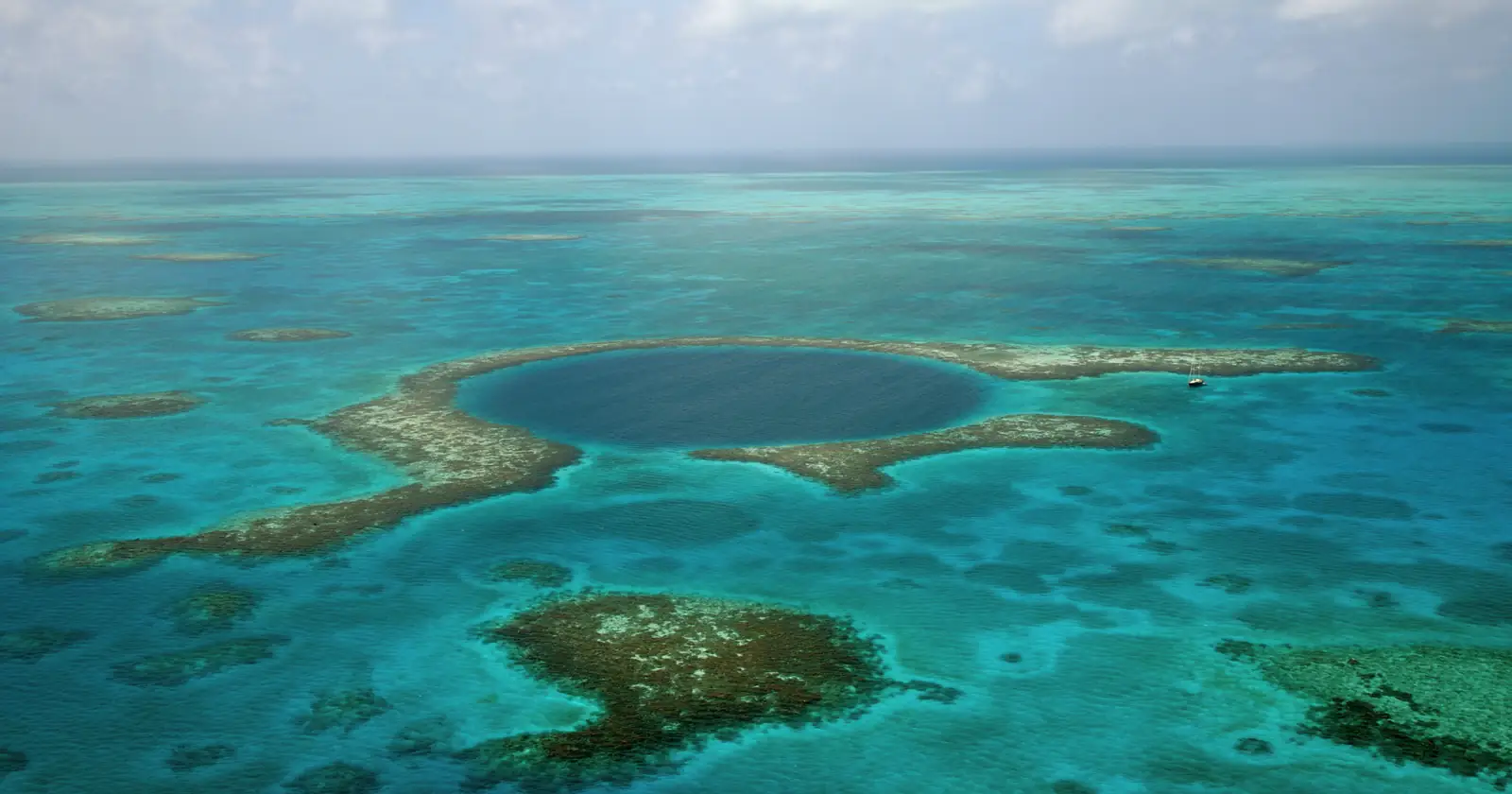
The Great Blue Hole inside Lighthouse Reef, about two and a half hours by boat from San Pedro. The TerraMar Project, Wikimedia Commons, CC BY 2.0, cropped.

Key takeaways
- Belize's reserve fees are set in law: Hol Chan's regulations charge foreign divers BZ$20 a day, BZ$50 a week or BZ$100 a year, though a local paper reported a US$15 day fee from August 2024
- The Blue Hole and Half Moon Caye cost a non-national BZ$80, about US$40, on top of a day trip that operators price at $285 plus 12.5% tax or more
- Belize's weather service gives the dry season as November to May, driest in April; hurricanes peak in September and October
- NOAA's satellites put Belize at their highest coral heat-stress alert in both 2023 and 2024, and the Healthy Reefs report card scores the country's reef 2.5 out of 5
- Visitors get 30 days and can extend for BZ$200 a month; the Work Where You Vacation permit allows up to 180 days for remote workers earning at least US$75,000
Belize diving starts from two cayes on the barrier reef
Belize's reef runs the length of the country, and most of the dive businesses a traveler can book sit on two islands off its northern half. San Pedro, the town on Ambergris Caye, is the larger: the barrier reef lies just offshore, the Hol Chan Marine Reserve starts at its southern tip, and Bacalar Chico Marine Reserve covers the northern end of the island up to the Mexican border. Caye Caulker, about 30 minutes south by water taxi, is smaller and cheaper, with its own marine reserve. From either island the boats run out to the two atolls that make Belize different from the rest of the Caribbean: Turneffe, the nearest, and Lighthouse Reef with the Great Blue Hole beyond it.
Belize's marine reserves are not just names on a map. Each has its own regulations under the Fisheries Resources Act, with zones, fees and rules for divers, and the Attorney General's Ministry publishes them in one consolidated volume, current to the end of 2020. Where this page quotes a fee or a rule, that volume is the source unless we say otherwise.
Hol Chan Marine Reserve: the Belize dive most trips start with
Hol Chan sits south of San Pedro and is the reef most visitors meet first, by boat in a few minutes. Its 2020 regulations set out what a diver may not do inside it: remove or disturb anything, including rocks, dead coral, shells or sand; feed fish; spearfish; or drop an anchor that could damage coral. Gloves are banned in the no-take zones and throughout Zone D. Shark Ray Alley, inside Zone D's exclusive recreation area, is closed to scuba altogether except for authorized research, which is why it is a snorkel stop. A dive tour may take at most eight divers per licensed instructor, and the guide has to explain the rules before you get in.
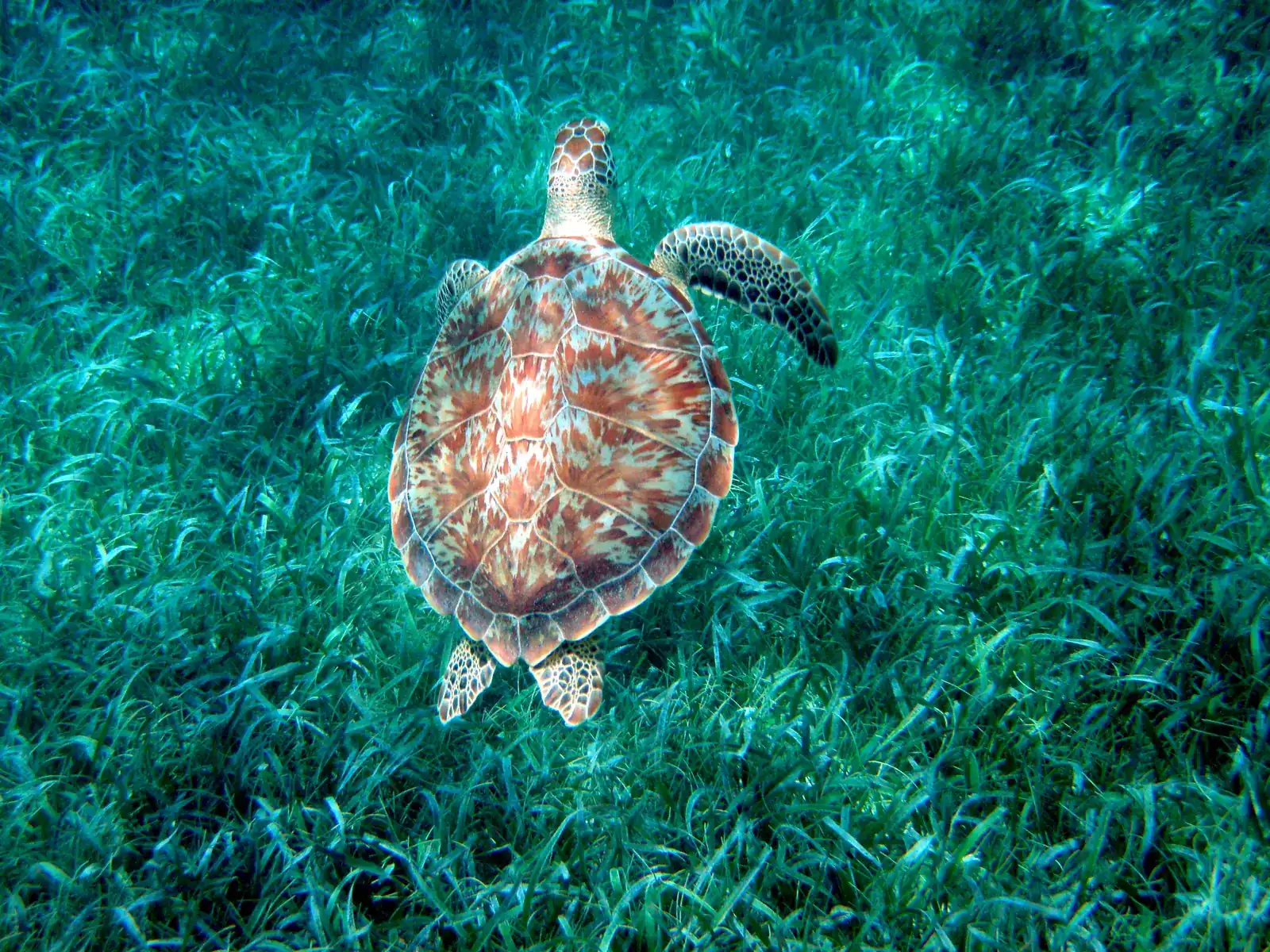
A green turtle over the seagrass in Hol Chan Marine Reserve. Nikdahl, Wikimedia Commons, CC BY-SA 3.0, resized.

The fee is the one place where the law and the dock may differ. The regulations charge a non-Belizean diver over twelve BZ$20 a day, BZ$50 a week or BZ$100 a year, which matters if you are staying for months; the Belize dollar is pegged at two to the US dollar. In August 2024 the San Pedro Sun reported a new entrance fee of US$15 for the reserve, which has grown from about five to more than 160 square miles. We found no amended regulation behind that figure, so ask the shop which ticket it sells and whether the annual one still exists.
The Great Blue Hole dive is 40 meters for under ten minutes
The Blue Hole sits inside Lighthouse Reef, the outermost of Belize's atolls. The Belize Audubon Society, which manages it together with the Half Moon Caye Natural Monument, gives the hole as 412 feet deep and about 1,000 feet across. The dive is a descent along the wall to the stalactites under the overhang: Ramon's Village says they start at 120 feet and are "plainly in view at the 130 foot limit of sport diving", with a bottom time of eight to ten minutes including the descent and a total dive of 20 to 25 minutes. The rest of the day is a reef dive or two at Half Moon Caye and the long ride home. From San Pedro the boat takes about two and a half hours each way and the day runs to about eleven hours; from Caye Caulker it is about two.
Nobody we found sets a legal minimum for it; the operators do. Belize Pro Dive Center asks for Open Water certification at least, strongly recommends Advanced, sets a minimum age of 15 and wants a logged dive in the previous six months, and says certification alone does not guarantee the 40-meter part. Frenchie's on Caye Caulker takes Open Water divers to 20 meters and Advanced divers to 40. The park fee is BZ$60 for the Blue Hole and BZ$20 for Half Moon Caye, BZ$80 in all for a non-national, which is the $40 the shops add to the trip. Ramon's and Belize Pro Dive Center price the day at $285 plus 12.5% tax and the park fee; Frenchie's lists $355 with the fee included.
Turneffe Atoll is the reserve between the cayes and the Blue Hole
Turneffe Atoll Marine Reserve is co-managed by the Turneffe Atoll Sustainability Association and the Fisheries Department. TASA sells the entry ticket itself: a standard environmental fee of US$10 a day or US$25 a week, a voluntary higher contribution of US$50 a day, and half price for Belizeans. The ticket covers the reserve's moorings and the wreck known as the Wit. Divers staying on resorts on the atoll pay through them. Turneffe's own regulations allow only certified divers or divers in training to use scuba there and ban spearfishing in its conservation, special and preservation zones. The statute also lists a yearly ticket of BZ$100, which TASA's site does not show.
Whale sharks at Gladden Spit are a Placencia trip, March to June
Belize's whale sharks are not off the cayes. They come to Gladden Spit, a reef promontory about 36 kilometers off Placencia in the south, to feed on the spawn of snapper aggregations; the Southern Environmental Association, which co-manages the reserve with the government, puts them there "during the full moon in the months of March-June". The reserve's regulations are strict in the spawning area: no touching or chasing, at least 15 feet from any shark, a maximum depth of 80 feet for divers of any certification, two boats per operator per day, twelve visitors per boat, eight divers per licensed divemaster, and everyone out of the water by 5:30 pm. The 2020 fee for scuba in the spawning area is BZ$100 a person. If whale sharks are the point, plan a few nights in Placencia around the full moon rather than a day from San Pedro.
When to dive Belize: November to May is the dry season
The National Meteorological Service of Belize gives the dry season as November to May, with April the driest month, and the rains as falling mostly from June to November, with a dry break in August that Belizeans call the Mauga. Its cool spell from November to February comes with cold fronts, about one every ten days at their December and January peak, which can blow out the outer reef for a day or two. Hurricanes are the reason to think about autumn: the US National Hurricane Center gives the Atlantic season as 1 June to 30 November with a peak on 10 September, and the Belizean service says storms peak in September and October.
The water is warm all year. NOAA Coral Reef Watch's long-term monthly averages for Belize run from 26.1 °C in February to 28.9 °C in September. The same satellite data for 2016 to 2025, averaged by month for this page, runs about a degree warmer, with September reaching about 30 °C at the surface. A 3 mm suit is enough for most of the year.
Belize's reef after record heat in 2023 and 2024
Belize had two years of severe heat stress in a row. NOAA Coral Reef Watch measures accumulated heat in degree heating weeks; at 20 or more it issues its top alert, which it describes as a risk of near complete coral mortality. Its Belize station reached about 20.9 in October 2023 and again in October 2024, and stayed high at 17.6 in 2025. Those are measures of heat, not counts of dead coral, but the monitoring agrees on the direction. The Healthy Reefs Initiative's 2024 report card, built on 2023 surveys, scores Belize's reef 2.5 out of 5, "poor", names the Northern Barrier Complex, which includes the reef off Ambergris Caye, and Glover's Reef as among the hardest hit by bleaching, and finds stony coral tissue loss disease the most common coral disease that year. That disease reached Bacalar Chico in June 2019, Hol Chan in April 2020, Caye Caulker in May 2020 and Lighthouse Reef in September 2020, according to a 2022 study in Frontiers in Marine Science.
What this means in the water is reef that varies a lot by site and year, and fish life that has held up better than hard coral. It also means the rules about gloves and touching are not decoration.
San Pedro has a 24-hour chamber; Caye Caulker has none
Subaquatic Safety Services runs a recompression chamber in San Pedro at #11 Lion's Street, next to the airstrip, and says it has operated 24 hours a day since Belize joined its network in 1989; its network holds DAN's recompression chamber partner designation. Its emergency line is +501 615 4288. A second chamber opened in 2015 at what is now Ambergris Hope Hospital on Pescador Drive; the hospital describes itself as open around the clock, but we found no page of its own confirming the chamber's hours. We found no chamber on Caye Caulker, which is about 30 minutes from San Pedro by boat. Divers on the Blue Hole trip are two and a half hours from either. Check that your dive insurance covers chamber treatment and the boat or plane to it.
Getting to Ambergris Caye: a 15-minute flight or a water taxi
International flights land at Philip S. W. Goldson International Airport outside Belize City. From there Tropic Air advertises hourly flights to San Pedro and to Caye Caulker, and Maya Island Air flies the same routes; the hop takes about 15 minutes on flight-tracking sites, since neither airline publishes it. The cheaper way is the water taxi from Belize City's marine terminal, about 25 minutes from the airport. San Pedro Belize Express gives about 45 minutes to Caye Caulker and 1 hour 30 to San Pedro; Caribbean Sprinter gives 45 minutes and 1 hour 15, with six sailings a day each way, and 30 minutes between the two cayes.
Staying in Belize for months as a remote worker
German, Austrian, Dutch, British and Swiss passport holders, among others, need no visa for Belize. Immigration grants 30 days on arrival; after that you visit an immigration office and pay BZ$200 for each further 30 days, on condition that you do no paid or unpaid work in Belize. We found no official statement on how many times you may extend.
For remote workers there is a specific permit, Work Where You Vacation. On the Belize Tourism Board's page as published in April 2026, it costs BZ$500 per adult, allows a stay of up to 180 days, and waives the work permit for people employed outside Belize. Applicants need an annual income of at least US$75,000, or US$100,000 for a couple or family, a notarized bank reference, a criminal record check no older than six months and travel insurance of at least US$50,000; applications go to the Immigration Department. The page does not say whether it can be renewed.
For work, Belize Telemedia laid a submarine cable to Ambergris Caye and launched fibre to homes in San Pedro in 2017; we could not check current coverage street by street. Do not plan on Starlink: in January 2025 the Public Utilities Commission refused it a general licence and allowed its equipment only in unserved or underserved areas, on boats and aircraft, and in emergencies.
Spearfishing, lionfish and licences: rules a visiting diver meets
Spearfishing is banned in eight listed marine reserves, among them Hol Chan, Bacalar Chico and Caye Caulker, and carrying a speargun, pole spear or Hawaiian sling there counts as spearfishing, with a fine of BZ$500 or six months in prison. Anywhere in Belizean waters, taking fish with scuba equipment needs a special permit from the Fisheries Administrator, and Belize's fisheries law counts all marine animals as fish. We found no official rule for lionfish culling, so the permit rule is the one to go by.
Dive businesses need a licence from the Belize Tourism Board, renewed every year, with insurance, passenger liability cover for each boat and an emergency plan, and they must be majority owned by Belizeans or permanent residents. Guides are licensed separately. The Tourism Board's operator directory returned an error when we checked, so there is no public list to look a shop up in; ask to see the licence.
Who Belize suits
Belize suits a diver who wants a long season of easy reef diving from a small island with a chamber on it, and a few big days out to the atolls. It suits a remote worker who meets the Work Where You Vacation income bar, or who is happy renewing a 30-day stamp. It suits Blue Hole fans who know what the dive is: a deep, short descent to stalactites, not a reef. It suits less well anyone coming for pristine hard coral after 2023 and 2024, and anyone who needs the season to be safe from storms in September and October.
Eight dive centers on our Ambergris Caye list
Our Ambergris Caye operator list holds 8 businesses, all from registers we can link per entry, read on 9 November 2026: Ambergris Adventure Tours, Amigos del Mar, Belize Pro Dive Center, Coral Divers, Deep Blue Adventures, Elite Adventures and TNT Dive Pros in San Pedro, published by SSI, two of them also by International Training, and Scuba Sensation on Caye Caulker, published by International Training. None is a Green Fins member. Many Belize shops, including Frenchie's and Ramon's quoted above, aren't on it, because the bodies they teach through don't publish a register we can link to entry by entry. A register entry says a training body lists a shop, not that the Tourism Board has licensed it.
FAQ: Belize diving
Is Ambergris Caye or Caye Caulker better for diving in Belize?
Ambergris Caye has more dive shops, the Hol Chan Marine Reserve at its southern tip and San Pedro's 24-hour chamber. Caye Caulker is smaller, quieter and a little closer to the Blue Hole, about two hours by boat against two and a half, and has no chamber of its own. The water taxi between them takes about 30 minutes.
How deep is the Great Blue Hole dive?
About 40 meters, or 130 feet, for Advanced divers, with a bottom time of eight to ten minutes and a total dive of 20 to 25 minutes. Some operators take Open Water divers to 20 meters. The hole itself is 412 feet deep according to the Belize Audubon Society, which manages it.
How much are marine park fees in Belize?
The Blue Hole and Half Moon Caye cost a non-national BZ$80, about US$40. Turneffe's ticket is US$10 a day or US$25 a week. Hol Chan's regulations set BZ$20 a day, BZ$50 a week or BZ$100 a year for foreign divers, though a local paper reported a US$15 day fee from August 2024.
When is the best time to dive in Belize?
November to May, the dry season by Belize's National Meteorological Service, with April the driest month. Hurricane season runs from June to November and peaks in September and October. For whale sharks at Gladden Spit, the reserve's co-manager gives the full moons of March to June.
Can I work remotely in Belize?
Belize's Work Where You Vacation permit allows remote workers to stay up to 180 days for BZ$500 per adult, with an income of at least US$75,000, or US$100,000 for a family, insurance of at least US$50,000 and a clean criminal record. A normal visitor stamp is 30 days, extendable for BZ$200 a month, and does not allow work in Belize.
Note: Conditions, safety guidance and regulations change. Verify current information with official sources, including the dive operator, the park authority and the relevant government department, before you travel or dive.
Founder of NOMADREEF and a former digital nomad. This guide is sourced from the references below; conditions, prices and rules change, so verify current details, and follow qualified local guidance and safety briefings. About the author · LinkedIn ↗
Sources
- Reserve regulations (primary). Attorney General's Ministry, Fisheries Resources Act, Chapter 210, subsidiary laws, revised edition as at 31 December 2020 (PDF): Hol Chan regulations (SI 145 of 2020: prohibitions, gloves, Shark Ray Alley, eight divers per instructor, Schedule II fees); Turneffe (certified divers, spearfishing, fees including the yearly ticket); Caye Caulker, Glover's Reef, Bacalar Chico ("no fees for the time being"); Gladden Spit (spawning-area rules and fees); Marine Reserve (Prohibition) Regulations, SI 76 of 2009 (spearfishing in eight reserves, presumption, penalty); Fisheries Regulations reg. 7 (no fishing on scuba without a permit). Amendments after 2020 were not readable, because the National Assembly site was suspended on 10 November 2026. Read 10 November 2026.
- Hol Chan fee in 2024 (news). San Pedro Sun, 1 August 2024, and 29 June 2024 on the reserve's size. Read 10 November 2026.
- Blue Hole and Half Moon Caye (primary). Belize Audubon Society, Blue Hole Natural Monument and Half Moon Caye Natural Monument: depth, diameter, entrance fees, VHF 16 mooring rule. Read 10 November 2026.
- Blue Hole trips (each operator primary for itself). Ramon's Village, scuba trips; Belize Pro Dive Center, Great Blue Hole; Frenchie's Diving. Read 10 November 2026.
- Turneffe (primary). TASA, Turneffe Atoll Marine Reserve and entry tickets. Read 10 November 2026.
- Whale sharks (primary). Southern Environmental Association, Gladden Spit and Silk Cayes Marine Reserve. Heyman, Graham, Kjerfve and Johannes, "Whale sharks Rhincodon typus aggregate to feed on fish spawn in Belize", Marine Ecology Progress Series 215, 2001, doi:10.3354/meps215275. Read 10 November 2026.
- Seasons (primary). National Meteorological Service of Belize, climate summary; NOAA National Hurricane Center, tropical cyclone climatology. Read 10 November 2026.
- Water temperature and heat stress (primary data). NOAA Coral Reef Watch, Belize regional virtual station data and bleaching alert levels. Climatological monthly means as published; the 2016–2025 monthly averages and the yearly peak degree heating weeks were calculated for this page from the daily file. Read 10 November 2026.
- Reef condition. Healthy Reefs Initiative, 2024 Report Card (PDF) and press release (PDF) (primary). Lee Hing et al., "Management responses in Belize and Honduras, as stony coral tissue loss disease expands its prevalence in the Mesoamerican reef", Frontiers in Marine Science 9, 2022 (primary). Read 10 November 2026.
- Chambers. Subaquatic Safety Services, Belize and network (primary for its own chamber). The Ambergris Hope chamber: Ambergris Today, 22 May 2015, 25 February 2024, and Ramon's Village (triangulated; no page of the hospital's own). Read 10 November 2026.
- Getting there (each operator primary for itself). Philip Goldson International Airport; Tropic Air; Maya Island Air; San Pedro Belize Express; Caribbean Sprinter sailings. The flight time is triangulated from flight-tracking sites, since neither airline publishes it. Read 10 November 2026.
- Entry and long stays (primary). Immigration and Nationality Department, who needs a visa and visitor's permit extension. Belize Tourism Board, Work Where You Vacation, read in the Internet Archive copy of 21 April 2026, because the live page refuses automated requests. Read 10 November 2026.
- Internet. Public Utilities Commission, press release on Starlink, 20 January 2025 (PDF) (primary). Huawei Marine, July 2017, on the cable to Ambergris Caye. Read 10 November 2026.
- Operator licensing (primary). Belize Tourism Board, tour operator licensing and licensing. Read 10 November 2026.
- The eight listings. Eight entries on the Ambergris Caye operator list, from the SSI register and the International Training facility register, read 9 November 2026.
- Left out. The air departure tax, given as anything from US$39 to US$56 and normally included in the ticket; the land border exit fee, whose 2024 amendment could not be read; Bacalar Chico's current fee; the Blue Hole best-practice booklet, which could not be retrieved; and rules for visitors spearfishing outside reserves, for which only forum posts exist.