Andaman Islands Diving in India: A 30-Meter Limit, No Decompression Dives and Parks Behind a Permit
 by Yannick Schroth
Sep 24, 2026
17 min read
by Yannick Schroth
Sep 24, 2026
17 min read
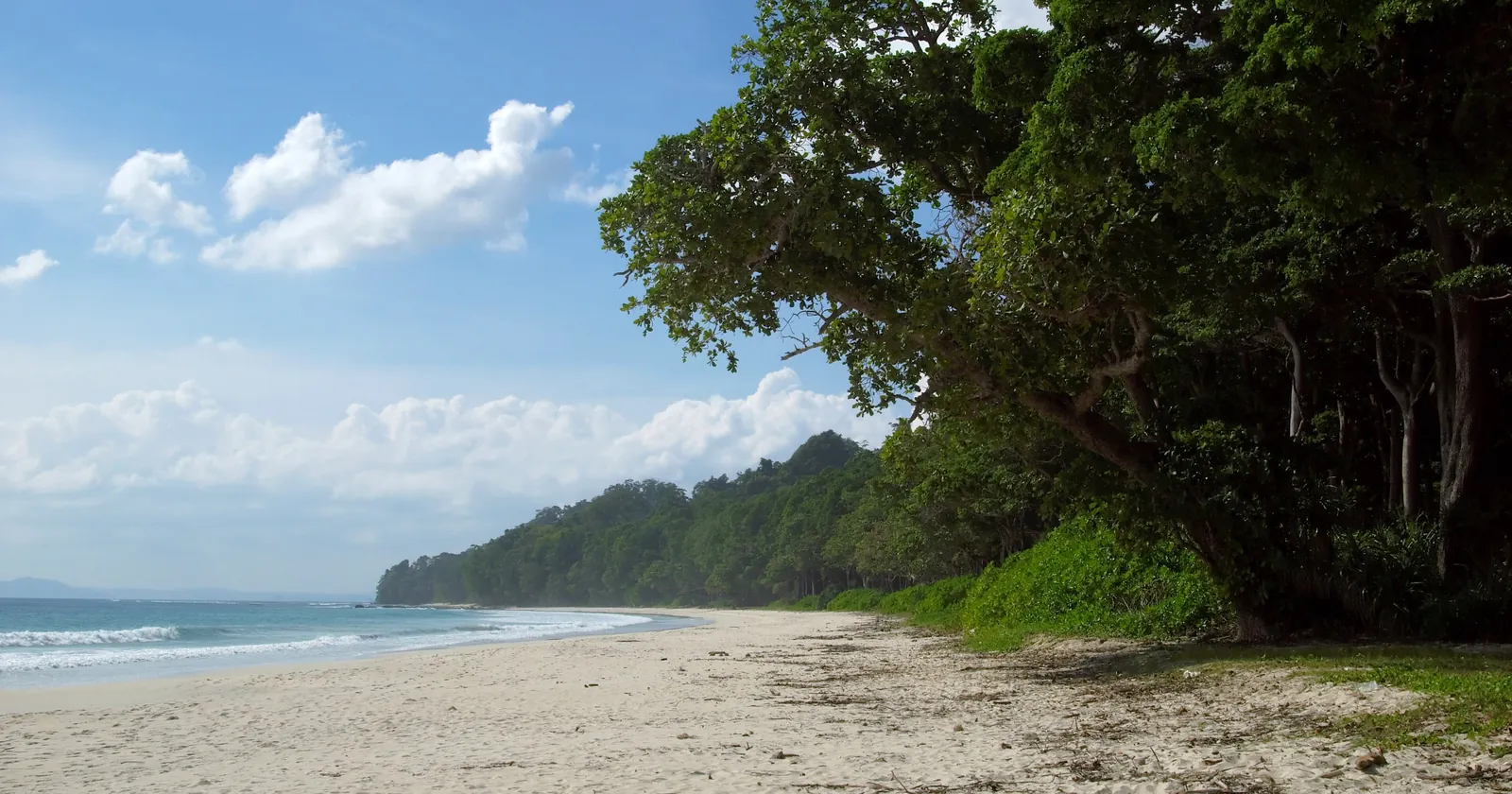
Photo: Vyacheslav Argenberg, Wikimedia Commons, CC BY 4.0.

Key takeaways
- The Andaman and Nicobar Gazette notification of 2 April 2014 caps all recreational diving at 30 meters and entry-level divers at 20, and allows only no-stop diving, for tourists and instructors alike
- A draft revision put out for comment in October 2025 drops the 30-meter cap for centers affiliated with a WRSTC agency but keeps the decompression ban word for word
- Havelock (Swaraj Dweep) and Neil (Shaheed Dweep) are among 29 islands foreign tourists may visit without a Restricted Area Permit, but anyone there for work still needs one
- Henry Lawrence, John Lawrence and Outram, the park islands near Havelock, are open for diving only with the Chief Wildlife Warden’s permission and a daily fee
- A Havelock site recorded the highest share of fully bleached coral, 69.49 percent, of the reefs surveyed in the 2010 bleaching
Andaman Islands diving rules cap every recreational dive at 30 meters
People searching for Andaman diving land on two different countries. Thailand’s west coast faces the Andaman Sea too, and our guides to Khao Lak and the Similans and to Phuket cover that side. This page is about the Indian union territory of the Andaman and Nicobar Islands, whose dive centers answer to the Directorate of Tourism in Sri Vijaya Puram, the city called Port Blair until September 2024.
The rulebook is short and blunt. The islands’ scuba diving guidelines were published as a Directorate of Tourism notification in the Andaman and Nicobar Gazette Extraordinary No. 54 of 2 April 2014. Their introduction says they draw on the National Institute of Water Sports in Goa and on the Maldives Recreational Diving Regulation of 2003.
Paragraph 3.6 sets the maximum depth for all recreational diving at 30 meters and names who it binds: tourists, dive center staff, instructors on or off duty, and students in advanced and deep courses. It applies without exception on liveaboard and safari boats. Entry-level divers stop at 20 meters, or at their agency’s own limit if that is shallower, until they are trained in deep diving. Diving beside an instructor is expressly no reason to go deeper.
Paragraph 3.7 is stricter. Only no-stop diving is allowed in the islands, and the text repeats the whole list of people it covers before closing with one line: “No exception whatsoever is allowed.” Paragraph 4.4 then names the prohibited dives: decompression dives, dives deeper than 30 meters, dives less than 24 hours before flying in a pressurized aircraft, and dives in restricted areas.
Two smaller rules shape an ordinary dive day. Solitary diving is not allowed under any circumstances. And after every dive except short, shallow ones, divers must make a safety stop of at least three minutes at five meters, starting it with no less than 50 bar in the tank.
A 2025 draft would lift the Andaman 30-meter cap and keep the decompression ban
On 13 October 2025 the Directorate announced that it was amending the guidelines after consultations with dive training agencies. It placed draft revised guidelines in the public domain for 30 days and asked for comments by 14 November 2025. The draft on its website is headed as a notification dated August 2025, with the day left blank.
The draft splits dive centers into two categories. Category A centers belong to a member agency of the World Recreational Scuba Training Council, and their maximum depth becomes “as per the course and Agency standards”. Category B centers follow the norms of the National Institute of Water Sports, keep introductory dives to 12 meters and take divers aged 12 to 60 only. Entry-level divers everywhere would stop at 18 meters instead of 20.
The decompression paragraph survives unchanged, down to “No exception whatsoever is allowed”, and so does the 24-hour flying rule. On 24 September 2026 the Directorate’s policy page still carried the 2014 gazette and, as a separate file, the draft. No final notification of the revision appeared there, so the 2014 text is the one to plan a trip around.
What an Andaman Islands dive center must see before you dive: a logbook with 900 minutes
Paragraph 4.5 of the 2014 guidelines lists what a diver must present. A certification card from a recognized agency that allows diving without supervision. A logbook showing open-water experience of at least 900 minutes, excluding training dives, which is fifteen hours underwater. A medical certificate dated within twelve months, or a signed declaration of fitness. And a completed registration form at the dive center.
The same text has a softer route for newer divers. Paragraph 3.4 says a diver who cannot show a logbook must demonstrate the skills to the instructor instead. Paragraph 3.11 requires an orientation dive from anyone certified who cannot show at least 30 dives, or who has not dived in the last three months: a shallow, controlled dive to practice mask clearing, regulator recovery, buoyancy, ascents, descents and alternate air. The guidelines call it “not a Test”.
Read together, a fresh Open Water card with nothing logged puts you in the orientation and supervised category, and paragraph 3.5 says divers without the skill or experience for the conditions must dive under the immediate supervision of dive center staff. Bring the logbook. The 2025 draft keeps the 900-minute clause and elsewhere accepts a physical or digital logbook. If you plan to certify on the trip, our note on getting certified while traveling covers the course side.
Andaman Islands diving is limited to listed areas, and Radhanagar Beach is not one
Scuba diving in the Andamans is permitted only in the areas the guidelines list in their Annexure VII, and paragraph 3.10 adds that only registered operators may take tourists there. The list has eighteen entries. Neil Island is open as a whole. Havelock Island is open with its shallow sites and the barren rocks in open sea such as Pilot Reef and Minerva Ledge, “excluding Havelock Jetty and Radhanagar Beach”.
Near Sri Vijaya Puram, the east coast of South Andaman is open between North Point and Chidiyatapu, except around Ross Island, the main harbor channel, Phoenix Bay, Chatham, Haddo, FDN-I and Brichgunj. The rest of the list runs to the east and south coasts of Rutland Island outside the park, Long Island, Avis Island, Sister Island, Campbell Shoal, the North and South Brother sanctuaries, and Narcondum and Barren Island with no landing ashore.
The list is not fixed. On 3 July 2026 the Directorate announced eight new sites in Mayabunder and Diglipur, identified with SSI, after four Diglipur sites were added to the guidelines in May 2026 with the Forest Department’s consent. That makes twelve in North and Middle Andaman. The release gives depth ranges for each, from 1 to 18 meters at Landfall East to 5 to 40 meters at Bochang, whose deeper end lies below the 30-meter limit in the 2014 text.

Diving Andaman’s marine national parks takes a wildlife permit and a daily fee
Several entries on the open list are marked Marine National Park. Three of them, Henry Lawrence, John Lawrence and Outram, are the islands that make up Rani Jhansi Marine National Park in Ritchie’s Archipelago, the chain Havelock and Neil also belong to. Havelock and Neil themselves are not among the park islands.
Jolly Buoy and Red Skin lie in Mahatma Gandhi Marine National Park at Wandoor, 29 kilometers from the capital. The Forest Department describes that park as established in 1983, 281.50 square kilometers in total including 220 of territorial sea, with 15 islands, and names Jolly Buoy, Red Skin, Grub and Chester among its islands richest in coral.
Two notes under the list set the terms. Scuba diving in a marine national park is subject to a prescribed fee, and entry is subject to prior permission from the Chief Wildlife Warden. The guidelines reprint the procedure from the Andaman and Nicobar Wildlife (Protection) Rules, 2008: an application in Form 4(A), and a permit in Form 4(B) issued on payment. The Directorate’s permit notice of March 2026 repeats that wildlife sanctuaries need separate approval.
The boat has rules of its own. A dive boat operating in a protected area needs the Chief Wildlife Warden’s permission, may anchor in a marine park only at designated buoys where they exist, and may not anchor within 50 meters of the shore of a park or sanctuary island without the Divisional Forest Officer’s leave.
On the fee, the official texts agree only in part. The 2008 rules as printed in the 2014 gazette and the Forest Department’s current entry-permit page both put scuba diving for an Indian citizen at Rs 500 per person per day. For foreigners the two give different figures, so ask the dive center what the Forest Department charged on its last park trip rather than trusting a number printed online.
Collecting coral or any marine life is prohibited and, in the guidelines’ words, attracts penal action under Section 29 of the Wild Life (Protection) Act, 1972.
Havelock and Neil are open to foreigners, but the Andaman Islands remain a Restricted Area
The version repeated on travel sites is that India abolished the Andaman permit in 2018. The rule text says something narrower. The Ministry of Home Affairs still lists the entire union territory of the Andaman and Nicobar Islands as a Restricted Area under the Foreigners (Restricted Areas) Order, 1963, and a foreigner needs a special permit to enter it unless an exclusion applies.
What happened in August 2018 was an exclusion: 29 inhabited islands, Havelock and Neil among them, were taken out of the Restricted Area Permit regime until 31 December 2022. The Directorate’s notice of 5 March 2026 confirms that foreign nationals need no permit for those 29 islands and adds 11 islands exempted for day visits only, valid to 31 December 2027.
The exceptions are where travelers get caught. Citizens of Afghanistan, China (including Hong Kong and Macau) and Pakistan, and foreign nationals of origin in those countries, still need a permit granted only with the Ministry’s prior approval, and arriving without one means refusal of entry. The notice quotes the Immigration and Foreigners Order, 2025: origin includes anyone who, or either of whose parents or any of whose grandparents, was born in and permanently resident in those countries.
Two more lines matter to divers. Citizens of Myanmar still need a permit for Mayabunder and Diglipur, where the new northern dive sites are. And any foreign national visiting for purposes other than tourism must hold a valid permit, applied for online at indianfrro.gov.in. The 2014 dive guidelines ask the same of foreign dive professionals, together with an employment or business visa. A season teaching on Havelock is not tourism under these rules.
The 2004 earthquake sank South Andaman’s reefs and lifted many northern Andaman reefs dry
The December 2004 earthquake tilted the plate the islands sit on. A reef survey published in 2005 by the Global Coral Reef Monitoring Network found that reefs from South Andaman to the Nicobars had subsided, while many reefs in the northern Andamans were lifted out of the water and died. The report’s own passages give different figures for how far the southern reefs dropped, so none is repeated here.
The most common damage came from debris such as logs, washed off the land to abrade and smother coral. The waves were stronger on the west coast of North and Middle Andaman and on all of South Andaman Island and Ritchie’s Archipelago, the Havelock and Neil chain, and most coral died in narrow channels where the energy was focused. The report estimated about 40,000 hectares of reef area destroyed across the islands.
Its early-2005 site notes read like a dive log. At Jolly Buoy, coral colonies more than two meters across were uprooted and scattered. At Red Skin, large colonies broke loose from the reef slope and were washed down to 15 meters. Grub had minimal damage, and North Bay near the capital showed very few impacts at all.
The report also made a forecast: reef flats once capped by sunlight and exposure now lay under several meters of water, which it expected to promote more coral growth, naming Mahatma Gandhi Marine National Park. That was a prediction in 2005, not a measurement.
A Havelock dive site bleached hardest of the Andaman reefs surveyed in 2010
The 2010 heat event is the one measured site by site. A team led from the Central Agricultural Research Institute in Port Blair, with a co-author from a Havelock dive company, ran line transects across South Andaman and Ritchie’s Archipelago. Measured as a share of total coral cover, fully bleached coral peaked at a Havelock site the authors call the Wall, at 69.49 percent, ahead of South Button Island at 67.28 and Nicolson Island at 56.45. A second Havelock figure came in at 43.45.
Havelock was also where the most coral escaped: the share of unaffected coral was highest at the Havelock dive sites, at 15.80 percent. The average seawater temperature across the study sites in the first week of May 2010 was 33.8°C, and the authors called the event the worst since 1998. Branching Acropora suffered most, while massive corals largely withstood the heat.
A follow-up study measured what stayed dead. It put coral mortality from the 2010 bleaching at 9.82 percent at Havelock against 2.05 percent in Port Blair Bay, with post-bleaching recovery of 13.29 percent at Havelock and 21.1 in the bay. Once the water returned to normal, most corals recovered.
The timing is the part to plan around. The 2010 paper found relatively warm water building around the islands in the last three weeks of April almost every year, and in 2010 it cooled only with the monsoon in the second and third weeks of May. A further bleaching in 2016 is widely reported for these islands, but the percentages in circulation could not be traced to a primary paper, so none is given here.
An Andaman saltwater crocodile killed a snorkeler off Havelock in 2010
In late April 2010 a 25-year-old American tourist snorkeling off Radhanagar Beach on Havelock was killed by a saltwater crocodile. Officers of the Forest Department and the Zoological Survey of India later wrote up what followed in the Herpetological Bulletin: the department urged people to watch for crocodiles around the beach, put up a warning sign, and identified the animal from an underwater video camera recovered at the scene.
It was an adult male of 4.25 meters and 480 kilograms, and catching it took two months. A night check of the floating cages that began at 22:45 on 6 June 2010 found it in the last one; it was secured by 04:00, taken to Havelock jetty and moved to the mini zoo in Port Blair. The authors were blunt about the limits of that fix: another dominant male will “inevitably dominate the area”.
The wider numbers come from a 2024 study that combined interviews with local people and victims, the Forest Department’s conflict register and a literature review. It documented 36 fatal and non-fatal incidents in the Andaman Islands between 1983 and 2023, a 75 percent increase after the 2004 tsunami, 79 percent of incidents and sightings in the wet season from June to December, and 53 percent in creeks.
The 2012 paper notes that the species is met in open sea, near the shore, in mangrove creeks, rivers and swamps. Obey the signs, and read our marine life safety notes before a shore entry.

Andaman Islands dive trips end at one airport, and the rules want 24 hours before the flight
Veer Savarkar International Airport, about two kilometers south of the capital, is the only commercial airport of the Andaman and Nicobar Islands, according to the Press Information Bureau release for its new terminal on 18 July 2023. The Directorate lists regular flights from Chennai, Kolkata, Hyderabad, Visakhapatnam, Bangalore and New Delhi.
The official names changed twice. The government renamed Port Blair Sri Vijaya Puram on 13 September 2024, and Havelock and Neil became Swaraj Dweep and Shaheed Dweep in December 2018. The Directorate files its dive operators under the new names.
From the capital, the Directorate of Shipping Services runs regular government ferries from Phoenix Bay Jetty to all populated islands. The Directorate of Tourism lists four private operators alongside them: ITT Majestic, Green Ocean Seaways, Sea Link Adventure, listed with the Nautika website, and Makruzz. It also mentions daily helicopter services to Shaheed Dweep and Swaraj Dweep.
Put the flying rule into the plan from the start. Every trip home passes through that one airport, and the guidelines prohibit any dive less than 24 hours before flying, so the last dive day ends a full day before the flight. A dive insurance policy is worth sorting before arrival as well.
Every Andaman Islands dive center must be registered with the Directorate of Tourism
Under the 2014 guidelines a scuba center must register with the Directorate before it starts work, and the Director enters it in a register and issues a certificate. Registration runs three years for Indian-owned centers and, for foreign-owned ones, only as long as the owner’s Restricted Area Permit. At least one instructor must be certified by PADI, CMAS, NAUI, BSAC or SSI.
The paper trail has teeth. A center needs pure oxygen and an emergency action plan, third-party insurance of at least Rs 10 lakh per person, and instructors carrying their own dive professional insurance. Its boat needs a crew of at least three including the instructor, plus a dive flag, flares, first aid, a radio and medical oxygen.
The Directorate publishes its list of registered water sports operators by location. On 24 September 2026 the scuba tables held 39 entries under Swaraj Dweep, 10 under Shaheed Dweep and 11 under Sri Vijaya Puram, each with a permission expiry date. Every one of those dates had already passed; the latest was 31 August 2026. That says more about how often the page is updated than about any center, but it means the list cannot settle whether a registration is current. The center’s own certificate can.
One more question belongs before the first dive. The model emergency plan in the guidelines routes a casualty to the island health center and, if needed, by air to the capital, and ends by handing the patient to “qualified recompression staff”. It does not say where they are. Ask your dive center where its own plan sends a diver with symptoms.
Six SSI-affiliated dive centers in the Andaman Islands
The Andaman Islands operator list holds 6 dive centers, all published by SSI in its register of affiliated centers, read on 24 September 2026. SSI files three under Havelock: Continental Scuba, DIVEIndia Havelock and Seahawks Watersports. It files DIVEIndia Neil under Shaheed Dweep, Dive Tribe under South Andaman, where the center’s own website gives Bharatpur Beach on Shaheed Dweep, and Ocean Tribe Scuba under Andaman and Nicobar.
SSI rates four of the six for Freediving and two, both DIVEIndia centers, for Extended Range; the Havelock one also for Rebreather. A rating is a statement about the listing, not evidence that a course runs this season, and any course that plans decompression stops would meet paragraph 3.7 of the gazetted guidelines in these waters.
Continental Scuba, Seahawk’s Watersports and Dive India Scuba and Resorts, listed with the diveindia.com address on both islands, also appear by name on the Directorate’s list. The other two do not appear there under the same names, which on a list with every date already past proves nothing either way. Which registers can be read explains what an SSI listing can and cannot tell you.
FAQ: diving in the Andaman Islands
Is Andaman diving in India or in Thailand?
Both use the name. The Andaman Islands are an Indian union territory in the Bay of Bengal, reached through Veer Savarkar International Airport in Sri Vijaya Puram, formerly Port Blair. Thailand's west coast around Phuket, Khao Lak and the Similan Islands faces the Andaman Sea. Dive centers on the Indian islands answer to the Directorate of Tourism of the Andaman and Nicobar Administration.
Do foreigners need a permit to dive on Havelock or Neil?
Not as tourists. Havelock (Swaraj Dweep) and Neil (Shaheed Dweep) are among 29 islands excluded from the Restricted Area Permit regime, which the Directorate of Tourism confirmed in a notice of 5 March 2026. Citizens of Afghanistan, China and Pakistan, people of origin in those countries, and any foreigner visiting for purposes other than tourism still need a permit. Dives inside a marine national park also need the Chief Wildlife Warden's permission.
How deep can you dive in the Andaman Islands?
Thirty meters. The islands' scuba diving guidelines, gazetted on 2 April 2014, cap all recreational diving at 30 meters for tourists, staff and instructors, including on liveaboards. Entry-level divers stop at 20 meters until trained in deep diving. A draft revision put out for comment in October 2025 would let centers affiliated with a WRSTC agency follow their agency's depth standards and set entry-level divers at 18 meters.
Can you do decompression or technical diving in the Andaman Islands?
Not decompression diving. Paragraph 3.7 of the 2014 guidelines allows only no-stop diving, for tourists, dive center staff, instructors on and off duty and students in advanced and deep courses, on shore and on liveaboards, and ends with the words no exception whatsoever is allowed. The October 2025 draft keeps that paragraph unchanged. Decompression dives are also first on the list of prohibited dives.
How much does it cost to dive in an Andaman marine national park?
For an Indian citizen, Rs 500 per person per day, a figure the 2008 wildlife rules printed in the 2014 guidelines and the Forest Department's current permit page share. For foreigners the two official texts give different figures, so ask the dive center what the Forest Department charged on its last trip. Entry also needs prior permission from the Chief Wildlife Warden.
Note: Conditions, safety guidance and regulations change. Verify current information with official sources, including the dive operator, the park authority and the relevant government department, before you travel or dive.
Founder of NOMADREEF and a former digital nomad. This guide is sourced from the references below; conditions, prices and rules change, so verify current details, and follow qualified local guidance and safety briefings. About the author · LinkedIn ↗
Sources
- The dive rules in force (primary). Andaman and Nicobar Administration, Directorate of Tourism, Notification No. 50/2014/F. No. 14-270/2010/TSM/PF-II, Guidelines for Scuba Diving Centres in Andaman and Nicobar Islands, Andaman and Nicobar Gazette Extraordinary No. 54, Port Blair, 2 April 2014: the introduction on the NIWS Goa and Maldives Recreational Diving Regulation 2003 basis; paragraph 2 on registration, the certificate within 30 days, three-year validity for Indian-owned centers and RAP-bound validity for foreign-owned ones, and the RAP and employment or business visa asked of foreign divers and operators; paragraph 3.1 on registration before commencement, diving only in Annexure VII areas and third-party insurance of Rs 10 lakh per person; 3.2 on oxygen, the emergency action plan and an instructor certified by PADI, CMAS, NAUI, BSAC or SSI; 3.4 on certification and the logbook alternative; 3.5 on supervision; 3.6 on the 30-meter maximum and the 20-meter entry-level limit; 3.7 on no-stop diving, “No exception whatsoever is allowed”; 3.9 on the dive boat, its crew of three, its equipment, park anchoring and Chief Wildlife Warden permission; 3.10 on solitary diving, the safety stop and registered operators; 3.11 on the orientation dive; 3.14 on anchoring within 50 meters of park and sanctuary islands and on Section 29 of the Wild Life (Protection) Act, 1972; 4.4 on prohibited dives including the 24-hour flying rule; 4.5 on the 900-minute logbook; Annexure I, the model emergency action plan ending with “qualified recompression staff”; Annexure IV, the extract of the Andaman and Nicobar Wildlife (Protection) Rules, 2008 with the Rs 500 scuba fee for Indians; Annexure VII, the eighteen areas open for scuba diving. Directorate of Tourism, Guidelines for Scuba Dive Centres (scanned gazette, PDF), linked from the Policies and Guidelines page. Read 24 September 2026.
- The 2025 draft revision (primary). Directorate of Tourism, F.No. M-17065/66/2025-AWSS-Tourism, draft Guidelines for Scuba Diving Centres headed “Dated ... August 2025”: categories A and B in 3.1; the 12-to-60 age limit for category B in 3.4; 3.6 on depth “as per the course and Agency standards” for category A, 12 meters for category B introductory dives and 18 meters for entry-level divers; 3.7 unchanged; 4.4 and 4.5 as above. Amendment of Scuba Diving Guidelines (PDF). The press release of 13 October 2025 describes it as draft revised guidelines placed in the public domain for 30 days, with comments due by 14 November 2025: Press release, 13 October 2025 (PDF). Read 24 September 2026. Gap: no final notification of the revision was posted on the Directorate’s site by that date, and whether one has been issued could not be confirmed.
- New dive sites in the north (primary). Directorate of Tourism press release of 3 July 2026 on eight sites in Mayabunder and Diglipur identified with SSI, their coordinates and depth ranges, and four Diglipur sites incorporated into the guidelines in May 2026 with the Forest Department’s consent. Press release, 3 July 2026 (PDF). Read 24 September 2026.
- The Directorate’s list of registered operators (primary). Location-wise tables of registered water sport operators: 39 scuba entries under Swaraj Dweep, 10 under Shaheed Dweep and 11 under Sri Vijaya Puram, each with a permission expiry date, none later than 31 August 2026. Water Sport Operators in Andaman and Nicobar. Read 24 September 2026.
- The Restricted Area Permit today (primary). Directorate of Tourism notice of 5 March 2026: no RAP for the 29 islands excluded from the regime; 11 islands exempted for day visits valid to 31/12/2027; RAP with prior MHA approval for citizens of Afghanistan, China (including Hong Kong and Macau) and Pakistan and persons of that origin, as defined in the Immigration and Foreigners Order, 2025; RAP for Myanmar citizens visiting Mayabunder and Diglipur; separate approvals for reserved forests, wildlife sanctuaries and tribal reserves; a valid RAP for any foreign national visiting for purposes other than tourism. Restricted Area Permit (RAP), 5 March 2026 (PDF). And the Ministry of Home Affairs statement that the entire union territory is a Restricted Area under the Foreigners (Restricted Areas) Order, 1963: MHA, Protected and Restricted Areas (PDF) and MHA, FAQs on PAP and RAP (PDF). Read 24 September 2026.
- The 2018 exclusion of Havelock and Neil (triangulated). That 29 inhabited islands, Havelock and Neil among them, were excluded from the RAP regime in August 2018 until 31 December 2022 rests on three reports rather than on the Ministry’s order, which could not be found online: Business Standard (PTI), 7 August 2018, The Week, 7 August 2018 and Drishti IAS, 8 August 2018. The first two may share a wire origin. The “abolished” version appears, for example, in Noonsite’s headline and on Adventure Andaman. Read 24 September 2026.
- The marine national parks and the fees (primary). Department of Environment and Forests, Andaman and Nicobar Administration: Mahatma Gandhi Marine National Park established in 1983 at Wandoor, 29 km from Port Blair, 281.50 km² including 220 km² of territorial sea, 15 islands, with Jolly Buoy, Red Skin, Grub and Chester named for coral diversity, Places of Interest; the current entry-permit page with the Rs 500 scuba fee for Indian citizens, Entry Permits; the list of national parks including Rani Jhansi Marine National Park, National Parks (PDF). Read 24 September 2026. Gap: the scuba fee for foreigners differs between the 2008 rules printed in the 2014 guidelines and the department’s current page, so no foreigner figure is given.
- Rani Jhansi Marine National Park and Ritchie’s Archipelago. That Outram, Henry Lawrence and John Lawrence make up the park is stated by the Zoological Survey of India chapter Raghunathan C, Venkataraman K (2012), Diversity and Distribution of Corals and Their Associated Fauna of Rani Jhansi Marine National Park, and by the Key Biodiversity Areas factsheet 18016, with the 2014 guidelines marking all three as Marine National Park. That Havelock and Neil belong to Ritchie’s Archipelago is triangulated from the same factsheet, the Zoological Survey chapter Sivaperuman C, Venkataraman K (2012), Diversity of Butterflies in Ritchie’s Archipelago, and Wikipedia. Read 24 September 2026. Published area figures for the park differ between sources, so none is given.
- The 2004 earthquake and tsunami. Patterson Edward JK, Kulkarni S, Jeyabaskaran R and others (2005), The Effects of the 2004 Tsunami on Mainland India and the Andaman and Nicobar Islands, in Status of Coral Reefs in Tsunami Affected Countries: 2005, GCRMN, pp. 85–97: subsidence from South Andaman to the Nicobars and uplift and death of many northern reefs; debris as the most common damage; stronger waves on the west coast of North and Middle Andaman, all of South Andaman and Ritchie’s Archipelago; mortality concentrated in narrow channels; about 40,000 ha of reef destroyed; the site notes for Jolly Buoy, Red Skin, Grub and North Bay; the forecast of more coral growth on deepened reef flats. CMFRI repository (PDF). Read 24 September 2026. The report gives both one to two and one to three meters for the subsidence in different passages, so no figure is quoted.
- The 2010 bleaching. Krishnan P, Dam Roy S, George G and others (2011), Elevated sea surface temperature during May 2010 induces mass bleaching of corals in the Andaman, Current Science 100(1): 111–117: fully bleached coral as a share of total cover of 69.49 percent at Havelock (Wall), 67.28 at South Button, 56.45 at Nicolson and 43.45 at the second Havelock figure; unaffected coral highest at the Havelock sites at 15.80 percent; 33.8 ± 0.6°C average seawater temperature in the first week of May 2010; warm water masses in the last three weeks of April almost every year; cooling with the monsoon in the second to third weeks of May; the Dive India Ltd, Havelock affiliation of one author. CMFRI repository record and PDF. Read 24 September 2026.
- Mortality and recovery after 2010. Marimuthu N, Jerald Wilson J, Vinithkumar NV, Kirubagaran R (2013), Coral reef recovery status in south Andaman Islands after the bleaching event 2010, Journal of Ocean University of China 12: 91–96: mortality of 9.82 percent at Havelock and 2.05 percent at Port Blair Bay; recovery of 13.29 and 21.1 percent. doi:10.1007/s11802-013-2014-2 (abstract). Read 24 September 2026. Gap: percentages circulating for a 2016 bleaching in the Andamans could not be traced to a primary paper and are left out.
- The crocodile at Radhanagar. Senthil Kumar S, Sivaperuman C, Yadav BP (2012), Management of problem saltwater crocodiles (Crocodylus porosus): a case study in the Andaman and Nicobar Islands, India, Herpetological Bulletin 120: 9–15, by authors from the Department of Environment and Forests and the Zoological Survey of India: the snorkeler killed at Radha Nagar Beach, the warning sign, the video identification, the 4.25-meter, 480-kilogram male, the capture on the night of 6 to 7 June 2010 and the move to the mini zoo. British Herpetological Society (PDF). Read 24 September 2026. The date of the attack in late April 2010 is triangulated from that paper with the NZ Herald and Today (NBC) reports, both of which give 28 April.
- Crocodile conflict since 1983. Shiva Shankar V, Purti N, Prabakaran N (2024), Snowballing trends of saltwater crocodile conflicts in Andaman Islands, European Journal of Wildlife Research 70: 67: 36 fatal and non-fatal incidents from 1983 to 2023, a 75 percent increase after the 2004 tsunami, 79 percent in the wet season, 53 percent in creeks. doi:10.1007/s10344-024-01818-y (abstract). Read 24 September 2026.
- Getting there (primary). Press Information Bureau, 18 July 2023, on the new terminal of Veer Savarkar International Airport, “the only commercial airport of Andaman & Nicobar Islands”, about 2 km south of the city: PIB release 1940448; PIB, 13 September 2024, on renaming Port Blair Sri Vijaya Puram: PIB release 2054647; the Directorate of Tourism on flights, Directorate of Shipping Services ferries from Phoenix Bay Jetty and helicopter services, How to Reach, and its four private ferry operators, Boat Operators. The December 2018 renaming of Havelock and Neil is triangulated from Business Standard, 30 December 2018, Wikipedia and the Directorate’s own use of the new names. Read 24 September 2026. Gap: ferry crossing times are left out for want of a primary timetable.
- The six SSI centers. Six businesses on the Andaman Islands operator list, read 24 September 2026, all published by SSI in its register of affiliated centers, with the towns and program ratings SSI gives them; Dive Tribe’s location is from the center’s own website. The register’s town field records where a body files a business, not necessarily where it operates, and the limits of each source are set out on which registers can be read.
- Gap: recompression. No primary source for the location or availability of a recompression chamber in the islands was found, so none is named. Ask the dive center where its emergency plan sends a diver.