How to SUP Fish: Stand-Up Paddleboard Fishing
 by Yannick Schroth
Jul 30, 2026
7 min read
by Yannick Schroth
Jul 30, 2026
7 min read
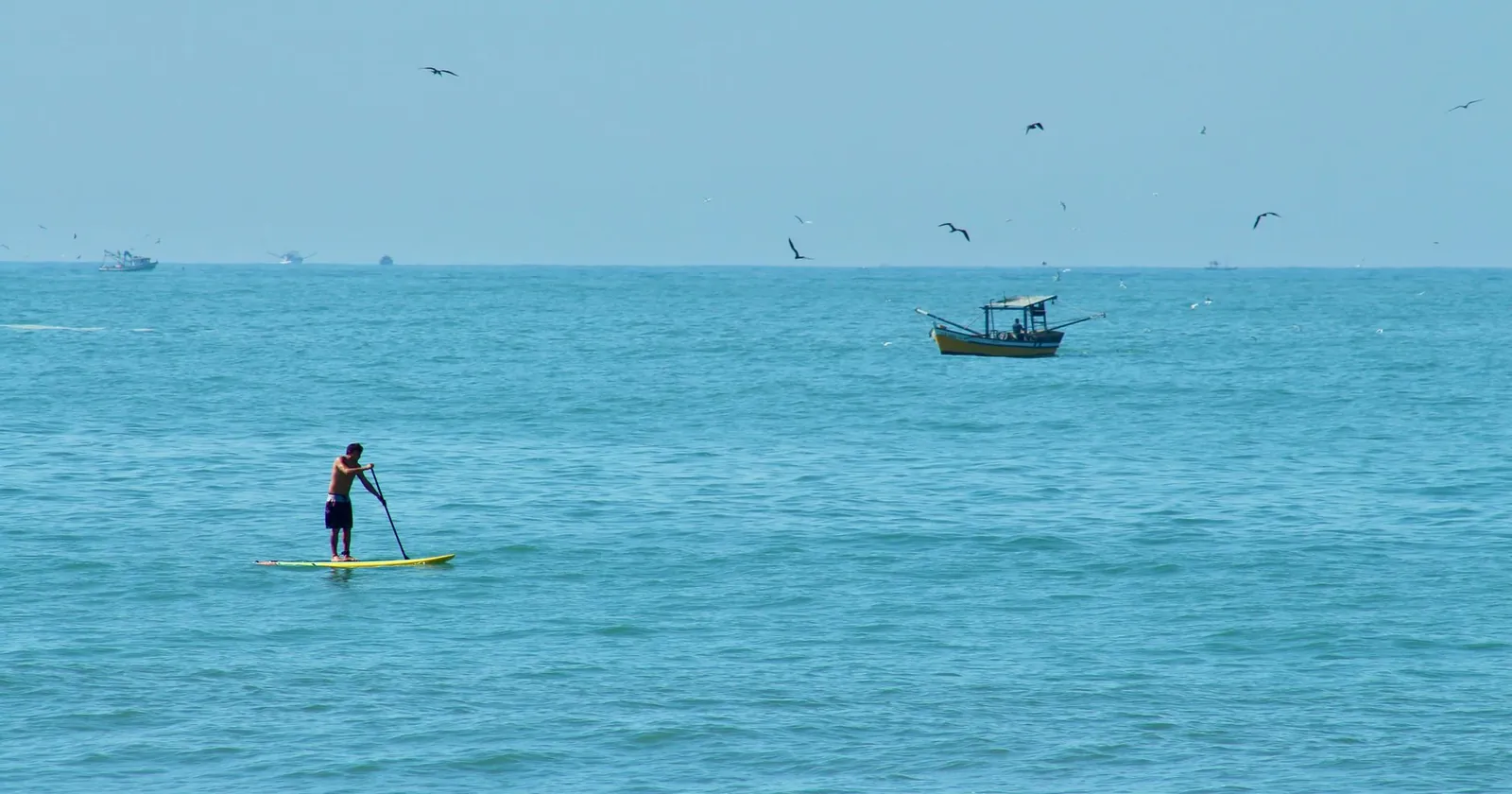
Photo: Camila Morini via Pexels (free license).
This is general beginner guidance, not a substitute for instruction and local knowledge.
Key takeaways
- Standing = sight-fishing; spot fish you never could sitting down.
- Wide, stable board; inflatable fishing SUPs are stable and packable.
- Rig simply; keep the deck clear so you can move your feet.
- Belt-pack PFD + leash; anchor or stakeout to hold position.
- Wind is the hazard: avoid offshore wind, start on calm water.
Why fish from a SUP?
SUP fishing uses a stand-up paddleboard as a quiet, low fishing platform. Standing gives an elevated view for sight-fishing, spotting fish and structure you would miss from a kayak, the approach is stealthy, and an inflatable board is wonderfully packable for a traveling nomad. It shines on calm lakes, estuaries, flats and sheltered coast.
How a beginner progresses in SUP fishing
Step 1: A wide, stable board
Choose a wide, stable, high-volume SUP, wider than a touring board, so you can stand and cast in comfort. Inflatable fishing SUPs with rigid drop-stitch construction are popular for their stability and packability. Prioritise stability and weight capacity over speed. See our inflatable SUP guide.
Step 2: Rig it simply
Add only what you need: a deck bag, cooler or crate for rods and tackle, one or two rod holders, and bungee storage. Keep the deck uncluttered so you can move your feet, and secure everything so nothing rolls off or sinks in a fall.
Step 3: PFD, leash and license
Wear a PFD (a belt-pack style keeps it clear of casting) and a board leash so your board does not float off. Get the correct fishing license and follow local rules on limits, seasons and protected areas.
Step 4: Anchor and sight-fish
Use a light anchor or a stakeout pole to hold position over a spot, so you are not paddling and casting at once. Then use your standing height to sight-fish, casting smoothly with soft knees and lowering your stance when fighting or landing a fish.
SUP fishing or kayak fishing?
Standing on a SUP gives a better view and a stealthier feel but demands more balance and is more affected by wind; a fishing kayak is more stable, carries more gear and copes better with wind, but you sit lower. For calm, shallow water and packability, SUP fishing wins; for bigger water and lots of gear, a kayak is often easier.
A fishing SUP is a vessel, and the statistics on that are specific
Loading a paddleboard with rods, a cooler and an anchor changes what it is. In the United States the Coast Guard already treats paddlecraft as vessels, and its 2024 recreational boating statistics put a number on the consequence.
Where vessel type was known, paddlecraft accounted for 26 per cent of all recreational boating deaths, second only to open motorboats at 46 per cent, and far ahead of pontoons at 8. Broken out, that is kayaks 16 per cent, standup paddleboards 5 per cent and canoes 4.5 per cent. Set against the whole picture: 3,887 incidents, 556 deaths, and where cause was known 76 per cent drowned.
The number that turns those into advice is the next one. Where life-jacket use was known, 87 per cent of the people who died were not wearing one. A fishing board is exactly the configuration where a jacket gets taken off: it is in the way of casting, it is hot, you are sitting down, the water is flat. That is the configuration the 87 per cent is describing.
One detail from the federal requirements is worth knowing precisely, because it is often misread as an exemption: vessels “16 feet and longer (except canoes and kayaks) must also carry one throwable PFD”. Canoes and kayaks are excused the throwable cushion. Nothing in that excuses anyone from the wearable one.
Worth knowing too that the discipline has a governing body rather than only a retail scene: the International Surfing Association, recognised by the IOC as “the World Governing Authority for Surfing”, explicitly governs “StandUp Paddle (SUP) Racing and Surfing” and crowned its first SUP world champions in 2012.
FAQ: SUP fishing
What is SUP fishing?
SUP fishing is fishing from a stand-up paddleboard. You use a wide, stable board as a quiet, low platform to paddle to spots and fish from, usually standing, which gives an elevated view for spotting fish (sight-fishing). It is stealthy, close to the water, and, with an inflatable board, very packable. It suits calm lakes, estuaries, flats and sheltered coast, and is a fun, minimal, travel-friendly way to combine paddling and fishing.
Do I need a special board for SUP fishing?
You want a wide, stable, high-volume board rather than a narrow touring or race SUP, so you can stand and cast comfortably and carry gear. Dedicated fishing SUPs are extra wide and often have accessory mounts and more weight capacity. Inflatable fishing SUPs with rigid drop-stitch construction are very popular because they are stable, forgiving and pack down for travel and storage. You can start on any wide, stable board, but a purpose-built fishing SUP makes it easier.
Is SUP fishing harder than kayak fishing?
They are different. Standing on a SUP gives a better view for sight-fishing and a stealthier, more connected feel, but it demands more balance and is more affected by wind and chop than sitting in a kayak, and offers less storage and shelter. Kayak fishing is more stable, carries more gear and copes better with wind, but you sit lower. For calm, shallow, warm water and packability, SUP fishing shines; for bigger water, wind and lots of gear, a kayak is often easier.
How do you stay in one spot when SUP fishing?
Use an anchor or a stakeout pole to hold position so you are not constantly paddling. A light folding or grapnel anchor on a line works in deeper water, while a stakeout pole pushed into the bottom is ideal in shallow flats and is quick and quiet. Anchoring lets you settle over a spot, sight-fish and cast without drifting off in the wind or current. Always be ready to release your anchor quickly and never anchor in strong current in a way that could pull the board under.
Is SUP fishing safe?
SUP fishing is safe with the usual water-sport precautions, but a paddleboard catches the wind easily because you stand up and present a big profile, so wind is the main hazard. Wear a PFD (a belt-pack style keeps it out of the way of casting), use a leash, avoid offshore winds, check the weather, dress for immersion, tell someone your plan, start on calm sheltered water, and learn to remount after a fall. Get the correct fishing license and follow local rules. Do not SUP fish alone while learning. This is general information, not instruction.
Yannick Schroth
Founder of NOMADREEF and a former digital nomad. This guide explains the beginner basics of SUP fishing; it is not a substitute for instruction, local knowledge or the correct license, and wind and on-water safety must always come first. About the author · LinkedIn ↗
Sources
- What share of the deaths are paddlecraft. US Coast Guard, Recreational Boating Statistics 2024: “the vessel types with the highest percentage of deaths were open motorboats (46%), paddlecraft (26%) and pontoons (8%). Paddlecraft deaths include canoes (4.5%), kayaks (16%) and standup paddleboards (5%)”; 3,887 incidents, 556 deaths; “Where cause of death was known, 76% of fatal boating incident victims drowned. Where Personal Flotation Device usage was known, 87% were not wearing a Personal Floatation Device.” uscgboating.org. Read 13 September 2026.
- The throwable-PFD exemption, exactly. US Coast Guard, A Boater’s Guide to the Federal Requirements for Recreational Boats: vessels “16 feet and longer (except canoes and kayaks) must also carry one throwable PFD (Type IV)”; the guide also notes that stand-up paddleboards “tend to be less stable and can easily capsize”. uscgboating.org. Read 13 September 2026.
- SUP has a governing body. International Surfing Association, About the ISA: the ISA, “founded in 1964, is recognized by the International Olympic Committee as the World Governing Authority for Surfing” and “governs and defines Surfing as… StandUp Paddle (SUP) Racing and Surfing”; it crowned “World StandUp Paddle (SUP, both surfing and racing) and Paddleboard Champions in 2012”. isasurf.org. Read 13 September 2026.
- SUP fishing conventions (board choice, rigging, belt-pack PFD, anchoring and stakeout, wind safety).
- Our own how to start SUP, kayak fishing and inflatable SUP guides.