Where to Learn to Wakeboard: Eight Cable Parks Compared
 by Yannick SchrothAug 28, 20265 min read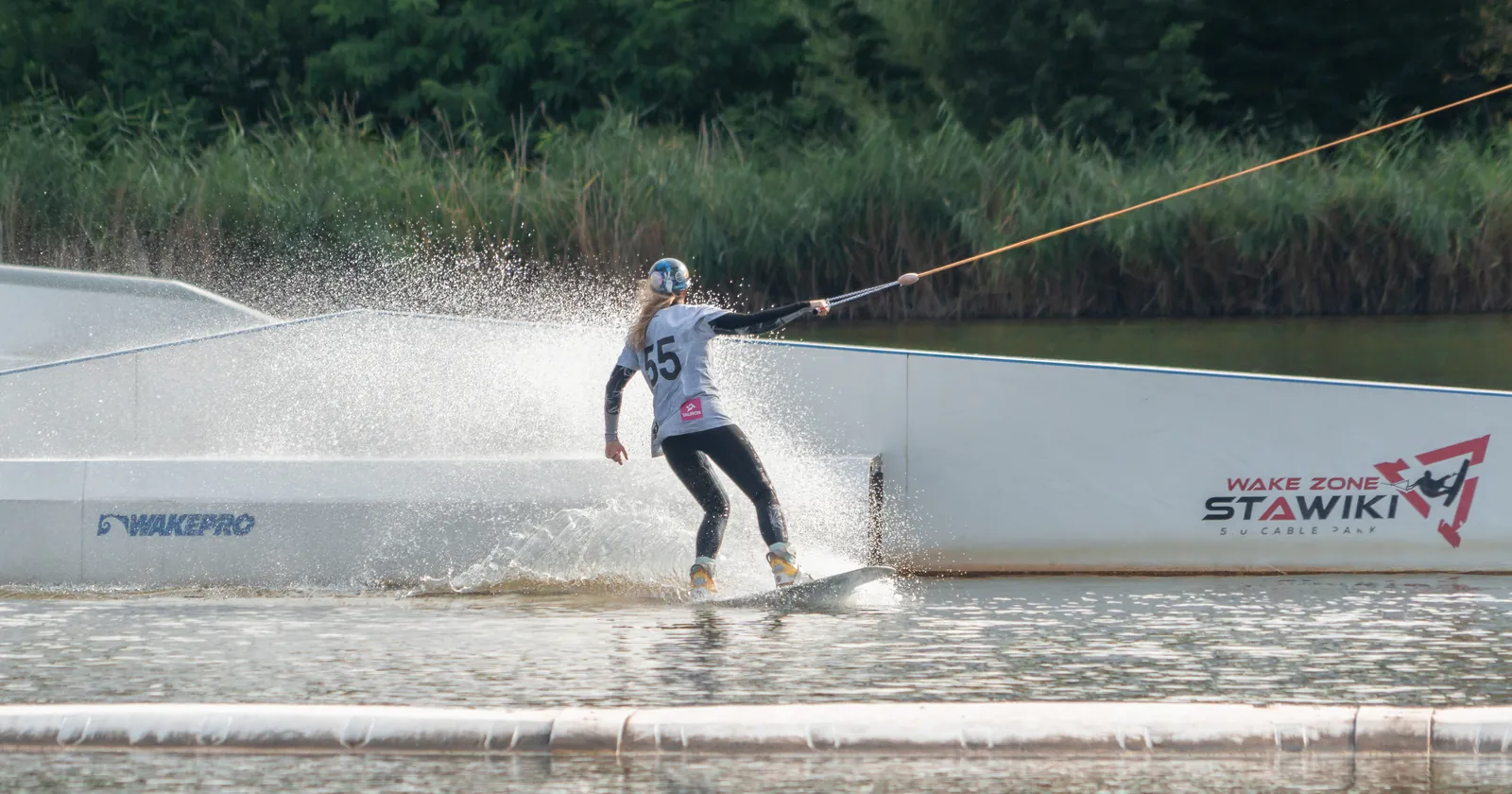
Photo: Krzysztof Popławski, Wikimedia Commons, CC BY 4.0. The 2024 Polish cable championships at Wake Zone Stawiki. The orange line is the cable doing the work: this rider is a competitor, not a beginner.

Key takeaways
- Ask who stops the cable. On a 2.0 line an operator does, and at Tallinn and Warsaw that is included. On a full-size loop nobody does.
- The headline price is not your first session. Six of the eight charge for the board on top, which adds 7 to 10 €.
- Stated minimum ages run from five to ten, and the operators disagree about the reason as much as the number.
- One park says you need not be able to swim. Most of the others require it in writing.
The eight, side by side
These are the parks whose own sites say enough about teaching to be compared. Six have guides here; Prague and Munich do not yet, and are included because they publish the same facts.
| Park | What a beginner rides | Who is watching | From age | A first go, with a board |
|---|---|---|---|---|
| Männiku Wakepark Tallinn | The Balcia Beginners Line, 208 m, fewer obstacles | An instructor drives the lane, in the price | not stated | 25 € for the 20-minute mini-course, gear included |
| Wawa Wake Warsaw | One of two lifts, one rider at a time | An instructor, in every price, plus wetsuit, vest and helmet | 8 to 9 | 89 zł, about 21 €, for 15 minutes with a board |
| Cachin near Annecy | A two-pulley line, towed out and back | A qualified instructor teaches beginners | 5 | 25 € for 15 minutes with a board |
| Singapore Wake Park Singapore | System A, 60 m, one rider at a time | A dedicated instructor, on System A only | 6 | S$55, about 37 €, an hour with a board |
| Copenhagen Cable Park Copenhagen | The Small Cable: two towers, instant stops, adjustable speed | One-to-one instruction on that cable | 10, its youngest ticket band | Basic Course 550 DKK, about 74 € |
| Wakeboardlift Wien Vienna | The full-size lift during its slow hour, 25–28 km/h | Guided courses exist; the course page returned 404 | 8 | 28 € an hour plus 10 for a board, 38 € |
| Prague Louka Prague | The whole 200 m lift to yourselves | Staff fit the gear and explain, per the operator | not stated | 1,200 Kč, about 50 €, an hour for up to four |
| Wasserskipark Aschheim Munich | A Slow Laps session, after the beginner course | A beginner course first, then a slowed session | not stated | 40 € for two hours including gear |
What actually matters: who is driving the cable
Cable parks come in two shapes, and the difference decides what your first hour feels like far more than the price does.
A full-size cable is a loop strung between four or six towers. It runs continuously at a set speed (30 km/h at Singapore, 28 to 31 at Vienna) and carries several riders at once. Nobody stops it for you. When you fall, you let go, swim to the bank and wait for your turn again.
A 2.0 system is a straight line between two masts with a person operating it. Männiku explains the consequence better than any other operator: that person sets the speed to the individual rider and, when you fall, stops the cable immediately and brings the handle back to you. Warsaw describes the same thing from the other end, the instructor stops the lift and swims out, and adds the comparison that makes it obvious: a ski lift does not stop during normal operation, and a wake lift does.
You are never dragged. That is the whole argument for learning on a 2.0 line, and it is why the three cheapest first sessions on this page are all on one.
What a first go really costs
The number on a park’s price list is usually the cable, not the equipment. Six of these eight charge for the board separately, so the figure in the table above is the one to compare and the headline rate is not.
- Cheapest with a board: Warsaw at about 21 € for fifteen minutes, with the instructor, wetsuit, vest and helmet already in it.
- Cheapest per hour, if you are four: Prague, where 1,200 Kč buys the entire lift for an hour and works out at about 12 € a head. Alone it is the most expensive hour here.
- Most expensive: Copenhagen’s Basic Course at about 74 €, which is a structured beginner course rather than a session, so it is not quite the same purchase.
- Best value for a first two hours: Munich’s Slow Laps session, 40 € including gear, which the park positions for people who have done the beginner course and are not ready for public operation.
Fifteen minutes sounds absurd until you have done it. Warsaw says a fifteen-minute lesson is enough to start riding and that comfortable movement comes after two or three of them, and Cachin sells the same length. On a first session most of your time is spent getting up, and your forearms give out before your interest does.
From what age, and why the operators disagree
The stated minimums span five years, which is a wide spread for one sport:
- Five at Cachin, with a qualified instructor for beginners.
- Six at Singapore, as a recommendation rather than a rule.
- Eight at Vienna, for its Just4Kids course and its school bookings.
- Eight or nine at Warsaw, and this is the only operator that gives a reason: wakeboarding is a directional, asymmetric sport, so it waits until a child’s body is strong enough not to be loaded on one side.
- Ten at Copenhagen, which does not state a minimum but sells no ticket below that.
Warsaw’s answer is the one worth reading before you book a child in anywhere. It is also the only one framed as a judgement the operator made rather than a number in a rule.
If you cannot swim
Most of these parks require swimming ability and put it in writing. Singapore requires it of every rider on all three of its cables; Vienna requires it of school and birthday groups; Männiku requires it in its inflatable Funpark.
Wawa Wake is the exception, and says so plainly: swimming is useful but not required, and if you cannot swim you should tell the instructor before the lesson so they prepare and run it differently. That is only workable because one rider is on the lift at a time and the operator stops it and swims out. A buoyancy vest is compulsory and included everywhere on this page.
If not being a strong swimmer has kept you off a board, that is the entry to look at: and it is worth asking any other park the same question directly rather than assuming.
Where we would send someone who has never stood on a board
On the published evidence, and without having ridden any of them:
- If you are near Tallinn, Männiku. A 20-minute beginner course for 25 €, an instructor driving your lane, a dedicated beginner line, and two harder lanes to move to at the same price when you are ready.
- If you are near Warsaw, Wawa Wake, for the same reasons plus the swimming answer and everything bundled into one number.
- If you are traveling to one of the others, Singapore’s System A is the most structured beginner setup here: nine one-hour lessons a day, four riders maximum, one on the cable at a time, with an instructor whose only job is you.
- If you have a child under eight: Cachin is the only one that takes them.
Our beginner’s guide to wakeboarding covers what happens on the water once you are there, and the cable-park roundup has what each of these places costs beyond a first session.
FAQ: Where to Learn to Wakeboard
Which cable park is best for a complete beginner?
The one where a person is driving the cable rather than a loop running at a fixed speed. At Maenniku in Tallinn and Wawa Wake in Warsaw that instructor is in the price of every session; at Singapore Wake Park it comes with System A only. All three stop the cable the moment you fall instead of towing you.
How much does a first wakeboarding session cost?
Between about 21 and 74 euro at the eight parks that publish a price, once the board is added. The cheapest first go with a board is Warsaw at 89 zloty for fifteen minutes; the most expensive is Copenhagen's Basic Course at 550 kroner. The headline hourly rate almost never includes a board.
Do I need to be able to swim to wakeboard?
At most parks yes, and they say so. Singapore requires it of every rider and Vienna of its school groups. Wawa Wake in Warsaw is the exception in our research: its FAQ says swimming is useful but not required, and asks you to tell the instructor beforehand.
How young can children start?
The stated minimums run from five at Cachin near Annecy to ten at Copenhagen, where the youngest ticket band begins. Warsaw puts it at eight or nine and explains why: wakeboarding loads the body asymmetrically, so it waits until a child is stronger.
Sources
- Every figure here is taken from the operator page cited on that park's own guide, all read 2026-08-28: Männiku Wakepark, Wawa Wake, Cachin, Singapore Wake Park, Copenhagen Cable Park and Wakeboardlift Wien.
- The two parks without a guide of their own: Prague Louka and Wasserskipark Aschheim, both read 2026-08-28.
- Currency conversions: European Central Bank euro foreign exchange reference rates, 27 August 2026.