Diving in Sanur, Bali: the Departure Point for Nusa Penida
 by Yannick Schroth
Sep 19, 2026
10 min read
by Yannick Schroth
Sep 19, 2026
10 min read
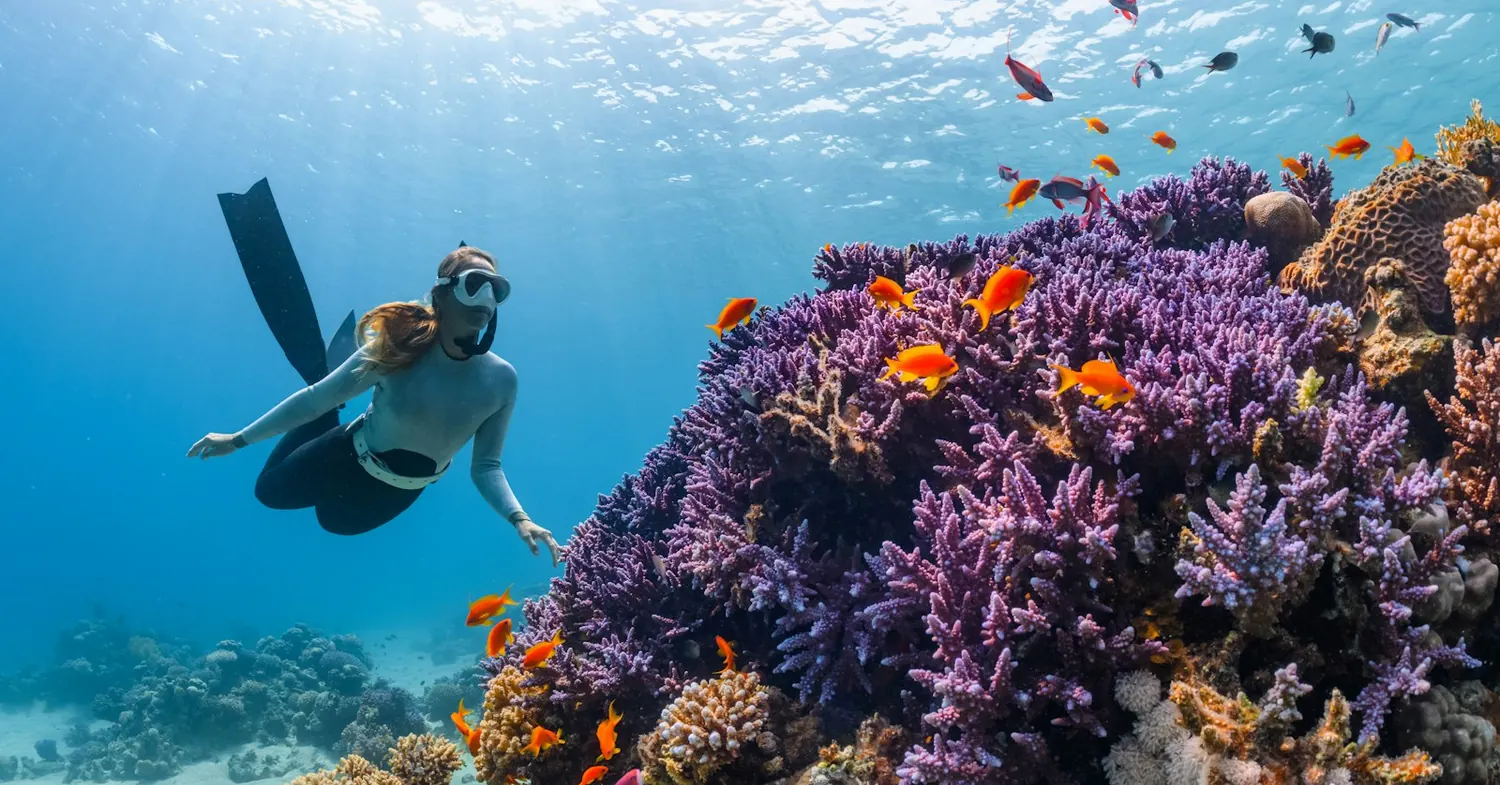
Photo: Unsplash (free licence).
Key takeaways
- The crossing to the Nusa Penida dive sites runs 30 to 45 minutes, and dive boats launch off Sanur beach rather than from the passenger terminal
- Manta Point holds reef mantas all year, so the variable is swell, not season; the cleaning stations are shallow and surge hard
- Mola mola season is July to October, driven by cold upwelling, with the deeper Crystal Bay dives in 18 to 22 degree water
- Crystal Bay produces down-currents that have killed experienced divers; more than fifty logged dives is not automatically enough
- The Bali chamber is at Prof. Ngoerah hospital in Denpasar, formerly Sanglah, and its hyperbaric clinic publishes weekday morning hours
Sanur Harbour and the crossing to Nusa Penida
Sanur sits on the east-facing coast of Denpasar, looking across the Badung Strait at Nusa Penida. What makes it a diving address has almost nothing to do with what is under its own water. It is the strait, and the fact that the boats cross it from here. Nearly every dive sold in Sanur is a day trip that starts on this sand and ends back on it in the late afternoon.
The passenger half of that traffic got a building in 2022. Pelabuhan Sanur, next to Matahari Terbit beach, was inaugurated by President Joko Widodo on 9 November 2022 together with Sampalan on Nusa Penida and Bias Munjul on Nusa Ceningan, at a combined cost of Rp 563 billion from the state budget. The three were built to finish the connectivity of what the transport ministry calls the Segitiga Emas, the golden triangle.
What the terminal replaced is the detail worth keeping. Transport minister Budi Karya Sumadi described the old arrangement plainly: the port was traditional, it had no jetty, and travellers who wanted to board had to walk into the water at the edge of the beach. There is now a pier, indoor check-in desks and an air-conditioned waiting room, inside a two-storey building shaped after the jukung outriggers that Sanur fished from.
Dive boats are separate traffic. Most Sanur dive centres still launch from the beach rather than the passenger pier, off Semawang and the stretches near it, which is why a dive day here tends to start with fins in hand and water to the knee. The crossing runs roughly 30 to 45 minutes to the Nusa Penida sites and a little less to Lembongan. Foot-passenger fast boats run from about 06:30 to about 17:00.
What Sanur’s own dive sites are for
Sanur has three named sites and a good reason not to plan a trip around them. Sanur Bay lies in the channel, a coral edge dropping onto a sand platform, with visibility of roughly five to ten metres. Penjor Reef is minutes offshore by speedboat and is the macro one. Jeladi Wilis, off the old Grand Inna beach hotel in east Sanur, starts at three metres and slopes to about twenty.
Blue Season Bali, which dives them daily, calls Sanur Bay the place for training and runs rescue and navigation courses in it. Jeladi Wilis gets recommended for night dives, with visibility of five to fifteen metres and current strong enough that slack tide matters. None of that is a bad dive. It is a check dive, a course dive and a way to get wet on an arrival day.
Which is the shape of the whole place. The lagoon in front of the hotels is reef-protected and flat, and it is where people paddle rather than where they dive. If the lagoon were the product, thirteen dive businesses would not fit into a suburb this quiet. They fit because the boats leave from here, and the water worth crossing for is half an hour out.
Manta Point and Crystal Bay: the Nusa Penida dives sold from Sanur
Manta Point, on the exposed south coast of Nusa Penida, is a cleaning station rather than a reef. The stations sit at five to ten metres with a maximum around eighteen, and the wall behind them falls to roughly forty. Reef mantas are there all year. That is the single most useful fact about the site: it is not a season you have to catch, it is a swell forecast you have to read.
The exposure is the catch. The site takes open-ocean swell off the Indian Ocean, and the water over the cleaning station surges rather than flows. In a big sea the boats simply do not go. Shallow does not mean easy here. Holding position at six metres in surge, with a manta coming past, is more work than a thirty-metre drift on a clean tide.
Crystal Bay is on the west side, in the channel between Nusa Penida and Nusa Ceningan, and it is the mola site. In the morning, above about fifteen metres, it is an Open Water dive. The deeper zone from roughly eighteen to thirty metres, where the sunfish come up to be cleaned, is where operators start asking for Advanced Open Water or equivalent. Both descriptions are of the same bay on the same day.
All of it lies inside the Nusa Penida marine protected area: 20,057 hectares across Nusa Penida, Nusa Lembongan and Nusa Ceningan, declared by Klungkung regency in 2010. The Coral Triangle Center, which helps manage it, records 296 coral species from a 2008 survey and more than 600 individual reef mantas identified since 2004, under three main zones and seven subzones.
Mola mola season at Nusa Penida, and the cold that comes with it
The sunfish that draws divers here is the short mola, Mola ramsayi, and the season is July to October, with the best odds in August and September. It is an upwelling season, not a breeding one. Cold water arrives from below during the southeast monsoon, and the fish come up into it to be cleaned by reef fish at depths they can tolerate rather than inhabit.
The satellite work is worth reading before you book a week around it. Thys and colleagues tagged short molas at Nusa Penida and published the first behavioural data for the species anywhere: a thermal range of 10 to 27.5 °C, 95 per cent of recorded time in the upper 250 metres, and a preference for the bottom of the warm surface layer. One tag stayed within 10 km of its deployment for six months. Another surfaced 747 km to the south-east.
For a diver that translates into a thermocline you can feel. Surface temperature around Nusa Penida in the southeast monsoon still averages close to 28 °C, so the boat ride tells you nothing. Below the thermocline the season water is commonly reported at 18 to 22 °C, colder in patches. A 5 mm suit and a hood are not overdressing in September. A 3 mm shorty is how divers end up back on the boat early and shivering.
And the odds stay odds. Sightings are not daily at any one site. Centres willing to put a number on it tend to give a single dive roughly one chance in ten, improving across a full day of three dives when the tide and the moon line up. Booking a week inside the season is a sensible plan. Booking one day and expecting a sunfish is not a plan at all.
What Nusa Penida currents ask of a diver leaving Sanur
The marketing around these sites is softer than the sites are. Nusa Penida is drift diving on a tidal strait that funnels the Indonesian Throughflow out of the Pacific towards the Indian Ocean, and the current is not only horizontal. Down-currents at Crystal Bay can take a diver deeper than planned, quickly, and release them somewhere else entirely. That is the mechanism behind the site’s record, not bad luck.
In February 2014, seven Japanese divers were swept away from their boat at Crystal Bay. Two died, one of them a dive instructor, and five drifted for three days before they were found. The contemporary report of that accident is blunt about the level involved: the site is really only suited to experienced divers, and those divers had more than fifty dives each, which it notes is often not enough. On 16 September 2026 a Malaysian diver died at the same site after a sudden current split the group.
None of which makes the place undiveable. It makes the briefing the thing you are actually buying. Ask before you get on the boat in Sanur: which sites are planned against the tide that day, what the guide does if the group separates, whether you are expected to carry and deploy your own surface marker buoy, and how many divers each guide takes. If the answer to the last one is eight, there is another boat.
The certification question has a plain answer. Open Water is enough for the shallow half of Crystal Bay in the morning and for Manta Point in calm swell with a guide who is actually watching. It is not enough for a thirty-metre mola dive in an upwelling, and no card substitutes for recent dives in moving water. If you have not dived in a year, do a Sanur check dive first. That is what those three local sites are for.
The hyperbaric chamber in Denpasar, the nearest one to Sanur
The chamber is at RSUP Prof. dr. I.G.N.G. Ngoerah on Jalan Diponegoro in Denpasar, known as Sanglah until 2022, a short drive inland from Sanur beach. The hospital switchboard is (0361) 227911. Being close to it is one of the quieter arguments for basing in Sanur rather than on the far coasts of the island, and it is the argument nobody puts in a brochure.
Read the published hours carefully. The hyperbaric polyclinic lists registration from Monday to Thursday, 07:00 to 13:30, and Friday 07:00 to 13:00. A dive accident does not arrive during clinic hours, and a chamber running a scheduled outpatient programme is not the same thing as a guaranteed 24-hour emergency recompression service. Insurance that pays for evacuation and chamber time is the part of the kit list nobody photographs.
What comes through that clinic says something about the diving. A 2023 review of its decompression illness patients from before the pandemic found 88.1 per cent were foreign visitors and 62.7 per cent had been diving deeper than 20 metres, with most cases classified as type 2 and most of those as major severity. That is the profile of dive tourism on deep, current-swept sites, which is a fair description of Nusa Penida.
The 13 dive businesses in Sanur, and what a listing settles
Thirteen dive businesses in Sanur appear in the sources behind the operator list: 11 published by SSI in its register of affiliated centres, read on 13 September 2026, and 2 Green Fins members, read on 14 August 2026. Eleven of the thirteen publish a website. Every row on the Sanur operator list links back to the page it was taken from.
Those two sources mean different things. Green Fins is the only source in this directory where a trained assessor physically visited the business and scored what they saw. It is also voluntary, and most of Sanur is not in it. A business outside Green Fins is outside a scheme rather than below a standard, and reading its absence as a mark against an operator would be wrong.
What a register listing settles is narrow. It says that a body lists the business, on the date given. It says nothing about the boat, the guide-to-diver ratio, the state of the rental regulators, or whether the centre is trading this season. For Nusa Penida, where the briefing is the safety system, that is precisely the gap that matters.
There is no national list to close it. Indonesia publishes no readable register of licensed dive operators: POSSI answers a plain request with HTTP 403, and the tourism ministry publishes no operator list at all. That is a statement about what can be read, not about what Indonesian law requires. The same problem, country by country, is set out in which registers can be read.
Staying in Sanur past the 30 days a visa on arrival gives
The Indonesian visitor visa, taken on arrival or bought online beforehand as an e-VOA, gives a 30-day stay. The Directorate General of Immigration publishes the terms: 87 eligible nationalities, a fee of IDR 500,000, a visa validity of 90 days, and permitted purposes of tourism, government visits, business meetings, goods purchasing or transit. Staying longer means a residence permit extension applied for at an immigration office.
Note what is missing from that list of purposes. Remote work is not on it, and the route Indonesia built for remote workers is the separate E33G permit, with its own income test and insurance requirement. That is set out in full on the Indonesia visa page rather than repeated here, because it is a different application with different paperwork.
For someone working from Bali and diving on the side, Sanur is the compromise position: a short airport transfer, the chamber a few minutes inland, flat quiet streets that are unusually good for cycling, and the boats to Nusa Penida leaving from the beach in front. Living on Nusa Penida itself removes the crossing and adds everything else. Amed, up the east coast, is the shore-diving answer with no boat at all.
FAQ: diving in Sanur and crossing to Nusa Penida
Is there any diving in Sanur itself, or only day trips to Nusa Penida?
There are three local sites: Sanur Bay in the channel, Penjor Reef a few minutes offshore, and Jeladi Wilis in east Sanur, which starts at three metres and slopes to about twenty. Visibility runs roughly five to fifteen metres, and dive centres use them for training, night dives and check dives. They are useful rather than remarkable. The reason a dozen centres are based here is the boat to Nusa Penida.
How long is the boat from Sanur to Nusa Penida?
About 30 to 45 minutes to the Nusa Penida dive sites, and a little less to Nusa Lembongan. Fast boats for foot passengers run from the Sanur terminal from roughly 06:30 until about 17:00. Dive boats are separate traffic and mostly launch from the beach itself rather than the passenger pier, so a dive day usually starts with wading out to the boat.
When is mola mola season at Nusa Penida?
July to October, with the best odds in August and September. The season follows the cold upwelling of the southeast monsoon rather than any breeding cycle. Sightings are not daily: a single dive is commonly put at around one chance in ten, and a full day of three dives improves on that. The fish at Nusa Penida is the short mola, Mola ramsayi.
Do you need to be an advanced diver to dive Nusa Penida from Sanur?
For shallow Crystal Bay in the morning and for Manta Point in calm swell, an Open Water certificate with a guide is normally accepted. For the deeper zone from about eighteen to thirty metres, where sunfish are cleaned in season, operators ask for Advanced Open Water or equivalent. Certification is only half of it. Recent dives and experience of current matter more than the card.
How cold is the water diving Nusa Penida in mola mola season?
The surface stays warm, averaging close to 28 degrees around Nusa Penida in the southeast monsoon, so the boat ride is no guide to what is below. Under the thermocline in season the water is commonly reported at 18 to 22 degrees and colder in patches. A 5 mm suit and a hood are reasonable in August and September. A 3 mm shorty is how people cut a dive short.
Are the manta rays at Nusa Penida there all year?
Reef mantas are present at Manta Point year round, which is unusual and is why the site sells in every season. The limiting factor is not the mantas but the swell: the site sits on the exposed south coast and boats do not run to it in a big sea. The cleaning stations are shallow, at roughly five to ten metres, with noticeable surge over them.
Where is the nearest hyperbaric chamber to Sanur?
At RSUP Prof. dr. I.G.N.G. Ngoerah on Jalan Diponegoro in Denpasar, a short drive inland, known as Sanglah hospital until 2022. The hospital switchboard is (0361) 227911. The hyperbaric polyclinic publishes registration on weekday mornings only, which is not the same thing as a 24-hour emergency recompression service, so dive insurance that covers evacuation and chamber treatment is worth holding.
How many dive schools are there in Sanur, and can I check a licence?
Thirteen dive businesses in Sanur appear in the sources behind the operator list: eleven published by SSI in its register of affiliated centres, read on 13 September 2026, and two Green Fins members, read on 14 August 2026. Eleven of the thirteen publish a website. There is no licence list to check them against, because Indonesia publishes no readable register of dive operators.
What visa do you need to dive in Sanur, Bali?
The Indonesian visitor visa, issued on arrival or online as an e-VOA, gives a 30-day stay for IDR 500,000, and a longer stay needs an extension applied for at an immigration office. Immigration lists the permitted purposes as tourism, government visits, business meetings, goods purchasing or transit. Remote work is not among them. The separate E33G remote worker permit is the route for working from Bali.
Founder of NOMADREEF and a former digital nomad. This guide is sourced from the references below; conditions, prices and rules change, so verify current details, and follow qualified local guidance and safety briefings. About the author · LinkedIn ↗
Sources
- The new Sanur port, and what it replaced. President Joko Widodo inaugurated Pelabuhan Sanur together with Sampalan (Nusa Penida) and Bias Munjul (Nusa Ceningan) on 9 November 2022, at a combined Rp 563 billion from the state budget, to complete the Segitiga Emas connection. Transport minister Budi Karya Sumadi on the old arrangement: “Sebelum dibangun, pelabuhan ini masih merupakan pelabuhan tradisional dan belum memiliki fasilitas pendukung seperti dermaga, sehingga wisatawan yang mau naik kapal harus masuk ke air di pinggir pantai.” CNBC Indonesia. The terminal description (Matahari Terbit beach, jukung-shaped two-storey building, indoor check-in, air-conditioned waiting room) from NOW! Bali. Read 19 September 2026.
- Mola mola behaviour and thermal range. Thys, Ryan, Weng, Erdmann and Tresnati, “Tracking a Marine Ecotourism Star: Movements of the Short Ocean Sunfish Mola ramsayi in Nusa Penida, Bali, Indonesia”, Journal of Marine Biology, 2016. Satellite tags give a thermal range of 10 to 27.5 °C, 95 per cent of time in the upper 250 m, a preference for the bottom of the warm surface layer, one tag recovered under 10 km from its deployment after six months and another 747 km to the south-east. doi:10.1155/2016/8750193, with the open record at Hasanuddin University. Read 19 September 2026.
- The Nusa Penida marine protected area. The Coral Triangle Center, which co-manages the MPA, publishes 296 coral species recorded in 2008, more than 600 individual reef mantas identified since 2004, a zoning plan of three main zones and seven subzones, and an upwelling season of July to October: coraltrianglecenter.org. The 20,057 hectare figure and the 2010 Klungkung regency declaration are triangulated across secondary conservation and management sources rather than read from the regency decree itself. Read 19 September 2026.
- Crystal Bay currents and what the site demands. The February 2014 accident in which seven Japanese divers were swept from their boat at Crystal Bay, two of whom died and five of whom drifted for three days, with the assessment that the site is “really only suited for experienced divers” and that “50-plus dives often aren’t enough”: Undercurrent, March 2014. The death of a Malaysian diver at the same site on 16 September 2026, after a sudden current separated the group, reported from the Klungkung police account: Divernet. Read 19 September 2026.
- The Bali hyperbaric chamber. RSUP Prof. dr. I.G.N.G. Ngoerah, Jalan Diponegoro, Denpasar 80113, switchboard (0361) 227911, with hyperbaric clinic registration hours of Monday to Thursday 07:00 to 13:30 and Friday 07:00 to 13:00: profngoerahhospitalbali.com. The patient profile (88.1 per cent foreign visitors, 62.7 per cent diving deeper than 20 m, type 2 and major severity predominating) is from “Characteristics of patients with decompression illness at the hyperbaric polyclinic of Prof IGNG Ngoerah General Hospital Bali before the COVID-19 pandemic”, International Journal of Health & Medical Sciences, 2023: sloap.org. Read 19 September 2026.
- Indonesian entry terms. The Directorate General of Immigration publishes the Visitor Visa terms directly: 87 eligible nationalities, a 30-day stay, a visa validity of 90 days, a fee of IDR 500,000, and permitted purposes of “Tourism, Government visits, Business Meetings, Goods Purchasing, or Transit only”, with a longer stay requiring a residence permit extension at an Immigration Office: evisa.imigrasi.go.id. Read 19 September 2026. The E33G remote worker route is covered on the Indonesia visa page.
- Sanur’s own dive sites. Site names, depths, visibility and use for training and night dives, published by a dive centre that runs them daily: Blue Season Bali. Operator-published, read 19 September 2026. Crossing times of 30 to 45 minutes, foot-passenger schedules of roughly 06:30 to 17:00, and the beach launch used by dive boats are triangulated across operator itineraries and ferry schedules rather than taken from a single published timetable.
- The 13 Sanur dive businesses, and why no licence is cited. Eleven from the SSI register of affiliated centres, read 13 September 2026, at divessi.com, and two Green Fins members, read 14 August 2026, at greenfins.net, both assessed in person. Each row links to its own register page on the Sanur operator list. Indonesia publishes no readable operator register: possi.or.id answers a plain request with HTTP 403, checked 19 September 2026, and the tourism ministry publishes no operator list. Recorded on which registers can be read.