Pemuteran Diving: Menjangan’s National Park Ticket, the Biorock Reef and the Provincial Park Next Door
 by Yannick Schroth
Sep 25, 2026
14 min read
by Yannick Schroth
Sep 25, 2026
14 min read
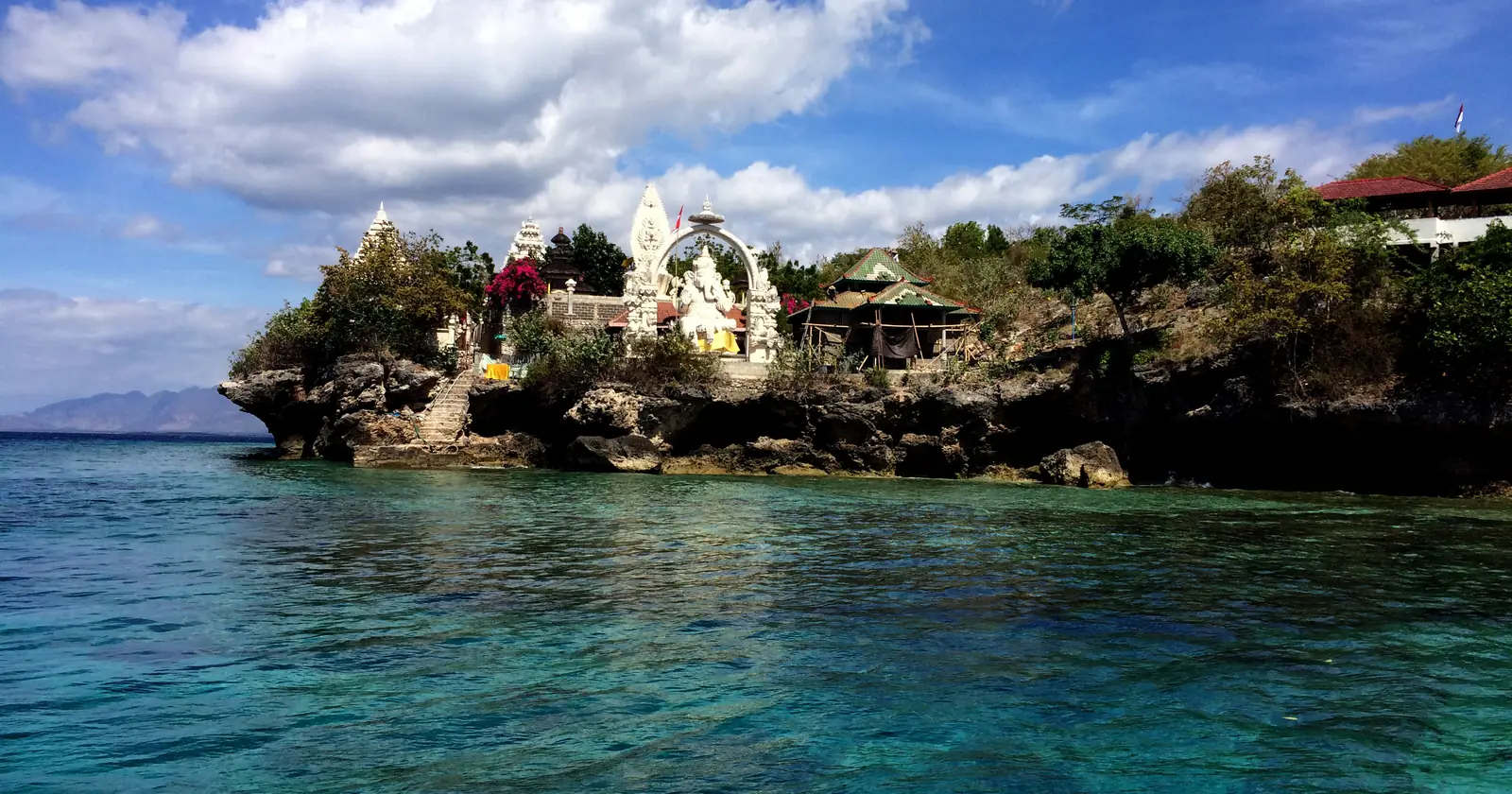
A temple on the shore of Menjangan Island, inside West Bali National Park. Photo: Lakshmi Sawitri, Wikimedia Commons, CC BY 2.0. Cropped.
.jpg)
Key takeaways
- A 2025 forestry regulation puts Taman Nasional Bali Barat, which includes Menjangan Island, in ticket class 2: Rp200,000 per foreign visitor per day
- The national tariff adds Rp25,000 per person per day for scuba diving in a national park, outside areas held under a nature-tourism business license
- Minister’s Decree 122 of 2023 made the waters around Pemuteran Area I of a provincial marine park, and gave Area I no core zone
- Water tourism there is permitted with conditions in the limited-use zone, including a local guide, and not permitted in the port zone or the religious and cultural site zone
- In June 2016, during a bleaching event, dead coral with algae covered 48.9 percent at the Biorock Pemuteran station and 51 percent at Menjangan
Pemuteran diving crosses from a provincial marine park into a national park
Pemuteran is a village on the northwest coast of Bali, in Buleleng regency. The diving here runs under two separate sets of rules, and which one applies depends on where the boat stops.
The water in front of the village lies in a marine conservation area that the Ministry of Marine Affairs and Fisheries designated in 2023 and handed to the Bali provincial government to manage. Menjangan Island, to the west, is part of Taman Nasional Bali Barat, West Bali National Park, on the forestry side of government. Its 2024 tariff regulation still carries the name of the old Ministry of Environment and Forestry; the 2025 regulation that sorts parks into ticket classes was signed by the Minister of Forestry.
The park is the older of the two. A 2015 study of its marine zoning dates it to 1984 and its definitive designation to Minister of Forestry Decree 493/Kpts-II/1995, which joined the Bali Barat wildlife reserve, the Pulau Menjangan wildlife reserve “and its surroundings (sea)” and the Bali Barat protection forest. At that point 3,415 hectares of the park were sea. The park office places Menjangan under its Section III at Labuan Lalang.
The east coast is a different trip, covered in the Amed guide, and so is the crossing to Nusa Penida in the Sanur guide. The Biorock growth measurement from Pemuteran reported in a 2022 review is set out in the Gili Trawangan diving guide, next to that island’s own frames.
Pemuteran’s water is Area I of the 2023 Buleleng decree, with no core zone
Minister of Marine Affairs and Fisheries Decree 122 of 2023, set on 31 July 2023 and in force the same day, designates the Kawasan Konservasi di Perairan di Wilayah Buleleng Provinsi Bali, the conservation area in the waters of Buleleng, and orders it managed as a Taman di Perairan, a park in the waters, of 18,060.18 hectares. The ministry’s legal database lists it as in force.
The decree splits that into three areas. Area I is “perairan sekitar Pemuteran”, the waters around Pemuteran: 1,646.07 hectares, of which 1,551.36 are limited-use zone, 47.55 a port and mooring zone and 47.16 a religious and cultural site zone. Area II, off Buleleng Banjar, covers 6,941.63 hectares, and Area III, off Tejakula, 9,472.48 hectares.
What Area I lacks is a core zone. The decree’s only two lie further east along the north coast: 61.21 hectares in Area II and 287.53 hectares in Area III, which also holds a 64.14-hectare rehabilitation zone. Around Pemuteran, every hectare is either limited-use water or water set aside for moorings and a religious site.
The fifth clause appoints the provincial government of Bali to manage the park, and the annex draws Area I and its zones from 41 numbered coordinate points spanning roughly 114°38′ to 114°43′ east. The decree names the areas and zones. It does not mention the village’s own fishing rules or the Biorock project.
That changes an older description. The UNDP Equator Initiative’s record of the village’s reef foundation speaks of “a de facto locally managed marine protected area”. Since July 2023 the waters around Pemuteran have also been a state-designated conservation area with a zoning map, which is the version to plan around.
Where Pemuteran’s 2023 zones let you dive, and the zone off Pura Pulaki
The decree draws the zones; the rules for each come from Regulation 31 of 2020 on managing conservation areas, which the decree cites as its basis. Its annex tabulates activities zone by zone. For a park, kegiatan pariwisata alam perairan, nature tourism in the water, reads: core zone “Tidak Diperbolehkan”, not permitted; limited-use zone “Diperbolehkan dengan Syarat”, permitted with conditions; other zones, not permitted.
The conditions are specific. Water tourism takes place in the tourism subzone of the limited-use zone, at the locations designated for each activity, with the required permit, with safety equipment suited to the activity and by people with the ability it demands. It must be “didampingi oleh pemandu wisata lokal atau pengelola Kawasan Konservasi”, accompanied by a local tour guide or the area’s manager, and visitor numbers may not exceed the area’s carrying capacity.
The religious and cultural site zone is one of the other zones, so the same row of the table closes it to water tourism. On the decree’s coordinates it is a strip of 47.16 hectares whose landward edge runs along the shore directly in front of Pura Pulaki, the coastal temple just east of Pemuteran in Banyupoh. That placement is our reading of the decree’s points against the temple’s mapped position; the decree itself names no temple.
The port and mooring zone, 47.55 hectares, is the other closed block, a four-cornered piece of water off the village between 114°39′40″ and 114°40′12″ east. The decree gives coordinates, not buoys, so ask the operator where the lines run before a shore or boat dive near either zone.

A Menjangan day from Pemuteran: the class 2 ticket and the scuba levy
National park tickets are set by Government Regulation 36 of 2024 on non-tax state revenue at the Ministry of Environment and Forestry, signed and promulgated on 30 September 2024 and in force 30 days later. It revoked Government Regulation 12 of 2014, which had priced park entry before. Its Article 5 says visitor tickets for national parks differ “berdasarkan kelas”, by class, and leaves the classes to a ministerial regulation.
That regulation is Minister of Forestry Regulation 17 of 2025, signed on 10 September 2025 and in force 30 days after promulgation. Its second annex puts Taman Nasional Bali Barat in class 2 and lists seven entry points: Gilimanuk (Karang Sewu), Tegal Bunder, Labuan Lalang, Teluk Terima, Sumberkima, Banyumandi and Pulau Menjangan. Pemuteran is not one of them.
The 2024 annex prices class 2 at Rp200,000 per foreign visitor per day, Rp20,000 per Indonesian visitor and Rp10,000 per student in a group of at least five. Class 1, where Komodo sits, is Rp250,000 for a foreign visitor, and class 3 is Rp150,000. A holiday rate of 150 percent applies to Indonesian visitors and student groups, not to foreign ones.
Diving is a separate line. Under the heading for nature-tourism levies outside areas held under a PB-PSWA, a nature-tourism facility business license, the annex charges Rp25,000 per person per day for “Menyelam (Scuba Diving)”. Boats pay their own ticket: Rp100,000 per unit per day for a motorboat of 40 to 100 horsepower, Rp150,000 from 101 to 500 and Rp200,000 above that.
For a foreign diver that is Rp200,000 before the scuba levy and before any share of the boat’s ticket. Whether the Rp25,000 applies to a given dive depends on whether the site lies inside a licensed concession, which the operator or the park office can answer. The 2025 regulation also lets a park’s class be changed by ministerial decree after an evaluation, so read the ticket you are given.
The provincial ticket Bali’s 2024 levy law sets for water like Pemuteran’s
The provincial side has a price list of its own. Bali Provincial Regulation 1 of 2024 on regional taxes and levies, set and promulgated on 5 January 2024, carries in its annex a table headed “Kawasan Konservasi Provinsi Bali”, conservation areas of the Province of Bali, among its recreation-site services.
Its entry ticket for nature tourism in the water is Rp100,000 per foreign visitor per day and Rp10,000 per domestic visitor, or Rp500,000 and Rp50,000 for a year. Equipment brought in is charged per unit per day: Rp15,000 for a scuba set, Rp10,000 for a snorkeling set, Rp20,000 for an underwater camera and Rp35,000 for underwater video. A tourist boat for fewer than 50 passengers is Rp2,000,000 a day.
Those figures match, line for line, the category B tariff that Government Regulation 85 of 2021 sets for the fisheries ministry’s own conservation areas, the same schedule the Gili Trawangan guide works through for the Gilis. So the provincial day ticket is half the national park’s class 2 ticket at Menjangan.
What the table does not settle is whether a Pemuteran dive is charged today. In September 2026 the head of the provincial fisheries agency told Bali Post that the levy at Nusa Penida, a provincial area, has run since 2023 and applies to activities such as snorkeling. In May 2026 the provincial parliament, passing an amendment to the 2024 regulation, listed Pemuteran among the marine tourism areas whose levy potential still needed to be optimized. That amendment may have changed the table.

Menjangan’s marine zoning and the 2002 dive code for Pemuteran boats
Mahmud, Satria and Kinseng (2015) read the park’s zoning through four versions, from 1987 to 2010. Their table for the 2010 zoning, set by the forestry director general’s Decree 143 of 2010, gives the sea 455.370 hectares of core zone, 221.741 of marine protection zone, 2,417.011 of utilization zone and 310.943 of traditional zone for fishers, the last split between Teluk Terima and Teluk Gilimanuk.
The park’s own visitor page says the main location tourists visit is the utilization zone on Pulau Menjangan, for snorkeling and diving, at eight points around the island. The same page names two official entry points set by a director general’s decree, Labuan Lalang and Banyuwedang, and lists Pemuteran among the other departure points for the island.
The 2015 study adds a detail that matters on a drift. At the time of the research the marine zone boundaries were not marked in the field: the lines were clear on the map, the authors write, but there were no markers on the water, which blurred where use was permitted and where it was not.
The rules a diver meets most directly come from a code of conduct, Decree 513/IV-BTNBB/2002 of the park head, dated 29 April 2002, for the waters of Menjangan and around it. No rubbish, no walking on or touching coral, no damaging or taking marine life, no fishing within about 500 meters of Menjangan’s shore in the diving area, no fish feeding and no dropping anchor.
Enforcement is stepped. An offender gets a first, second and third warning, after which the park stops providing administrative services to them, and the code states that its sanctions do not replace criminal penalties. The code dates from 2002 and was reported in 2015, so ask at Labuan Lalang whether a newer version applies.
Pemuteran’s Biorock reef: the 2012 Equator Prize and the record behind it
The Biorock project is why many people know the village. The UNDP Equator Initiative lists Yayasan Kerang Lestari Teluk Pemuteran, the Pemuteran Bay Coral Protection Foundation, as an Equator Prize winner in 2012, founded in 2000, and says it “oversees more than 70 artificial ‘biorock’ coral reefs”. Its 2013 case study adds that the first structure went in during 2000 with money from a local hotel, and that the structures run to half a kilometer in total over about two hectares.
Two details in that record are worth knowing. The UN spells the name Kerang, which in Indonesian means shellfish; the foundation is usually written Karang Lestari, karang being coral, which is how the 2017 study below spells it. And the case study makes two different growth claims, corals growing two to six times faster on one page and three to five times faster two pages later. Neither is a measurement.
A peer-reviewed study gives the layout on the ground. Trialfhianty and Suadi (2017) place the restoration work in Banjar Loka Segara, in northwest Pemuteran, across four areas: the first and largest, 1.5 hectares, managed by the Karang Lestari Foundation, the second and third by Reef Seen Diving Centre and the fourth by Adi Asri Resort.
Thomas Goreau, who developed the method with the late Wolf Hilbertz, writes in his 2022 review that the Pemuteran project started two years after almost all the corals there had bleached and died in 1998. He also writes that fish densities are visibly higher on Biorock than around it, “but few measurements have been made”.
Pemuteran’s Biorock and Menjangan in the June 2016 bleaching survey
A set of measurements comes from Subhan and twelve co-authors (2024), who surveyed the Biorock area and Menjangan in June 2016, during a bleaching event, with point intercept transects and underwater visual census. Dead coral with algae dominated both: 48.9 percent at Biorock Pemuteran and 51 percent at Menjangan. Both fell in the poor category for coral condition, 0 to 24.9 percent.
The fish were a different picture. The team counted 11,260 fish of 120 species; abundance was 1,326 ± 224 per 250 square meters at Menjangan against 551 ± 235 at Biorock Pemuteran, and the authors describe both communities as stable, with low dominance and moderate to high diversity. Trialfhianty, whose 2017 study appears above, is among the authors.
A longer record exists for the park. Suparno and colleagues (2019), in Atoll Research Bulletin 620, followed fish and stony coral inside and outside Bali Barat National Park from 2011 to 2016, including Menjangan, which they call its most popular dive site. They name the stressors seen there for decades: destructive fishing, elevated water temperatures and “damage from anchors and careless visitors”.
For a diver the lesson is plain rather than dramatic. Neither site was spared in 2016, and anchors sit on the published list of causes, which is exactly what the 2002 code bans. Buoyancy near the reef is the part of that list you control.
Who enforces Pemuteran’s fishing rules: the Pecalang Laut
Before the state zoning, the village’s protection was its own. The UNDP case study describes village rules against destructive fishing that had been declared earlier but poorly enforced, and that were revived with a community patrol, the pecalang laut, a village police that watches the protected water. Offenders are warned first; repeat offenders, it says, have their boats and fishing gear seized and are arrested and punished by the Indonesian police.
Trialfhianty and Suadi interviewed 116 people in April and May 2016, among them 10 Pecalang Laut, 20 fishers, 11 people working in dive centers, 20 in tourism, 10 farmers and 38 tourists, alongside key informants. About 56 percent of the community had taken part in the project, and the Pecalang Laut, dive instructors and fishers were the most involved. Fishers told them the reef’s decline began around 1980, with bombs and cyanide.
The same study records that the growing tourism industry on the beach “and traditional rules limited the fishing area”, and that many fishers moved into guiding, dive centers and hotels. Neither source reproduces the text of the village’s customary rule, so its terms here are as the two sources describe them.
Pemuteran divers and the hyperbaric clinic in Denpasar
The hyperbaric chamber that Bali’s central state hospital publishes is at RSUP Prof. dr. I.G.N.G. Ngoerah on Jalan Diponegoro, Denpasar 80113, which its own page still calls Sanglah; switchboard (0361) 227911. The page lists the hyperbaric polyclinic as open Monday to Friday except holidays, with registration from 07:00 to 13:30 Monday to Thursday and 07:00 to 13:00 on Friday.
Denpasar is on the far side of the island from Pemuteran. A clinic with registration hours is not the same thing as round-the-clock emergency recompression, so ask the operator for its evacuation plan before the first dive, and check that your dive insurance pays for evacuation and chamber treatment. The Sanur guide describes who that clinic treats.
Eight dive businesses on the Pemuteran list, two assessed in person
The Pemuteran operator list holds 8 dive businesses. Six are published by SSI in its register of affiliated centers, read on 13 September 2026. Two are Green Fins members assessed in person within the last 12 months, read on 14 August 2026: Abyss Ocean World as a Certified Gold Member and Easy Divers Bali as a Certified Silver Member. All eight publish a website.
SSI’s town field files two of the six under Singaraja and one under Banyuwedang, where the park’s Banyumandi entry point is; a filing town is not always where the boats leave. SSI rates that one for Freediving, Extended Range and Rebreather, which describes the listing rather than a course running this season.
Neither register records whether an operator is licensed for the park or the provincial area, which is what decides the boat ticket and the levy above, so ask. Which registers can be read sets out what each source can and cannot prove.
FAQ: scuba diving in Pemuteran
How much does it cost to dive Menjangan Island from Pemuteran?
West Bali National Park, which includes Menjangan, is a class 2 park under Minister of Forestry Regulation 17 of 2025, so the ticket under Government Regulation 36 of 2024 is Rp200,000 per foreign visitor per day. The same annex lists Rp25,000 per person per day for scuba diving outside areas held under a nature-tourism business license, and a motorboat of 40 to 100 horsepower pays Rp100,000 a day.
Is Pemuteran part of West Bali National Park?
No. Menjangan Island is in the national park. The waters around Pemuteran are Area I of the conservation area in the waters of Buleleng, designated by Minister of Marine Affairs and Fisheries Decree 122 of 2023 on 31 July 2023 and managed by the Bali provincial government. Area I covers 1,646.07 hectares and has no core zone.
Where can you dive off Pemuteran under the 2023 zoning?
In the limited-use zone, which is 1,551.36 of Area I’s 1,646.07 hectares. Regulation 31 of 2020 permits water tourism there with conditions, including a local tour guide or the area’s manager. It lists water tourism as not permitted in the other zones, which around Pemuteran are a 47.55-hectare port and mooring zone and a 47.16-hectare religious and cultural site zone.
How did the Pemuteran Biorock reef come through the 2016 bleaching?
A survey in June 2016, during the bleaching event, found dead coral with algae covering 48.9 percent at the Biorock Pemuteran station and 51 percent at Menjangan, and put coral condition at both in the poor category. Fish abundance was 551 per 250 square meters at the Biorock against 1,326 at Menjangan, and the authors described both fish communities as stable.
Where is the hyperbaric chamber for divers in Pemuteran?
The chamber Bali’s central state hospital publishes is at RSUP Prof. dr. I.G.N.G. Ngoerah on Jalan Diponegoro in Denpasar, on the far side of the island, switchboard (0361) 227911. Its hyperbaric polyclinic registers patients Monday to Thursday 07:00 to 13:30 and Friday 07:00 to 13:00, except holidays, so the operator’s evacuation plan and insurance that covers chamber treatment matter.
Note: Conditions, safety guidance and regulations change. Verify current information with official sources, including the dive operator, the park authority and the relevant government department, before you travel or dive.
Founder of NOMADREEF and a former digital nomad. This guide is sourced from the references below; conditions, prices and rules change, so verify current details, and follow qualified local guidance and safety briefings. About the author · LinkedIn ↗
Sources
- The Buleleng conservation area and Area I around Pemuteran (primary). Keputusan Menteri Kelautan dan Perikanan Nomor 122 Tahun 2023 tentang Kawasan Konservasi di Perairan di Wilayah Buleleng Provinsi Bali, set 31 July 2023: diktum KESATU and KEDUA on the designation and management as a “Taman di Perairan”; KETIGA on 18,060.18 ha, Area I “Perairan sekitar Pemuteran” of 1,646.07 ha (limited-use zone 1,551.36 ha; port and mooring zone 47.55 ha; religious and cultural site zone 47.16 ha), Area II off Buleleng Banjar of 6,941.63 ha with a core zone of 61.21 ha, Area III off Tejakula of 9,472.48 ha with a core zone of 287.53 ha and a rehabilitation zone of 64.14 ha; KEEMPAT with Lampiran I (coordinates, points 1 to 41 for Area I) and Lampiran II (map); KELIMA appointing the Bali provincial government to manage it; KEENAM on entry into force on the day it was set. Kepmen KP 122/2023 (PDF, 20 pages, JDIH KKP) and its JDIH record, which shows the status “Berlaku”. The position of the religious and cultural site zone in front of Pura Pulaki is a calculation for this page: its Lampiran I points 17 to 29 and 38 to 41 set against the mapped position of the temple in OpenStreetMap, way 1122597593 (Pura Pulaki, Banyupoh, Gerokgak). Read 25 September 2026.
- What each zone permits (primary). Peraturan Menteri Kelautan dan Perikanan Nomor 31/PERMEN-KP/2020 tentang Pengelolaan Kawasan Konservasi, set 22 September 2020, promulgated 9 October 2020: Pasal 11 and 15 on the zones, including “zona religi/situs budaya” as one of the other zones; Lampiran, table A, row 11 (“Kegiatan pariwisata alam perairan”) for a taman: core zone “Tidak Diperbolehkan”, limited-use zone “Diperbolehkan dengan Syarat”, other zones “Tidak Diperbolehkan”; table B, item 11, on the tourism subzone, designated locations, permits, safety equipment, ability, the local guide or manager and carrying capacity. Permen KP 31/2020 (PDF, 58 pages, JDIH KKP), listed as in force on its JDIH record. Read 25 September 2026.
- National park tickets and the scuba levy (primary). Peraturan Pemerintah Nomor 36 Tahun 2024 tentang Jenis dan Tarif atas Jenis Penerimaan Negara Bukan Pajak yang Berlaku pada Kementerian Lingkungan Hidup dan Kehutanan, set and promulgated 30 September 2024: Pasal 5 on ticket classes set by ministerial regulation; Pasal 18 revoking PP 12/2014, PP 33/2014 and PP 44/2014; Pasal 19 on entry into force 30 days after promulgation; Lampiran, item VIII.C.1.a (class 1 Rp250,000, class 2 Rp200,000 and class 3 Rp150,000 per foreign visitor per day; class 2 Rp20,000 per Indonesian visitor and Rp10,000 per student in a group of at least five), VIII.C.1.c (motorboats Rp100,000, Rp150,000 and Rp200,000 per unit per day by horsepower), VIII.D (150 percent on holidays for Indonesian visitors and student groups) and VIII.E.1.a.5 (“Menyelam (Scuba Diving)”, Rp25,000 per person per day, under the heading for levies outside PB-PSWA areas). PP 36/2024 with its annex (PDF, 157 pages, Ministry of Forestry) and the BPK record, which lists it as in force from 30 October 2024. Read 25 September 2026.
- West Bali National Park in class 2 (primary). Peraturan Menteri Kehutanan Nomor 17 Tahun 2025 tentang Pembagian Kelas Tiket Masuk Pengunjung Wisata Alam di Taman Nasional dan Taman Wisata Alam untuk Pengenaan Jenis Penerimaan Negara Bukan Pajak, set 10 September 2025: Lampiran II, page 26, listing TN Bali Barat in Kelas 2 with the entry points Gilimanuk (Karang Sewu), Tegal Bunder, Labuan Lalang, Teluk Terima, Sumberkima, Banyumandi and Pulau Menjangan; Pasal 27 on class changes by ministerial decree after evaluation; Pasal 29 revoking P.36/MENHUT-II/2014 on rayon; Pasal 30 on entry into force 30 days after promulgation. Permenhut 17/2025 (PDF, 47 pages, peraturan.go.id), read from the copy linked on its pasal.id record because the government server refused connections on the day. That copy leaves the promulgation date blank; the record gives 3 October 2025. Read 25 September 2026.
- The provincial ticket (primary). Peraturan Daerah Provinsi Bali Nomor 1 Tahun 2024 tentang Pajak Daerah dan Retribusi Daerah, set and promulgated 5 January 2024: Pasal 96 on entry into force; Lampiran, recreation-site services, table B “Kawasan Konservasi Provinsi Bali”: day ticket Rp100,000 per foreign and Rp10,000 per domestic visitor, annual ticket Rp500,000 and Rp50,000, tourist boat under 50 passengers Rp2,000,000, underwater camera Rp20,000, underwater video Rp35,000, scuba set Rp15,000 and snorkeling set Rp10,000 per unit per day. BPK record; read from the copy linked on pasal.id (370 pages), annex pages 342 and 343. The amendment passed by the provincial parliament on 18 May 2026 was not read, so any change it made to the table is not reflected here. Read 25 September 2026.
- The national category B tariff for comparison (primary). Peraturan Pemerintah Nomor 85 Tahun 2021 tentang Jenis dan Tarif atas Jenis Penerimaan Negara Bukan Pajak yang Berlaku pada Kementerian Kelautan dan Perikanan: Lampiran, item XI.B, category B day and annual tickets and equipment brought in, annex pages 127 to 129. PP 85/2021 with its annex (PDF, 170 pages, KKP). Read 25 September 2026.
- Whether the provincial levy is collected (secondary, news reports of official statements). The head of the Bali fisheries agency on the Nusa Penida levy running since 2023 and applying to activities such as snorkeling: Bali Post, 15 September 2026. The provincial parliament listing Pemuteran among marine tourism areas whose levy potential “masih perlu dioptimalkan”, still needs to be optimized: Bali Post, 18 May 2026. Read 25 September 2026.
- Menjangan in the park, entry points and dive points (primary). The park office’s visitor page: Menjangan under SPTN Wilayah III Labuan Lalang and in Buleleng regency; the main visited location being “zona pemanfaatan yang berada di Pulau Menjangan berupa aktivitas snorkeling dan diving”; diving and snorkeling “pada 8 titik”; the two official entry points under a director general’s decree, Labuan Lalang and Banyuwedang (Kelompok Nelayan Banyumandi), and other departure points including Pemuteran. Taman Nasional Bali Barat, Profil Umum, read in the archived copy of 18 July 2024 because the park’s server did not respond on 25 September 2026. The same page gives the park an area that differs from the ministry’s profile and from the 1995 designation, so no current area is stated on this page.
- The park’s history, zoning and code of conduct (peer-reviewed). Mahmud A, Satria A, Kinseng RA (2015), Zonasi Konservasi untuk Siapa? Pengaturan Perairan Laut Taman Nasional Bali Barat, Jurnal Ilmu Sosial dan Ilmu Politik 18(3): 237–251: the park established in 1984 and designated by SK Menteri Kehutanan 493/Kpts-II/1995 from the Bali Barat and Pulau Menjangan wildlife reserves and the Bali Barat protection forest, with 3,415 ha of sea; table 6, the 2010 zoning (sea core zone 455.370 ha, marine protection zone 221.741 ha, sea utilization zone 2,417.011 ha, traditional zone 310.943 ha at Teluk Terima and Teluk Gilimanuk), sourced there to “Keputusan Dirjen PHKA No. SK. 143/ VI-KK/2010”; the absence of zone markers in the field; the Code of Conduct under SK Kepala Balai TNBB No. 513/IV-BTNBB/2002 of 29 April 2002 and its sanctions. journal.ugm.ac.id. The 2010 zoning decree and the 2002 code were not read at their source. Read 25 September 2026.
- The Equator Prize record (primary). UNDP Equator Initiative, Yayasan Kerang Lestari Teluk Pemuteran (Pemuteran Bay Coral Protection Foundation): Equator Prize winner 2012, founded 2000, “more than 70 artificial ‘biorock’ coral reefs”, “a de facto locally managed marine protected area”. equatorinitiative.org, read in the archived copy of 7 March 2025 because the live page answered with a captcha. Its Indonesian case study, UNDP (2013), Pemuteran Bay Coral Protection Foundation, Indonesia, Equator Initiative Case Study Series: the first structure in 2000 funded by a local hotel; more than 70 structures with a total length of half a kilometer over two hectares; growth “antara dua hingga enam kali lebih cepat” on page 6 and “tiga hingga lima kali lebih cepat” on page 8; the pecalang laut, warnings, confiscation of boats and gear, arrest and punishment by the Indonesian police. Case study (PDF, Bahasa Indonesia), read in the archived copy. Read 25 September 2026.
- The restoration areas and the community survey (peer-reviewed). Trialfhianty TI, Suadi (2017), The role of the community in supporting coral reef restoration in Pemuteran, Bali, Indonesia, Journal of Coastal Conservation 21(6): 873–882: the four areas in Banjar Loka Segara and who manages each; the April to May 2016 survey of 116 respondents, including 10 Pecalang Laut, 20 fishers, 11 people in dive centers, 20 in tourism, 10 farmers and 38 tourists; about 56 percent participation; decline beginning around 1980; traditional rules limiting the fishing area. doi:10.1007/s11852-017-0553-1. Read 25 September 2026.
- Biorock at Pemuteran in the literature (peer-reviewed review). Goreau TJF (2022), Coral Reef Electrotherapy: Field Observations, Frontiers in Marine Science 9: 805113: figure 7, the Pemuteran project starting two years after almost all corals bleached and died in 1998; the statement that fish densities are visibly higher on Biorock “but few measurements have been made”. The case study above names Wolf Hilbertz and Thomas Goreau as the developers of the method. doi:10.3389/fmars.2022.805113. Read 25 September 2026.
- The June 2016 survey (conference paper, CC BY). Subhan B, Arafat D, Jundulloh MAA, Arya AGTV, Setiawan A, Wibowo MM, Astika K, Karissa PT, Trialfhianty TI, Bachtiar R, Akbar N, Aisyah SZ, Ayu IP (2024), Monitoring coral reef conditions in the Biorock Pemuteran rehabilitation area during the 2016 coral bleaching, BIO Web of Conferences 106: 02004: dead coral with algae 48.9 percent at Biorock Pemuteran and 51 percent at Menjangan; both in the poor category (0 to 24.9 percent); 11,260 fish of 120 species in 21 families; 1,326 ± 224 against 551 ± 235 individuals per 250 m². doi:10.1051/bioconf/202410602004. Figures read from the published abstract; the publisher refused automated requests for the full text. Read 25 September 2026.
- The park’s reefs from 2011 to 2016 (peer-reviewed). Suparno N, Currier K, Milner C, Alling A, Dustan P (2019), Ecological Changes in the Coral Reef Communities of Indonesia’s Bali Barat National Park, 2011–2016, Atoll Research Bulletin 620: the study scope inside and outside the park including Menjangan, “its most popular dive site”, and the stressors named, including “damage from anchors and careless visitors”. doi:10.5479/si.0077-5630.620. Read from the abstract in the Smithsonian repository record; the full text could not be downloaded, so no coral-cover figure from it is used. Read 25 September 2026.
- The hyperbaric chamber (primary). RSUP Prof. dr. I.G.N.G. Ngoerah, Poliklinik Hyperbaric Chamber, Jl. Diponegoro, Denpasar 80113, switchboard (0361) 227911: open Monday to Friday except holidays, registration Monday to Thursday 07:00 to 13:30 and Friday 07:00 to 13:00. profngoerahhospitalbali.com. Read 25 September 2026.
- The eight businesses. Eight dive businesses on the Pemuteran operator list: six published by SSI in its register of affiliated centers, read 13 September 2026, and two Green Fins members read from the Green Fins member register on 14 August 2026. The register’s town field records where a body files a business, not necessarily where it operates; the limits of each source are set out on which registers can be read.
- Gaps. Whether the Biorock field off Pemuteran’s beach lies inside Area I was not determined: the western boundary of Lampiran I runs close to it and the mapped position of the reef is not precise enough to decide. The text of Pemuteran’s customary rule (awig-awig) was not found in a primary or peer-reviewed source, so its terms are not quoted. Whether the 2010 zoning and the 2002 code are still current, and whether the provincial levy is charged at Pemuteran today, are open. Published population figures for Pemuteran disagree (about 8,000 in the UNDP case study, 4,747 in the 2014 figure the 2017 study cites), so none is given. No fact on this page is triangulated; every figure comes from the single source named for it.