Lagos, the Algarve: a surf and coasteering base for digital nomads
 by Yannick Schroth
Jul 31, 2026
7 min read
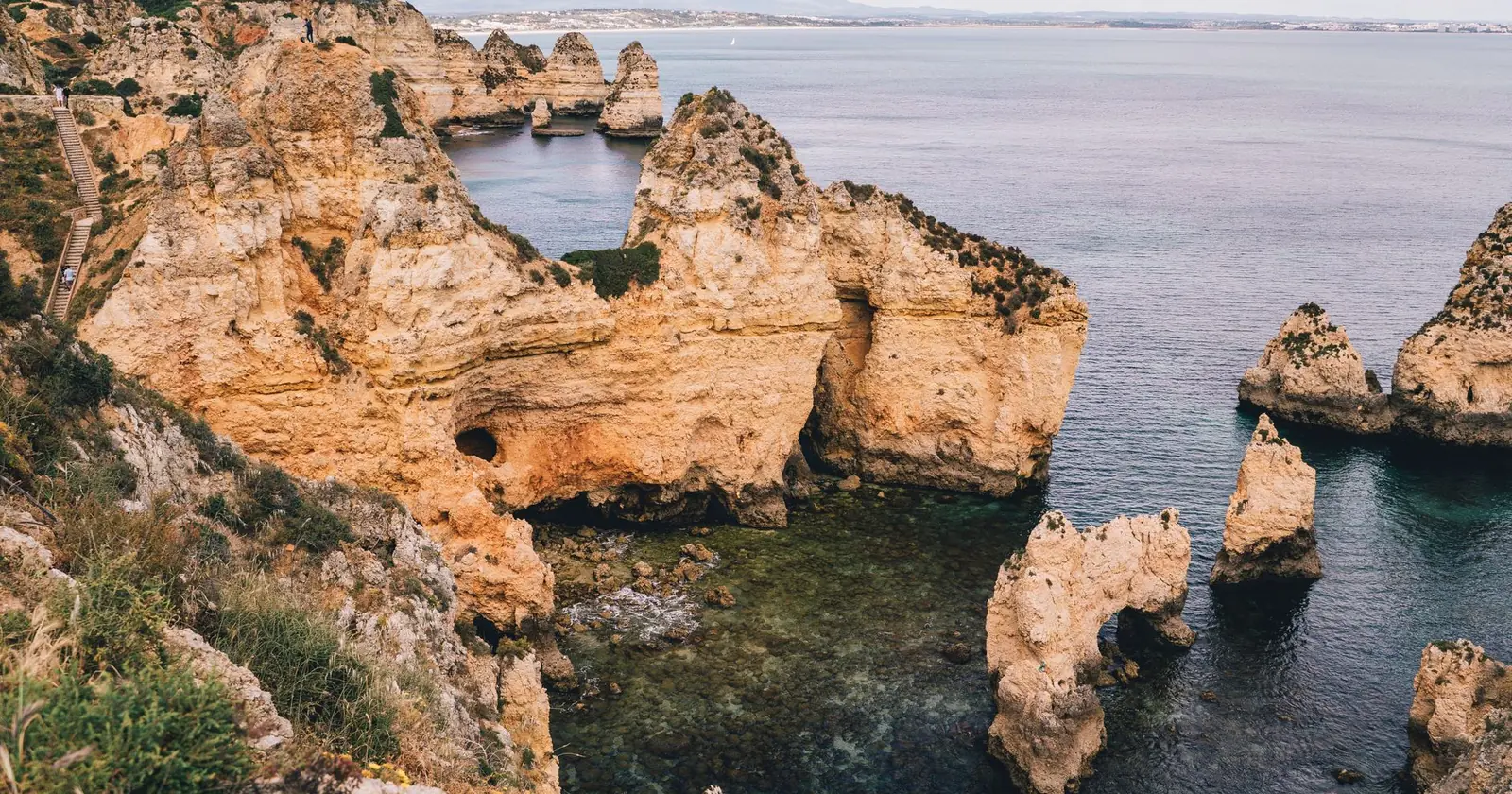
Photo: Alesia Kozik / Pexels.
Figures are indicative and "as of 2026"; verify prices, seasons and visa rules before you rely on them.
Key takeaways
- Surf and coasteering in one small, walkable base, with Faro airport about 90 minutes away
- Meia Praia and Porto de Mos suit beginners; the west coast near Sagres and Arrifana suits improvers
- Best window is roughly April to October; the sea averages about 19 to 20°C from August to October, and crowds thin after August
- Budget around 1,800 to 2,200 euros a month all in as of 2026; rent drops sharply in winter
- The Atlantic is cold and cliff jumps carry real risk, so go with a reputable operator
The watersport: surf on your doorstep, coasteering on the cliffs
Lagos sits where the south-facing Algarve coast meets the exposed Atlantic west coast, so you get two very different playgrounds within a short drive. For surfing, Meia Praia is the easy win: a long, gently shelving sandy beach five minutes from the old town, ideal for learning and for small summer days. Porto de Mos, just south, is another mellow option. When you want more, the west coast around Arrifana (roughly 40 minutes north) and the Sagres beaches pick up far more swell and are where most surf schools run their improver sessions. How far apart the two coasts are in swell, and what that means for a base, is the subject of Lagos vs Sagres.
Coasteering is the other headline here, and Lagos is one of the best places in Europe for it. Operators run trips along the Costa Vicentina between Lagos and Sagres and around the honey-colored Ponta da Piedade rock formations, mixing swimming, scrambling, sea-cave exploring and cliff jumps that range from small step-offs up to around 8 to 10 meters for the confident. You will be kitted out with a wetsuit, buoyancy aid, helmet and grippy shoes.
When to go, and what each season brings
The sweet spot for a nomad stay is roughly April to October. Summer (June to August) gives warm air, calm smaller surf that flatters beginners, and reliable coasteering conditions, but it is also when the town is busiest and priciest and beaches get crowded.
If you can, aim for the shoulder: the sea in the Bay of Lagos averages about 18.9°C in September and 19.7°C in October, October being the warmest month of the year (NOAA satellite record, 2021 to 2025, as we averaged it), with more consistent surf and noticeably thinner crowds. Spring is lovely and quieter but the ocean is still cold from winter. Winter (November to March) is the downside: the town half-empties, many businesses cut hours, and the Atlantic gets cold, big and often stormy, which suits experienced surfers but not much else.
The nomad reality: wifi, cost and getting a visa
Lagos has a real, established nomad and backpacker scene, with plenty of laptop-friendly cafes, several coworking spaces and coliving options. Home fibre and coworking wifi are generally solid; as with anywhere, verify the specific connection at your flat before committing to calls, and keep a data eSIM as backup.
On cost, budget roughly 1,800 to 2,200 euros a month all in as of 2026, verify before you rely on it. One-bed rents commonly run about 900 to 1,400 euros in season and drop substantially in winter, and coworking memberships sit around 150 to 250 euros a month. On entry: EU, EEA and Swiss citizens can simply live and work here. Non-EU visitors get the Schengen 90 days in any 180 rule; for a longer legal stay Portugal's D8 digital nomad visa requires average monthly income over the last three months of at least four times the Portuguese minimum wage, 3,680 euros in 2026, plus health insurance with at least 30,000 euros of cover, so check current rules and timelines with an official source before planning.
Getting to Lagos, and getting around
Nearly everyone flies into Faro, about 90 minutes east by car or a direct train and bus. Faro has cheap, frequent connections across the UK and Europe, which is a big part of why Lagos is such an easy base. From Faro, trains and buses run straight to Lagos, which is the western terminus of the Algarve line.
Lagos itself is walkable and the old town, marina and Meia Praia are all close. To reach the best west-coast surf and coasteering put-ins near Sagres and Aljezur you will want a hire car or a lift from your surf or coasteering operator, as public transport out west is limited.
Safety note: cold water, shore break and cliff jumps
This is Atlantic, not Mediterranean, water. Even in summer it is bracing, and outside summer it is genuinely cold, so wear an appropriate wetsuit and respect how quickly cold saps your strength. West-coast beaches can have powerful surf, strong rips and heavy shore break; check flags, swim and surf near lifeguarded zones in season, and never surf alone if you are still learning.
Coasteering and cliff jumping carry real, occasionally serious risk: submerged rocks, changing tides and swell, and misjudged entries cause injuries every year. Only jump where a qualified guide has checked the depth and conditions that day, always go with a reputable operator who provides helmet and buoyancy aid, and never jump from cliffs on your own. If in doubt, walk down rather than jump; there is no shame in it.
The Algarve winter is warm and short, and the short part is the one nobody plans for
Lagos gets recommended as a mild winter base, which is true about temperature and misleading about the day. At 37°06′ North the Algarve has a real seasonal swing in daylight, and the US Naval Observatory's table for the spot puts numbers on it: 14 h 43 min on 21 June against 9 h 37 min on 21 December. That is a difference of five hours and six minutes between the longest and the shortest day.
In clock terms the December day runs from about 07:44 to 17:21 local time, and the June day from 06:15 to 20:58 on summer time. So a winter working day here has one usable session in it, not two, and if you want that session in daylight it has to be carved out of the middle of the day rather than added to the end.
Compare that with the tropics. A base near the equator gives the same twelve hours every day of the year; Lagos gives you a summer with a long evening and a winter that closes at half past five. Which is better depends entirely on whether your working hours are yours to move.
On the plus side, the sea and the air stay usable through that short day, which is why the Algarve has a winter season at all.
FAQ: Lagos, the Algarve
Is Lagos good for a complete beginner surfer?
Yes. Meia Praia, right by town, is a long, gentle sandy beach that is ideal for learning, and small summer swell makes it even friendlier. Numerous surf schools in and around Lagos run beginner lessons and can shuttle you to whichever beach is working that day.
Do I need a visa to stay in Lagos for a couple of months?
EU, EEA and Swiss citizens do not; they can live and work freely. Other nationalities can usually visit visa-free under the Schengen 90-days-in-180 rule, which covers a multi-week stay. For longer, Portugal's D8 digital nomad visa is the main route, but it has an income requirement, so check official sources as of 2026 before relying on it.
How much should I budget per month?
As a rough 2026 ballpark, many nomads run on about 1,800 to 2,200 euros a month all in, with one-bed rents around 900 to 1,400 euros in season. Winter is much cheaper, high summer much dearer. Treat these as estimates and verify current prices before you book.
Is the wifi reliable enough for video calls?
Generally yes. Lagos has decent fibre and several coworking spaces with fast, reliable connections, and it is a well-trodden nomad town. Still, always test the actual connection in your accommodation and carry a data eSIM as a backup for important calls.
Can I surf and coasteer year-round?
Technically yes, but the experience changes a lot. April to October is the comfortable window; September and October are arguably best: the sea is near its yearly peak, about 19 to 20 degrees on average, and the crowds are thinner. Winter brings cold, big, stormy Atlantic conditions that suit experienced surfers but make coasteering and beginner surf much less viable.
Yannick Schroth
Founder of NOMADREEF and a former digital nomad. This guide is sourced from the references below; conditions, prices and rules change, so verify current details, and follow qualified local guidance and safety briefings. About the author · LinkedIn ↗
Sources
- Corrected 14 October 2026. An earlier version of this page gave the sea in September and October as “around 19 to 21 degrees” without a source; NOAA's satellite record for the Bay of Lagos averages 18.9°C in September and 19.7°C in October (2021 to 2025). It also said the D8 visa came with a processing backlog of several months, which no official source on this page supports, so that is removed. Generic source lines for water temperature, beaches, visa and Schengen rules are replaced by the primary sources below.
- How much daylight the Algarve winter has. US Naval Observatory, Astronomical Applications Department, table of sunrise and sunset for an entire year. Lagos (N37 06, W008 40), 2027: 21 June 14 h 43 min of daylight (rise 06:15, set 20:58 on summer time); 21 December 9 h 37 min (rise 07:44, set 17:21 on winter time). aa.usno.navy.mil. Read 13 September 2026.
- Sea temperature in the Bay of Lagos. NOAA, Optimum Interpolation Sea Surface Temperature v2.1 (daily, 0.25° grid), via NCEI ERDDAP, 2021 to 2025, averaged by month by us for the cell at 37.125°N 8.625°W: August 19.5°C, September 18.9, October 19.7, February 15.9. A satellite and buoy blend for open water, not a reading at the beach. ncei.noaa.gov. Read 14 October 2026.
- Which Lagos beaches are surf-teaching beaches. Câmara Municipal de Lagos, procedure for the 2026 surf-teaching licences: surf corridors at “Praia da Luz”, “Porto de Mós” and “Meia Praia” (section 11.1). cm-lagos.pt (PDF). Read 14 October 2026.
- How much more swell the west coast gets. Météo-France MFWAM wave model, Copernicus Marine product GLOBAL_ANALYSISFORECAST_WAV_001_027 (1/12°, about 0.083°, three-hourly values, no interpolation), significant wave height 2023 to 2025, averaged by us: about 2.0 m off the west coast near Sagres against 1.1 m off Lagos. Generated using E.U. Copernicus Marine Service Information; https://doi.org/10.48670/moi-00017. Copernicus Marine. Read 2 November 2026.
- Algarve and Lagos surf-school and local surf guides for named breaks (Arrifana, Sagres)
- Algarve coasteering operators (e.g. Costa Vicentina and Ponta da Piedade trips) for activity format, kit and jump-height ranges
- The D8 income threshold. Consulate General of Portugal in Toronto, D8 requirements (PDF): “rendimentos médios mensais auferidos nos últimos três meses no valor mínimo equivalente a quatro remunerações mínimas mensais garantidas”; insurance “cobertura mínima de 30.000€”. consuladoportugal.mne.gov.pt. DGERT: Decree-Law 139/2025 “fixou o valor da retribuição mínima mensal garantida em €920, com efeitos a partir de 1 de janeiro de 2026”; four times €920 is €3,680. dgert.gov.pt. Both read 14 October 2026.
- The 90-day rule. European Commission, Migration and Home Affairs, visa policy: visits “of up to 90 days in any 180-day period”; “Visas for stays exceeding 90 days are subject to national procedures.” home-affairs.ec.europa.eu. Read 14 October 2026.
- Trains from Faro. CP, Comboios de Portugal, regional timetable Vila Real de Santo António to Lagos, “Horário em vigor desde 19 de julho 2026”: the westbound timetable runs from Vila Real de Santo António through Faro and ends at Meia Praia and Lagos. cp.pt (PDF). Read 14 October 2026.
- 2026 Algarve and Lagos cost-of-living and coworking round-ups for rough rent, budget and membership ranges