Dominican Republic Diving: Bayahibe's Wrecks and Park Reefs, Samaná's Whale Season and the Rules on Sea Life
 by Yannick Schroth
Nov 10, 2026
12 min read
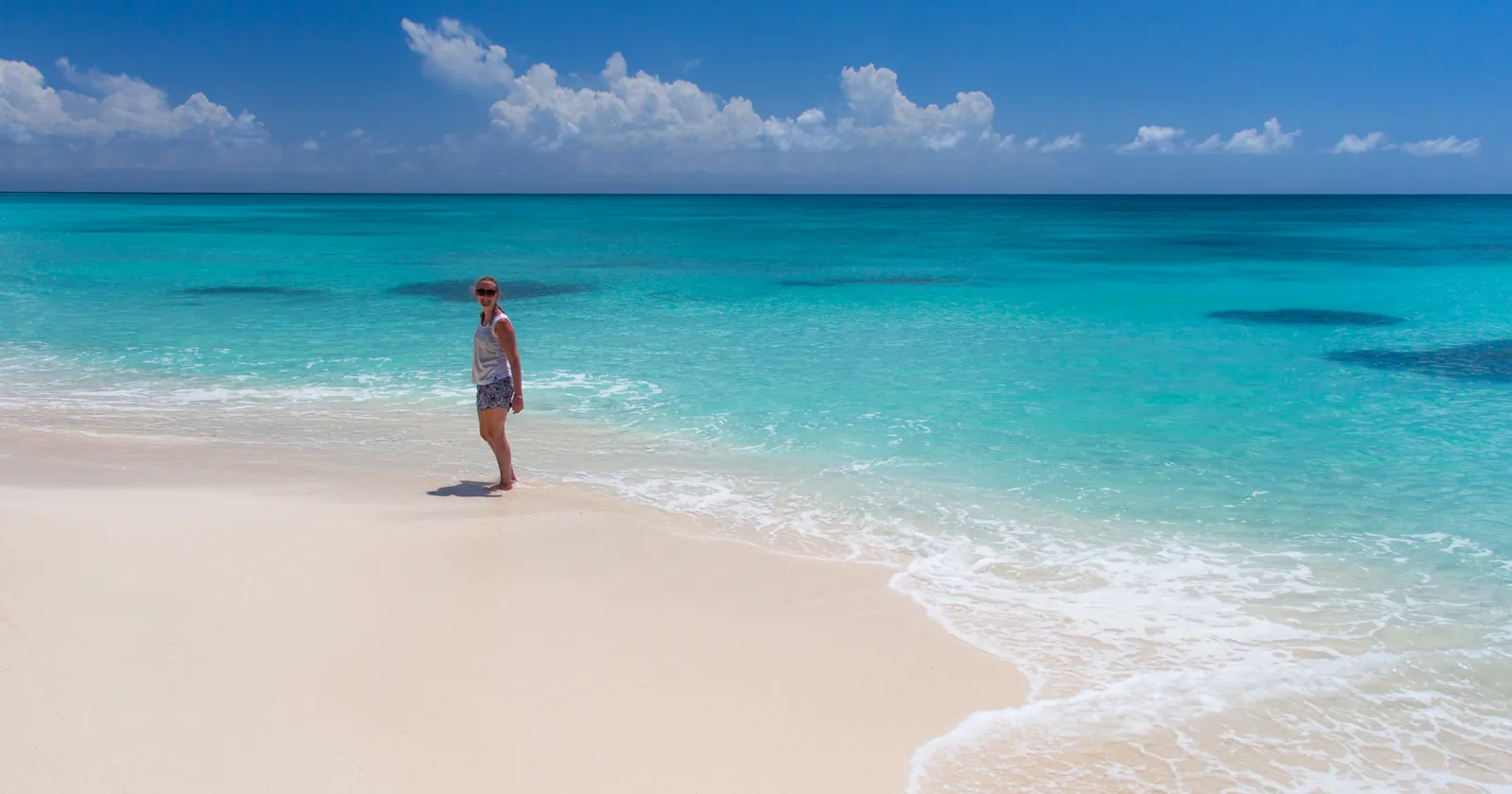
A beach on Isla Saona, inside Parque Nacional Cotubanamá. bez_uk on Flickr, Wikimedia Commons, CC BY-SA 2.0, cropped.

Key takeaways
- Bayahibe is the main dive base: the St George wreck lies at 15 to 44 meters by one shop's count, the Atlantic Princess at 12, and Peñon and Tortuga sit inside Parque Nacional Cotubanamá
- Whale watching in Samaná Bay ran from 15 January to 31 March in 2025, with three boats per group, 30 minutes per group and 20 with a mother and calf
- Sharks, rays, listed parrotfish and surgeonfish and the black sea urchin are protected nationally, and a 2023 decree bans fishing any fauna inside protected areas
- NOAA's satellite averages give 26 to 29 °C all year; the Atlantic hurricane season runs from 1 June to 30 November and peaks on 10 September
- The only public hyperbaric unit we could confirm is in Santo Domingo, and its health-service profile does not mention divers; 911 is the emergency number
Dominican Republic diving by region
Most of the country's recreational diving happens in the south-east, around the fishing village of Bayahibe and the protected coast between it and Isla Saona. The north coast has a smaller scene around Sosúa, next to the kite beaches of Cabarete. In the north-east, Samaná Bay and the offshore Silver Bank are the country's humpback whale grounds, and the in-water side there is snorkelling, not scuba. This guide covers those three regions. We could not read a dive operator's own pages for Samaná or Monte Cristi, so neither gets dive-site detail here.
Bayahibe, Cotubanamá and Catalina
Parque Nacional Cotubanamá is the old Parque Nacional del Este, renamed in 2014 after a Taíno leader. It was declared in 1975 by Decree 1311, covers 310 square kilometers, and takes in Isla Saona with its villages of Mano Juan and Catuano, according to the environment ministry as published by the presidency. Isla Catalina, west of Bayahibe, is a separate protected area, the Monumento Natural Isla Catalina. In 2023 the ministry issued Resolution 0024-2023 to end foam and single-use plastics on Saona and Catalina.
Coral Point Diving, a PADI centre on Bayahibe beach, lists the sites it uses all year. The wrecks close to the village are the Atlantic Princess at 10 to 14 meters, five to ten minutes out, Matthew's at 10 to 14, and the Coca wreck at 18 to 24. The reefs nearby include Viva Shallow at 6 to 10 meters, Dominicus at 10 to 14 and Guaraguao at 10 to 14. Further out, Peñon and Tortuga lie inside the national park, 25 to 30 minutes by boat, with maximum depths the shop gives as 14 and 12 meters, and it notes that fishing there is forbidden. Catalina's Wall runs from 6 to 30 meters and its Aquarium from 10 to 14, 35 to 45 minutes away. Coral Point keeps groups to four or five divers per guide.
The Atlantic Princess, in Coral Point's account, was a 30-meter tourist boat that ran aground in Tropical Storm Fay in 2008 and sank on its own on 6 May 2009. It now rests at 12 meters and is used for first wreck dives and try-dives.
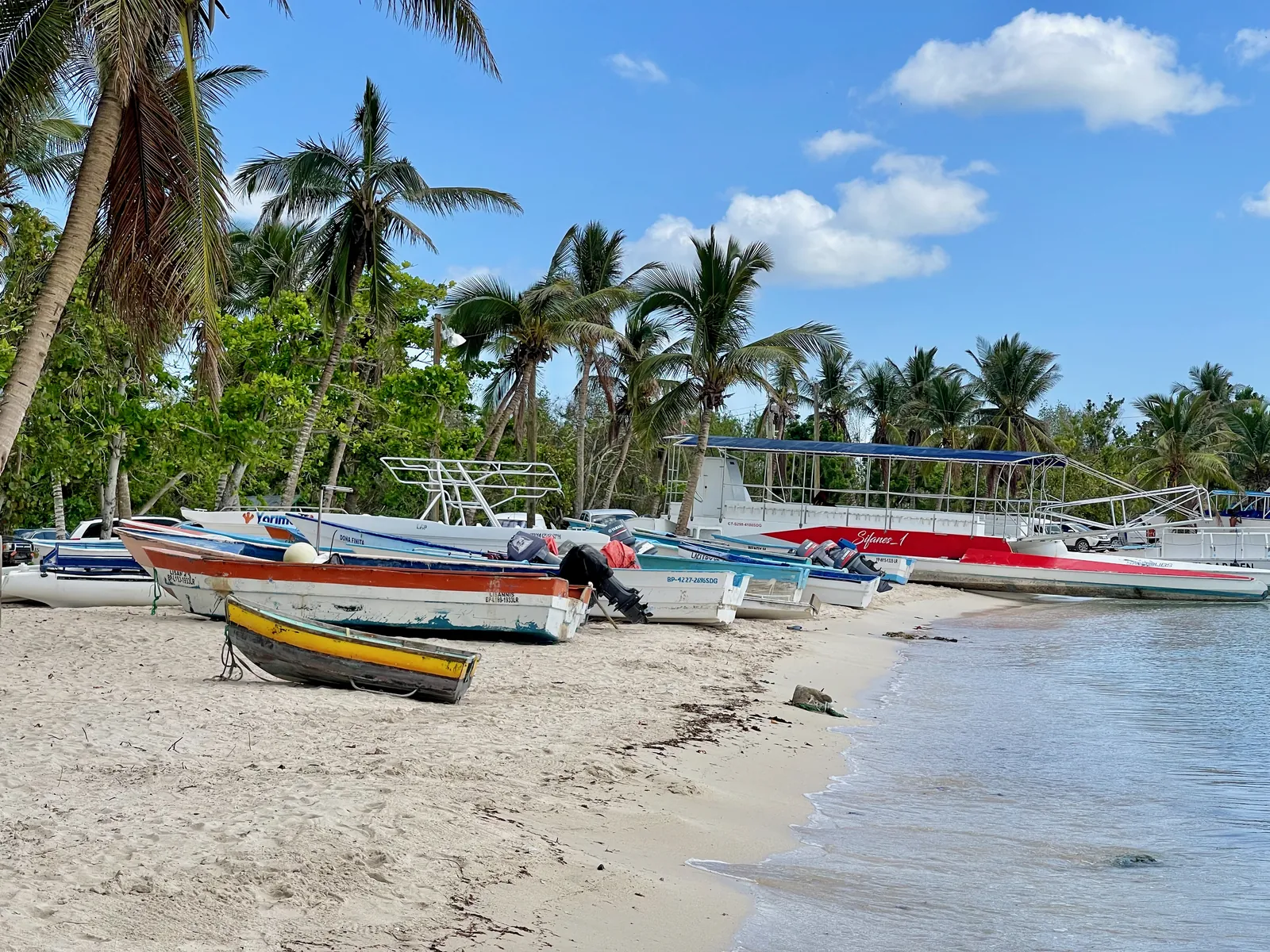
Boats on the beach at Bayahibe. Oleg Yunakov, Wikimedia Commons, CC BY-SA 4.0, cropped.

The St George wreck
The St George is the deep dive of the area. Coral Point gives it as 73 meters long, sunk on purpose in 1999 about 800 meters off its shop, with the top of the funnel at 15 meters, most of the wreck between 25 and 35 meters and the bottom at 44. Its price page lists the same wreck at 30 to 40 meters, so treat the deepest figure as the seabed, not the planned depth. The shop recommends it only for Advanced divers, says an average dive there lasts 30 minutes, and warns that surface currents are common and a strong current can cross the deck at depth.
Living museums in the sea
Two of Bayahibe's sites are underwater heritage preserves set up by Indiana University's Center for Underwater Science with the Dominican government. The 1724 Guadalupe Underwater Archaeological Preserve, the country's first underwater shipwreck museum, was created in 2004 next to Viva Dominicus Beach and inaugurated as a Living Museum of the Sea on 23 May 2011. It is not a wreck site: its iron anchor and seven cannons come from the galleons Guadalupe and Tolosa, which sank in Samaná Bay in a hurricane in 1724 and were salvaged in the 1970s. The university has documented 16 colonies of pillar coral on the reef within 100 meters of it. Coral Point's Viva Shallow dive, off the same beach, has Spanish cannons it calls the living museum at about five meters.
The second is the wreck of Captain Kidd's Quedagh Merchant, abandoned in 1699 and found by a snorkeler in 2007 off Catalina. The university says it lies in about 2.4 meters of water, 25 meters from the island's rocky shore, with 26 cannons, so it is a snorkelling site rather than a dive.
Indiana University has also documented the flooded Padre Nuestro cavern inside the park as an archaeological site with Taíno material and extinct sloth remains. We found no official rule on recreational cave diving there.
Samaná and the humpback whale sanctuary
The Santuario de Mamíferos Marinos Bancos de la Plata y de la Navidad, which the environment ministry calls the country's largest marine protected area, covers Samaná Bay and the offshore banks. The ministry runs the whale season each winter under an agreement with local authorities and operators. In 2025 it ran from 15 January to 31 March; in 2024 it was given as 15 January to 30 March. For 2026 the ministry issued 46 whale-watching authorizations, 43 of them for regular and rotating turns and three for boats leaving from Puerto Plata. The first quarter of 2024 brought 61,558 visitors, 40,667 of them from abroad.
The rules the ministry explained to captains in 2024 are strict. Each boat needs a radio. Only three boats may watch a group at once, whatever their size, in order of arrival, and others wait 250 meters back in groups of three. A boat may stay 30 minutes with a group of whales and 20 minutes with a mother and calf, engines may not be switched off, and watching runs from 8:00 to 16:00. The ministry says it checks compliance with the sanctuary's management plan; we could not read the plan itself or a fee schedule.
Swimming with the whales happens on the Silver Bank, on liveaboard trips of about a week. Cheesemans' Ecology Safaris, which runs one on the Turks and Caicos Explorer II from Puerto Plata, puts the bank about 130 kilometers north of the country and describes the encounter as floating at the surface in mask, fins and snorkel and letting the whale approach, with at least 5,000 humpbacks using the bank from January to early April and water usually at 24 to 26 °C. We found no official text setting out the in-water rules, so take the operator's briefing as the guide.
Sosúa and the north coast
Dive Cabarete, despite its name, runs from Calle La Puntilla in Sosúa. It sells one-, two- and three-tank boat trips starting at 8:00 or 12:30, a night dive, and supplements for the Zingara wreck and the Airport Wall or Elephant sites; the shop opens Monday to Saturday from 8:00 to 16:00. It says winter Atlantic winds can make afternoons choppy. For the kite and surf side of the same coast, and a longer look at living there, see our Cabarete guide.
Rules on taking sea life
The environment ministry's Resolution 0023/2017 bans catching or selling any shark or ray in Dominican waters, with an indefinite closure, and bans the capture and sale of listed parrotfish and surgeonfish and the capture or removal of the black sea urchin, Diadema antillarum. The general environment law, Law 64-00, already bans hunting, fishing, capturing, harassing or keeping threatened species.
Decree 281-23 of 30 June 2023 added a two-year closure, to 2 July 2025, for parrotfish, surgeonfish, angelfish, butterflyfish and sea cucumbers; we could not confirm whether it was extended. Its second article restates a permanent ban on fishing eels and any other fauna species inside protected areas and their buffer zones, and its third bans diving compressors used to catch the closed species. Breaches are punished under the environment, protected-areas and fisheries laws. We found no official rule on lionfish culling, so ask your centre before you carry a spear.
When to dive: sea temperature and hurricanes
NOAA's satellite averages for 1991 to 2020 put the sea off Bayahibe at about 26.7 °C in January, 26.5 °C in February and March, 27.6 °C in May, 28.7 °C in August and 29.0 °C in September, still 28.9 °C in October. The north is a little cooler in late winter: about 26.1 °C at the mouth of Samaná Bay and 26.0 °C off Sosúa in February, and 25.9 °C over the Silver Bank in the whale months. These are surface figures.
The US National Hurricane Center gives the Atlantic hurricane season as 1 June to 30 November, with an average of 14 named storms, seven hurricanes and three major hurricanes a year over 1991 to 2020. The peak is 10 September, and most activity falls between mid-August and mid-October. We couldn't check the Dominican weather service's own figures.
Chamber and emergencies
We found no official or hospital source confirming a hyperbaric chamber that treats divers near Bayahibe, Samaná or Sosúa, or one staffed around the clock. The public health service describes a hyperbaric therapy unit at the Hospital Traumatológico Dr. Ney Arias Lora in Santo Domingo, opened in July 2023 with one chamber, two specialist doctors and two technicians, taking patients from the hospital or referred from the public network; it lists wounds, trauma and infections and does not mention diving. Ask your dive centre where it sends a bent diver and check that your dive insurance covers an evacuation. The emergency number is 911, which has covered La Romana and Bayahibe since September 2018, according to three news reports.
What a dive costs
Prices on the operators' own pages, read on 10 November 2026, in US dollars per diver:
| Item | Coral Point Diving, Bayahibe | Dive Cabarete, Sosúa |
|---|---|---|
| One dive | $60, equipment $10 a day extra | $65, equipment included |
| Two dives | $85 | $100 |
| Night dive | $65, light $5 extra | $75 |
| Special trips | Peñon and Tortuga +$30, Catalina +$50 | Zingara wreck +$15 |
For a longer stay, Coral Point charges $170 for four dives, $245 for six, $320 for eight and $365 for ten. Dive Cabarete includes all gear except a computer, which costs $15 a day, and charges $30 for a refresher; its prices exclude transport, which it quotes at $30 return from Cabarete for up to four people.
Getting there
Punta Cana International Airport, which describes itself as one of the first and largest privately run international airports, is the usual gateway for Bayahibe; Coral Point puts Punta Cana 40 to 60 minutes away by the Coral Highway and offers transfers. The airport says the tourist-card charge is now included in the airfare. For Samaná, El Catey airport lies 23 kilometers from Las Terrenas, 46 from Santa Bárbara de Samaná and 74 from Las Galeras, according to its operator Aerodom. For Sosúa and the Silver Bank boats, Puerto Plata's Gregorio Luperón airport takes wide-body jets. Santo Domingo's Las Américas airport sits at Punta Caucedo east of the capital.
Staying as a remote worker
The Dominican Republic has no digital-nomad visa. The foreign ministry's visa page lists tourist, business, work-contract, dependant, residence, student and diplomatic visas, and nothing for remote work. Most visitors, including those from the US, Canada, the UK and the EU, need no visa, according to the tourism ministry, but everyone arriving or leaving on a commercial flight must fill in the free E-Ticket form, and since April 2023 airlines check for a return ticket. A tourist stay beyond 30 days is charged on departure on a sliding scale by length of stay, paid online or at the airport; we could not read the immigration office's fee table. Until 31 December 2026, tourists from the EU, the US, Canada and England, as the tourism ministry puts it, need only a passport valid for the length of the stay. We found no official figure on internet speeds in Bayahibe or Sosúa. Our Cabarete guide covers longer stays on the north coast.
Who the Dominican Republic suits
It suits a warm-water diver who wants easy boat dives on reefs and wrecks, one deep wreck for Advanced divers, and shallow heritage sites, with a big airport an hour away. It suits a remote worker on a stay of a few months who accepts paying an overstay charge on departure, and anyone who wants to see humpbacks between January and March. It suits less well anyone who needs a confirmed diving chamber close by, a formal remote-work visa, or cave diving with clear official rules.
FAQ: Dominican Republic diving
Where is the best diving in the Dominican Republic?
Most diving is around Bayahibe in the south-east, with wrecks such as the St George and the Atlantic Princess, reefs inside Parque Nacional Cotubanamá and the wall at Catalina. Sosúa on the north coast has a smaller boat-diving scene.
How deep is the St George wreck in Bayahibe?
Coral Point Diving gives the top of the wreck at 15 meters, most of it between 25 and 35 meters, and the bottom at 44 meters; its price page lists 30 to 40 meters. The shop recommends it for Advanced divers only and warns of surface currents.
Can you swim with humpback whales in the Dominican Republic?
On the Silver Bank, liveaboard trips from Puerto Plata offer passive snorkelling encounters from January to early April. In Samaná Bay the season is about mid-January to the end of March, and the rules limit boats to three per group of whales and 30 minutes, or 20 with a mother and calf.
Is there a hyperbaric chamber for divers in the Dominican Republic?
We could not confirm one. The public hospital Ney Arias Lora in Santo Domingo has run a hyperbaric unit since July 2023, but its health-service profile does not mention diving or 24-hour service. Ask your dive centre for its emergency plan and call 911 in an emergency.
Does the Dominican Republic have a digital nomad visa?
No. The foreign ministry lists no remote-work visa. Visitors from the US, Canada, the UK and the EU enter without a visa but must fill in the free E-Ticket form, and a stay beyond 30 days is charged on departure on a sliding scale.
Note: Conditions, safety guidance and regulations change. Verify current information with official sources, including the dive operator, the park authority and the relevant government department, before you travel or dive.
Founder of NOMADREEF and a former digital nomad. This guide is sourced from the references below; conditions, prices and rules change, so verify current details, and follow qualified local guidance and safety briefings. About the author · LinkedIn ↗
Sources
- Cotubanamá, Saona and Catalina (primary). Presidency of the Dominican Republic, environment ministry news of 20 March 2023, 3 October 2022 and 29 May 2023. Read 10 November 2026.
- Dive sites (each centre primary for itself). Coral Point Diving, dive sites and packages; Dive Cabarete, fun dives and FAQ. Read 10 November 2026.
- Living museums (primary). Indiana University Center for Underwater Science, Guadalupe preserve, Captain Kidd, Living Museums in the Sea and East National Park. Read 10 November 2026.
- Whale season (primary). Presidency, environment ministry news of 16 January 2026, 16 January 2025 and 25 January 2024; Silver Bank trip from Cheesemans' Ecology Safaris (operator). Read 10 November 2026.
- Sea life rules (primary). Environment ministry Resolution 0023/2017 (PDF, FAOLEX), quoting Law 64-00, article 140; Decree 281-23 (PDF, FAOLEX), articles 1 to 3 and 6. Read 10 November 2026.
- Sea temperature and hurricanes (primary). NOAA PSL, OISST v2.1 monthly long-term means 1991–2020, cells 18.125°N 68.875°W, 19.125°N 69.125°W, 19.875°N 70.625°W and 20.375°N 69.875°W, computed for this page; NOAA National Hurricane Center, tropical cyclone climatology. Read 10 November 2026.
- Chamber and emergency number. Servicio Nacional de Salud, En Salud no. 13, 2025 (PDF), pages 45 to 47 (primary); 911 in La Romana and Bayahibe from Diario Libre, El Día and Diario Digital (triangulated). Read 10 November 2026.
- Prices (each centre primary for itself). Coral Point Diving, Dive Cabarete. Read 10 November 2026.
- Getting there (primary). Punta Cana International Airport, factsheet and tourist card notice; Aerodom, El Catey, Puerto Plata and Las Américas. Read 10 November 2026.
- Staying and working (primary). Ministry of Foreign Affairs, visas; Ministry of Tourism, entry requirements. Read 10 November 2026.
- Left out. Protected-area entry fees for Cotubanamá, Saona and Catalina and any whale-watching fee, because the environment ministry's site blocked us; the sanctuary management plan and the formal in-water rules; lionfish rules and whether the 2023 reef-fish closure was extended; a chamber confirmed to treat divers and its hours; 911 coverage outside La Romana from the 911 service itself; dive operators in Samaná and Monte Cristi; the immigration office's overstay fee table; Dominican weather service statistics; and internet speeds.