Cyprus Diving by Coast: Larnaca's Zenobia, Cape Greco's Caves, Limassol's Reefs and Paphos' Walls
 by Yannick Schroth
Nov 10, 2026
12 min read
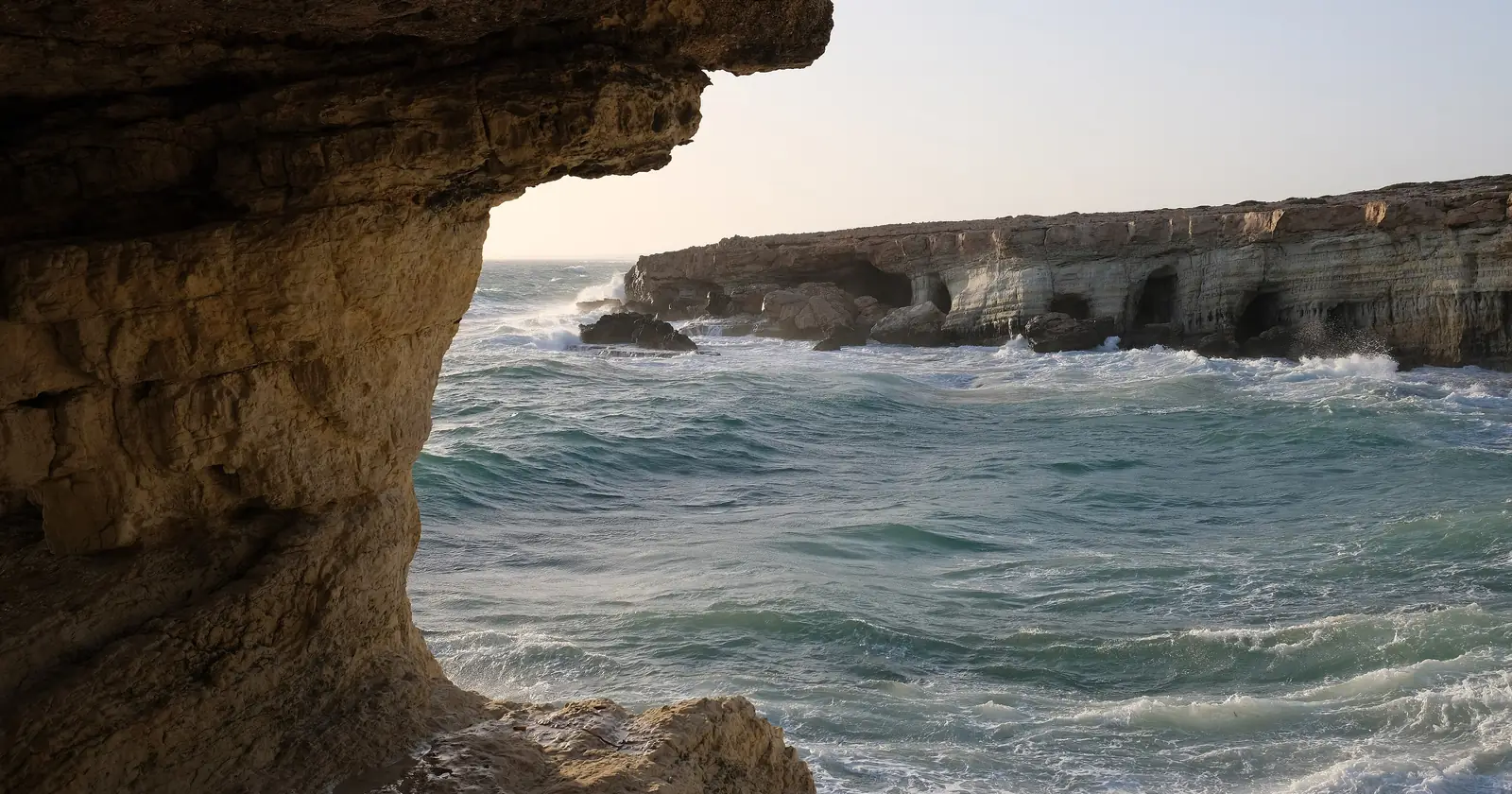
The sea caves of Cape Greco, east of Ayia Napa. kallerna, Wikimedia Commons, CC BY-SA 4.0, cropped.

Key takeaways
- Cyprus' Deputy Ministry of Tourism publishes one diving map for the island, with depths for every wreck and artificial reef, from the 13-meter LEF1 to the 55-meter walls of Kakoskali
- Fishing is banned around the Zenobia and in the artificial-reef areas, which are there for divers; a 2025 decree closes the Pegeia sea caves to boats
- There is no dive-centre licensing law yet: a bill for a three-year licence and an official register went to parliament in 2025
- The public hyperbaric unit at Famagusta General Hospital in Paralimni treats diving emergencies from all over Cyprus 24 hours a day
- Cyprus is not yet a full Schengen member, so its 90 days are counted separately, and its digital nomad permit asks for €3,500 a month
Cyprus diving comes down to four coasts
Cyprus' diving is not one place. The Deputy Ministry of Tourism's diving map, the official guide to the island's sites, groups them around four towns, and they offer different things, so choosing a base is choosing what you want to dive most. Some shops travel: Pissouri Bay Divers, on the south coast, sells a day trip to Larnaca's wrecks.
| Coast | Known for | Depths on the ministry's map |
|---|---|---|
| Larnaca | The Zenobia; the Elpida, LEF1 and HMS Cricket wrecks | 13 to 42 m |
| Ayia Napa and Protaras | Cape Greco's caves; the Kyrenia, Liberty and Nemesis III; the MUSAN sculpture museum | 23 to 27 m for the wrecks |
| Limassol | Lady Thetis, Costantis, the Amathus pyramids, the Three Stars | 18 to 35 m |
| Paphos and Akamas | Kakoskali walls and caves at Agios Georgios | to 55 m |
Larnaca: the Zenobia and a bay of smaller wrecks
Larnaca is where most visiting divers start, for one reason: the Zenobia, a 172-meter ferry that sank in 1980 with more than a hundred lorries aboard and now lies between 16 and 42 meters about two kilometers from the harbour. A two-dive day costs from about €80 to €150 depending on the shop and the equipment. Around her, the ministry lists the Elpida at 30 meters, the small LEF1 at 13 meters for beginners and snorkellers, and HMS Cricket, a 1915 British gunboat, at 32. Our Zenobia wreck guide covers the wreck, the shops' requirements and their prices, and the airport is on the edge of town.
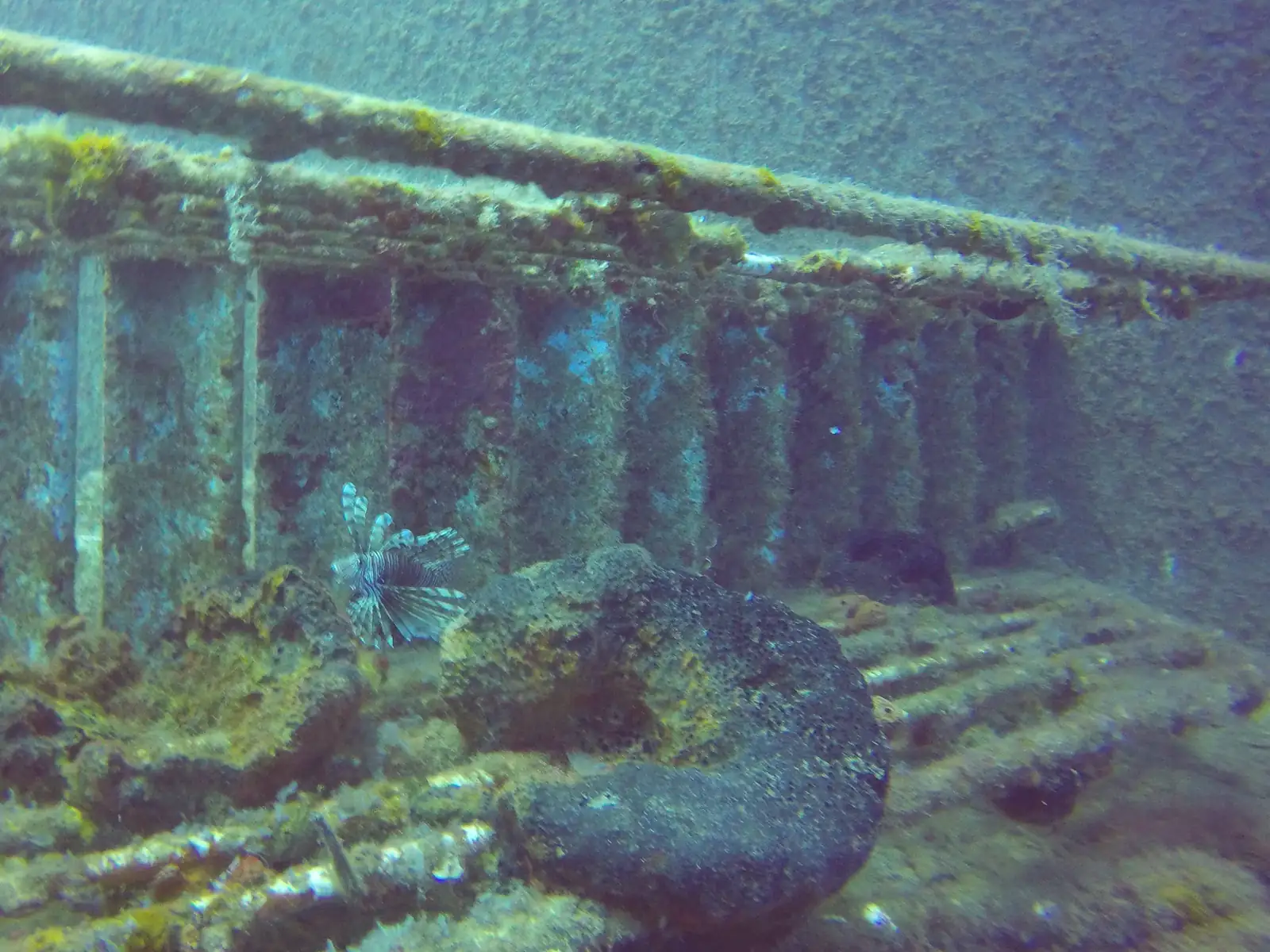
A lionfish on the Zenobia. dronepicr, Wikimedia Commons, CC BY 2.0, resized.

Ayia Napa and Protaras: Cape Greco's caves and three sunken ships
The south-east corner has the island's best shore diving, in the caves and canyons around Cape Greco, and three ships sunk for divers off Protaras and Ayia Napa: the Kyrenia, formerly the Greek navy vessel HS Knossos, at 23 meters, and the Liberty and Nemesis III, 90 meters apart at 26 and 27 meters. Off Ayia Napa, the MUSAN underwater sculpture museum holds more than 90 works at 23 meters. Our Protaras diving guide covers this coast in detail, including the night-diving rule and the buffer zone, and the island's chamber is nearby in Paralimni.
Limassol: artificial reefs and wrecks sunk for divers
Limassol's diving is built on purpose. Off the Dasoudi beach, the Lady Thetis, a West German coastal passenger ship from 1953, lies at 19 meters, and the Costantis, a Soviet-built trawler from 1989, at 24 meters, 200 meters away. To the east, the Amathus artificial reef is the island's first and largest at 2.5 square kilometers, with concrete pyramids up to 18 meters tall from 18 to 35 meters deep, and a set of eleven large structures, with two carnival masks added in 2022, sits at 22 meters. Out toward Akrotiri, the Three Stars wreck lies at 20 meters. Fishing is banned in the island's artificial-reef areas.
Paphos and Akamas: walls, caves and a protected coast
The west coast is wilder. The ministry describes the walls and caves off Agios Georgios island, known as Kakoskali, as part of a marine protected area reaching 55 meters. Further north, the sea caves of Pegeia on the Akamas coast were closed in 2025 to fishing and to the passage and anchoring of boats by decree 98/2025, according to its published summary. Since March 2026, entering the monk seal caves inside marine protected areas needs a special licence from the fisheries department, and harassing or feeding protected species can bring a fine of up to €20,000, the Cyprus Mail reported. Paphos General Hospital also has a hyperbaric clinic, though its pages do not say whether it is open around the clock.
When to dive Cyprus: 17°C in February, 27°C in August
NOAA's satellite averages for 1991 to 2020 put the sea around Cyprus at about 16.6 to 16.8 °C in February, the coldest month, 20 to 21 in May, 27.1 to 27.8 in August and still about 25 in October. The east coast off Protaras runs a few tenths warmer in summer than Larnaca or Limassol. The ministry calls the island a place for year-round diving; Larnaca's shops dive through the winter, while Pissouri Bay Divers on the south coast gives April to October as the best time.
| Sea surface, °C | Feb | May | Aug | Oct | Dec |
|---|---|---|---|---|---|
| Larnaca | 16.6 | 20.3 | 27.3 | 25.1 | 19.4 |
| Protaras and Cape Greco | 16.7 | 20.7 | 27.8 | 25.3 | 19.3 |
| Limassol | 16.8 | 20.1 | 27.1 | 24.8 | 19.5 |
| Paphos | 16.7 | 20.4 | 27.6 | 24.7 | 19.4 |
Cyprus has no dive-centre licence yet, so check the shop
Anyone can open a dive centre in Cyprus today without a specific licence. A study for the Deputy Ministry of Tourism, reported by the Cyprus Mail in August 2026, found "no comprehensive legal framework governing diving sites, dive centres or diving tourism" and counted 86 registered centres, 37 of them in the Famagusta district, plus an unknown number of freelance instructors. The cabinet approved a bill in November 2025 that would require a three-year licence from the ministry, an official register of providers and instructors certified to the ISO standard; it was still waiting for parliament in 2026. Until then, the Cyprus Dive Centres Association, a trade body, keeps a list of its members, and training agencies keep theirs. Ask a shop which agency it teaches under and check the entry.
Diving accidents in Cyprus go to Paralimni
The State Health Services Organisation runs the hyperbaric unit at Famagusta General Hospital in Paralimni, near Protaras. Its own page says it treats emergencies such as divers' disease "from all over Cyprus 24/7" in a multiplace chamber for six patients, and DAN Europe names it the preferred hospital for diving accidents. From Paphos or Limassol that is a long drive across the island. In an emergency call 112 or 199, and check that your dive insurance covers chamber treatment and the transfer.
Cyprus for remote workers: the nomad permit, Schengen and fibre
Cyprus is in the EU but not yet a full Schengen member: the European Commission says it takes part in Schengen cooperation, but its internal border controls have not been lifted. Days in Cyprus are therefore counted on their own, and an EU decision lets Cyprus accept multiple-entry Schengen visas for stays of up to 90 days in any 180. For longer, Cyprus has a digital nomad residence permit. We couldn't access its official page, so the terms here come from three or more law firms and news sites that agree: a net income of at least €3,500 a month, a first permit of one year renewable for two more, an application in Nicosia within three months of arrival, and a cap of 500 permits.
Connections are good. The European Commission's 2025 Digital Decade report puts Cyprus' fibre to the premises at 89% of homes, well above the EU average, and 5G at 100%; most households buy the 200 Mbps entry speed. Larnaca and Paphos airports, both run by Hermes, are the ways in, and airlines told Hermes in November 2026 that they want to lengthen the winter season.
Where to base yourself in Cyprus
For wrecks and an airport on the doorstep, Larnaca. For caves, shore diving and the chamber nearby, Protaras, as long as you can live with a resort town that empties in winter. For a city base and purpose-built reefs, Limassol. For the quieter west and Akamas, Paphos, with the longest drive to the chamber. A month on one coast with day trips to the others covers most of what the island has.
Cyprus on our operator lists
We keep two Cyprus lists, built from registers we can link per entry: the Larnaca list, with seven dive centres and kite and windsurf schools, and the Protaras and Paralimni list. Limassol and Paphos don't have enough register entries for a list of their own. A register entry says a training body lists a centre; in Cyprus, with no licence law yet, it is one of the few things you can check.
FAQ: Cyprus diving
Where is the best diving in Cyprus?
It depends on what you want. Larnaca has the Zenobia wreck, Ayia Napa and Protaras have Cape Greco's caves and three sunken ships, Limassol has artificial reefs and wrecks sunk for divers, and Paphos has walls and caves to 55 meters at Kakoskali.
Can you dive in Cyprus in winter?
Yes. The sea averages about 17 °C in February, and Cyprus' tourism ministry describes the island as a year-round dive destination. Larnaca's shops dive through the winter, though some centres elsewhere give April to October as their best season.
Where is the hyperbaric chamber in Cyprus?
At Famagusta General Hospital in Paralimni, run by the State Health Services Organisation, which says it treats diving emergencies from all over Cyprus 24 hours a day. Paphos General Hospital also has a hyperbaric clinic. In an emergency call 112 or 199.
Are dive centres licensed in Cyprus?
Not yet. Cyprus has no dive-centre licensing law. A bill approved by the cabinet in November 2025 would create a three-year licence and an official register, but it was still before parliament in 2026.
Does Cyprus count toward the Schengen 90 days?
Cyprus is not yet a full Schengen member, so time there is counted separately from the Schengen 90 days. Under an EU decision, Cyprus accepts multiple-entry Schengen visas for stays of up to 90 days in any 180.
Note: Conditions, safety guidance and regulations change. Verify current information with official sources, including the dive operator, the park authority and the relevant government department, before you travel or dive.
Founder of NOMADREEF and a former digital nomad. This guide is sourced from the references below; conditions, prices and rules change, so verify current details, and follow qualified local guidance and safety briefings. About the author · LinkedIn ↗
Sources
- Dive sites (primary). Deputy Ministry of Tourism, diving map 2025 (PDF): every wreck, reef and depth named here, Kakoskali, year-round diving; Zenobia brochure (PDF). Read 10 November 2026.
- Protection. K.D.P. 379/2021 (PDF, Greek) on the Zenobia (primary); decree 98/2025 on the Pegeia sea caves, read only as its FAOLEX summary; Cyprus Mail, 31 March 2026 on the 2026 fisheries amendment (news report). Read 10 November 2026.
- Water temperature (primary data). NOAA PSL, OISST v2.1 monthly long-term means 1991–2020, four grid cells off Larnaca, Protaras, Limassol and Paphos, read for this page. Season: Pissouri Bay Divers and Alpha Divers (operators). Read 10 November 2026.
- Licensing (news reports; the bill text was not found). Cyprus Mail, 19 November 2025, 26 March 2026 and 4 August 2026. Cyprus Dive Centres Association member list. Read 10 November 2026.
- Chambers. State Health Services Organisation, hyperbaric clinic, Famagusta General Hospital (primary); DAN Europe, Cyprus communication (primary); Deputy Ministry of Tourism, Paphos General Hospital hyperbaric clinic. Read 10 November 2026.
- Entry and remote work. European Commission, Schengen area, and Decision 565/2014/EU (primary). Digital nomad permit, triangulated because the official page refused our requests: GCP Law, April 2025, Expats.cy, October 2026 and other law-firm and news sources. Read 10 November 2026.
- Internet and flights. European Commission, Digital Decade 2025 country report on Cyprus (PDF) (primary); Cyprus Mail, 4 November 2026, quoting Hermes Airports. Read 10 November 2026.
- Left out. A current marine decree for Cape Greco and Moulia; whether the Paphos chamber runs around the clock; the digital nomad permit's fees, which only two non-official sources give; and which routes from Larnaca and Paphos run all year, which Hermes does not publish in a form we could read.