Colombia Diving: The Seaflower Reserve, Tayrona and the Rosario Islands, Malpelo by Boat, and the Rules on Coral
 by Yannick Schroth
Nov 10, 2026
13 min read
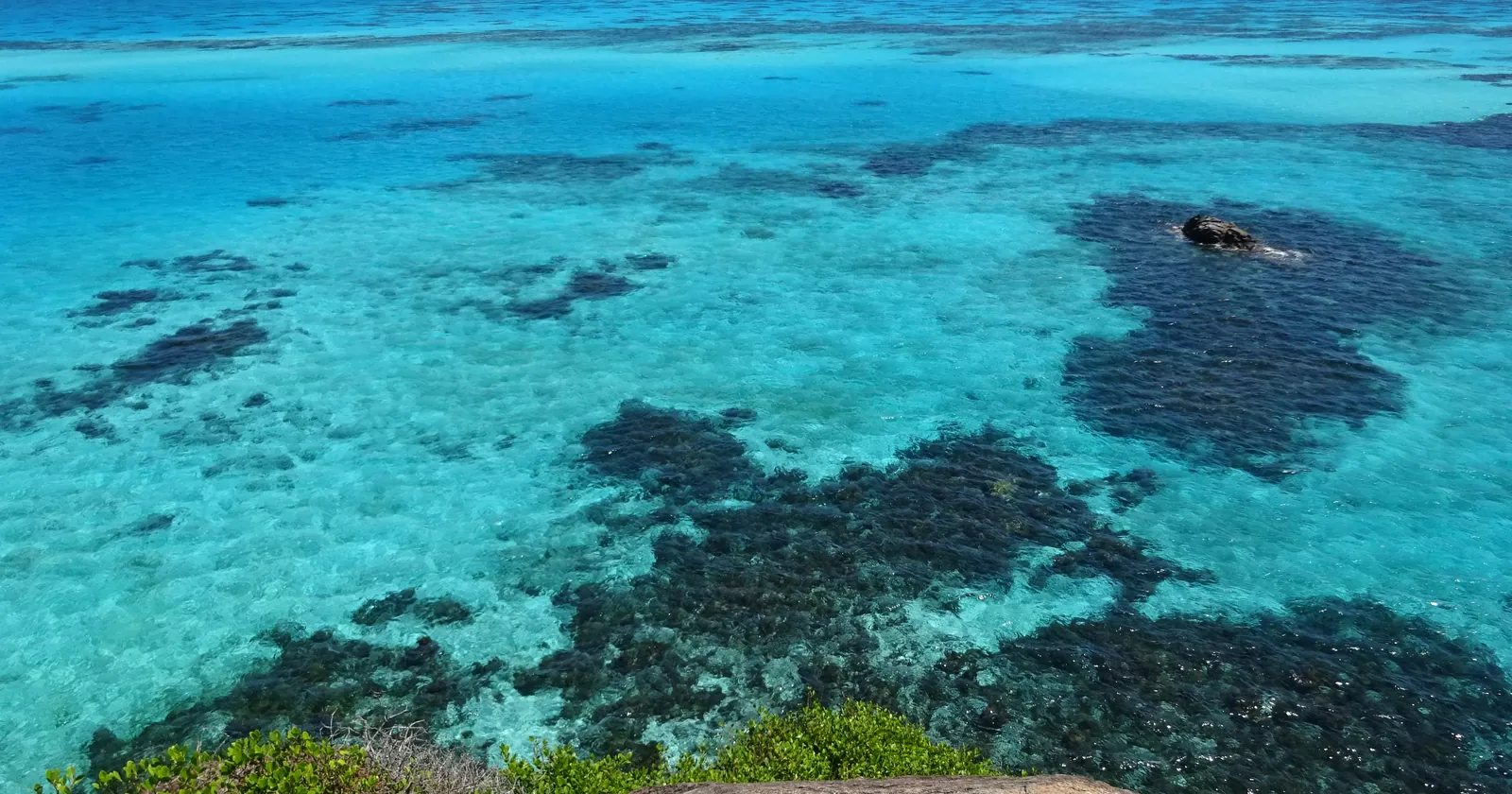
Reef in the Old Providence McBean Lagoon national park. Felviper, Wikimedia Commons, CC BY-SA 4.0, cropped.

Key takeaways
- San Andrés and Providencia sit in the Seaflower marine protected area, where feeding or handling fish, sharks and rays is banned and parrotfish are protected
- Visitors to San Andrés need a tourist card; news reports put it at COP 153,000 for 2026, but the government's own page still shows an older figure
- Tayrona national park was closed from 17 February to 5 March 2026 for security reasons, so check its status before booking dives there
- Malpelo is a World Heritage sanctuary about 490 km west of Buenaventura, a port that UK and German travel advice warn against
- The departmental hospital had two chambers in 2023, on San Andrés and Providencia, both due for repair; we could not confirm either is working now
Colombia diving: four regions on two oceans
Colombia has coast on the Caribbean and the Pacific, and its diving falls into four quite different places. In the western Caribbean, the islands of San Andrés and Providencia lie inside one of the largest marine protected areas in the region. On the mainland, Taganga near Santa Marta dives the coast of Tayrona national park, and Cartagena's dive boats run to the Rosario Islands. Far out in the Pacific, Malpelo is a remote sanctuary about 490 km from the mainland. Each comes with its own rules, its own season and, for the Pacific, its own travel warnings, so this guide takes them one at a time. If you are on the north coast for wind rather than reefs, our Cabo de la Vela kite guide covers La Guajira.
San Andrés and Providencia: diving inside Seaflower
The whole archipelago of San Andrés, Providencia and Santa Catalina became a biosphere reserve in 2000. In 2005 the environment ministry created the Seaflower marine protected area around it, 6,500,000 hectares divided into zones of different use, which Coralina, the islands' environmental authority, calls the third-largest barrier reef system in the world. Since 2019 the zoning has been run as an integrated management district under Acuerdo 002 of 2019.
Two Coralina rules matter most to divers. Resolution 611 of August 2022 bans feeding and handling marine animals, including fish, sharks and rays, anywhere in the archipelago; Coralina issued a warning in 2023 after a dive centre filmed tiger sharks and an oceanic whitetip feeding on a dumped pig carcass near a bathing and dive area. Resolution 369 of 2019 restricts catching and selling parrotfish and surgeonfish, and also angelfish and butterflyfish, because grazing fish keep algae off the reef. Coralina asks people to report breaches on 123.
Banda Dive in San Andrés describes its standard trip for certified divers as two dives at two different sites, with boat, equipment, tanks, weights and a guide included; its night dive needs an Advanced card and at least four people. It publishes no prices.
Old Providence McBean Lagoon: the islands' national park
On Providencia, the Old Providence McBean Lagoon national park is, according to Coralina, the only national park in Colombia's oceanic Caribbean islands. It covers a mangrove, the small Iron Wood Hill and the reef lagoon in front of it, and Coralina describes Providencia's barrier reef as the second most extensive in the Caribbean after Belize's. Coralina lists two snorkelling areas in the park, around Crab Cay and at White Shoal, and says filming or photographing for commercial use needs prior permission from the parks authority. We couldn't check the scuba rules and fees with the parks authority itself.
Providencia after Hurricane Iota
In November 2020 the southern eyewall of Hurricane Iota, with category-4 winds, made a direct hit on Providencia and Santa Catalina. The US National Hurricane Center's report cites island officials who said 98% of Providencia's infrastructure was destroyed, and notes that the hospital was too damaged to use.
Diving did come back. In late 2024 Coralina ran four lionfish hunts around Providencia, mostly behind Santa Catalina, and caught more than 130 fish with help from a local dive centre. Health care is still being rebuilt: a 2023 tender by the islands' public hospital described Providencia's facility as a provisional hospital at Cotton Cay, and in October 2026 the departmental government reported that the President had announced work on new hospital projects for both San Andrés and Providencia. We found no official count of dive shops open on Providencia in 2026.
Taganga and Tayrona: diving from the Santa Marta coast
Taganga, a fishing village next to Santa Marta, is the base for diving the coast of Tayrona national park. Poseidon Dive Center describes itself as sitting at the gateway to the park and runs two-dive trips by catamaran, with guides choosing sites by weather and experience; it also sells technical dives between 30 and 45 meters.
Tayrona's opening is not guaranteed. The national parks authority closed the park by Resolution 091 of 17 February 2026 over security conditions, according to the trade and tourism ministry, which later announced that the government had reopened it from 5 March 2026. We couldn't check the park's fees or closure dates with the parks authority. Ask your dive centre where its boats can go that week.
The rules inside any Colombian national park come from Decree 1076 of 2015. It bans hunting, fishing except authorised scientific, sport or subsistence fishing where permitted, collecting plants, carrying gear for hunting or fishing, dumping waste, damaging the park's natural features, entering outside set hours or without authorisation, and feeding animals. Commercial photography needs prior approval.
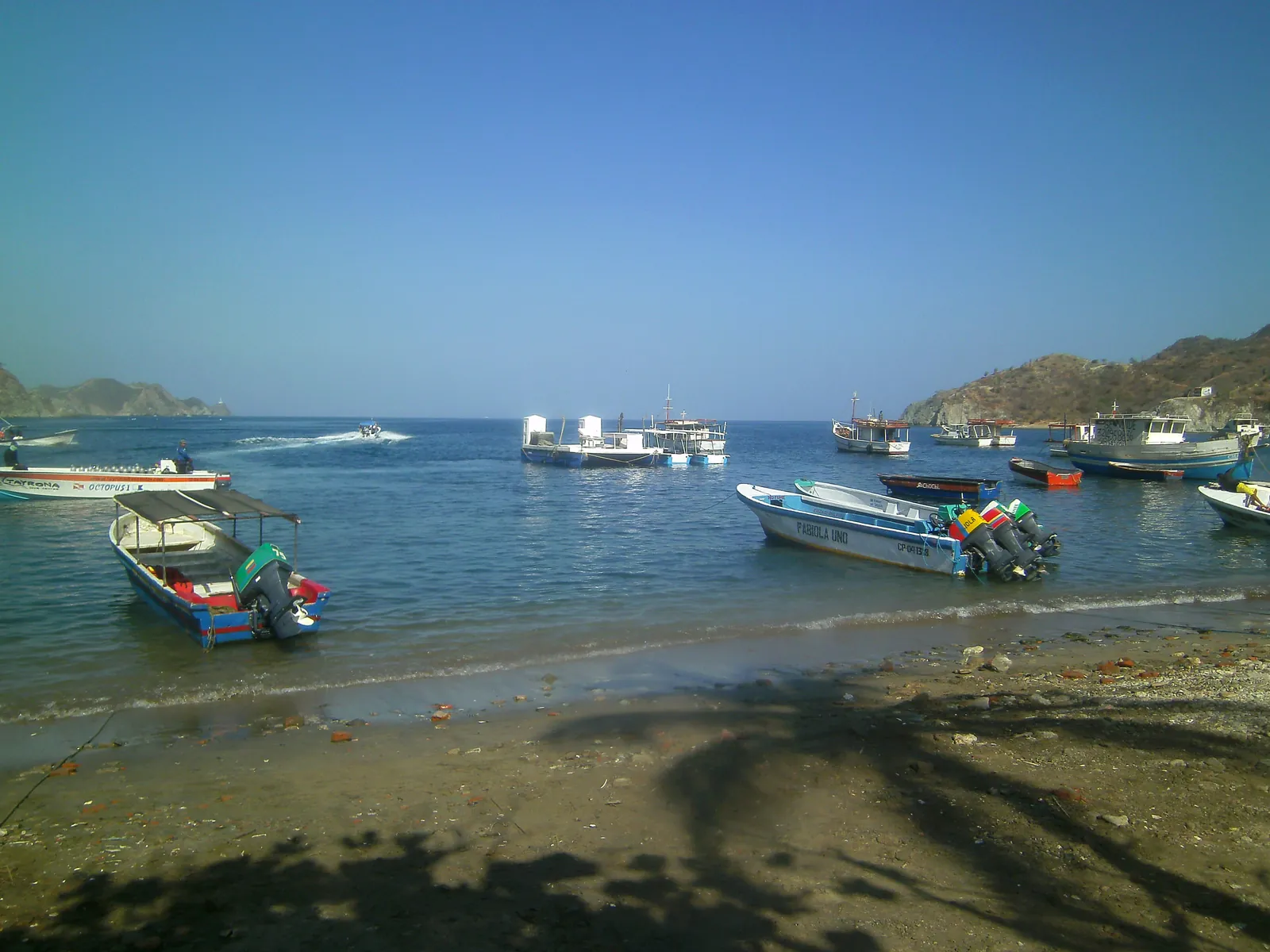
Boats in Taganga bay, near Santa Marta. Tisquesusa, Wikimedia Commons, CC BY-SA 4.0, cropped.

Cartagena and the Rosario Islands
From Cartagena, dive boats run to the Corales del Rosario y San Bernardo national park, which Diving Planet says lies an hour by speedboat from the walled city and has 27 small islands and islets. Its certified-diver day leaves the Muelle de la Bodeguita at 8:00, makes two dives on walls, reefs or wrecks chosen by the sea that day, and returns at about 16:15. Diving Planet gives depths of 5 to 40 meters, visibility of 10 to 20 meters and light to moderate currents, and its price includes the park entry fee and what it calls mandatory dive insurance. It tells divers to wait at least 18 hours before flying. We could not read the parks authority's 2026 fee for the Rosario park.
Malpelo: a Pacific sanctuary reached by boat
Malpelo is a fauna and flora sanctuary declared in 1995, about 490 km west of the port of Buenaventura and inside that municipality. Its limits were redrawn in 2002 to match a Particularly Sensitive Sea Area designated by the International Maritime Organization, UNESCO listed it as a World Heritage site on 12 June 2006, and the environment ministry enlarged it in 2022 to about 4,815,114 hectares. One of the stated aims of that expansion is to conserve the sanctuary's value for ecotourism.
Trip listings we saw sell Malpelo as a multi-day boat trip with minimum logged-dive requirements and daily park fees, but we couldn't confirm any of this with the parks authority or with a boat operator. Ask the boat for the sanctuary's current requirements in writing. Also ask where it departs from and how you get there: both the UK and German governments advise against travel to Buenaventura (see the safety section).
The Pacific coast: Nuquí and Bahía Solano
The UK Foreign Office calls Nuquí and Bahía Solano on the Chocó coast "whale-watching towns" and exempts them from its warning for the rest of Chocó, but tells travellers to arrive only by air and not to travel inland or along the coast out of town. We found no official source for the humpback season or for diving operators there, so this guide leaves the Pacific mainland out.
National rules: coral, lionfish and the parks
Colombia treats taking coral as a crime. Article 328 of the penal code, as rewritten in 2021, punishes anyone who, in breach of the rules, takes, extracts, transports or trades specimens or parts of corals or other marine life with 60 to 135 months in prison and a fine. Inside national parks, Decree 1076 adds the ban on fishing gear and feeding animals described above.
Lionfish are the exception that divers are asked to remove. The environment ministry added Pterois volitans to Colombia's list of invasive species in 2010, with measures that include workshops with dive schools, incentives for removing the fish, a ban on trading or breeding it, and warnings to tourists that its spines are venomous. Coralina runs organised hunts. We found no rule on whether a visiting diver may spear lionfish outside them, so leave it to your guide.
When to dive Colombia: sea temperature and hurricanes
NOAA's satellite averages for 1991 to 2020 put the surface sea at the following monthly means, for points near each dive area:
| Area (grid cell centre) | Coolest month | Warmest month |
|---|---|---|
| San Andrés (12.625°N, 81.875°W) | February, 27.0 °C | September, 29.0 °C |
| Providencia (13.375°N, 81.625°W) | February, 27.0 °C | September, 29.0 °C |
| Santa Marta and Taganga (11.375°N, 74.375°W) | February, 25.5 °C | September and October, 29.0 °C |
| Rosario Islands (10.125°N, 75.875°W) | March, 27.4 °C | July, 29.7 °C |
| Malpelo (3.875°N, 81.625°W) | March, 26.1 °C | May, 27.9 °C |
The Santa Marta coast is the coolest of the Caribbean areas from January to April, about 25.5 to 26.5 °C at the surface, and Poseidon offers 3 or 5 mm full wetsuits. These are surface figures; the water at depth can be colder.
Germany's Foreign Office gives June to November as the hurricane season on the Caribbean coast, and the UK Foreign Office says hurricanes and tropical storms, although uncommon, can reach the coast and the San Andrés archipelago, and points to Colombia's weather institute IDEAM and the US National Hurricane Center for forecasts.
Chambers and emergencies
Colombia's single emergency number is 123, set in the communications regulator's short-code table; the UK Foreign Office says to call 123 and ask for an ambulance.
For decompression illness, the picture is uncertain. In 2023 the public departmental hospital of San Andrés and Providencia put out a tender to repair and certify its two hyperbaric chambers, one on San Andrés and one on Providencia, where the work included putting the chamber into service. In October 2026 the departmental government reported new measures to deal with "the difficulties" the San Andrés hospital faces in providing care. We could not confirm that either chamber is working today or staffed around the clock, and we could not read an official source for chambers in Cartagena or Santa Marta. Ask your dive centre where it would send you. Poseidon includes dive insurance with chamber cover in its price, and Diving Planet includes insurance too; check that your own dive insurance covers an evacuation from the islands to the mainland.
What a dive costs in Colombia
Prices on the dive centres' own pages, read on 10 November 2026:
| Dive centre | Two dives | What is included |
|---|---|---|
| Poseidon Dive Center, Taganga | COP 430,000 | Nitrox, full equipment, dive computer, snack, insurance with chamber cover |
| Diving Planet, Cartagena | COP 630,000 from Cartagena; COP 440,000 from the Rosario Islands | Park entry fee, insurance, equipment; boat and lunch from Cartagena |
For a longer stay, Poseidon sells six dives over three days for COP 1,200,000 and ten dives over five days for COP 1,900,000, and a night dive for COP 275,000. We found no published prices on the websites of shops in San Andrés, Providencia or on the Malpelo boats.
Getting to the islands and the dive towns
Visitors to San Andrés and Providencia need a tourist card. The departmental government's procedures page lists it at COP 104,492 and requires a return ticket, but five Colombian news outlets reported in early 2026 that Decree 0010 of 2026 raised it to COP 153,000; we could not read the decree. The UK Foreign Office says you buy it at the boarding gate on the day of your flight, and do not need one for a stay under 24 hours. On the mainland, Taganga's dive boats leave from the beach, and Cartagena's leave from the Muelle de la Bodeguita near the old town. For Malpelo, the boat's departure arrangements decide everything; ask early.
Colombia as a remote-work base
Colombia has a visitor visa for digital nomads, the Visa V nómada digital. We couldn't check its current requirements with the Foreign Ministry. Law-firm and news summaries consistently say it was created by Resolution 5477 of 2022 for people working remotely for foreign employers or their own business, and give the income bar as three monthly minimum wages, shown by bank statements. The 2026 minimum wage is COP 1,750,905, fixed by decree, which by our arithmetic makes the bar COP 5,252,715 a month. Check the figure and the fees with a Colombian consulate before you apply. We found no official data on internet speeds in the dive towns. Our nomad visa overview compares other countries' schemes.
Safety: what official travel advice says
The UK Foreign Office, updated on 30 October 2026, advises against all but essential travel to the western part of Valle del Cauca, including Buenaventura, and to Chocó except Quibdó, Nuquí, Bahía Solano and Capurganá. Germany's Foreign Office, in its partial travel warning current on 10 November 2026, strongly advises against travel to Valle del Cauca including Buenaventura, except Cali when arriving by air, and to Chocó except Bahía Solano and the coast between Utría national park and Punta Arusí. Neither names San Andrés, the Santa Marta area or Cartagena among the areas it warns against, though the UK says to visit Ciudad Perdida in the Sierra Nevada de Santa Marta only on an organised tour. Germany's advice notes more robberies using drugs such as scopolamine in big cities including Cartagena since 2023, and recommends a dive-medical check before a diving trip.
Who Colombia diving suits
Colombia suits a diver who wants warm Caribbean water all year and is happy with simple reef diving from small boats: the Seaflower islands for protected reefs, Taganga for a base with multi-dive packages, Cartagena for a day trip or a night on the Rosario Islands. It suits an experienced diver willing to plan a long Malpelo trip around the travel advice. It suits a remote worker who meets the visa's income bar. It suits less well anyone who needs a confirmed, staffed chamber nearby, or who wants Tayrona's coast on a fixed date without a backup plan.
FAQ: Colombia diving
Where do people dive in Colombia?
In four areas. San Andrés and Providencia sit inside the Seaflower marine protected area in the western Caribbean, Taganga dives the coast of Tayrona national park, Cartagena's boats go to the Rosario Islands national park, and Malpelo is a remote Pacific sanctuary about 490 km offshore.
How much is the San Andrés tourist card in 2026?
Colombian news outlets reported COP 153,000 for 2026 under Decree 0010 of 2026. The departmental government's procedures page still showed COP 104,492 when we read it, so check the price when you book. The UK Foreign Office says you buy it at the boarding gate and do not need it for stays under 24 hours.
What is the water temperature for diving in Colombia?
NOAA's 1991 to 2020 averages put the surface at 27 to 29 °C around San Andrés and Providencia and 27.4 to 29.7 °C off the Rosario Islands. Off Santa Marta it drops to about 25.5 °C in February. Malpelo averages 26.1 to 27.9 °C.
Is there a hyperbaric chamber in San Andrés?
The departmental hospital had two chambers in 2023, one on San Andrés and one on Providencia, and tendered their repair and certification that year. We could not confirm that either works today or is staffed around the clock. Ask your dive centre for its emergency plan and call 123 in an emergency.
Is it legal to take coral or shells while diving in Colombia?
No for coral. The penal code punishes taking, extracting or trading corals and other marine life in breach of the rules with 60 to 135 months in prison. National parks ban fishing gear, collecting and feeding animals, and San Andrés bans feeding or handling fish, sharks and rays.
Note: Conditions, safety guidance and regulations change. Verify current information with official sources, including the dive operator, the park authority and the relevant government department, before you travel or dive.
Founder of NOMADREEF and a former digital nomad. This guide is sourced from the references below; conditions, prices and rules change, so verify current details, and follow qualified local guidance and safety briefings. About the author · LinkedIn ↗
Sources
- Seaflower and the archipelago rules (primary). Coralina, marine protected areas, Old Providence McBean Lagoon, notice on Resolution 611 of 2022, parrotfish Resolution 369 of 2019 and 2024 lionfish hunts. Read 10 November 2026.
- Hurricane Iota and Providencia (primary). NOAA National Hurricane Center, Tropical Cyclone Report, Hurricane Iota (PDF); Gobernación de San Andrés, announcements of 16 October 2026. Read 10 November 2026.
- Tourist card. Gobernación de San Andrés, tarjeta de turismo procedure (primary); the COP 153,000 figure triangulated from February 2026 reports in Vanguardia, El Universal, Publimetro, Noticias RCN and El País. Read 10 November 2026.
- Tayrona (primary). Ministerio de Comercio, Industria y Turismo, 23 February 2026 and 4 March 2026. Read 10 November 2026.
- Malpelo (primary). Ministerio de Ambiente, Resolución 0669 de 2022 (PDF). Read 10 November 2026.
- National rules (primary). Decreto 1076 de 2015, articles 2.2.2.1.15.1 and 2.2.2.1.15.2; Ley 599 de 2000 (penal code), article 328; Resolución 0207 de 2010 on lionfish (PDF). Read 10 November 2026.
- Season and weather. NOAA PSL, OISST v2.1 monthly long-term means 1991–2020, five grid cells, read for this page; Auswärtiges Amt, Kolumbien: Reise- und Sicherheitshinweise (primary); UK FCDO, safety and security (primary). Read 10 November 2026.
- Chambers and emergency numbers (primary). E.S.E. Hospital Departamental de San Andrés, Providencia y Santa Catalina, 2023 chamber maintenance tender (PDF); CRC Resolución 5937 de 2020; UK FCDO, getting help. Read 10 November 2026.
- Dive centres (each primary for itself). Poseidon Dive Center, fun and technical dives with prices and about us; Diving Planet, fun dives and where we dive; Banda Dive, diving trips. Read 10 November 2026.
- Visa and minimum wage. Decreto 0159 de 2026 on the 2026 minimum wage (primary); the three-minimum-wage income bar from law-firm and news summaries of Resolución 5477 de 2022, which we could not check against the Foreign Ministry. Read 10 November 2026.
- Travel advice (primary). UK FCDO, warnings and insurance, regional risks and entry requirements; Auswärtiges Amt, as above. Read 10 November 2026.
- Left out. Everything on the national parks authority's website, which blocked our requests: 2026 entrance fees, McBean scuba rules, Tayrona's closure calendar, and Malpelo's permit and diver-experience rules; the Foreign Ministry's own visa requirements and fees; the text of San Andrés Decree 0010 of 2026; whether any Colombian chamber is working and staffed 24/7; prices from shops in San Andrés, Providencia and on Malpelo boats; the Pacific humpback season from an official source; and internet speeds in the dive towns.