Brazil Diving: Arraial do Cabo's Reserve Caps, the Abrolhos Marine Park, Bonito's Cave Lake, Rio's Islands and Noronha
 by Yannick Schroth
Nov 10, 2026
13 min read
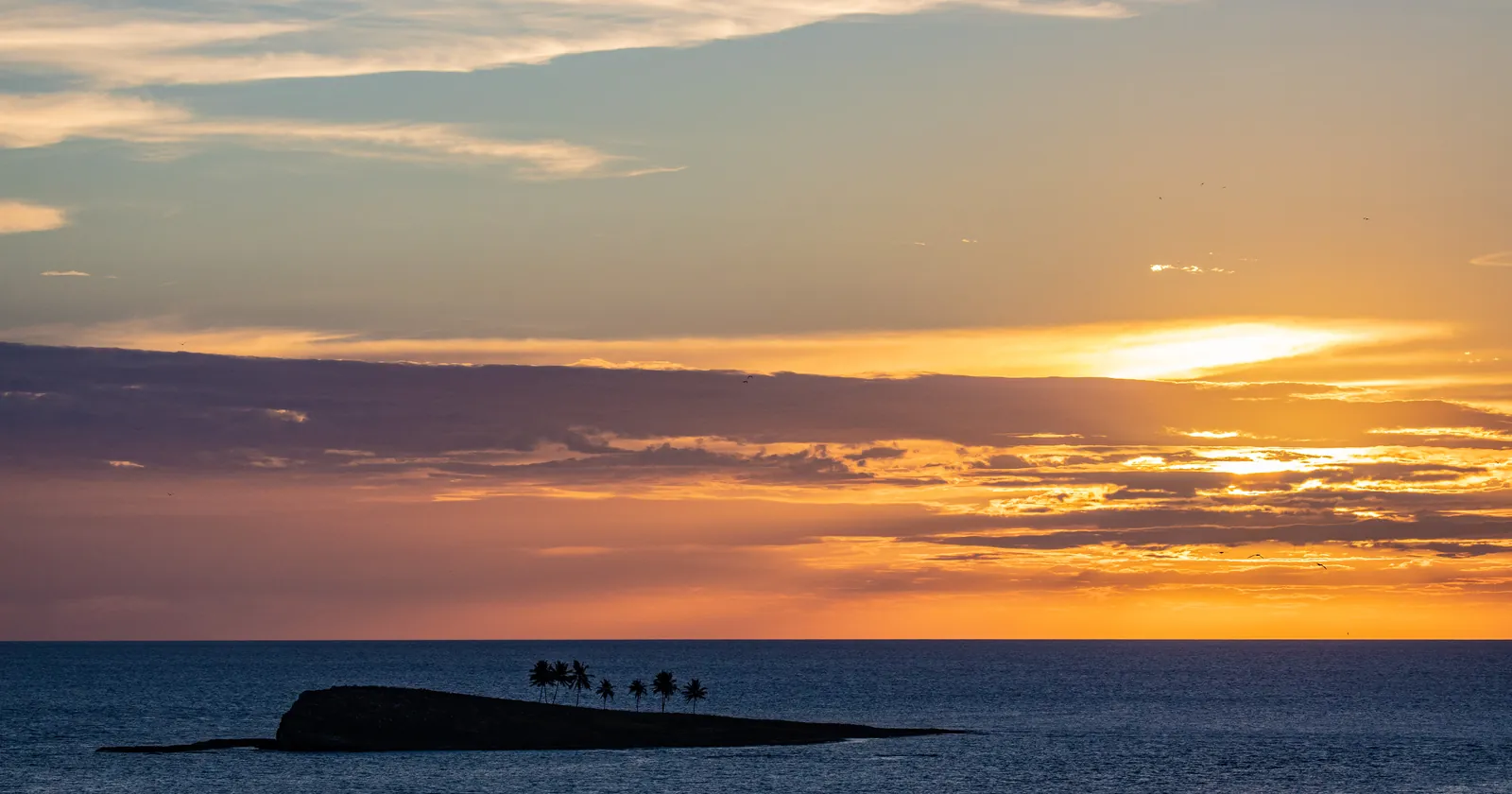
Abrolhos Marine National Park at sunset. RobertoCostaPinto, Wikimedia Commons, CC BY-SA 4.0, cropped.

Key takeaways
- Arraial do Cabo's reserve allows visitor scuba only with ICMBio-authorised operators, at most 13 of them, with up to 40 divers a boat and a diver cap at each site
- In the Abrolhos marine park, scuba is only allowed at set sites with an authorised underwater guide, you must carry your card, and gloves and knives are not allowed
- Brazil's fisheries ministry bans breathing apparatus while spearfishing, so taking fish on scuba is out; Brazilian law also bans diving with whales and dolphins
- NOAA's satellite averages put the sea off Arraial at 21.4 to 25.5 °C, off Abrolhos at 24.5 to 27.4 °C and off Recife at 26.0 to 28.7 °C
- We could not confirm from an official or hospital source any hyperbaric chamber that treats divers around the clock in the regions covered; dial 192 for the SAMU ambulance and 185 for the Navy at sea
Brazil diving by region: who manages what
The dive areas in this guide are mostly protected areas run by ICMBio, the federal conservation institute, and each has its own rulebook. Arraial do Cabo in Rio de Janeiro state is a marine extractive reserve, a protected area built around artisanal fishing, where divers are guests of the fishing community. Abrolhos off southern Bahia and Fernando de Noronha off Pernambuco are marine national parks, the strictest category, with authorised operators only. The Cagarras islands off Rio de Janeiro city are a federal natural monument. Bonito, in Mato Grosso do Sul, is freshwater and runs on a municipal booking system rather than federal rules.
ICMBio set national procedures for diving in federal protected areas in an instruction published on 24 April 2020. According to the institute's own summary, it applies to the protected area, to commercial operators and to the dive guides ICMBio authorises, and it leaves each area to fix its dive points, rules for night, cave and liveaboard diving, and the number of divers per guide.
Arraial do Cabo: a fishing reserve with dive caps
The Reserva Extrativista Marinha do Arraial do Cabo was created in 1997 to protect the town's artisanal fishing. It covers a strip of sea three miles wide along Arraial's coast, between Massambaba and Praia do Pontal on the border with Cabo Frio, about 50,816 hectares of water in all, which ICMBio has granted to the residents' association Aremac. The reserve's 2020 management plan explains why the diving is unusual for Brazil: upwelling, wind and tides bring rich fishing grounds, and the area is a transition between tropical and subtropical fauna, with one of the highest seabed biodiversities on the Brazilian coast.
Diving here is governed by the reserve's management agreement, approved by ICMBio order 895 of 23 September 2020. Visitor scuba may only be run by operators ICMBio has authorised, with a limit of 13 operators and 13 boats and at most 40 visiting divers per boat. Dive boats tie up to moorings, one boat per mooring, and each site has its own cap and hours. The inner side of the Ilha de Porcos takes 100 divers per period until 17:00; Praia do Forno and the inner cove of Saco do Cherne take 120 each with three and four moorings; Saco dos Ingleses, listed as Thetis and Gruta Azul, takes 80 with two boats until 14:00; the Furnas dos Soldados and Harligen site takes 80 between 11:00 and 14:00; and the smaller Camarinha takes 40 from 11:00 to 13:00. Night scuba is allowed only in the Cardeiro, Cherne and Forno coves. Grapnels and anchors may not be dropped on coral, and the reserve council can change any of these caps after ICMBio inspections or studies.
The plan adds general rules. You may not touch or chase whales, dolphins, turtles or seabirds anywhere in the reserve, or collect, stand on or handle coral, and food scraps may not be thrown from boats. Visitors' own boats may anchor only in the marked areas at Praia dos Anjos and Praia do Forno. Spearfishing is a traditional local practice here, but the agreement allows amateur spearfishing only to a category of registered reserve beneficiaries with ICMBio authorisation, and the restricted zone around Pedra Vermelha and the Ilha do Farol bans it outright. Sport fishing is banned in the areas used for recreational scuba.
We couldn't find a visitor fee for diving in the reserve, depths for its sites from an official or operator source, or current prices. The websites we tried for Arraial operators didn't load.
Abrolhos: Brazil's first marine national park
The Parque Nacional Marinho dos Abrolhos was created on 6 April 1983, Brazil's first marine national park, and covers 87,943 hectares. It has two parts: an area about 70 kilometers off Caravelas that holds the Abrolhos archipelago and the Parcel dos Abrolhos, a field of thousands of chapeirões, and the Timbebas reef nearer the coast between Alcobaça and Prado. ICMBio describes the chapeirões as mushroom-shaped reef pillars up to 30 meters, found only on the Abrolhos Bank, and says the region is the only place in the world with the brain coral Mussismilia braziliensis.
ICMBio says the park holds three wrecks open to visitors, and that scuba lets you dive wrecks, caves and chapeirões and make night dives at the archipelago, including a cabled underwater trail on the Mau-Mau chapeirão near Santa Bárbara. Apecatu Expedições, one of the authorised operators, names the Rosalinda, Guadiana and Santa Catarina wrecks among its dive sites.
The park's rules are short and strict. Diving is only allowed at pre-set sites and with a guide the park has authorised, called a condutor subaquático for scuba, and you must carry your certification card. Fishing is banned inside the park, and so are molesting animals, collecting anything and using gloves or knives on a dive. A private boat that wants to run scuba needs the safety equipment of the ISO 24803 standard and a guide qualified at least as a divemaster. Only operators authorised by the park may take visitors to the archipelago, and ICMBio's visitor page names 11 of them, all based in Caravelas.
The ticket is R$20 per person per day on a day trip, or per night on an overnight trip, according to the park's visitor page; residents of the seven Costa das Baleias towns pay nothing. The crossing from Caravelas takes 2.5 to 5 hours depending on the boat and the weather. Day trips run roughly from 07:00 to 18:00, and liveaboards last two to four days. ICMBio does not recommend trips when the wind is over 20 knots.
Season is the other choice. ICMBio calls December to April the best period for diving, with warmer water and better visibility. From June to November humpback whales come to the Abrolhos Bank to breed, with the peak from July to October and most sightings in August and September. Boats must stay at least 100 meters from whales, approach from the side and stay with a group no more than 30 minutes.
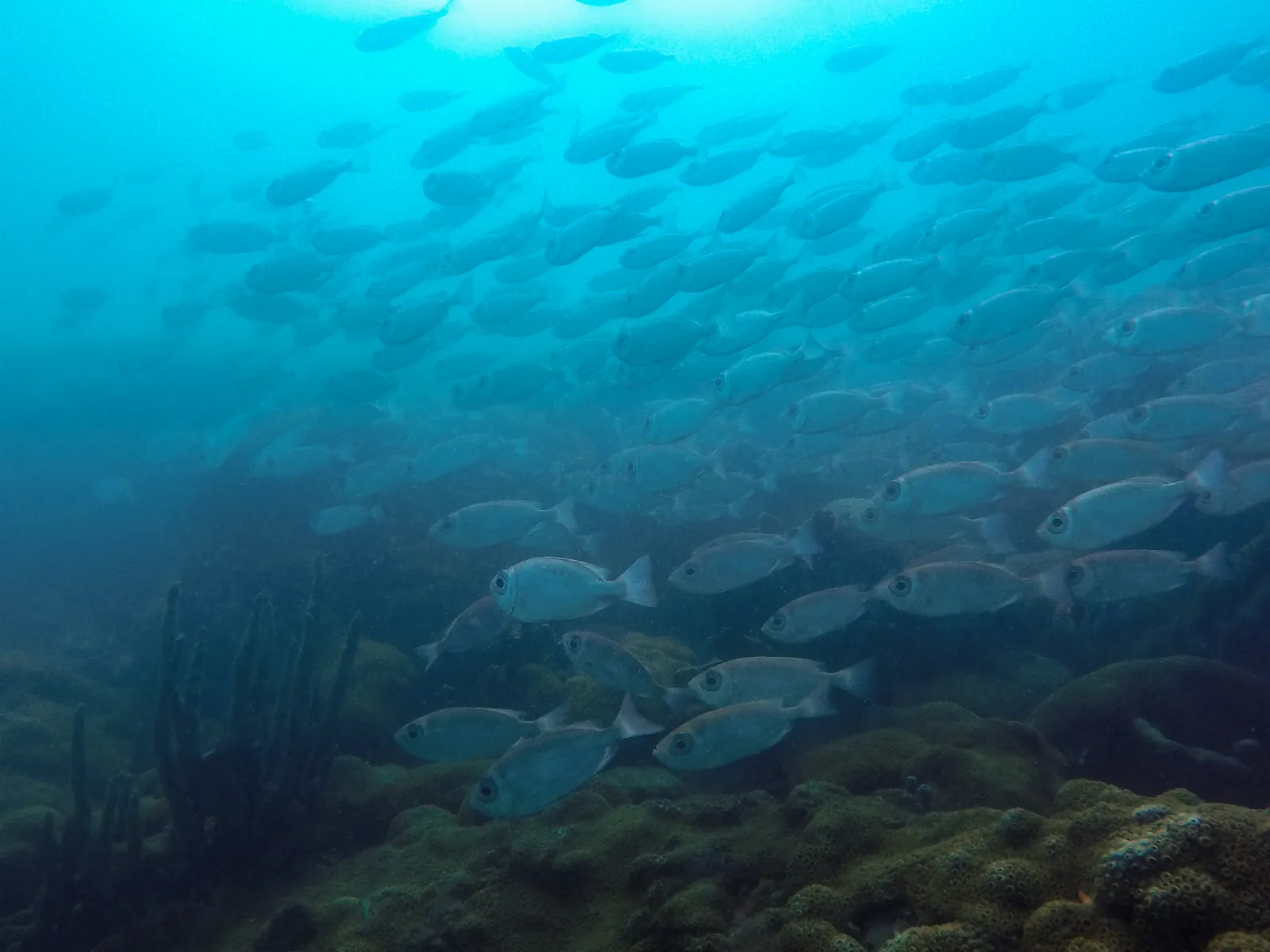
A school of bigeye at Enseada do Cardeiro, Arraial do Cabo. Geraldo da Silva Souza, Wikimedia Commons, CC BY-SA 4.0, cropped.

Bonito: freshwater snorkelling and the Anhumas cave
Bonito, in Mato Grosso do Sul, is inland and its water is fresh. Its tourism runs on the voucher único, a booking system that has limited visitor numbers since 1995. The municipal tourism office puts the capacity at about 9,000 places a day across the attractions, and its guidance is plain: you do not visit the attractions on your own, tours are bought through a travel agency and always guided. The main activity is flutuação, drifting face down along clear rivers in a wetsuit, mask, snorkel and life jacket supplied by each site, and the office says the rivers are clearest from May to September.
The scuba dive in the region is the Abismo Anhumas, a cave 23 kilometers from Bonito. The operator says you reach the lake by an electric rappel of 72 meters and leave the same way; the lake reaches 80 meters deep in places, and it claims visibility of 60 meters. Certified divers need at least an Open Water card: the operator's product page says the dive goes to 18 meters and its title says 20, where it says you see the whole field of submerged limestone cones. A try-dive for people without a card goes to 8 meters.
Rio de Janeiro: the Cagarras islands
Off Rio de Janeiro city, the Monumento Natural do Arquipélago das Ilhas Cagarras is a federal strict-protection area of 91.23 hectares, created by law in 2010. ICMBio's 2021 public-use plan says the site operators use most is the Enseada Norte on the north side of Ilha Comprida, sheltered from southerly winds and good for beginners, with a maximum depth of about 13 meters; it is 3.3 nautical miles from Posto 6 in Copacabana, about 15 minutes by speedboat. The Face Sul reaches about 20 meters close to the island but is exposed to southerly wind and swell. The plan says the management plan set no specific dive rules, so ICMBio's 2020 diving procedures and the general rules apply, including anchoring at least 30 meters from each island. ICMBio now credentials dive operators and guides for the islands and publishes the list on the monument's page.
Ilha Grande and Angra dos Reis: where you may not dive
In the Baía da Ilha Grande around Angra dos Reis, part of the water is off limits to divers. The Estação Ecológica de Tamoios is a federal ecological station made up of islands and the sea around them, and ICMBio says presence and fishing are banned in all of it. It lists diving, spearfishing, anchoring and landing on the islands among the activities that unauthorised entry leads to, and it runs anti-anchoring patrols each summer at the Piraquara de Dentro, Pingo d'Água, Tanguá and Sandri coves. Ask your operator whether a site is inside the station. We found no official source for dive rules or sites in the Ilha Grande State Park, which is run by the state environment agency.
Fernando de Noronha: a park of its own
Noronha, about 545 kilometers off Recife, is covered in our Fernando de Noronha diving guide. In short: scuba in the marine park is only allowed with ICMBio-authorised operators, you pay a park ticket of R$393 for foreigners and the island's daily environmental tax, reported at R$105.79 a day in 2026, and operators sell the Corveta Ipiranga wreck at about 60 meters as a technical dive. The sea there stays between about 26.4 and 28.6 °C all year.
Salvador, Recife and the coast we could not cover
This guide doesn't cover Salvador and the Bahia coast north of Abrolhos, or the artificial wrecks off Recife. We couldn't reach Pernambuco's state websites or find an official source for their rules and sites. For the north-east coast's wind sports, see our Preá kite guide.
Rules that apply across Brazil
Three national rules matter to a visiting diver. First, Brazil's Ministry of Fisheries and Aquaculture lists using breathing apparatus while spearfishing as prohibited, and bans boats that support amateur fishing from carrying compressed-air or other breathing gear, except where the maritime authority requires it. So spearfishing is breath-hold only, and taking fish on scuba is out. Amateur fishing needs a licence, which a Brazilian citizen can request for a foreigner without a tax number since November 2025, and the catch may not be sold. Second, Brazilian law forbids diving with whales and dolphins and sets a minimum distance of 50 meters, as ICMBio's Abrolhos page explains. Third, inside any federal protected area, ICMBio's 2020 procedures and the area's own rules apply, and in practice that means authorised operators and guides.
We couldn't access the Navy's website, so we couldn't check whether any of its maritime rules apply to recreational divers.
Sea temperature and season by region
NOAA's satellite averages for 1991 to 2020, computed for three grid cells, show the spread:
| Month | Arraial do Cabo (23.125°S 41.875°W) | Abrolhos (17.875°S 38.625°W) | Recife (8.125°S 34.875°W) |
|---|---|---|---|
| January | 24.5 °C | 26.5 °C | 27.9 °C |
| March | 25.5 °C | 27.4 °C | 28.6 °C |
| April | 25.1 °C | 27.4 °C | 28.7 °C |
| June | 22.8 °C | 25.5 °C | 27.2 °C |
| August | 21.5 °C | 24.5 °C | 26.0 °C |
| September | 21.4 °C | 24.6 °C | 26.3 °C |
| November | 22.8 °C | 25.6 °C | 27.1 °C |
| December | 24.1 °C | 26.0 °C | 27.5 °C |
These are surface figures over a cell about 25 kilometers wide. Off Arraial, where the reserve's plan describes upwelling, the water at depth can be colder than the table shows; we found no measured figure for that. On these averages, a thicker wetsuit makes sense there in the southern winter. We found no statement from Brazil's weather services on a storm season for these coasts; Abrolhos trips are limited by wind, and Bonito by river clarity, as described above.
Chambers and emergency numbers
We could not confirm from any official or hospital source a hyperbaric chamber that treats divers around the clock near Arraial do Cabo, Rio de Janeiro, Caravelas, Bonito, Salvador or Recife. Search results point to a Navy hospital service in Rio de Janeiro, but we couldn't access the Navy's website, so we can't list it as confirmed. On Noronha, a diver was treated in a chamber on the island in 2024, according to three news reports; that is not an official confirmation either. Ask your operator where it would send you, and check that your dive insurance covers an evacuation, which from Abrolhos means a long boat ride before any road.
Brazil's emergency numbers, according to the telecoms regulator Anatel, are 192 for the SAMU ambulance, 193 for the fire brigade, 190 for the military police and 185 for the Navy's maritime and river emergencies. From a mobile, 112 and 911 reach the military police. Calls to emergency services are free, and the Ministry of Health says SAMU runs 24 hours a day, seven days a week.
What diving costs in Brazil
Prices on operators' own pages, read on 10 November 2026:
| Operator and trip | Price | What the operator says is included |
|---|---|---|
| Escama Turismo, Caravelas: Abrolhos dive liveaboard, 2 days | R$2,200 | Breakfast and lunch, instructor, filled tanks, island landings; scuba gear R$50 per piece per day extra |
| Escama Turismo: Abrolhos dive liveaboard, 3 days | R$3,200 | As above |
| Escama Turismo: Abrolhos dive liveaboard, 4 days | R$4,000 | As above |
| Escama Turismo: try-dive | R$300 per dive | Added to a trip |
| Abismo Anhumas, Bonito: certified dive | R$2,037 high season, R$1,799 low season | Rappel, boat tour and dive |
| Abismo Anhumas: try-dive to 8 m | R$1,898 high season, R$1,699 low season | Rappel, boat tour, snorkel and dive |
| Abismo Anhumas: snorkel only | R$1,598, children R$799 | Rappel, boat tour and snorkel |
Escama asks certified divers to request a quote and requires them to show their card. It also sells an overnight Abrolhos trip without scuba for R$1,500, including the park fee. For Arraial do Cabo and Rio we could not read prices on an operator's own page.
Brazil as a remote-work base
Brazil's digital-nomad visa is the VITEM XIV, for foreigners without a Brazilian employment contract whose work can be done remotely. Brazil's consulates ask for foreign-source income of at least US$1,500 a month or US$18,000 in the bank, health insurance valid in Brazil, and a contract with a foreign employer or client plus a statement that the work can be done remotely. The first residence period is up to one year, renewable for one more, under the rule published in January 2022, and people already in Brazil can apply through the Justice Ministry's MigranteWeb system. We found no source for internet speeds in Arraial, Caravelas or Bonito.
Who Brazil diving suits
Brazil suits a diver who is happy to dive inside protected areas on their terms: capped, operator-run sites in Arraial do Cabo's cool, rich water; long boat trips or a liveaboard to the reefs and wrecks of Abrolhos in the southern summer; a guided, booked-ahead cave dive in Bonito; and, for a bigger budget, Noronha. A remote worker on the VITEM XIV can move between them across a year. It suits less well anyone who wants to dive independently from the shore in the parks, to spearfish on scuba, or to know before the trip exactly which chamber would treat them.
FAQ: Brazil diving
What are the main places to dive in Brazil?
Fernando de Noronha and the Abrolhos marine park are national parks with warmer water and authorised operators; Arraial do Cabo near Rio has cooler, nutrient-rich water inside a fishing reserve with site caps; Bonito offers freshwater snorkelling and a cave dive at the Abismo Anhumas.
Do you need a permit to dive in Abrolhos?
You need to go with one of the operators the park has authorised, all based in Caravelas, and pay the park ticket, which the park lists at R$20 a day for the general public. Scuba is only allowed at set sites with an authorised underwater guide, and you must carry your certification card.
When is the best time to dive Abrolhos?
ICMBio calls December to April the best period for diving, with warmer water and better visibility. Humpback whales are on the Abrolhos Bank from June to November, peaking from July to October. Trips depend on the wind, and the park does not recommend going out above 20 knots.
Can you spearfish with scuba in Brazil?
No. Brazil's fisheries ministry lists using breathing apparatus while spearfishing as prohibited, and boats supporting amateur fishing may not carry compressed-air gear except where the maritime authority requires it. In Arraial do Cabo's reserve, amateur spearfishing is reserved to registered beneficiaries with ICMBio authorisation.
How cold is the water in Arraial do Cabo?
NOAA's satellite averages for the sea surface off Arraial run from about 21.4 °C in September to 25.5 °C in March. The reserve's management plan describes upwelling along this coast, so water at depth can be colder than the surface figure.
Note: Conditions, safety guidance and regulations change. Verify current information with official sources, including the dive operator, ICMBio and the relevant municipal or state authority, before you travel or dive.
Founder of NOMADREEF and a former digital nomad. This guide is sourced from the references below; conditions, prices and rules change, so verify current details, and follow qualified local guidance and safety briefings. About the author · LinkedIn ↗
Sources
- National diving procedures (primary). ICMBio, ICMBio em Foco no. 555 (PDF), on the diving instruction of 24 April 2020. Read 10 November 2026.
- Arraial do Cabo reserve (primary). ICMBio, reserve page and management plan, 2020 (PDF); Portaria ICMBio 895 of 23 September 2020, management agreement, items 58 to 61 and 65 to 69, read from the Diário Oficial page as archived by the Instituto Socioambiental (PDF). Read 10 November 2026.
- Abrolhos (primary). ICMBio, Abrolhos visitor guide, including the IBAMA rule on whales and dolphins; Apecatu Expedições, packages (operator). Read 10 November 2026.
- Bonito. Bonito tourism secretariat, planning article on the voucher system (official site); Abismo Anhumas, certified dive (operator). Read 10 November 2026.
- Rio de Janeiro and Angra dos Reis (primary). ICMBio, MONA Cagarras page and public-use plan, 2021 (PDF); ICMBio, ESEC Tamoios, protection. Read 10 November 2026.
- Spearfishing and fishing (primary). Ministry of Fisheries and Aquaculture, amateur and sport fishing booklet (PDF). Read 10 November 2026.
- Sea temperature. NOAA PSL, OISST v2.1 monthly long-term means 1991–2020, three grid cells, computed for this page (primary). Read 10 November 2026.
- Emergency numbers (primary). Anatel, public-utility and emergency codes; Ministry of Health, SAMU 192. Read 10 November 2026.
- Prices (each operator primary for itself). Escama Turismo; Abismo Anhumas, certified dive, try-dive and snorkel. Read 10 November 2026.
- Staying and working (primary). Ministry of Foreign Affairs, consulate pages on the VITEM XIV in San Francisco and Amsterdam. Read 10 November 2026.
- Left out. The full text of ICMBio's 2020 diving instruction, because the official gazette site refused our connection; any Navy rules for recreational divers, because the Navy's site blocked us; a hyperbaric chamber confirmed by an official or hospital source in any region covered; Arraial do Cabo prices, site depths and any visitor fee; dive rules for the Ilha Grande State Park; Salvador, and Recife's wreck park and Pernambuco's diving law, because the state sites did not load; a met-service storm season; and internet speeds.