Fernando de Noronha Diving: The Marine Park's Dive Sites, Its Two Fees, the Ipiranga Wreck and When the Sea Allows It
 by Yannick Schroth
Nov 10, 2026
12 min read
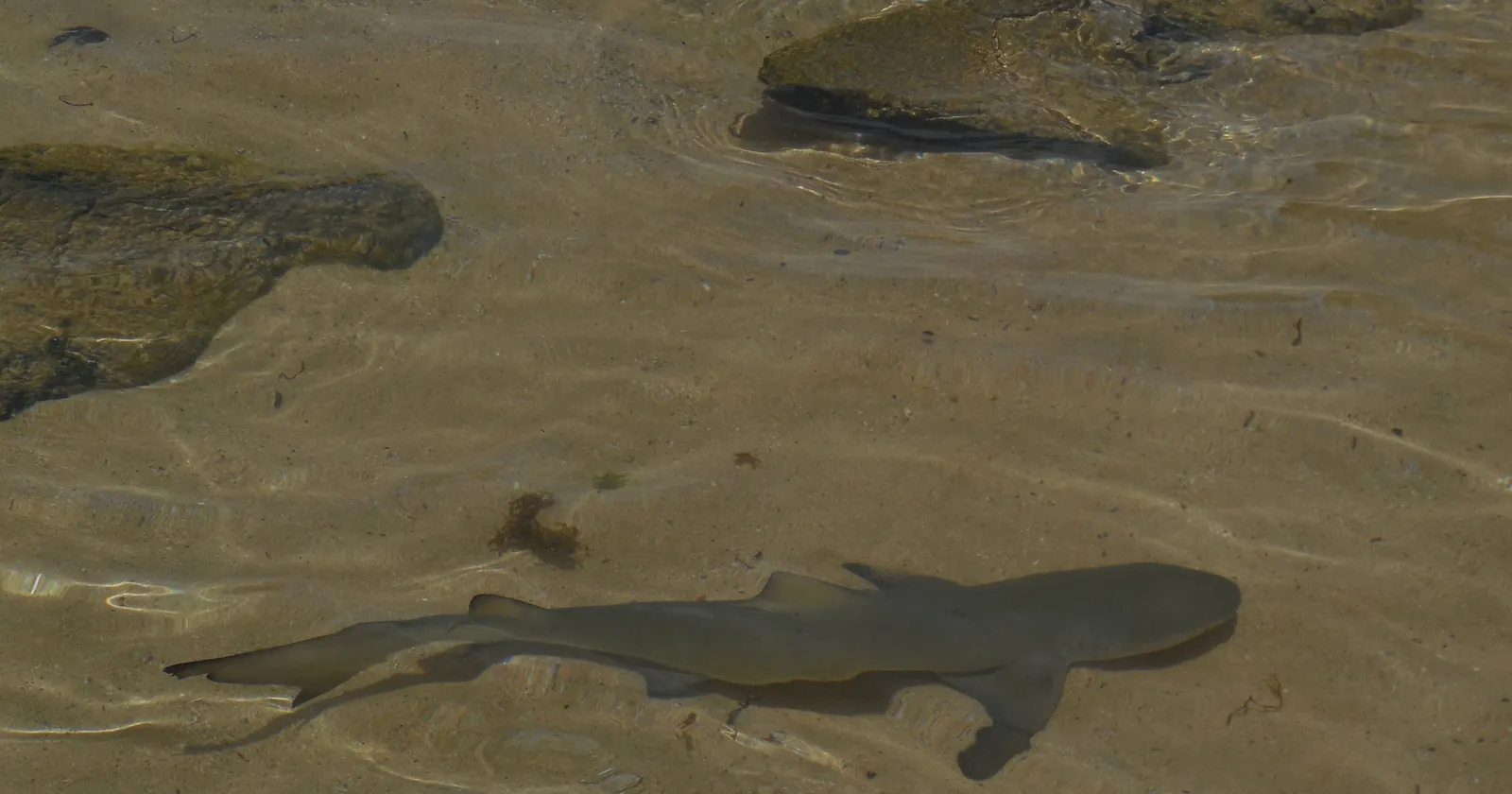
A lemon shark at Fernando de Noronha. M H Mathias, Wikimedia Commons, CC BY 2.0, cropped.

Key takeaways
- Scuba in the national marine park is only allowed with operators that ICMBio has authorised, and the park ticket is a prerequisite for scuba in the park
- The park ticket costs R$393 for foreigners and R$196.50 for Brazilians, valid for ten days; the island's environmental tax was R$105.79 a day in 2026, according to three news reports
- Collecting, touching, chasing or feeding animals is banned, spearguns are banned on the island, and ICMBio fines run from R$500 to R$10,000
- NOAA's satellite averages put the sea at 28.6 °C in April and 26.4 °C in September; ICMBio describes heavy rain from February to July
- A diver with decompression sickness was treated in a hyperbaric chamber on the island in 2024; we could not confirm it is staffed around the clock
Fernando de Noronha diving: a marine park with its own rules
The archipelago lies about 545 kilometers from Recife and 360 from Natal. It is two federal protected areas run by ICMBio, Brazil's conservation institute. The Parque Nacional Marinho, created in 1988, covers about 70% of the main island and all the other islands, 20 in all; it is a strict-protection park where the use of natural resources is restricted. The rest is an Área de Proteção Ambiental (APA), which holds the town, the inns, the hospital and the port. The park and Atol das Rocas have been a UNESCO World Heritage site since 2001, and the park is also a Ramsar wetland. ICMBio counts about 230 fish species and 15 coral species in the park.
That shapes how you dive. Scuba in the park is only allowed with operators ICMBio has authorised, so you book a boat dive, show your park ticket at the port and go where the day's conditions and the park's rules allow. The park now takes about 120,000 visitors a year, up from about 20,000 in 1995, by ICMBio's count.
Where you dive: the park's list of scuba sites
ICMBio's visitation protocol names the points where scuba is allowed, taken from the operators' authorisations and a 2009 carrying-capacity study. The list runs to 25 entries: Ilha do Meio, Canal da Rata, Ressurreta, Buraco das Cabras, Cagarras Rasa and Cagarras Funda, Buraco do Inferno, Cordilheiras, Pontal do Norte, Cabeço das Cordas, Pontal da Macaxeira, Caieiras, Pedras Secas 1 and 2, Ilha do Frade, Trinta Réis, Cabeço do Submarino, Iuias, the Naufrágio do Leão, Capim-Açu, Caverna da Sapata, Cabeço da Sapata, Cabeço das Garças and Laje Dois Irmãos. ICMBio picks out Pedras Secas, and Ilha do Meio, Cagarras and Ressurreta near the secondary islands as easy for beginners.
Operators split the island into the Mar de Dentro, the side facing the mainland, and the Mar de Fora, facing the open Atlantic. Boats leave from the Porto de Santo Antônio, and Noronha Diver says the run to the secondary islands takes about 20 minutes. A certified trip is two dives at two sites, 30 to 50 minutes each at Atlantis Divers, and Noronha Diver says it picks the sites each morning by sea, wind and the park's permission.
Águas Claras, which says it has worked on the island since 1985, publishes depths for its sites:
| Site | Depth, per Águas Claras | What the operator says |
|---|---|---|
| Ressurreta | 8 to 12 m | Calm, used for try-dives and night dives |
| Ilha do Meio | to 15 m | Sheltered, small caves |
| Pedras Secas | about 15 m | Corridors, canyons, arches and small caves |
| Buraco do Inferno | to 15 m | An underwater grotto |
| Buraco das Cabras | about 15 m | Drift from the Mar de Fora into the Mar de Dentro |
| Ilha do Frade | 8 to 22 m | Mar de Fora, off Atalaia beach |
| Laje Dois Irmãos | to 22 m | Turtles, spotted eagle rays and sharks |
| Iuias | 12 to 25 m | Far out, with current; experienced divers only |
| Cordilheiras | 30 m wall | Near Ilha da Rata |
| Cagarras | shallow, walls to 34 m | Try-dives and certified divers |
| Macaxeira | 40 m | Northern tip, current always present |
| Cabeço da Sapata | 42 m | Advanced and technical divers |
Other operators give other numbers for the same places: Atlantis Divers puts the Caverna da Sapata at 27 meters, Ilha do Meio at 16 and Laje Dois Irmãos at 24. Águas Claras describes the Sapata cave as about 15 meters high and 30 long, with current. Treat every figure as the operator's description, not a survey.
The Corveta Ipiranga: a deep technical dive
The wreck that operators sell is the Corveta Ipiranga, the V17, which Águas Claras describes as a Brazilian Navy corvette. Águas Claras puts it at about 60 meters and says divers must meet prerequisites, and it offers trimix; Atlantis sells it as a technical deep dive at 63 meters. It is not among the scuba points named in the park's protocol, and we could not confirm from ICMBio which area it lies in or how it is authorised. In October 2024 a 43-year-old tourist died of decompression sickness after diving to 62 meters on the Ipiranga, according to three news reports. Atlantis says an Open Water card covers dives to 18 meters; the wreck lies more than three times deeper.
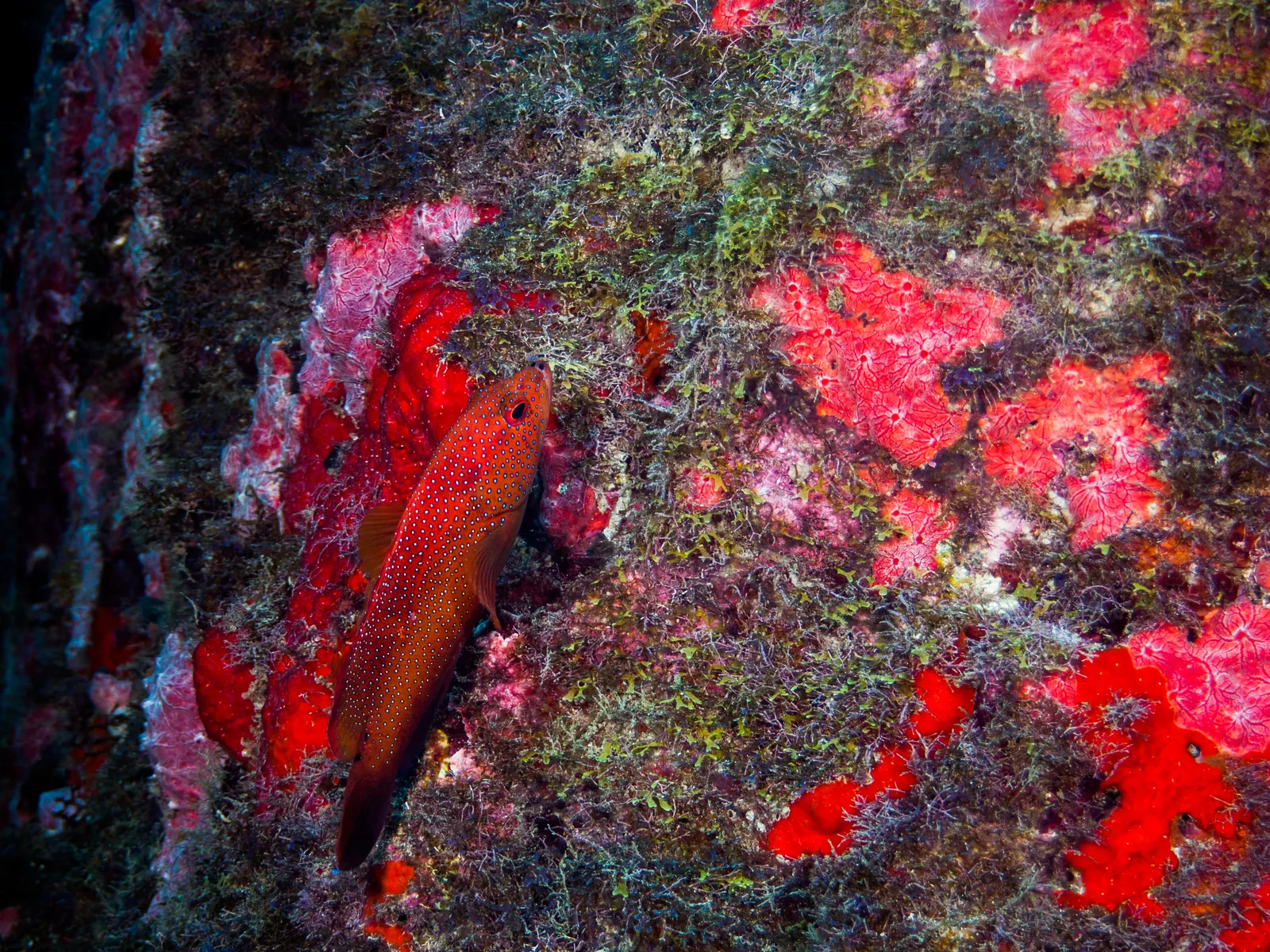
A grouper in the national marine park. João D'Andretta, Wikimedia Commons, CC BY-SA 4.0, cropped.

Park rules for divers
ICMBio's rules for divers are short. You may not collect anything from nature, including shells and stones. You may not touch, fish, kill, capture, chase or feed animals. You may not carry fishing or hunting gear in the park, use camera poles, or land on the secondary islands. Spearguns are banned on the whole island, which is why the invasive lionfish, first recorded in 2020, is culled only by trained professionals with special equipment; about a thousand have been caught. ICMBio also runs training on these rules for new staff of the dive and underwater photo companies.
The APA's management plan adds rules for the rest of the coast: no feeding wild animals anywhere, no touching or chasing turtles, sharks, rays, fish or dolphins, no throwing food scraps from boats, and no intentional diving or swimming with dolphins. Feeding sharks to draw them to tourists is illegal, and the fine under federal Decree 6.514/2008 runs from R$500 to R$10,000. ICMBio stepped up patrols after a tourist was bitten by a shark while diving off Praia do Porto in November 2024. In October 2025 it fined a tourist R$10,000 after her family held a green turtle, and fined a local businessman R$6,240 for taking a boat into the park without authorisation.
The 2009 carrying-capacity study, which the protocol cites, set a daily ceiling for each site, about 51 divers a day at each of the two Pedras Secas points and 47 at the Caverna da Sapata, and recommended that every dive be guided, with groups of 12 and three guides. It also noted that Noronha's dive boats do not drop anchor. We could not confirm how those ceilings are applied today. On the surface, the park caps snorkel stops at Sancho to four boats at a time.
Two fees before you dive: park ticket and TPA
The park ticket is the one that matters for diving: ICMBio makes it a prerequisite for scuba and boat trips in the park, and it is checked at the kiosk at the Porto de Santo Antônio. Under ICMBio order 4,932 of 15 October 2026 it costs R$393 for the general public and R$196.50 for Brazilians, and it is valid for ten days. Children under 12 are exempt. You can buy it online and use the QR code, or at the Visitor Centre in Boldró, open 08:00 to 21:00. Neither Atlantis nor Noronha Diver includes it in its prices.
The second fee is the Taxa de Preservação Ambiental, the TPA, charged by the Pernambuco state district on every non-resident visitor for each day on the island. It was R$105.79 a day from 1 January 2026, up 4.4%, according to three news reports; it rises with the IPCA inflation index each year. The same reports say the tax is progressive with the length of stay, designed to discourage long stays. We couldn't confirm the table on the district's own site, so check it there before you book, and budget for both fees on top of every dive price below.
When to dive Noronha: rain, swell and water temperature
Noronha's operators dive all year; Noronha Diver says it closes only on 1 January. The question is which side of the island is open. The 2009 study, drawing on operators' records, found a good chance of diving both sides from March to June. From July to October the east wind makes the Mar de Fora hard to reach, so most dives are on the Mar de Dentro. From November to February big swell hits the Mar de Dentro, the season of the island's surf contest, and dives move to the Mar de Fora. Each side can be closed about four months a year. Atlantis calls March to July one of the best periods, with calm water on both sides often, and warns that August and September are windy, with rougher sea and lower visibility.
ICMBio describes a tropical climate with a clear dry season and heavy rain from February to July. Brazil's weather service publishes no climate normals for a Noronha station, so we cannot give monthly rainfall. Noronha Diver says rain alone rarely stops a dive. The busiest tourist months run from July to January, according to ICMBio.
NOAA's satellite averages for 1991 to 2020, for the cell at 3.875°S 32.375°W, put the sea at 27.5 °C in January, 28.4 °C in March, a peak of 28.6 °C in April and 27.8 °C in June, falling to 26.5 °C in August and a low of 26.4 °C in September, then 26.9 °C in November and 27.1 °C in December. These are surface figures. Operators quote visibility of 25 to 40 meters (Atlantis) and 25 to 35 meters (Noronha Diver); ICMBio says it can reach 50.
Chamber and emergencies
When the diver from the Ipiranga fell ill in October 2024, SAMU took him to the island's Hospital São Lucas and he was treated in a hyperbaric chamber on the island, according to three news reports. One of them, Itatiaia, quotes ANEMA, the association of the island's dive companies, as responsible for the equipment, called on by the hospital. We could not confirm from any official source that the chamber is still in service or staffed around the clock, nor which mainland chamber would take an evacuated diver. Ask your operator what its plan is, and check that your dive insurance covers an air evacuation to the mainland.
Brazil's emergency numbers are free: 192 for the SAMU ambulance service, which runs 24 hours a day, 193 for the fire brigade, 190 for the police and 185 for the Navy's maritime emergencies. On a mobile, 112 and 911 reach the military police.
What diving on Noronha costs
Prices on the operators' own booking pages, read on 10 November 2026, before the park ticket and TPA:
| Trip or course | Atlantis Divers | Noronha Diver |
|---|---|---|
| Two-dive trip, certified divers | from R$1,000 | R$990 |
| Try-dive (batismo) | from R$1,160 | R$1,165 |
| Open Water course | from R$7,600 | R$6,980 (private) |
| Advanced course | from R$7,100 | R$8,250 (private) |
| Nitrox | from R$2,950 | R$1,620 (theory) |
What is included differs. Atlantis includes transfer, weights, two tanks and a guide, and charges extra for the wetsuit and the rest of the kit. Noronha Diver includes transfer, tanks, weights, mask, fins and a guide, and charges extra for the wetsuit, BCD and regulator. Both offer a discount for paying by Pix. Atlantis asks for a stay of at least five days for its Open Water course. Noronha Diver also sells a Scuba Review for divers out of practice at R$1,930. Águas Claras publishes no prices and books by WhatsApp. The minimum age for a try-dive is ten at Atlantis and Noronha Diver, and Atlantis and Águas Claras keep try-dives to 12 meters or less.
Getting to Noronha
The island is reached mainly by air, through the Governador Carlos Wilson Campos airport, with regular flights, according to ICMBio. Recife is the usual gateway. Press reports say Azul ended its Natal flights in March 2025 and Gol returned to the island with flights from Recife and São Paulo for the 2025 to 2026 summer; we could not check the airlines' own schedules, so look up the current routes before you plan a Natal connection. Leave a gap between your last dive and your flight out: Atlantis asks for at least 12 hours, and Noronha Diver recommends 24 where possible.
Noronha as a remote-work base
Brazil's digital-nomad visa is the VITEM XIV, for foreigners without a Brazilian employment contract who can work remotely for a foreign employer or client. Brazil's consulates ask for foreign-source income of at least US$1,500 a month or US$18,000 in the bank, health insurance valid in Brazil, the employment or service contract and a statement that the work can be done remotely. The first residence period is up to one year, renewable for one more, under the National Immigration Council rule published in January 2022, and people already in Brazil can apply through the Justice Ministry's MigranteWeb system.
The visa does not touch the island's own cost. The TPA is charged for every day you stay and rises with the length of the stay, so a month on Noronha is far dearer than a week, and we could not confirm from the district whether it sets a maximum stay. We found no source for internet speeds on the island.
Who Noronha suits
Noronha suits a diver who wants warm, clear Atlantic water with turtles, sharks and rays inside a strictly managed park, and who is happy to dive on fixed sites with authorised boats. It suits a technical diver with the training for a 60-meter wreck. It suits less well a diver on a tight budget, since two fees come on top of dive prices near R$1,000 a trip, or a remote worker who wants a long, cheap stay. For the rest of north-east Brazil's coast, see our Preá kite guide.
FAQ: Fernando de Noronha diving
Do you need a park ticket to dive in Fernando de Noronha?
Yes. ICMBio makes the national park ticket a prerequisite for scuba diving and boat trips in the park, and it is checked at the Porto de Santo Antônio. It costs R$393 for foreigners and R$196.50 for Brazilians and is valid for ten days. The island's daily environmental tax, the TPA, is charged separately.
Can you dive in Noronha without an operator?
Not in the national park. ICMBio says scuba in the park may only be done with operators it has authorised, on the sites listed in its visitation protocol. Spearguns are banned on the whole island.
How deep is the Corveta Ipiranga wreck?
About 60 meters according to Águas Claras and 63 meters according to Atlantis Divers, which sells it as a technical dive. Águas Claras says divers must meet prerequisites. A tourist died of decompression sickness after diving to 62 meters on the wreck in October 2024.
What is the best time to dive Fernando de Noronha?
March to June gives the best chance of diving both sides of the island, according to a 2009 study for the park; Atlantis Divers names March to July. From July to October the east wind limits the outer side, and from November to February swell limits the inner side. The sea stays between about 26.4 and 28.6 °C all year.
Is there a hyperbaric chamber on Fernando de Noronha?
A diver was treated in a hyperbaric chamber on the island in October 2024, according to three news reports, one of which says the dive operators' association runs it. We could not confirm from an official source that it is still in service or staffed around the clock. In an emergency call 192 for SAMU.
Note: Conditions, safety guidance and regulations change. Verify current information with official sources, including the dive operator, ICMBio and the Fernando de Noronha district administration, before you travel or dive.
Founder of NOMADREEF and a former digital nomad. This guide is sourced from the references below; conditions, prices and rules change, so verify current details, and follow qualified local guidance and safety briefings. About the author · LinkedIn ↗
Sources
- The park and the APA (primary). ICMBio Noronha, home page, protected areas and public-use plan of the national park, 2024 (PDF). Read 10 November 2026.
- Park ticket (primary). ICMBio Noronha, visitor information, citing Portaria ICMBio 4,932 of 15 October 2026, and FAQ. Read 10 November 2026.
- TPA (triangulated). Diario de Pernambuco, travel.com.br and Click Petróleo e Gás, all January 2026. The district's own site did not resolve. Read 10 November 2026.
- Diving rules (primary). ICMBio Noronha, visitation protocol 02/2022 (PDF), sections 15 and 17; attractions and diving rules; notices on diver training and lionfish (4 August 2025), shark feeding and APA rules (22 November 2024) and fines (14 October 2025); Osmar J. Luiz Jr., carrying-capacity study for nautical tourism, December 2009 (PDF). Read 10 November 2026.
- Dive sites, season notes and prices (each operator primary for itself). Águas Claras, dive sites, home and about; Atlantis Divers, certified dives, try-dive, Open Water and FAQ; Noronha Diver, prices, certified dives, dive sites and FAQ. Read 10 November 2026.
- Sea temperature. NOAA PSL, OISST v2.1 monthly long-term means 1991–2020, cell 3.875°S 32.375°W, computed for this page (primary). Climate from the ICMBio public-use plan (primary); INMET's climate normals list no Noronha station. Read 10 November 2026.
- Chamber and the 2024 accident (triangulated). CNN Brasil, Itatiaia and Band, 17 and 18 October 2024. Read 10 November 2026.
- Emergency numbers (primary). Ministry of Health, SAMU 192; Anatel, public-utility and emergency codes. Read 10 November 2026.
- Getting there. ICMBio public-use plan, as above (primary); Movimento Econômico on the Natal route (23 January 2025) and Gol's return (12 September 2025) (secondary). Read 10 November 2026.
- Staying and working (primary). Ministry of Foreign Affairs, consulate pages on the VITEM XIV in San Francisco and Amsterdam. Read 10 November 2026.
- Left out. The TPA's progressive table, any maximum stay and the law text, because the district's and the state's websites did not resolve; monthly rainfall and storm data from Brazil's weather service, which publishes no normals for the island; whether the island's chamber is staffed around the clock and which mainland chamber takes evacuated divers; whether the 2009 per-site caps are enforced today; how the Corveta Ipiranga dive is authorised; the airlines' own schedules; and internet speeds on the island.