Bonaire vs Aruba: Shore Diving or Kite Wind for a Month?
 by Yannick SchrothOct 26, 202613 min read
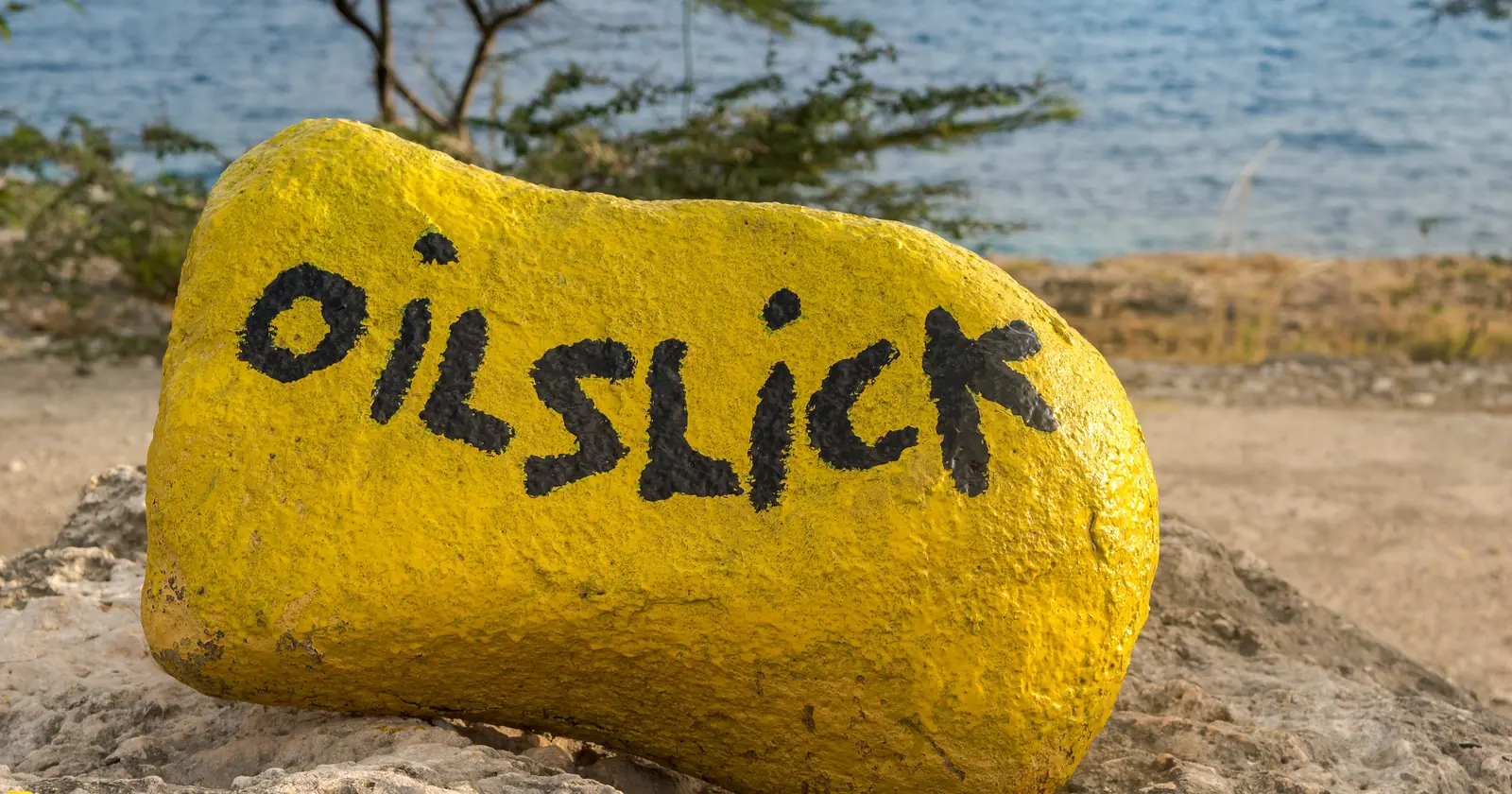
The painted stone that marks the Oil Slick Leap dive site on Bonaire's west coast, April 2017: the Bonaire side of this comparison. Photo: dronepicr, Wikimedia Commons, CC BY 2.0, cropped.
| Bonaire | Aruba | |
|---|---|---|
| Modeled wind, daytime mean, 2021–2025 | 14.5 knots | 16.4 knots |
| Daytime hours at 15 knots or more | 49% | 72% |
| Where you may kite | Only the entry and exit zone at Atlantis inside the marine park; never in Lac Bay | Hadicurari (Fisherman's Huts) and Boca Grandi are the kite beaches the tourism authority names |
| Sea surface, February / October | 27.1 / 29.8 °C | 26.6 / 29.7 °C |
| Marine park | The whole coast to 60 m depth; US$40 per calendar year for every user | Parke Marino Aruba, five zones; the founding decree sets no fee |
| Signature dive | Shore diving: 86 public dive sites, many with shore access | Wrecks, among them the Antilla at about 60 ft, on guided trips |
| Stay without a permit | Dutch and US citizens 180 days in 365 (90 if working); other visa-free nationals 90 in 180 | 30 days as standard; US citizens up to 90; longer only on extension |
| Charges on arrival | US$75 entry tax per visit, age 13 and over | US$20 sustainability fee once a year, age 8 and over |
| Currency | US dollar | Aruban florin, fixed at 1.79 to the dollar |
| US customs preclearance | No | Yes, at Queen Beatrix airport |
Wind is ERA5 reanalysis data and water is NOAA's satellite sea surface temperature, both averaged for this page over 2021 to 2025. Fees, park rules and entry terms are as read on the issuing body's pages on 26 October 2026.
Bonaire vs Aruba wind, month by month: where the kite days are
The two islands sit 195 km apart in the same trade wind, so any Bonaire vs Aruba choice for a wind month looks close on paper. The model says otherwise. These are means for the daylight working window, 10:00 to 19:00 local time, from five years of hourly model data:
| Month | Aruba: mean | Aruba: hours at 15 kn+ | Bonaire: mean | Bonaire: hours at 15 kn+ |
|---|---|---|---|---|
| January | 17.3 kn | 77% | 15.0 kn | 52% |
| February | 17.5 kn | 85% | 15.5 kn | 58% |
| March | 17.4 kn | 81% | 15.5 kn | 59% |
| April | 16.8 kn | 76% | 15.3 kn | 60% |
| May | 18.2 kn | 84% | 16.3 kn | 70% |
| June | 18.1 kn | 89% | 16.1 kn | 69% |
| July | 18.1 kn | 88% | 15.4 kn | 60% |
| August | 15.9 kn | 69% | 13.6 kn | 33% |
| September | 14.6 kn | 56% | 12.9 kn | 26% |
| October | 12.9 kn | 38% | 12.0 kn | 26% |
| November | 13.9 kn | 48% | 12.7 kn | 32% |
| December | 16.2 kn | 71% | 14.2 kn | 44% |
Calculated for this page from ECMWF's ERA5 reanalysis, wind at 10 m, read from the Copernicus Climate Data Store for 1 January 2021 to 31 December 2025. ERA5's grid is 0.25°, about 28 km. The Aruba cell is centered at 12.50° N, 70.00° W, the nearest to both Hadicurari and Boca Grandi; the Bonaire cell at 12.00° N, 68.25° W is the nearest to both the Atlantis kite beach and Lac Bay. Hours are counted from 10:00 to 18:59, UTC−4.
Aruba leads in every month. Across the year it has 15 knots or more in 72% of daytime model hours, Bonaire in 49%. At 20 knots the gap widens: 15% of daytime hours off Aruba, 3% off Bonaire. At 12 knots it narrows to 88% against 80%, which is why light-wind gear changes the picture more on Bonaire than on Aruba. The 15-knot line here is a reference point, not a rule, because rider weight, kite size and board all move it.
Both islands share the same season. The wind peaks from May to July and drops through August to a low in October, when Aruba's daytime mean is 12.9 knots. Plan a kite month for October on either island and you are planning around luck. On both, the model's mean direction is from the east, between 82° and 97° in every month.
The limits matter. A 28 km cell sees open water and part of the island at once, so it cannot show how wind wraps around a headland or drops behind a hotel. A neighboring sea cell east of each island, at 12.50° N 69.75° W and 12.25° N 68.00° W, puts the annual share of all hours at 15 knots within two points of the cells above, so the difference between the islands is not an accident of grid placement.
Why kiting on Bonaire is confined to one beach at Atlantis
On Bonaire the wind is only half the question. The other half is the island decree on the underwater park, the Eilandsbesluit onderwaterpark Bonaire, in force in its current version since 1 January 2023. Article 3(3) bans being pulled along "on or above the waters of the underwater park within 75 meters of the coast" by a kite or similar object, except at places the park manager designates. Article 39 bans kiting on the waters of Lac outright.
STINAPA, the foundation that manages the park, has designated one place. Its rules say kitesurfing inside the marine park is "only allowed at the entry and exit zone of Atlantis", a beach on the south-west coast near the island's southern tip, and windsurfing "exclusively at Lac Bay". Beyond the park, both may ride in deep water at least 75 meters from shore. The other limits in STINAPA's wording:
- Klein Bonaire: no kiting or windsurfing within a 500-meter buffer, and no launching or landing on the islet.
- Downwinders: only with STINAPA's written consent, requested by email.
- Foils: allowed in the dark blue water at least 75 meters out; windsurf foiling in Lac is "currently condoned" while a new zoning for the bay is discussed.
- Lac Bay boats: jet skis are banned there, and motorboats are held to two knots outside the marked channel and four inside it (articles 37 and 38).
The nature fee covers "all users" of the park, so a kiter at Atlantis needs the same $40 tag as a diver. For a windsurfer, Lac Bay is a shallow, protected lagoon that STINAPA lists, with Klein Bonaire, as a Ramsar wetland. For a kiter, Bonaire is one beach and a permission email.
Hadicurari and Boca Grandi: Aruba's two kite beaches
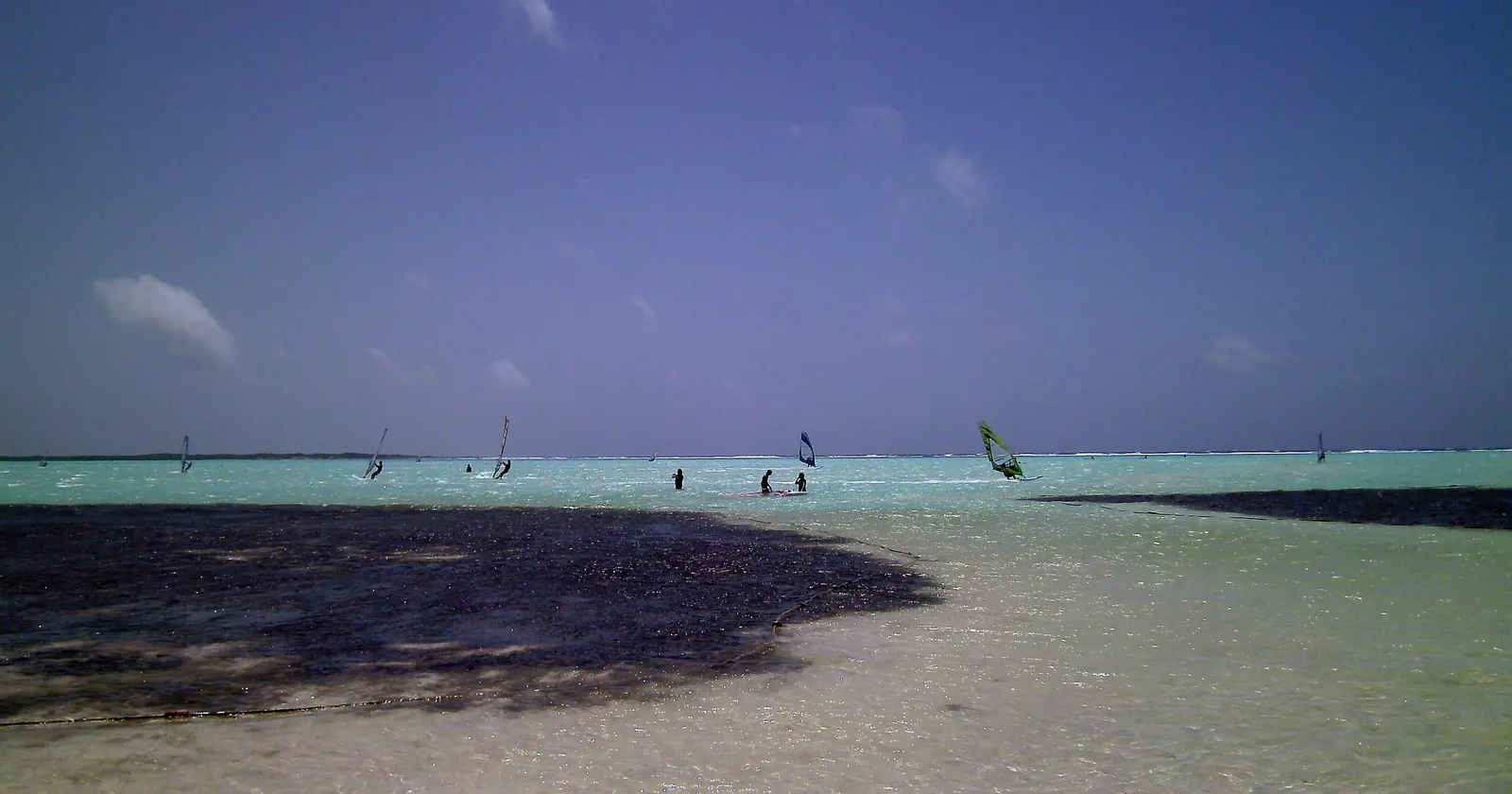
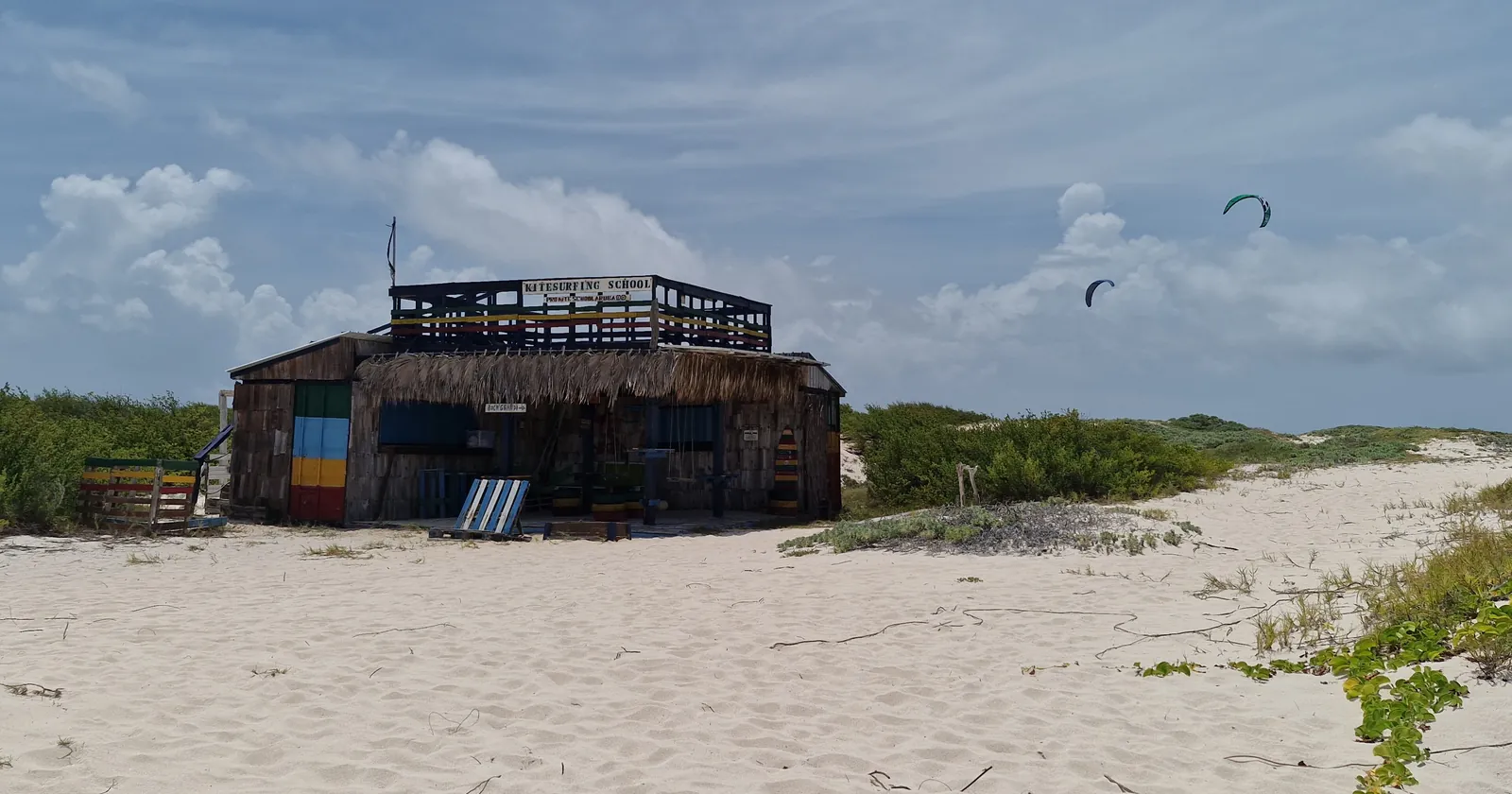
Aruba's tourism authority describes Hadicurari, also called Fisherman's Huts, as "the most popular spot in Aruba to learn and practice wind and kite surfing". It is a rocky strip past the Marriott resort, with wind and kite schools on the beach, and the authority calls the water there "very shallow and calm". The Aruba Hi-Winds windsurfing event is held off it every year in June or July, the windiest stretch in the table above.
Boca Grandi lies five minutes' drive from San Nicolas, the town at the island's south-eastern end. The same authority writes that it draws "the most advanced and adventurous kite surfers", that "the current is strong here" and that swimming is "strongly discouraged". That is the Bonaire vs Aruba difference on land: two very different kite beaches on one island. A learner has the shallows at Hadicurari, and a rider who wants waves has Boca Grandi.
One caution on the comparison. Aruba's marine park decree says nothing about kites, and the tourism pages describe beaches rather than rules. That is not the same as there being no rules on the beach: ask the school where it is allowed to teach.
Shore diving in the Bonaire National Marine Park: the $40 tag and its rules
Bonaire's case is the reef. The Bonaire National Marine Park takes in all the water around Bonaire and Klein Bonaire "from the high-tide mark to 60 meters (200 feet) of depth", about 27 km², and STINAPA counts 86 public dive sites on one page and 88 marked sites on another. Many can be reached from the shore, where each is marked by its name on a yellow stone. That is the point of a month here: much of the reef needs no boat.
The price of entry is the nature fee. Annex I of the island decree sets it at "$40 per gebruiker per kalenderjaar", $40 per user per calendar year, and STINAPA's 2026 tag runs to 31 December 2026 and covers Washington Slagbaai National Park too. Under article 2, nobody under 13 pays, nor do residents of Bonaire, Curaçao, Aruba, Sint Maarten, Sint Eustatius or Saba, nor anyone staying 24 hours or less. A tag bought in October lapses in December, so a stay across New Year needs two.
The rules a diver meets, from the decree and STINAPA's diving page:
- Orientation dive: article 15(3) requires visiting divers to attend an introduction and make an orientation dive before their first dive in the park, from the dive operation that fills their tanks or a place STINAPA designates.
- No gloves: article 8 bans them for divers; STINAPA adds knee pads and grants medical exceptions on request.
- No spearfishing: article 9 bans spearguns and hand spears in the park and even carrying a speargun over public ground.
- No anchoring anywhere in the park (article 5), with narrow exceptions.
- Two reserves, Boka Slagbaai to Playa Frans and Karpata to the Goto jetty, are closed without a permit (article 3).
- Gear and sunscreen: no chemical light sticks or pointer sticks, and sunscreen free of oxybenzone and octinoxate.
Coral disease adds a step. Stony coral tissue loss disease has reached Bonaire's reefs, and STINAPA asks every diver and snorkeler to disinfect gear before the first dive and after the last, in a 10% bleach solution for gear that can take it. On 26 October 2026 its page listed every dive site as open except Washington Slagbaai National Park, which "remains closed for diving". Diving on the east coast is "for advanced divers only", and STINAPA recommends a guide there.
Aruba's wrecks and its newer marine park
Aruba's tourism authority names the island's shipwrecks, Spanish Lagoon and Barcadera Reef as its prized dive spots. Its page on the Antilla describes a German cargo ship scuttled by its crew during the Second World War, lying near Malmok Beach at about 60 feet and stretching about 400 feet. It writes that "numerous diving operators" run guided trips to it. Plan on booking those trips.
The island also has a marine park, a newer one built from zones. The Landsbesluit Parke Marino Aruba of 20 December 2018 designates coastal waters and their seabed as a nature reserve, in five areas listed in its annex: Arikok, Sero Colorado, Mangel Halto, and two areas off Oranjestad, Oranjestad I and II. Inside them, catching or disturbing wild animals is banned outside the fishing rules of the park's management plan (article 8), so is damaging the reef structure or removing sand and rock (article 9), and commercial fishing is not allowed (article 3).
Two differences from Bonaire stand out. The Aruban decree leaves anchoring bans to a management plan instead of banning anchoring everywhere, and it sets no fee for using the park. The decree covers zones, not the whole coast.
Bonaire and Aruba water temperature: Bonaire about half a degree warmer
Both islands are warm-water destinations all year. The difference is small but steady. NOAA's satellite sea surface temperature, as monthly means for 2021 to 2025:
| Month | Off Bonaire's west coast | Off Aruba's west coast |
|---|---|---|
| February | 27.1 °C | 26.6 °C |
| April | 27.3 °C | 26.9 °C |
| June | 28.1 °C | 27.7 °C |
| August | 28.9 °C | 28.5 °C |
| October | 29.8 °C | 29.7 °C |
| December | 28.3 °C | 27.9 °C |
Monthly means of NOAA's Optimum Interpolation sea surface temperature v2.1, January 2021 to December 2025, for the quarter-degree cells centered at 12.125° N 68.375° W, west of Kralendijk, and 12.625° N 70.125° W, west of Hadicurari.
Bonaire averages 28.2 °C over the year, Aruba 27.9 °C. The coolest water on both comes in February and March, around 26.5 to 27 °C, and the warmest in October, near 30 °C. The months with the most wind are not the warmest ones: June's water is 1.7 to 2 degrees cooler than October's. For a Bonaire vs Aruba choice the water is close to a tie, and the wind is not.
Entry rules for a month: Bonaire's 90 or 180 days against Aruba's 30
Both islands belong to the Kingdom of the Netherlands, but their entry rules differ, and the difference turns on your passport.
Bonaire is part of the Caribbean Netherlands. Rijksdienst Caribisch Nederland states that Dutch and US citizens "may freely enter Bonaire, St. Eustatius and Saba for up to 180 days every 365 days", cut to 90 days in 365 for anyone who works or does an internship. Everyone else from a visa-free country, other EU citizens included, gets 90 consecutive days within 180, counted across the three islands. Border officers check a passport valid for the whole trip, a return ticket and means of support, with "$1000.00 per week" as the basic rule.
RCN's page does not say whether remote work for a foreign employer counts as work. If you hold a Dutch or US passport and want more than 90 days, put the question to the IND before you book.
Aruba admits guests for 30 days as standard. Its tourism authority's immigration page says US nationals may stay up to 90 days without asking, and others may request up to 90 within the first 30. Beyond that, up to 180 days a calendar year, extensions go to Dutch nationals or to visitors with property in Aruba or a resident who acts as guarantor. An approved online ED card is required before travel. The same page lists medical insurance of at least US$15,000 covering hospital care, emergency treatment and repatriation, and requires travel insurance from anyone who asks to stay past 30 days. The authority's One Happy Workation FAQ says there is no mandatory insurance. Carry proof of cover.
One Happy Workation is a package, not a visa. The tourism authority's FAQ limits it to US nationals, for one week to 90 days, booked through a participating hotel or apartment, with "no governmental documentation". You must be employed or self-employed in your home country, and you may not "render services to and receive income from an Aruban company or individual".
For a flight home to the US, Aruba has one more advantage. US Customs and Border Protection runs preclearance at Queen Beatrix International Airport, so US-bound travelers clear US immigration before departure. Bonaire is not on CBP's list of preclearance locations.
What a month on Bonaire or Aruba costs before rent: three fixed charges
The fixed charges are easy to compare, because both governments publish them. Rent, food and car hire are not, and they belong in the island guides.
On Bonaire, every non-resident arriving by air or pleasure boat pays a Visitor Entry Tax: "$75 per persoon voor iedereen vanaf 13 jaar en ouder", $75 for everyone aged 13 and over, and $10 for children up to 12. The island government sells it from seven days before arrival on its own site, tourismtax.bonairegov.com, and warns against resellers. Cash is not accepted at the airport. Add the $40 nature fee and a diver's fixed cost for a month is $115.
On Aruba, the Sustainability Fee is $20 for visitors arriving by air, charged with the ED card since 1 July 2024 to fund sewage treatment. Children under eight are exempt, and you pay it once a year rather than per visit; a repeat visitor charged again claims a refund from the operator, AWSS. That makes Aruba's fixed charge $20, plus whatever the insurance costs.
Money itself works differently. Bonaire has used the US dollar as legal tender since 1 January 2011, according to De Nederlandsche Bank. Aruba uses its own florin, pegged since 1986 at Afl. 1.79 to the dollar by the Centrale Bank van Aruba.
Dive centers and kite schools on our Bonaire list, and why Aruba has none
Our Bonaire operator list carries 12 dive centers, compiled 21 September 2026. Eight are Green Fins members and four come from SSI's register of training centers. All eight Green Fins members are Digital Members, which means they evaluated themselves and nobody assessed them in person. Six of the eight are branches of one business, Dive Friends Bonaire. The list holds no kite or windsurf school.
Aruba has no operator list on this site. The kite and dive schools mentioned above are the ones the tourism authority names, and none is checked against a register here. Before you book in either place, ask a school for its training-body membership number and check it with the body that issued it.
Bonaire vs Aruba in five lines
- Aruba for wind: 15 knots or more in 72% of daytime model hours, against 49% on Bonaire, and it leads in every month.
- Bonaire limits kites to the Atlantis zone inside the marine park and bans them on Lac Bay.
- Bonaire for diving: 86 public dive sites, many from the shore, a $40 tag per calendar year and a compulsory orientation dive.
- Entry favors Bonaire for US passports: 180 days in 365, against 90 on Aruba.
- October is the weakest wind month on both islands; the water is warmest then, near 30 °C.
Bonaire for a diving month, Aruba for a kiting month
Pick Bonaire if the month is mostly underwater. The shore sites, the single annual tag and the longer stay for Dutch and US passports all point the same way. The Bonaire diving guide covers living there, and Bonaire vs Curaçao compares it with its nearer neighbor. Do not pick it for a kite season: you get one beach.
Pick Aruba if you want to kite most afternoons from May to July, and you want two very different beaches to choose from. The Aruba guide covers the island as a base, and Aruba vs Cabarete weighs it against the Dominican Republic. Do not pick it for October, and without a Dutch passport, property on the island or a resident guarantor, do not plan on more than 90 days.
If you are new to the sport, start with how to learn kitesurfing. For a month of either, check that your insurance covers kiting and diving, all the more on Aruba, where proof of cover is on the entry list.
FAQ: Bonaire vs Aruba
Is Aruba or Bonaire better for kitesurfing?
Aruba. In ERA5 model data for 2021 to 2025, the cell over Aruba's kite beaches has 15 knots or more in 72% of daytime hours, against 49% at Bonaire's southern tip, and Aruba leads in every month. Bonaire also limits kiting inside its marine park to the entry and exit zone at Atlantis and bans kites on Lac Bay.
Do you have to pay to dive or swim in Bonaire?
Yes. Every user of the Bonaire National Marine Park needs STINAPA's nature fee, $40 per calendar year, which also covers Washington Slagbaai National Park. Children under 13, residents of the six Dutch Caribbean islands and visitors staying 24 hours or less are exempt. Separately, visitors aged 13 and over pay a $75 entry tax per visit.
Can you work remotely from Bonaire or Aruba on a tourist stay?
On Aruba, the One Happy Workation package lets US nationals stay one week to 90 days through a participating accommodation, if they are employed or self-employed at home and take no income from an Aruban company or individual. On Bonaire, Dutch and US citizens get 180 days in 365, but 90 if they work; the rules do not say whether remote work for a foreign employer counts, so ask the IND.
Is the water warmer in Bonaire or Aruba?
Bonaire, by about half a degree. NOAA satellite data for 2021 to 2025 put the sea off Bonaire's west coast at 28.2 °C on average and off Aruba's at 27.9 °C. Both are coolest in February and March, around 26.5 to 27 °C, and warmest in October, near 30 °C.
When is the wind weakest on Aruba and Bonaire?
October. The model's daytime mean that month is 12.9 knots on Aruba and 12.0 on Bonaire, with 15 knots or more in 38% and 26% of daytime hours. The wind is strongest from May to July on both islands.
Do you need insurance to enter Aruba?
Aruba's tourism authority lists medical insurance of at least US$15,000, covering hospital care, emergency treatment and repatriation, among its entry requirements, and requires travel insurance from anyone who asks to stay past 30 days. Its One Happy Workation FAQ says there is no mandatory insurance, so carry proof of cover.
Sources
- Wind. ECMWF ERA5 reanalysis (0.25°, hourly), wind speed and direction at 10 m, 1 January 2021 to 31 December 2025, read from the Copernicus Climate Data Store on 3 November 2026 for the cells at 12.50° N 70.00° W (Aruba) and 12.00° N 68.25° W (Bonaire), with 12.50° N 69.75° W and 12.25° N 68.00° W as a check. Monthly means and the shares of hours at 12, 15 and 20 knots or more, 10:00 to 18:59 local time, are calculated for this page. Contains modified Copernicus Climate Change Service information. Neither the European Commission nor ECMWF is responsible for any use that may be made of it. Copernicus Climate Data Store
- Sea surface temperature. NOAA OISST v2.1, monthly means of the daily analysis, quarter-degree cells at 12.125° N 68.375° W and 12.625° N 70.125° W (with 12.125° N 68.125° W and 12.375° N 69.875° W as a check), January 2021 to December 2025, read on 26 October 2026 from NOAA PSL's server, because the daily dataset was not active on NCEI's ERDDAP that day. NOAA PSL, NCEI product page
- Bonaire's park rules. Eilandsbesluit onderwaterpark Bonaire, version in force since 1 January 2023: fee and exemptions (article 2 and Annex I, "$40 per gebruiker per kalenderjaar"), reserves and the kite ban within 75 m of the coast outside designated places (article 3), anchoring (article 5), gloves (article 8), spearfishing (article 9), orientation dive (article 15(3)), Lac Bay speed limits, jet skis and kites (articles 37 to 39). Read 26 October 2026. lokaleregelgeving.overheid.nl
- STINAPA Bonaire. Kite and windsurfing rules (Atlantis, Lac Bay, 75 m, Klein Bonaire 500 m, downwinders, foils), diving rules (88 marked sites, orientation dive, gloves and knee pads, light sticks, sunscreen), the marine park page (high-tide mark to 60 m, about 27 km², 86 public dive sites, yellow stones, Ramsar sites, SCTLD disinfection, Washington Slagbaai closed for diving), the nature fee page and the 2026 tag ("Exp 31/12/2026 (USD 40)"). Read 26 October 2026. kite and windsurfing, diving, marine park, nature fee
- Aruba's marine park. Landsbesluit Parke Marino Aruba, 20 December 2018, Afkondigingsblad van Aruba 2018 no. 77: articles 2 to 10 and the five areas in Annex II. Read 26 October 2026. AB 2018 no. 77 (PDF, archived copy of the official gazette)
- Aruba's beaches and wrecks. Aruba Tourism Authority pages on Hadicurari Beach, Boca Grandi and the Antilla wreck. Read 26 October 2026. Hadicurari, Boca Grandi, Antilla
- Bonaire entry. Rijksdienst Caribisch Nederland, tourist stay, and the Marechaussee pages for travelers with and without a Dutch or US passport ("up to 180 days every 365 days"; 90 if working; 90 in 180 for others; "$1000.00 per week"). Read 26 October 2026. tourist stay, non-Dutch passport
- Aruba entry and One Happy Workation. Aruba Tourism Authority, immigration regulations (30 days, 90 for US nationals, extensions to 180 a calendar year, means of US$150 to 200 a day, insurance of US$15,000, ED card) and the One Happy Workation FAQ. Read 26 October 2026. immigration regulations, One Happy Workation
- Arrival charges. Openbaar Lichaam Bonaire on the Visitor Entry Tax ($75 from 13, $10 up to 12, online from seven days ahead, no cash). Aruba Wastewater Sustainable Solutions, through the tourism authority, on the US$20 Sustainability Fee. Both read 26 October 2026. bonairegov.com, aruba.com
- Money and airports. De Nederlandsche Bank on the dollar in the Caribbean Netherlands since 1 January 2011; Centrale Bank van Aruba on the florin at Afl. 1.79; US Customs and Border Protection's list of preclearance locations. Read 26 October 2026. dnb.nl, cbaruba.org, cbp.gov
- Distance between Kralendijk and Oranjestad is a great-circle distance calculated for this page.
- Counted from the operator list: Bonaire, compiled 21 September 2026, from the Green Fins and SSI registers. greenfins.net, divessi.com