Bonaire vs Curaçao: Which for Shore Diving?
 by Yannick SchrothSep 5, 20266 min read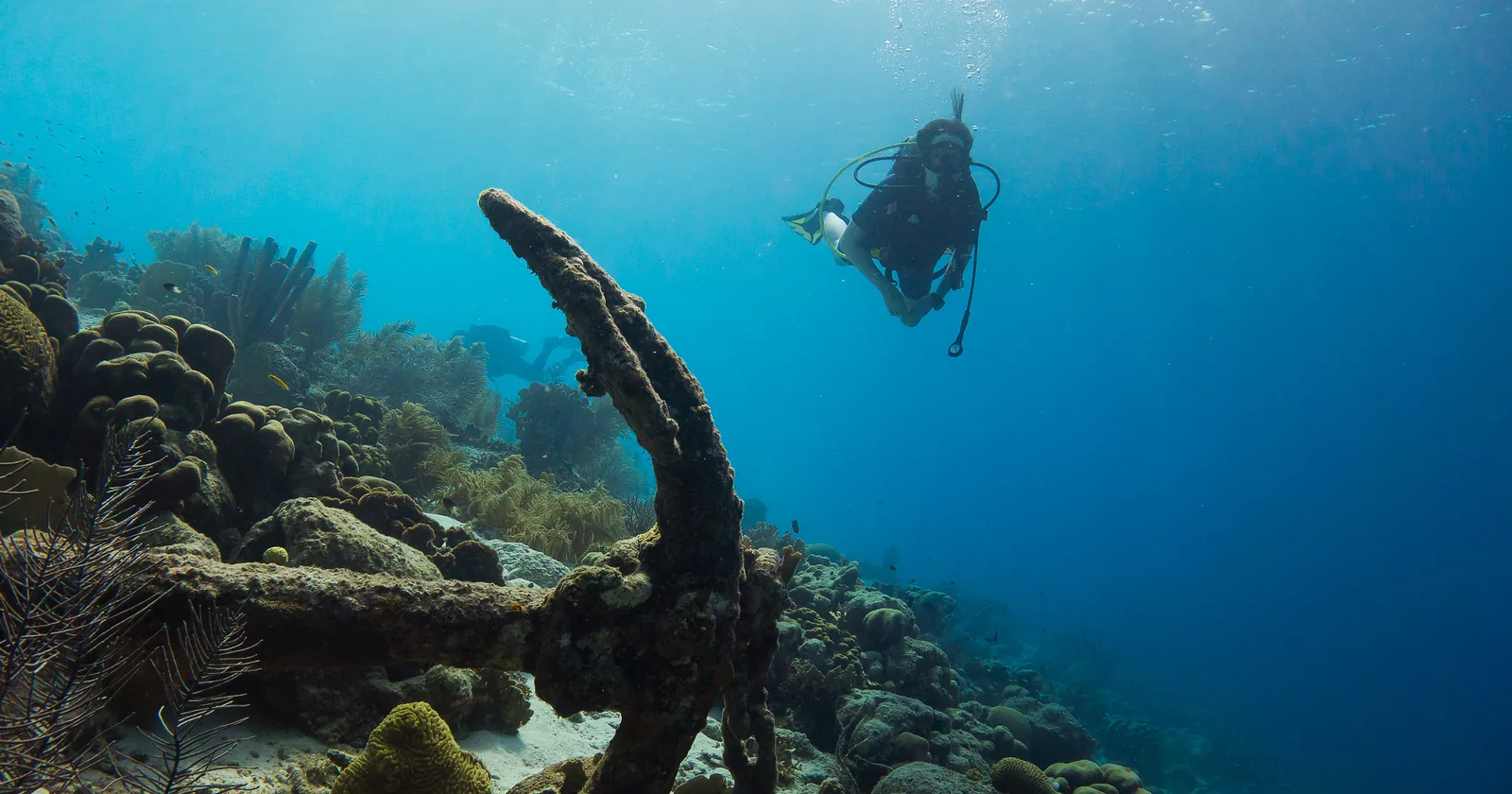
Shore entry at Bonaire, one of the two islands, not both. Photo: Kris Mikael Krister, Wikimedia Commons, CC BY 3.0.
Two lists built from different registers
The gap in the counts is partly a gap in what the registers publish. Bonaire's page is built from the Green Fins member register alone: all 8 of its operators are in it, and an operator on Bonaire that never joined Green Fins is not on our page. Curaçao's 22 come mostly from the SSI training centre register, 19 of them, with 4 also in Green Fins.
So 22 against 8 is not "Curaçao has three times the dive centres". It is two lists drawn from different sources. What both counts do settle is that neither island is short of operators.
The Green Fins level, and why it is not what people think
Green Fins publishes membership at several levels, and the difference between them is the whole point. A Certified member has been assessed in person against a published standard within the last twelve months. A Digital Member completed a self-evaluation online and nobody visited.
| Bonaire | Curaçao | |
|---|---|---|
| Dive centres on our list | 8 | 22 |
| In Green Fins | 8 | 4 |
| Assessed in person | 0 | 0 |
| In a register we can link per entry | 0 | 19 |
Every Green Fins member on both islands is a Digital Member. That is worth knowing before the badge does any work in your decision: it means the operator filled in a form about itself, which is the same kind of claim as anything else on its own website.
The fee that only one island charges
STINAPA manages Bonaire's marine park and charges a nature fee for anyone entering the water, with a separate rate for divers. It is not a donation, not a dive-centre surcharge, and not optional; you carry the tag. Budget for it and buy it before you plan your first dive rather than at the shop counter.
Curaçao has no equivalent island-wide fee. That is a genuine cost difference between two islands 50 kilometres apart, and it is the kind of thing that does not show up in a count of dive centres.
What actually separates them
- Curaçao has the longer list, 22 to 8, but drawn from a different register.
- Bonaire charges a nature fee before you enter the water. Curaçao does not.
- Nobody has been assessed on either island. Every Green Fins member on both is a Digital Member.
- Only Curaçao's entries link to a per-operator register record, so only there can you check the affiliation at the source.
And the other island's park manager, for comparison
The fee section above rests on Bonaire's side of the ledger. It is worth naming who holds the other side, because the absence of a charge is easier to trust when you know who would be charging it.
Curaçao's parks are run by CARMABI, a non-profit foundation on the island established in 1955, which describes itself as working across marine and terrestrial research, park management, education and consultancy, and which oversees five national parks, Christoffel, Shete Boka, the Curaçao Rif Mangrove Park, the Curaçao Marine Park and Seru Largu.
Its own site describes the marine park's purpose, “Conserving the island's vibrant coral reefs and supporting scientific research for coral restoration”, and states no visitor or diver fee for it. That is an absence rather than a declaration, and it is reported here as one: what can be said is that the body that manages the park publishes no fee, while Bonaire's publishes one. For a diver comparing two weeks on each island, that is the difference between a fixed line in the budget and no line at all.
Bonaire or Curaçao: which to pick
Bonaire if you want to dive from the shore on your own schedule, and you accept a fee for the privilege of a marine park that has been managed since 1979. Curaçao if you want more centres to choose from, want to check an affiliation at the source before you book, and would rather not pay to get in the water.
What neither list supports is a claim that one island's operators are better run than the other's. Nobody has looked.
FAQ: Bonaire vs Curaçao
Is Bonaire or Curaçao better for shore diving?
Bonaire is the shore-diving island and its dive tag is compulsory: the nature fee is paid before you enter the water. Curaçao carries far more dive centres, 22 against 8 on our lists, and no equivalent island-wide fee.
Do I have to pay to dive in Bonaire?
Yes. STINAPA, which manages the marine park, charges a nature fee and issues a dive tag. It is not optional and it is not paid to the dive centre.
Has anyone inspected the dive operators on either island?
No. Every Green Fins member on both islands is a Digital Member, which means the operator completed a self-evaluation and nobody visited. There is no assessed operator on either list.
Sources
- Who manages the other island's park. CARMABI, “a non-profit foundation on the island of Curaçao in the Dutch Caribbean”, established 1955, working in research, park management, education and consultancy, and overseeing five national parks including the Curaçao Marine Park, described as “Conserving the island's vibrant coral reefs and supporting scientific research for coral restoration”. The site states no visitor or diver fee for the marine park; that is recorded here as an absence on the manager's own pages, not as a declaration that none exists. carmabi.org. Read 11 September 2026.
- Green Fins member register, for the membership levels on both islands. greenfins.net
- STINAPA Bonaire, for the nature fee and the dive tag. stinapa.org
- SSI training centre register, for the 19 Curaçao entries. divessi.com
- Counted from the operator lists: Bonaire, compiled 13 August 2026, and Curaçao, compiled 3 September 2026.