Bodrum Diving: Famous Wrecks, Closed Waters and the Rules Around the Peninsula
 by Yannick Schroth
Sep 25, 2026
14 min read
by Yannick Schroth
Sep 25, 2026
14 min read
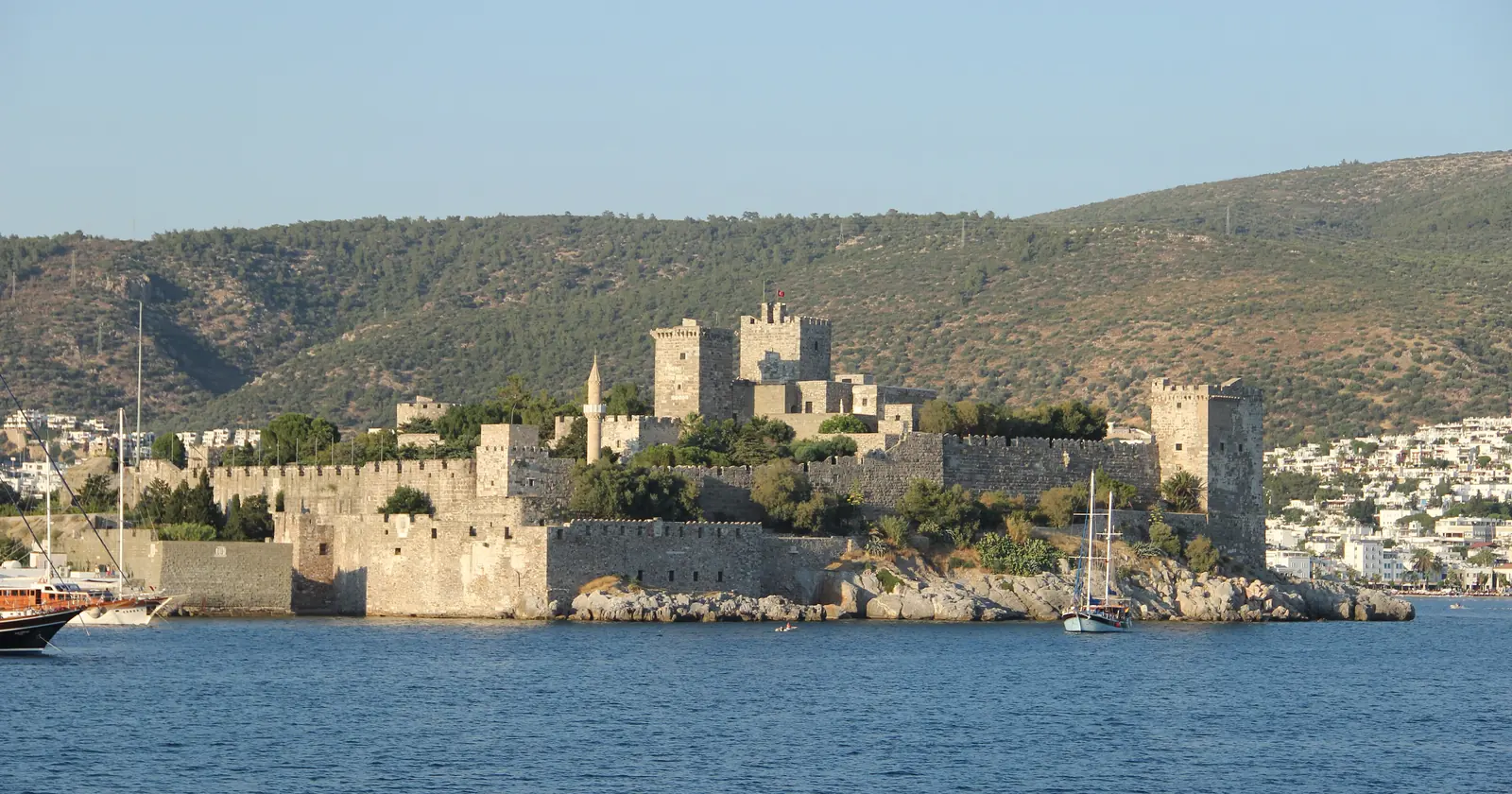
Bodrum Castle from the sea, 16 July 2015. The Museum of Underwater Archaeology is inside its walls. Photo: Hamdigumus, Wikimedia Commons, CC0 1.0, cropped.

Key takeaways
- Decision 2016/8743 closes seven boxes around the Bodrum peninsula, E25 to E31, from the islets off Gündoğan to the water off Karaincir, and the amendments of 2020 and 2022 left all seven unchanged
- Box E30 takes in Yassıada, where the Institute of Nautical Archaeology excavated a Byzantine wreck at 32 to 39 meters between 1961 and 1964
- The 1990 regulation caps sport scuba at 30 meters, 42 in training, bans decompression dives and requires foreign divers to dive with a Turkish guide diver
- The C-47 Dakota sunk off Karaada in 2008 as an artificial reef broke in two, and three accounts put its deepest part past 30 meters
- Bodrum State Hospital has taken pressure-chamber patients since 23 February 2009, and decompression sickness heads its list of treated conditions
Bodrum's castle holds Türkiye's museum of underwater archaeology
The Castle of St Peter was built by the Knights of Rhodes at the start of the fifteenth century, on top of ancient remains, and it stands on UNESCO's Tentative List. Since 1964 it has housed the Bodrum Museum of Underwater Archaeology, which the museum's own page describes as the only one of its kind in the country. Its collection runs from the sixteenth century BC to the sixteenth century AD.
Most of it came up in underwater excavations along the Turkish coast since 1960, and the halls are named after wrecks: the Late Bronze Age Wrecks, the Serçe Limanı Glass Wreck, Tektaş, the Bozukkale Archaic Wreck and the Yassıada Wrecks. The Institute of Nautical Archaeology, whose finds the museum displays, dates the museum's current name to 1978 and opened its own Bodrum Research Center in the town in July 1995.
The wreck the museum calls the greatest discovery of twentieth-century underwater archaeology did not sink in Bodrum water. The Uluburun ship, which the museum dates to the fourteenth century BC, lies off Kaş on the Antalya coast. In 1982 a Turkish sponge diver there reported what he called “metal biscuits with ears”. INA excavated the site over 11 seasons between 1984 and 1994, logging more than 22,000 dives to depths beyond 150 feet, about 46 meters.
The cargo was copper and tin in the ten-to-one ratio that makes bronze, with glass ingots, ebony, ivory and a gold scarab naming Nefertiti. INA dates the sinking to about 1320 BC, give or take 15 years. The site sits inside the Kaş-Kekova protected area that the Antalya diving guide covers; the finds are shown in Bodrum.
The Serçe Limanı hall holds what the museum calls the largest group of glass from Syria, in its words the most important Islamic glass-making center of the Middle Ages, including scrap collected for recycling a thousand years ago. INA began excavating that eleventh-century wreck in 1977 and opened the exhibit in 1990. The museum page, in its January 2026 archive copy, gave opening hours of 08:30 to 22:00 from 1 June to 1 October and 08:30 to 17:30 the rest of the year.
Yassıada off Bodrum: the wreck island sits inside a closed box
The most famous excavation off Bodrum took place at Yassıada, a low islet west of Turgutreis. A sponge diver from Bodrum reported it to the journalist Peter Throckmorton in 1958. Between 1961 and 1964 a team directed by George Bass, then at the University of Pennsylvania, excavated it, and the Institute of Nautical Archaeology dates the ship to AD 625.
National Geographic credits the techniques tried there with helping to revolutionize underwater archaeology. The ship lay 32 to 39 meters down, carrying about 900 wine amphoras, a tiled galley with a chimney, and a steelyard inscribed with the name of its captain, Georgios. The same 2025 account describes a hidden reef around the islet and at least a dozen wrecks in the water around it, with a Roman-age wreck lying yards from the Byzantine one.
None of it is open to a sport diver. Box E30 in the Aegean annex of decision 2016/8743 is a small rectangle between 36°59.4′ and 36°59.75′N and 27°11.5′ and 27°12.1′E, and the islet that OpenStreetMap names Yassıada sits inside those corners. Inside a box, only scientific diving is allowed. The excavation depths would put the wreck past the 30-meter sport limit in any case.
Seven closed boxes ring the Bodrum peninsula
Türkiye closes water to divers by coordinates. Decision 2016/8743 of 5 April 2016, published in the Resmî Gazete of 20 May 2016, issue 29717, draws the boxes under Article 35 of the Act on the Conservation of Cultural and Natural Property No. 2863. Its Article 1 says that inside the areas shown on the annexed maps and coordinate lists, no diving may take place other than scientific diving.
The Aegean annex numbers its boxes from E1, and seven of them, E25 to E31, sit around the Bodrum peninsula. The decision names no places, only corners in WGS 84. Put on OpenStreetMap, they fall like this:
- E25, around 37°10′N and 27°21′ to 27°23′E: the islets Fener Adası and Küçük Tavşan Adası off Küçükbük, Gündoğan.
- E26, 37°06.3′ to 37°08.7′N and 27°15′ to 27°16.9′E: the Küdür peninsula west of Yalıkavak.
- E27, 37°05.1′ to 37°05.55′N: the islet Küçükkiremit Adası.
- E28, 37°02.4′ to 37°04.65′N, around 27°13.5′E: the west coast from Koyunbaba past the ancient city of Myndos at Gümüşlük to Kadıkalesi.
- E29, 36°59.9′ to 37°01′N: the shore at Turgutreis, with the islet Çatalada.
- E30, 36°59.4′ to 36°59.75′N: Yassıada.
- E31, 36°57.9′ to 36°58.3′N and 27°18.5′ to 27°19.2′E: the water off Karaincir and Bağla on the south coast.
Two more sit close by. E23 is a square of open water in the mouth of the Gulf of Güllük, north of the peninsula, and E47 runs along the north shore of the Gulf of Gökova between Mazıköy and Çökertme. The place names are a reading aid; the coordinates are the law. Article 3 of the decision puts the boxes on the navy's nautical charts, which is what a skipper should work from.
Three amendments to the Aegean list were found, and none of them moved these boxes. Decision 2339 of 1 April 2020 reissued the whole Aegean map and list, adding E48 and E49 elsewhere, and E23, E25 to E31 and E47 read exactly as in 2016. Decision 2802 of 27 July 2020 rewrote E19 and E24, and decision 5068 of 5 January 2022 rewrote E17. Karaada, the large island off Bodrum town, lies outside all of them.
A box can be opened to tourism diving. Under a regulation of 20 March 2020, a seven-member commission decides, and the director of the Bodrum Museum of Underwater Archaeology is one of its standing members. The site and everything within 100 meters of it is surveyed first, and decisions are announced on the ministry website. No opening for a Bodrum box turned up in the pages read for this guide. The Fethiye diving guide follows the same decision on the Mediterranean side.

What Law 2863 protects under Bodrum's water, and the three-day reporting rule
The law reaches the seabed by definition. Article 3 of Act No. 2863 defines cultural property as all movable and immovable property from prehistoric and historic periods with original scientific and cultural value, whether above ground, underground or under water, and defines natural property the same way. An ancient amphora on the seabed falls under the same act as a column on land.
Article 4 sets the duty. Anyone who finds cultural or natural property must report it within three days to the nearest museum directorate, or to the village headman or the civil administrator. Article 67 makes knowingly breaching that duty without excuse punishable by six months to three years in prison.
Article 35 ties the law to the boxes. Underwater regions holding cultural and natural property in need of protection are determined and published by Presidential decision, and sport diving in them is prohibited; research and excavation may go ahead only with a permit. The 1990 diving regulation adds Article 17: touching, damaging or moving archaeological values is prohibited, and so is lifting them from the seabed even to show them to museum officials.
Decision 2016/8743 repeats the reporting duty for divers. Its Article 2 says a diver who comes across cultural property outside the boxes, or in an area opened for diving, must tell the nearest civil administrator or museum, and that any intervention in the meantime is prohibited.
Bodrum scuba dives run under a 1990 regulation: 30 meters and a Turkish guide
The diver's rulebook is the Regulation on Scuba Diving for Sporting Purposes in Turkish Territorial Waters of 3 March 1990, read here in its current text on the state legislation portal. Article 10 sets the depth limit for sport scuba at 30 meters, and 42 in training, requires medical staff and equipment on dives beyond 30, and says the limits on your certificate may not be exceeded. Article 11 bans decompression dives and lifting bags.
Article 9 is the one a visitor notices: foreign nationals must dive accompanied by a Turkish guide diver, who is responsible for protecting cultural and natural property during the dive. Article 7 makes every scuba dive by a foreign diver subject to permission, and its last sentence exempts training dives and two-person buddy dives outside the prohibited zones from notice and permission.
Article 18 then says that foreign divers who arrive on their own may dive provided they follow all the rules, “permission and guide included” in its own brackets. The regulation does not say how that sits with the exemption in Article 7. Article 8 accepts certificates from international training bodies, and Article 13 makes Turkish boats the norm, with foreigners' own boats needing permission.
Freedivers should read Article 2, which limits the regulation's scope to scuba dives. Article 4 defines breath-hold diving separately, and the depth limit in Article 10 and the permission rule in Article 7 name scuba dives expressly. The closed boxes are different: decision 2016/8743 bars any diving in them other than scientific diving. The permit a Bodrum dive business needs is a separate document, which the Antalya guide walks through.
The C-47 Dakota off Karaada is Bodrum's artificial reef, and part of it lies past 30 meters
Bodrum's plane wreck is a retired Turkish Air Force C-47 Dakota, sunk in 2008 as an artificial reef by BOSAD, the Bodrum underwater association, off Paçoz bay on Karaada. The accounts agree on the aircraft, the year and the place, and Karaada lies outside every closed box in the decision.
It did not stay in one piece. Three of the accounts say the wreck broke in two after it was sunk, with the tail section sliding deeper, but they give different depths: 28 to 34 meters for the deeper part in one, 32 to 33 in another and about 35 in the third. What they share is that part of the aircraft now lies past 30 meters.
That makes the depth limit a live question on this dive rather than a formality. Under Article 10, going past 30 meters is for training dives only, to 42, with medical staff and equipment on hand. Ask before the boat leaves which part of the wreck the dive plan covers. The wreck diving list covers coasts built around this kind of dive.
Bodrum State Hospital has run a pressure chamber since 2009
Bodrum State Hospital, under the Muğla provincial health directorate, lists a hyperbaric oxygen unit on its own site. The page says the chamber began taking patients again on 23 February 2009, after a long gap, once technical staff had been trained and an undersea medicine physician appointed, and that the hospital runs it with its own resources. In an emergency, it says, all the staff concerned come to the unit and treatment starts at once.
The conditions it lists begin with decompression sickness and air or gas embolism, followed by carbon monoxide poisoning and a long list of wound and infection cases. The page is dated 10 April 2026, but its own count is older: 200 chamber runs since 15 March 2010, 20 of them for decompression sickness, with no later date attached.
At a dive tourism workshop in Fethiye on 8 November 2024, the Muğla governor said the province had hyperbaric oxygen treatment centers in its Bodrum and Marmaris districts and would soon open one at the Muğla Sıtkı Koçman University hospital. For help at sea, the Bodrum district governorship lists the coast guard's ALO 158 line, free and open around the clock, with +90 312 158 00 00 for calls from the open sea or from abroad.
The same line takes reports of illegal fishing and diving. Before you dive, ask the operator which chamber its emergency plan uses and how the boat gets a diver there, and check what your dive insurance covers for transport.
Gökova's no-fishing bays lie across the gulf from Bodrum, in Ula and Marmaris
The protected area across the gulf is not in Bodrum district. The environment ministry places the Gökova Special Environmental Protection Area in Ula and Marmaris districts, taking in Akyaka, Gökova, Akçapınar, Gökçe, Çamlı, Karacaköy and Çetibeli.
The ministry names Boncuk bay as a breeding area of the sandbar shark, Carcharhinus plumbeus, and the Akyaka Kadın Azmağı as breeding and feeding ground of the otter. It lists Audouin's gull, the Mediterranean monk seal and the European shag among the species that live there.
In 2010 six bays in the gulf were closed to every kind of fishing: Akyaka, Çamlı, Boncuk, Okluk, Bördübet and Akbük. The Muğla environment directorate says the zones were set jointly by its ministry, the agriculture ministry, the governorship and the coastal fishers, and it relays figures from the Mediterranean Conservation Society: monthly income per boat of the Akyaka fishing cooperative rose from 1,485 lira in 2010 to 4,220 in 2015.
For a Bodrum diver the practical point is the map. The closed dive box on the Bodrum side of the gulf, E47, sits on its north shore between Mazıköy and Çökertme, while the six bays lie inside the Ula and Marmaris protected area. The 2010 closures are fishing closures, and the directorate's notice says nothing about diving.
Sea temperature for Bodrum diving, from the official Aegean series
The Turkish State Meteorological Service publishes an official sea water temperature series for the Aegean from 1970 to 2025. Its monthly means give the shape of the year: 13.9°C in January, a low of 13.3°C in February, 15.9 in April, 18.8 in May, 22.1 in June, 24.2 in July, a peak of 24.6°C in August, 23.3 in September, 20.8 in October and 15.6 in December.
The whole-period mean is 18.8°C, and the trend sits in the same file, cut into five periods: 18.2°C from 1970 to 1980, 18.3 to 1991, 18.5 to 2002, 19.0 to 2013 and 19.8°C from 2014 to 2025. The file's headline names 2018 as the warmest year at 19.8°C, but its own chart of yearly means runs higher in 2019 and 2024, so no warmest-year figure is given here.
The series covers the Turkish Aegean as a whole, not a Bodrum station, so it gives the regional shape of the year rather than a reading off Karaada. The Mediterranean series quoted in the Antalya guide, 1970 to 2024, peaks at 28.1°C in August. Against a February mean of 13.3°C, the travel wetsuit guide is worth reading before a winter trip.
Four dive businesses in the registers for Bodrum
The Bodrum operator list holds 4 businesses, read on 4 September 2026, all four published by SSI in its register of affiliated centers. Three of the four publish a website there and one does not.
The register files two of them under the province, as Mugla, and two under Bodrum, so a search of that register by town finds only half. SSI rates two of the four for Freediving and Mermaid, and one of those also for freediving instructor training. A register entry records a training affiliation, not an operating permit, and it is no proof that a course runs this season; which registers can be read logs what each source returned.
FAQ: scuba diving in Bodrum
Can you dive Yassıada in Bodrum?
Not as a sport diver. Yassıada, the islet west of Turgutreis where the Institute of Nautical Archaeology excavated a Byzantine wreck at 32 to 39 meters between 1961 and 1964, falls inside box E30 of decision 2016/8743, where only scientific diving is allowed. The finds are shown in the Yassıada Wrecks hall of the Bodrum Museum of Underwater Archaeology in the castle.
Where is diving banned around Bodrum?
Inside seven coordinate boxes around the peninsula, E25 to E31 in the Aegean annex of decision 2016/8743, where only scientific diving is allowed. On a map they take in the islets off Gündoğan, the Küdür peninsula at Yalıkavak, Küçükkiremit Adası, the coast from Koyunbaba past Gümüşlük to Kadıkalesi, the Turgutreis shore with Çatalada, Yassıada, and the water off Karaincir. Karaada lies outside all of them.
How deep can you dive in Bodrum?
Thirty meters. The 1990 Regulation on Scuba Diving for Sporting Purposes in Turkish Territorial Waters sets the sport limit at 30 meters and allows a maximum of 42 meters in training, with medical personnel and equipment required on dives beyond 30. Decompression dives are forbidden, and the limits written on your certificate may not be exceeded. Foreign divers must dive with a Turkish guide diver under Article 9.
Is there a decompression chamber in Bodrum?
Yes. Bodrum State Hospital lists a hyperbaric oxygen unit and says its pressure chamber has taken patients since 23 February 2009, run with the hospital's own resources and an undersea medicine physician. Decompression sickness and air or gas embolism head its list of treated conditions. In November 2024 the Muğla governor also named a hyperbaric center in Marmaris.
Can you dive the Dakota plane wreck in Bodrum?
Yes, it is outside the closed boxes. The wreck is a retired Turkish Air Force C-47 Dakota that BOSAD, the Bodrum underwater association, sank off Paçoz bay on Karaada in 2008 as an artificial reef. It later broke in two, and three accounts put the deeper part past 30 meters, the sport limit, so ask which part of the wreck the dive plan covers.
Note: Conditions, safety guidance and regulations change. Verify current information with official sources, including the dive operator, the park authority and the relevant government department, before you travel or dive.
Founder of NOMADREEF and a former digital nomad. This guide is sourced from the references below; conditions, prices and rules change, so verify current details, and follow qualified local guidance and safety briefings. About the author · LinkedIn ↗
Sources
- The closed boxes (primary). Decision 2016/8743 of 5/4/2016 on applying a diving ban in regions holding underwater cultural and natural property in need of protection, made under Article 35 of Act No. 2863: Article 1 barring all but scientific diving inside the annexed maps and coordinate lists; Article 2 on the duty to report finds; Article 3 on charting by the Office of Navigation, Hydrography and Oceanography; the Aegean annex, “Ege Denizi dalışa yasak saha koordinatları (WGS 84 datumu)”, with boxes E23, E25 to E31 and E47 as quoted. The annex is a scanned image and was read page by page. Resmî Gazete, 20 May 2016, issue 29717 (PDF). Read 25 September 2026. Place names for the boxes come from reverse lookups of the published corner points on OpenStreetMap and are a reading aid, not part of the decision.
- The amendments (primary). Presidential decision 2339 of 1 April 2020, reissuing the map and coordinate list of the Aegean annex, in which E23, E25 to E31 and E47 read as in 2016 and E48 and E49 are added, Resmî Gazete, 2 April 2020, issue 31087 (PDF); decision 2802 of 27 July 2020 amending E19 and E24, Resmî Gazete, 28 July 2020, issue 31199 (PDF); decision 5068 of 5 January 2022 amending E17, Resmî Gazete, 6 January 2022, issue 31711 (PDF). Read 25 September 2026. No later amendment was found.
- Opening a box to tourism diving (primary). Regulation on the procedures and principles for determining tourism and sport diving areas in regions holding underwater cultural and natural property in need of protection: Article 4 seating the seven-member Underwater Protection Commission, with the director of the Bodrum Museum of Underwater Archaeology as a standing member; Article 7 on the survey of the site and 100 meters in every direction and on announcing decisions on the ministry website. Resmî Gazete, 20 March 2020, issue 31074. Read 25 September 2026.
- What the law protects (primary). Act No. 2863 on the Conservation of Cultural and Natural Property of 21 July 1983, current consolidated text including amendments to 2026: Article 3 defining cultural and natural property above ground, underground or under water; Article 4 on reporting within three days to the nearest museum directorate, village headman or civil administrator; Article 35, last paragraph, on underwater protection regions set by Presidential decision, in which sport diving is prohibited; Article 67 on six months to three years in prison for knowingly breaching the reporting duty. mevzuat.gov.tr, Act No. 2863, current text. Read 25 September 2026.
- The diver's rulebook (primary). Regulation on Scuba Diving for Sporting Purposes in Turkish Territorial Waters, 3 March 1990: Article 2 limiting its scope to scuba dives; Article 4 defining breath-hold and scuba diving, with the 30 m limit, 42 m in training and no decompression; Article 5 on prohibited zones; Article 7 on permission and its exemption for training dives and two-person buddy dives outside the prohibited zones; Article 8 on certificates; Article 9 on the Turkish guide diver; Article 10 on depth, medical cover and certificate limits; Article 11 on decompression and lifting bags; Article 13 on boats; Article 17 on cultural property; Article 18 on individual foreign divers, “izin ve rehber alma dahil”. mevzuat.gov.tr, current text. Read 25 September 2026.
- The museum (primary). Bodrum Museum of Underwater Archaeology, museum page on Turkish Museums, the portal the ministry's Directorate General of Cultural Heritage and Museums points visitors to: in the castle, serving since 1964; collection from the sixteenth century BC to the sixteenth century AD, mostly from underwater excavations since 1960; the named wreck halls; Uluburun dated to the fourteenth century BC; the Serçe Limanı glass; the castle built by the Knights of Rhodes in the early fifteenth century and on UNESCO's Tentative List; summer and winter opening hours. turkishmuseums.com, Internet Archive copy of 14 January 2026. The live page reset the connection on 25 September 2026.
- The excavations (primary for their own work). Institute of Nautical Archaeology: Yassıada Byzantine shipwreck, reported in 1958, excavated 1961 to 1964 under George Bass, dated AD 625, 32 to 39 m deep, about 900 amphoras, the galley and the steelyard of Georgios; Uluburun Late Bronze Age shipwreck, found near Kaş in 1982, excavated over 11 seasons from 1984 to 1994 with more than 22,000 dives to beyond 150 feet, dated about 1320 ± 15 BC, with its copper and tin cargo and the Nefertiti scarab; INA history, for the museum's name in 1978, the Serçe Limanı excavation from 1977 and its exhibit in 1990, and the Bodrum Research Center in July 1995. Read 25 September 2026.
- Yassıada as a place (secondary; location triangulated). Roff Smith, “This Byzantine shipwreck transformed underwater archaeology”, National Geographic, 4 September 2025: a low, rocky islet about a two-hour sail from Bodrum, a hidden reef, at least a dozen wrecks and a Roman-age wreck beside the Byzantine one. That this is the islet west of Turgutreis inside box E30 is triangulated from that account, English Wikipedia (between Turgutreis and Pserimos) and Turkish Wikipedia (off Turgutreis), with the islet's position taken from OpenStreetMap. Read 25 September 2026.
- The Dakota (triangulated). A retired Turkish Air Force C-47 sunk in 2008 by BOSAD off Paçoz bay, Karaada, as an artificial reef, later split in two with the deeper section given as 28 to 34 m, 32 to 33 m and about 35 m: Sualtı Gazetesi, Blue Escape Diving, Kırmızı Mercan and, quoting BOSAD, havacılar.com. Read 25 September 2026. BOSAD's own announcement was not reached; the exact day is given by two accounts only and is left out, and the depths disagree, so only the range is reported.
- The pressure chamber (primary). Bodrum State Hospital, “Hiperbarik Oksijen Tedavisi - Basınç Odası”, dated 10 April 2026: patients accepted since 23.02.2009, the undersea medicine physician, the hospital's own resources, 200 chamber runs since 15.03.2010 with 20 for decompression sickness, and the list of treated conditions. bodrumdh.saglik.gov.tr. Read 25 September 2026.
- The governor on hyperbaric centers (primary). Muğla Governorship, “Muğla’da Sualtı Dalış Turizmi Çalıştayı Yapıldı”, 8 November 2024: hyperbaric oxygen treatment centers in Bodrum and Marmaris and one to open at the Muğla Sıtkı Koçman University Training and Research Hospital. mugla.gov.tr. Read 25 September 2026. Whether the university center has opened is unverified, needs human check.
- The coast guard line (primary). Bodrum District Governorship, Sahil Güvenlik: ALO 158, free and around the clock, +90 312 158 00 00 from the open sea or abroad, and reports of illegal fishing and diving. bodrum.gov.tr. Read 25 September 2026.
- Gökova (primary). Ministry of Environment, Urbanization and Climate Change, General Directorate for the Protection of Natural Assets, Gökova page: the protected area in Ula and Marmaris districts and its settlements, Boncuk bay as a sandbar shark breeding area, the otter at Kadın Azmağı, and the listed species. tvk.csb.gov.tr, Internet Archive copy of 6 August 2025; the ministry server did not answer on 25 September 2026. Muğla Provincial Directorate of Environment, “Gökova Özel Çevre Koruma Bölgesinde Kıyı Balıkçısının Yüzü Tekrar Gülmeye Başladı”, 29 July 2016: the six bays closed in 2010, who set them, and the cooperative income figures relayed from the Mediterranean Conservation Society. mugla.csb.gov.tr, Internet Archive copy of 2 July 2022.
- Sea temperature (primary). Official Aegean sea water temperature statistics for 1970 to 2025: monthly means of 13.9, 13.3, 14.0, 15.9, 18.8, 22.1, 24.2, 24.6, 23.3, 20.8, 18.0 and 15.6°C; a whole-period mean of 18.8°C; five periods at 18.2, 18.3, 18.5, 19.0 and 19.8°C. The headline warmest year, 2018 at 19.8°C, disagrees with the yearly values in the same file's chart and is not used. Meteoroloji Genel Müdürlüğü, Ege deniz suyu sıcaklık (PDF). Read 25 September 2026. The series covers the Turkish Aegean as a whole, not a Bodrum station.
- The four businesses. Four dive businesses on the Bodrum operator list, read 4 September 2026, all published by SSI in its register of affiliated centers, two filed under Mugla and two under Bodrum, three with a website in the register, two rated for Freediving and Mermaid. The limits of each source are set out on which registers can be read.
- Left out. Named dive sites such as the reefs off Karaada, and the SG-115 and Pınar 1 wrecks, appear only in operator material and are not described. Visibility figures were not found in a primary source. The date Gökova was declared a protected area was not on the pages read. No announcement opening any Bodrum box to tourism diving was found. The operator permit rules for Muğla were not read for this guide.