How to Start Whitewater Kayaking
 by Yannick Schroth
Jul 29, 2026
9 min read
by Yannick Schroth
Jul 29, 2026
9 min read
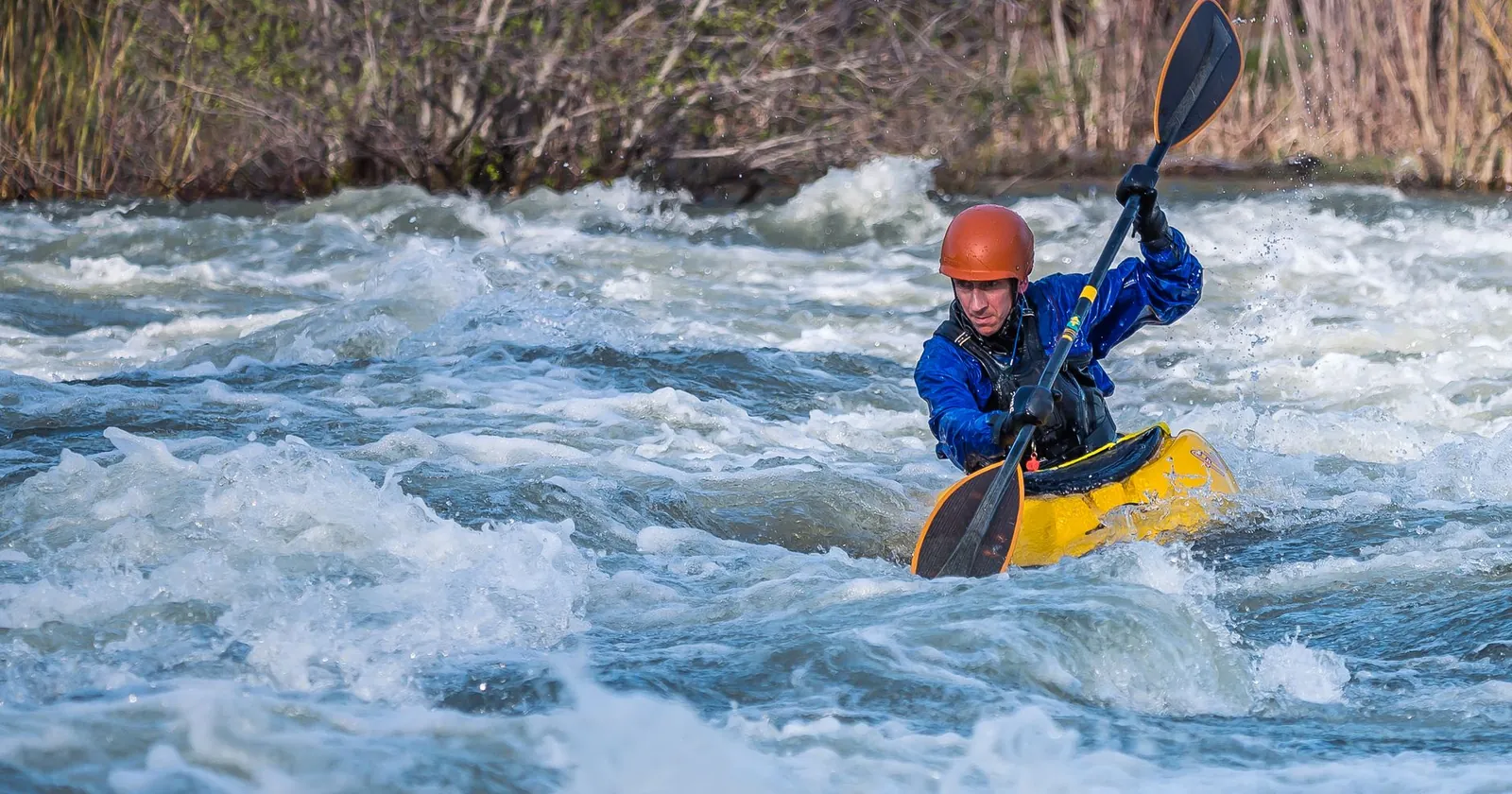
Photo: Brett Sayles via Pexels (free licence).
This is general beginner guidance, not a substitute for a course or in-water supervision.
Key takeaways
- Learn with a club or course, never teach yourself on moving water alone.
- The wet exit comes first: capsize, release the deck, swim out, calmly.
- The roll is the milestone, not the entry ticket; learn it after the wet exit.
- Grades run Class 1 to 5 in American Whitewater's current scale; beginners paddle 1 and 2.
- Never paddle alone; wear a buoyancy aid and helmet, carry rescue gear.
Why you start with a club, not a river
Whitewater kayaking means paddling a small, agile boat down moving, turbulent water. Unlike calmer paddleboarding or flat-water touring, the water itself is the hazard: currents, drops, obstacles and cold. That is exactly why the sport has such a strong club culture. A local canoe or kayak club, or a certified paddle school, gives you instruction, the right beginner boats, and, crucially, rescue-trained company on every trip. It is the standard and safest way in, and it is usually cheap or free through a club.
The beginner progression
Step 1: Get comfortable on flat water
Before any rapid, spend sessions on flat, calm water. Learn to sit in the boat, fit the spray deck (the skirt that seals you into the cockpit), use a forward and sweep stroke, and edge the kayak without tipping. Getting relaxed when the boat wobbles is the foundation for everything that follows.
Step 2: Master the wet exit
The wet exit is your number-one safety skill. It is what you do when you capsize and do not roll up: stay calm upside down, find the grab loop at the front of the spray deck, pull it to release, and slide out of the boat. Practise it repeatedly in a pool or calm water with supervision until it is automatic. Once a capsize does not frighten you, everything else gets easier.
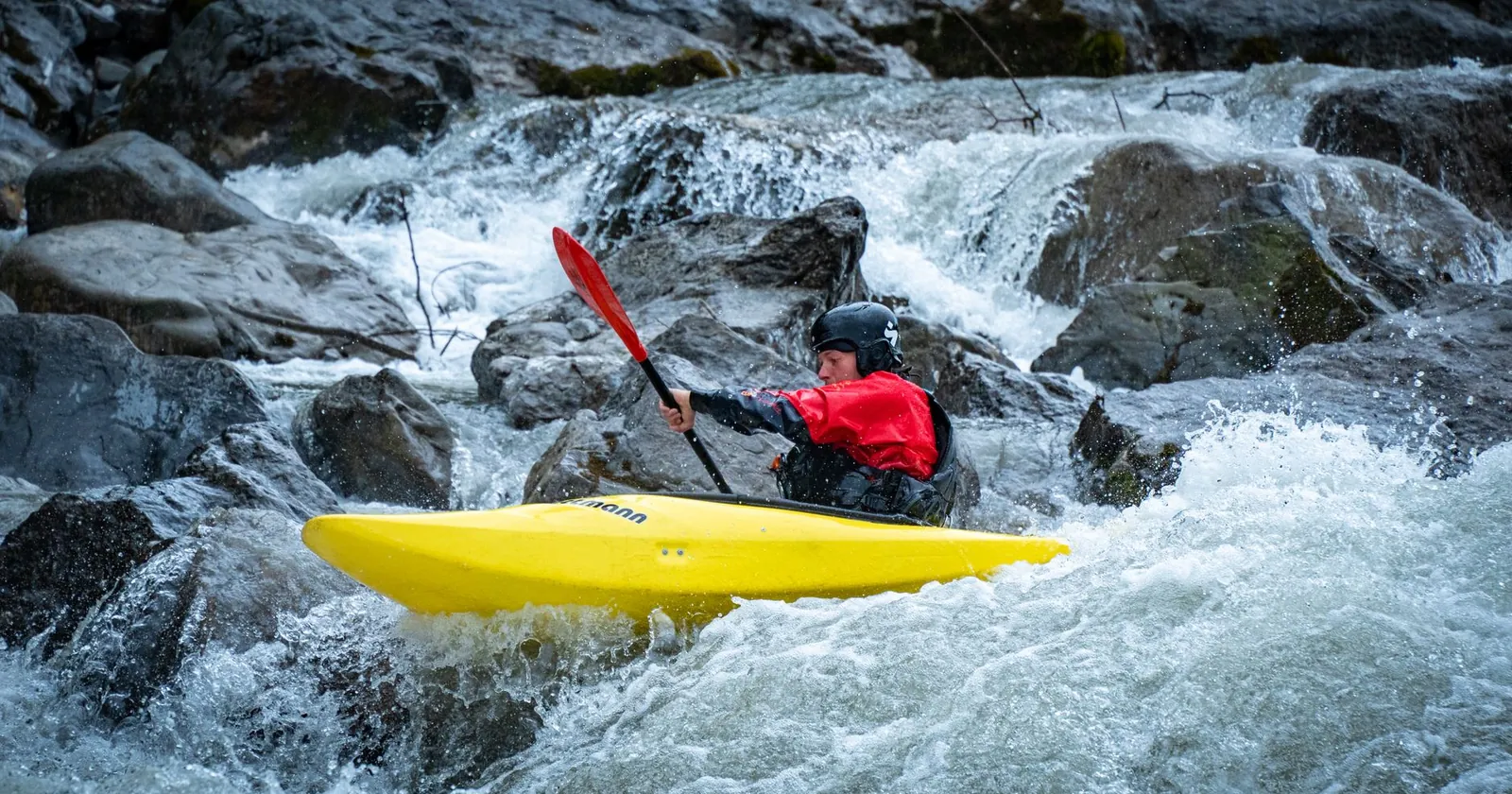
Step 3: Learn to roll
The kayak roll rights you and the boat without swimming, using a hip flick and a sweeping paddle stroke. It usually starts in a pool and takes real practice to make reliable, but it is the skill that lets you paddle harder water with confidence. Treat it as a major milestone, not a prerequisite: the wet exit remains your fallback if a roll fails.
Step 4: Read moving water
Whitewater rewards reading the river. Learn to spot the main current, the eddies (pockets of calm water behind rocks and bends), and to use eddy turns to pull in and out of them, and ferry gliding to cross the flow without being swept downstream. Just as important is spotting hazards, especially strainers (see the safety note).
Step 5: Progress through the grades
Build up gradually. Start on Class 1 and 2 water and only step up as your skills, roll and judgement grow, always with experienced paddlers. There is no prize for rushing the grades on moving water.
Understanding the grading scale
Rivers are rated on the International Scale of River Difficulty, which in American Whitewater's current edition runs from Class 1 to Class 5. In short: Class 1 is easy moving water; Class 2 is novice; Class 3 is intermediate; Class 4 is advanced; and Class 5 is expert, which AW puts as "near the limits of navigation". As a beginner you live on Class 1 and 2, and each step up is a big jump in commitment. The Class VI of older guidebooks is dealt with below.
What gear do you need?
Clubs and schools provide the core kit, so you rarely buy first. The essentials are a whitewater kayak, a spray deck, a well-fitting buoyancy aid (PFD), a whitewater helmet, a suitable paddle, and clothing for the water temperature (often a wetsuit or drysuit). See our whitewater kayak gear guide, and use club or rental gear while you learn.
What the Safety Code actually says about swimming a rapid
"Feet downstream" is the advice everyone repeats, and on its own it is incomplete in a way that matters. American Whitewater Safety Code (2024) describes two techniques and tells you when each applies:
- Defensive. "When swimming in shallow or obstructed rapids, lie on your back with your feet held high and pointed downstream. Use your feet to kick off objects at the surface and your arms to maneuver in the current."
- Aggressive. "If you're in slow moving water or the rapids are deep, roll onto your stomach and swim aggressively for shore."
Staying on your back in deep, slow water is the mistake: there you are supposed to turn over and swim hard for the bank. The Safety Code is equally specific about standing up, and gives a threshold rather than a slogan: "Do not attempt to stand in fast-moving water. Swim to slow-moving water (little to no current) or very shallow water (below your knee) before attempting to stand." Below your knee, not "when it feels shallow".
On going out alone the code is blunt: "River running alone is strongly discouraged. Single-craft outings are a common factor in incidents and drownings." Its own summary of how to stay out of trouble is four lines: dress for the swim, sober is safer, know before you go, boat with a team.
Quoted from American Whitewater Safety Code (2024), checked 8 August 2026. American Whitewater states these are "only a collection of guidelines", published "for informational purposes only" and not intended as a standard of care. They are not a substitute for instruction, a guidebook or local knowledge.
The grading scale, as it is written today
The grades come from American Whitewater's International Scale of River Difficulty (2024). Its current wording is shorter than the version most guidebooks quote, and pairs each class with a skill level and a craft recommendation:
| Class | Skill level | River environment (AW wording) |
|---|---|---|
| 1 | Beginner | Very easy with small, regular waves and riffles |
| 2 | Novice | Easy rapids and waves requiring some maneuvering |
| 3 | Intermediate | Moderate difficulty with large waves and features requiring skilled maneuvering |
| 4 | Advanced | Difficult with powerful rapids and hazardous features requiring precise maneuvering |
| 5 | Expert | Very difficult with long rapids and strong turbulence, expert maneuvering around frequent obstacles. Near the limits of navigation |
Class VI, settled as far as the documents allow. The 2024 scale sheet stops at Class 5, which it describes as "near the limits of navigation". We then searched the full 52-page 2024 Safety Code, the document that carries the scale, for "Class VI" and "Class 6": zero occurrences. So Class VI is not part of what American Whitewater currently publishes, and the "limits of navigation" phrasing it used to carry now sits on Class 5. What we still cannot tell you, because no AW document we found says it, is whether the grade was formally retired or quietly dropped. Treat Class VI as legacy usage you will meet in older guidebooks and river descriptions, not as a current AW grade. Checked 12 August 2026.
AW also warns against reading the scale too literally: "The scale is not exact. Rivers do not always fit easily into one category, and regional or individual interpretations may cause misunderstandings." It tells you to allow extra margin when the water is cold, high, or the river is remote, and to act cautiously in an unfamiliar region until you learn how locals apply the scale. Checked 8 August 2026 against International Scale of River Difficulty (2024).
FAQ: starting whitewater kayaking
Is whitewater kayaking hard to learn?
The basics of sitting in the boat, paddling and doing a wet exit are learned quickly, often in a first pool or flat-water session. What takes longer is a reliable roll, reading moving water and building the judgement to run rapids safely. It is a skill sport with real hazards, so the sensible path is steady progression through a club or paddle school rather than jumping onto hard rivers early.
Do I need a roll to start whitewater kayaking?
No, you do not need a roll to begin, but you do need a solid wet exit, which is releasing the spray deck and swimming out of the boat after a capsize. The wet exit is your fundamental safety skill and you practise it first. A roll is the next big milestone; it lets you right yourself without swimming and paddle harder water, but it is learned after you are comfortable capsizing and exiting.
What do the river grades mean?
Rivers are rated on the International Scale of River Difficulty. American Whitewater's 2024 edition runs Class 1 to Class 5: 1 is very easy with small regular waves and riffles; 2 is easy rapids requiring some manoeuvring; 3 is moderate difficulty with large waves needing skilled manoeuvring; 4 is difficult with powerful rapids and hazardous features; and 5 is very difficult with long rapids and strong turbulence, described as near the limits of navigation. The Class VI you will still meet in older guidebooks appears nowhere in that 52-page document. Beginners learn on Class 1 and 2.
Is whitewater kayaking safe?
Whitewater has genuine hazards including capsizing, cold water, strainers (obstacles that let water through but trap a person or boat) and entrapment, so it should be taken seriously. It is made much safer by learning with a club or course, always paddling with others, wearing a proper buoyancy aid and helmet, carrying rescue gear such as a throw bag, and staying well within your grade. Never paddle whitewater alone. This is general information, not a substitute for instruction and in-water supervision.
What gear do I need to start?
For a beginner, clubs and schools provide the core kit, so you rarely need to buy first. The essentials are a whitewater kayak, a spray deck, a well-fitting buoyancy aid (PFD), a whitewater helmet, a suitable paddle, and clothing for the water temperature (often a wetsuit or drysuit). Groups also carry safety gear like throw bags. Use provided or rented gear while you learn before investing in your own.
Yannick Schroth
Founder of NOMADREEF and a former digital nomad. This guide explains the standard beginner whitewater progression; it is not a substitute for a course or in-water supervision, which every new whitewater paddler should have. About the author · LinkedIn ↗
Sources
- American Whitewater Safety Code (2024). Defensive and aggressive swimming techniques and when each applies; "Do not attempt to stand in fast-moving water. Swim to slow-moving water (little to no current) or very shallow water (below your knee) before attempting to stand"; "River running alone is strongly discouraged"; and the Big Four summary. American Whitewater Safety Code (2024), checked 8 August 2026. AW publishes these as guidelines "for informational purposes only", not as a standard of care.
- American Whitewater, International Scale of River Difficulty (2024). Class 1 to Class 5 definitions and skill levels, and AW's own caution that the scale is not exact and is interpreted differently by region. International Scale of River Difficulty (2024), checked 8 August 2026. The sheet does not list a Class 6, and neither does the full 52-page Safety Code (2024), searched for "Class VI" and "Class 6" on 12 August 2026 with zero hits. Corrected 12 August 2026: the key takeaways, the grading section and the FAQ on this page all still said the scale runs to Class VI while the section below said it stops at 5. The page contradicted itself; it now follows the document throughout.
- Our own whitewater destinations guide for where to paddle, each entry drawn from a fact-checked destination guide.