Tahiti Diving: Polynesia’s Own Dive Law, the Shark Sanctuary and the Whale Season
 by Yannick Schroth
Sep 24, 2026
17 min read
by Yannick Schroth
Sep 24, 2026
17 min read
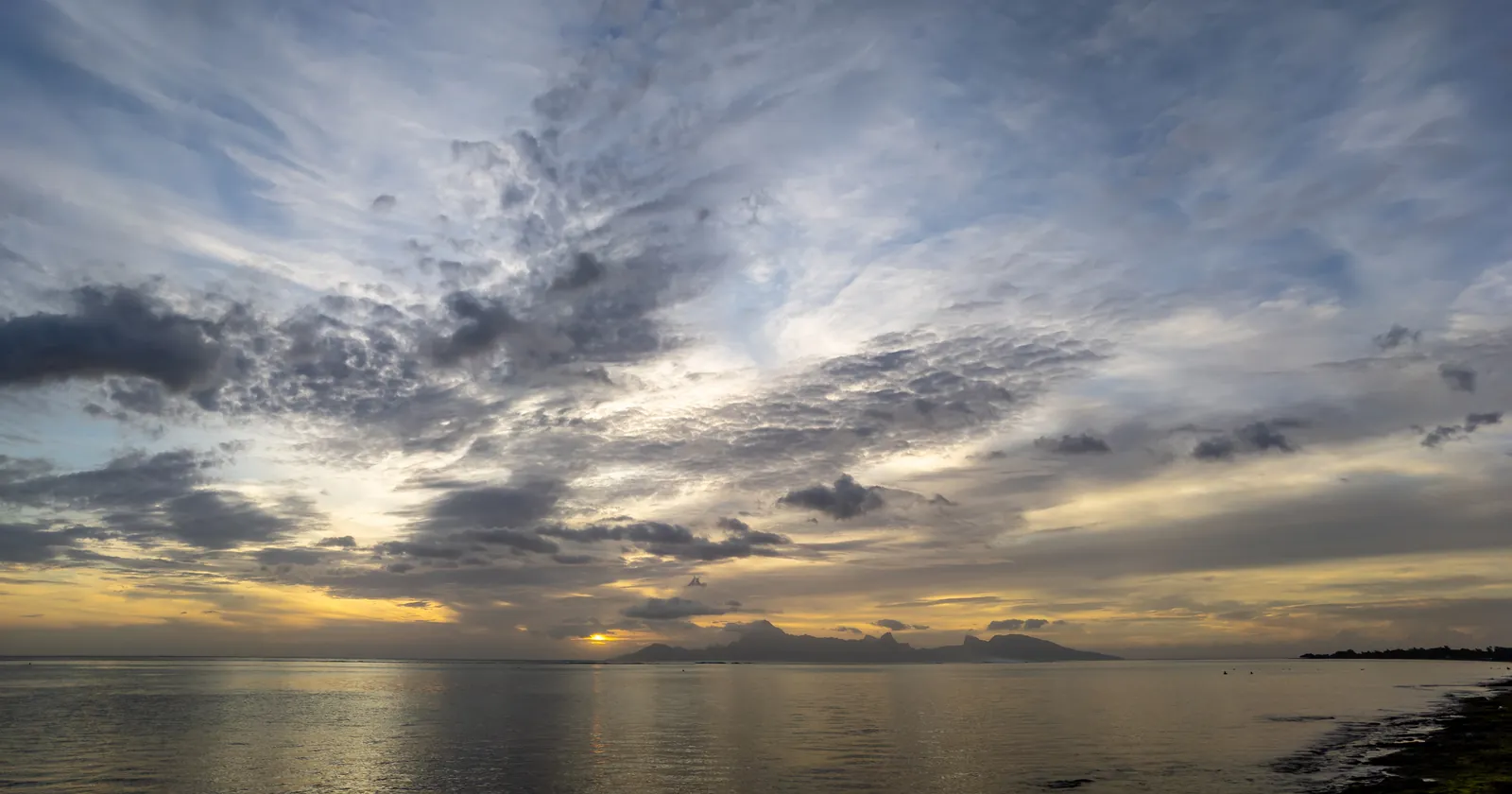
PK 18 beach at Punaauia, 29 April 2019, looking west to Moorea. Photo: Matthew Dillon, Wikimedia Commons, CC BY 2.0.
.jpg)
Key takeaways
- Recreational diving in Tahiti is governed by loi du pays n° 2017-44 of 28 December 2017 and arrêté n° 199 CM of 15 February 2018, both French-language texts of French Polynesia
- The order lists the ISO 24801-2 level, which SSI’s Open Water Diver meets, at 20 meters and again at 30 meters in both its guided and its unguided table, with extra decompression training asked only for dives with a mandatory stop; the dive director decides
- A doctor’s certificate is required only for divers with a relevant medical history or a past decompression accident or chamber treatment; everyone else signs a statement on honor
- The environment code lists all species of sharks as protected, but among rays only Mobula, the manta rays
- Whale-watching authorizations cover only 20 July to 20 November, 7:30 to 17:30, and nobody may enter a 15-meter zone around the animal
Diving in Tahiti runs under a Polynesian law of its own, passed in December 2017
French Polynesia writes its own rules for recreational diving. The base text is loi du pays n° 2017-44 of 28 December 2017 “relative à l’exercice de la plongée subaquatique de loisir”, and the detail sits in arrêté n° 199 CM of 15 February 2018, adopted by the territory’s council of ministers. Both are in French. The Direction de la jeunesse et des sports (DJS) in Papeete administers them and lists both on its diving page.
What that means for a visitor starts at the counter. Article 1 of the order lists what a center must display or hand you on request: the receipt for its declaration as a sports establishment, issued by the territory’s sports service; its liability insurance certificate; the diplomas and professional cards of the people who guide and teach; the conditions for air diving set out in annexes X and XI; and an emergency chart with the phone numbers of whoever would come.
The DJS adds that a dive center must be declared as an établissement d’activités physiques et sportives and insured for the operator, the dive directors, every instructor and the divers themselves, with an assistance guarantee on top. The order backs this with fines aimed at the business rather than at you. Skipping the display duty costs 178,997 F CFP, which the text gives as 1,500 euros, and putting equipment in poor working order into a diver’s hands costs 894,975 F CFP, or 7,500 euros.
How deep an Open Water card goes in Tahiti: 20 meters, or 30 on a no-stop dive
The order never says “Open Water”. Its annexes VII and VIII translate cards into aptitudes: PE for diving in a guided group and PA for diving without a guide, each followed by a depth. PADI, SSI and SDI cards sit in a column headed “Brevets ISO”, so what counts is the ISO level printed behind the brand. SSI files its Open Water Diver under ISO 24801-2, the autonomous diver standard.
The two tables are built the same way. ISO 24801-2 appears plain at PE-20 and PA-20, and again at PE-30 and PA-30, where the only addition is decompression training “en cas de plongée avec palier obligatoire”, for dives with a mandatory stop. Read literally, an Open Water card reaches 30 meters on a no-stop dive, guided or not. Read as a ladder, the card alone stops at 20. The text settles 20 meters for certain.
Without a guide there is a further gate: article 24 grants autonomy only to adults (“plongeurs majeurs”) and only on the decision of the dive director. The director sets the plan for your dive either way, so ask which reading the center applies before you book a deep site.
Going deeper takes named training. PE-40 needs the ISO card plus the “plongée profonde” deep specialty, and PE-50 needs advanced decompression training, which the annex spells out as PADI TEC 50, SSI Technical Extended Range, TDI Extended Range or IANTD Technical Diver. The ISO 24801-1 level, SSI’s Scuba Diver, stops at PE-12. A first try dive, the baptême, may not go below 6 meters under article 25.
Two ceilings apply whatever the card says. Article 4 caps air and nitrox diving at 50 meters, with 10 more allowed only on a course that requires it. Article 5 limits air or nitrox dives deeper than 9 meters to three a day and all diving to six hours a day, decompression included. Article 29 caps the oxygen partial pressure at 1.6 bar, the figure that fixes how deep a given nitrox mix may go under this order.
Neither number is your agency’s. SSI’s own standard trains Open Water divers to dive without a guide to depths shallower than 18 meters, and a director may always set a shallower plan than the order allows. If you plan to certify while traveling, the level you finish at decides which of these lines you stand on.
A Tahiti dive center needs your signature, and a doctor’s certificate in two cases
Article 12 of the order is short. A certificate of no medical contraindication is required from two groups only: people with a history or medical problem that may contraindicate diving, and divers who have had a decompression accident or one or more sessions in a hyperbaric chamber after a diving incident or accident.
Everyone else confirms fitness by signing a statement on honor, an attestation sur l’honneur, signed by the diver or a legal guardian on the model in annex XVII. The DJS publishes it as a multilingual form. Article 38 puts the risk on the center: an establishment that fails to have the diver fill it in faces the 178,997 F CFP sanction.
The rule cuts both ways. A diver with a past decompression accident who turns up with only the signed form is outside the text, however healthy they feel. Staff live under a stricter regime: under article 13, guides and dive directors undergo reinforced medical checks at least every 12 months, by the occupational doctor for employees and otherwise by a doctor qualified in diving, hyperbaric or sports medicine, or a general practitioner on islands without one.
Pass and drift dives in Tahiti require a surface watch on the boat
The order treats the reef passes as a category of their own. Article 9 requires a surface watcher aboard the dive boat for the whole dive on every night dive, every drift dive, every dive in the passes, every rebreather dive, every dive beyond 40 meters and every trimix or heliox dive. Outside those cases, surface cover is left to the dive director.
The watcher is not a passenger. The text requires them to hold the license to drive that boat, to stand ready on the director’s instruction, and to be trained to raise the alarm and give first aid. On a drift dive, article 11 adds that the boat stays on the zone the whole time and follows the divers.
The kit is written down too. Article 8 requires the alpha flag with a hoist of at least 0.50 meters. Article 15 asks for VHF radio when diving from a boat on an island with a rescue-coordinated VHF network, a first aid kit and oxygen with a reserve of at least 600 liters at one bar.
Under article 20 every group carries at least one surface marker buoy in open water, and every guided diver going below 20 meters, every diver without a guide and every guide carries their own means of monitoring the dive and the ascent.
Article 15 also sets the threshold for trouble low: “any anomaly observed during or after a dive must be considered a diving accident”. When one needs medical care, the center must notify the DJS within 48 hours on the form in annex XIX.
Every shark species in Tahiti’s waters is protected, but only one ray genus
The Code de l’environnement de la Polynésie française, also in French, sorts protected species into two categories. Category A holds species considered vulnerable or endangered; category B holds those that are rare or of particular interest. The category B table lists the Elasmobranchii as “toutes les espèces de requins”, all species of sharks, and the environment directorate (DIREN) states the listing as every elasmobranch except the rays. Marine mammals and the green turtle sit in the same category.
For sharks, DIREN sets out the particular prescriptions. Fishing sharks and keeping all or part of one are banned, and an accidental catch goes straight back into the sea. Trade, sale, purchase, import under any customs regime and export of any part of a shark are banned, including when it is mounted as jewelry.
A 2023 paper in PLOS ONE dates the sanctuary to 28 April 2006, when it covered every species except the shortfin mako, and says the mako was added in 2012, “making the entire French Polynesia EEZ a complete sanctuary for sharks and rays”. The code is narrower than that sentence on rays. The only rays its lists name are Mobula sp., “raie manta”, and they sit in category A, not with the sharks.
The stakes are stated in article LP. 2300-2: breaking the protected-species articles is punishable by two years in prison and a fine of 17,800,000 F CFP, or either one. A repeat offense doubles both to four years and 35,600,000 F CFP, and the first fine doubles when the offense happens in a classified natural area.
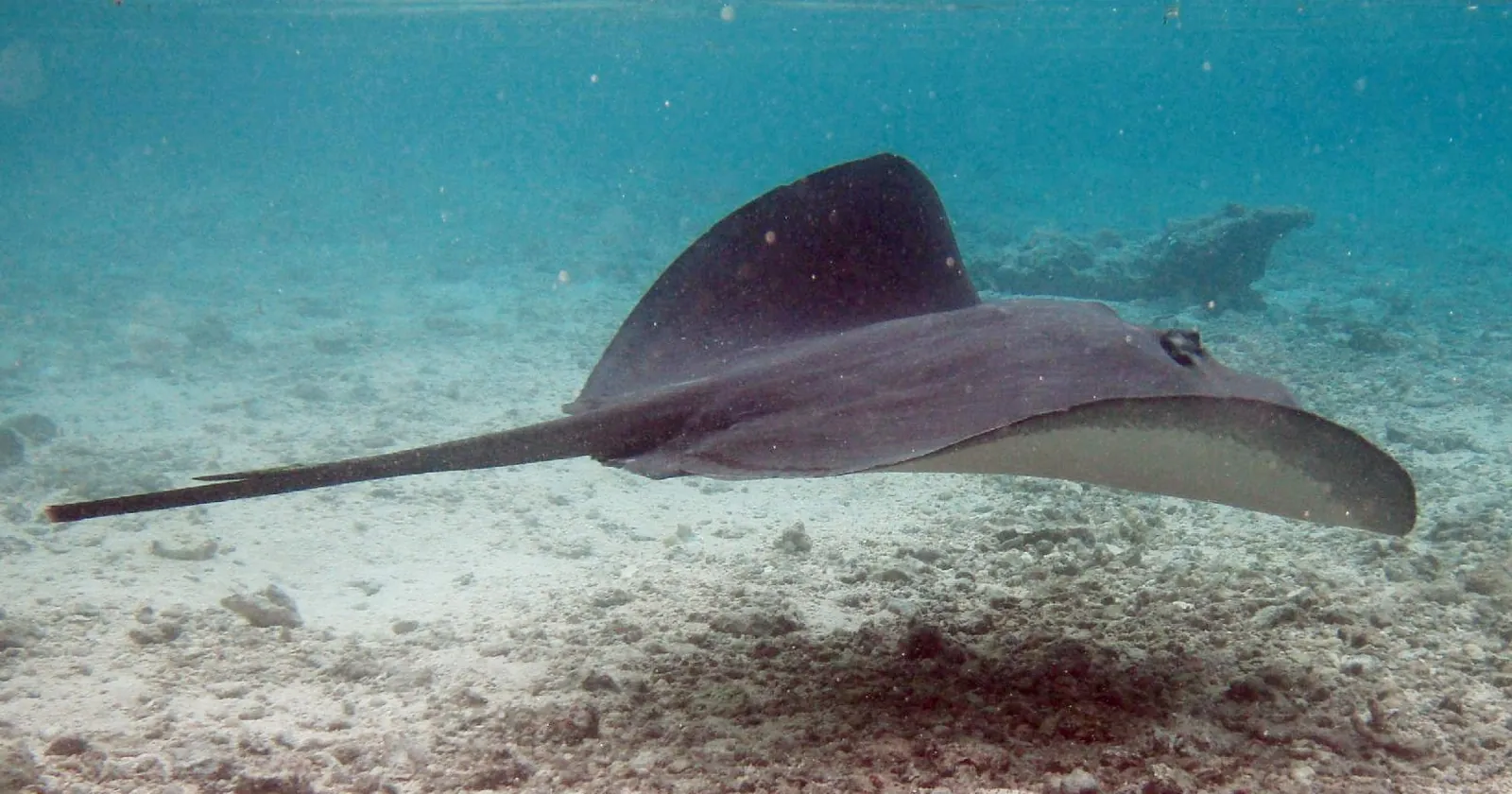
A pink whipray, Himantura fai, off Tahiti, 4 December 2007. Photo: Kat Kellner, Wikimedia Commons, CC BY 2.0.

Shark feeding off Tahiti: the White Valley tiger sharks and a ban with a condition
The feeding rule is not in the shark listing. It is in article LP. 2200-1, which forbids intentionally disturbing the natural development of wild species and names, among the banned acts, attracting wild species “notamment par des gestes, bruits ou promesses de nourriture”, by gestures, noises or promises of food.
The sentence does not end there, and the rest is a condition. The ban applies “lorsque cette pratique risque de constituer une gêne pour les autres utilisateurs de l’espace ou d’attirer des prédateurs”: when the practice risks bothering other users of the space or attracting predators. Read plainly, luring sharks with food is attracting predators, so a shark feed meets the condition by its nature. The penalty, in LP. 2300-3, is a third-class contravention fine, not the prison term that protects the sharks themselves.
Tahiti has a measured example of what feeding changes. The same PLOS ONE study pooled 13,916 dives logged by 114 volunteers between July 2011 and April 2018, and of the four most sampled islands, Tahiti had the highest share of dives with at least one rare species: 84.7 percent of its 1,253 dives. The authors tie Tahiti’s high count of rare species to baiting.
Their example is the tiger shark at the White Valley site, present “on a very regular basis” until 2020, “when the feeding activity was definitively stopped, and occurrences became extremely rare”. That last point rests on the lead author’s own observation rather than on the survey data. The three species the study classed as common, seen at many sites, were the blacktip, gray and whitetip reef sharks. Our shark diving list compares other places to see sharks.
Tahiti whale season: 20 July to 20 November, and 15 meters nobody may cross
Humpback whales arrive in French Polynesia from July to the end of October, according to the environment directorate, which puts Polynesian water in the southern winter at 21°C to 27°C. That falls in what Météo-France Polynésie calls the cool season, May to October. It places the Society Islands’ rainy season between November and April, with December and January the wettest months, and gives Faa’a an annual mean air temperature of 26°C.
Where you may look is fixed first. Article A. 2213-1-4 of the code bans searching for and approaching whales and other marine mammals, to watch, photograph or record them, in lagoons, bays and passes and within 1 kilometer of a pass axis, for anyone and by any means of transport. Beyond those waters, anyone doing it habitually or professionally needs an authorization, applied for through the PARAOA online service.
DIREN’s 2025 brochure sets out the current terms. Authorizations are possible only in the territorial sea around Bora Bora, Huahine, Mo’orea, Ra’iatea, Rurutu, Taha’a, Tahiti, Teti’aroa and Tubuai, from 20 July to 20 November inclusive, from 7:30 to 17:30, for one authorized vessel per island per group of companies.
Around the animal the brochure draws three rings. In the 300-meter observation zone only authorized boats may enter, three at most, below 3 knots. No boat may enter the 100-meter exclusion zone. Nobody may enter the 15-meter safety zone. Water entries happen outside the exclusion zone, seven people per boat including the guide, and the brochure asks you to keep each encounter to 15 minutes, less with a newborn calf present.
The 15 meters is recent. The consolidated code of 28 May 2024 still told swimmers and divers to keep a permanent 30 meters, so that figure belongs to the older text.
The camera is regulated as well: LP. 2213-2 forbids taking or using footage of these species obtained without the authorization, and DIREN’s filming form asks for a synopsis and a methodology. The text makes no exception for a visitor’s own camera and the form is built for film shoots, so ask the boat what its authorization covers before you post. More humpback water is on our whale watching list.
Tahiti’s regulated fishing zones at Punaauia and Tautira, and the rahui on Tahiti Iti
The marine zones written into law around Tahiti regulate fishing, not diving. The fisheries directorate, the Direction des ressources marines, runs zones de pêche réglementée, locally agreed fishing zones, and counted 34 of them across French Polynesia in September 2023. Its list of Tahiti texts, updated in November 2023, covers Faa’a, Pirae, Arue, Mahina, Hitia’a, Tautira, Punaauia, two zones at Papara and one at Mataiea.
Punaauia, the west-coast town where two of the SSI centers below are filed, has three under arrêté n° 208 CM of 29 February 2016. At Tata’a and Atehi all fishing is banned except line fishing and spearfishing by day. Nuuroa also allows ature nets of up to 100 meters from 5:00 to 12:00 and ina’a dip nets. Inside Atehi, the Vaiava aquatic trail bans every kind of fishing. A breach is a fifth-class contravention, 179,000 F CFP, with the gear and catch seized.
On Tahiti Iti, the southern peninsula, the written zone on the list is Tautira’s, set by arrêté n° 39 CM of 15 January 2021. In its second subzone, Tahunatara Vaionifa no Tautira, all fishing is banned; in Tautira Bay, large ature nets are allowed only from 8:00 to 17:00. No zone named for Teahupo’o appears on that list.
Absence from that list says nothing about local rules. The environment code defines a rahui in article LP. 2122-1 as a land or sea area where “des règles non écrites”, unwritten rules, restrict the use of a resource for a set period and are applied in the traditional way. Unwritten is the point: the rules live with the community, not in a gazette, so ask your operator or the village before you take anything from the reef.
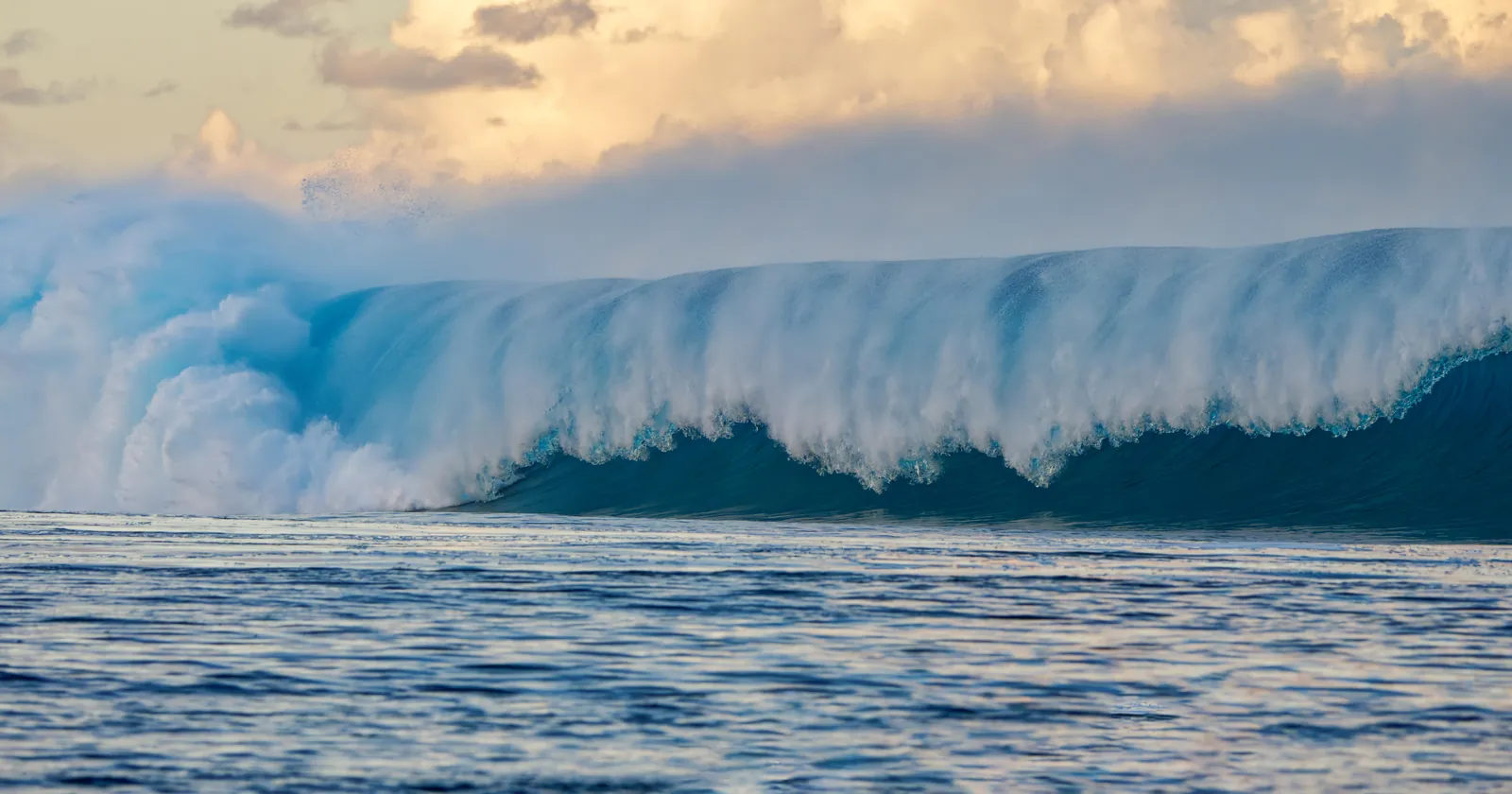
The swell breaking on the coral reef at Teahupo’o, Tahiti Iti. Photo: Olivier Dugornay, IFREMER, Wikimedia Commons, CC BY 4.0.
_(Ifremer_00783-89469_-_49353).jpg)
Tahiti’s recompression chamber is at the territorial hospital in Pirae; the number is 15
The Centre Hospitalier de la Polynésie française, the territorial hospital in Pirae, runs a caisson hyperbare inside its emergency department. The hospital describes it as a hyperbaric oxygen unit that treats decompression accidents in divers, carbon monoxide poisoning and infections such as gas gangrene, and its 2019 activity report says the chamber takes divers’ accidents as emergencies.
The call goes to 15. The hospital’s SAMU runs the reception and regulation center that answers 15 for the whole of French Polynesia, sends its mobile intensive care teams, and organizes inter-island medical evacuation flights. For a diver on Tahiti, the chamber is on the same island.
At the dive site, article 14 of the diving order requires a written emergency plan with the alert procedure and the numbers of the rescue services. Before you book, ask which evacuation the plan names and who pays for it, then compare the answer with the dive insurance guide.
Teaching diving in Tahiti takes a state diploma, not a PADI or SSI instructor card
For a traveling instructor this is the rule that matters most. The DJS states that to teach, guide or lead diving for pay you need a diploma on the current homologation list, a prior declaration and a valid professional card, plus the annual medical check, a five-yearly refresher and an up-to-date PSE1 first aid certificate.
The list is set by arrêté n° 2391 CM of 1 December 2025: the French BPJEPS, DEJEPS and DESJEPS diving diplomas, the older BEES, and the Polynesian BPP GAPPN “plongée subaquatique”. A PADI, SSI, SDI or NAUI instructor rating, the DJS says, “est une qualification technique”. It does not on its own get you a card; a training body may count it toward exemptions.
Two more lines close the side doors. The DJS quotes article LP 5 of the 2017 law: “Dans les organismes à but lucratif, toute forme de bénévolat est interdite”, so a commercial center cannot take you on unpaid. And the Polynesian diploma has its own entry bar under arrêté n° 1778 CM of 6 October 2017: a coastal boat license, CMAS 2 stars or Advanced Open Water, and 30 dives since that level, 10 of them without a guide and 5 below 30 meters.
Five SSI dive centers on Tahiti, filed in Punaauia, Arue, Papeete and Taravao
The Tahiti operator list holds 5 dive centers, read on 24 September 2026, all published by SSI in its register of affiliated centers. SSI files Fluid and Tahiti Dive Management under Punaauia, and both of their own sites give Marina Taina. Dive and Sea Tahiti is filed under Papeete, while its site puts the center at Punaauia. École de Plongée de Tahiti is filed under Arue, in the Yacht Club de Tahiti marina by its own account, and Tahiti Iti Diving under Taravao.
Four of the five publish a website in the register. SSI rates two of them for Extended Range, the course the Polynesian table names as decompression training, one for Rebreather, and two for Freediving; that is a statement about the listing, not proof that a course runs this season. Tahiti Dive Management’s own site offers private guided dives rather than public courses.
An SSI listing says nothing about the declaration receipt, the insurance or the professional cards, and those are exactly what article 1 makes the center show you, so ask to see them. Moorea, across the channel, is a separate trip with its own centers and is not on this list. Which registers can be read explains what each source can and cannot tell you.
FAQ: scuba diving in Tahiti
How deep can I dive in Tahiti with an Open Water certification?
Arrêté n° 199 CM of 15 February 2018 lists the ISO 24801-2 level, which SSI's Open Water Diver meets, at 20 meters and again at 30 meters in both its guided and unguided tables; the 30-meter lines add decompression training only for dives with a mandatory stop. So 20 meters is certain and 30 is possible on a no-stop dive, as the dive director decides. SSI's own standard trains Open Water divers for depths shallower than 18 meters.
Do I need a medical certificate to dive in Tahiti?
Usually not. Article 12 of the diving order requires a certificate only from people with a history or medical problem that may contraindicate diving, and from divers who have had a decompression accident or chamber treatment after a diving incident. Everyone else signs a statement on honor on the model in annex XVII, and a center that fails to collect it faces a 178,997 F CFP sanction.
Is shark feeding legal in Tahiti?
Article LP. 2200-1 of the environment code forbids attracting wild species by gestures, noises or promises of food when the practice risks bothering other users or attracting predators, and luring sharks with food is attracting predators. The penalty is a third-class contravention fine. A 2023 PLOS ONE study reports that tiger sharks at Tahiti's White Valley site became extremely rare after feeding there stopped in 2020.
When can you see humpback whales in Tahiti, and how close can you get?
Whale-watching authorizations run from 20 July to 20 November inclusive, 7:30 to 17:30, in the territorial sea only; lagoons, bays, passes and the water within 1 kilometer of a pass axis are closed to it. Boats keep out of a 100-meter exclusion zone, people enter the water outside it, seven per boat including the guide, and nobody may enter the 15-meter safety zone around the animal.
Where is the nearest recompression chamber for Tahiti divers?
At the Centre Hospitalier de la Polynésie française in Pirae, whose emergency department runs a hyperbaric chamber that treats divers' decompression accidents. Emergency calls go to 15, which the hospital's SAMU answers for all of French Polynesia and which also organizes inter-island evacuation flights.
Note: Conditions, safety guidance and regulations change. Verify current information with official sources, including the dive operator, the park authority and the relevant government department, before you travel or dive.
Founder of NOMADREEF and a former digital nomad. This guide is sourced from the references below; conditions, prices and rules change, so verify current details, and follow qualified local guidance and safety briefings. About the author · LinkedIn ↗
Sources
- The diving order (primary, in French). Arrêté n° 199 CM du 15 février 2018 portant mesures d’application de la loi du pays n° 2017-44 du 28 décembre 2017 relative à l’exercice de la plongée subaquatique de loisir, NOR SJS1820214AC-1, as transmitted to the Assembly of French Polynesia: article 1 on the display duties; article 4 on the 50-meter cap; article 5 on three dives and six hours a day; article 8 on the alpha flag; article 9 on the surface watcher; article 11 on drift dives; article 12 on the medical certificate and the statement on honor; article 13 on staff medicals; articles 14 and 15 on the emergency plan, the 600-liter oxygen reserve, VHF, the anomaly rule and the 48-hour report; article 20 on computers and surface marker buoys; articles 24 and 25 on autonomy and the try dive; article 29 on oxygen partial pressure; article 38 on the 178,997 and 894,975 F CFP sanctions; annexes VII and VIII on PE and PA aptitudes, including the column “Brevets ISO (PADI, SSI, SDI)”. Arrêté n° 199 CM, Assemblée de la Polynésie française (PDF). Read 24 September 2026. The official database LexPol refused connections on that date, so amendments to the order made after 2018 could not be checked; the DJS page below still cites it as in force. The text of loi du pays n° 2017-44 itself was not read, and its article LP 5 is quoted here as the DJS quotes it.
- The administration of diving and the rules for instructors (primary, in French). Direction de la jeunesse et des sports, “Plongée subaquatique de loisir : réglementation et démarches”: the EAPS declaration and insurance obligations; the professional card, its free online application and five-year renewal; the annual medical, five-yearly refresher and PSE1; the diploma list under arrêté n° 2391 CM of 1 December 2025; the statement that a PADI, SSI, SDI or NAUI instructor rating is a technical qualification that does not by itself give a professional card; the quotation of article LP 5 on volunteering; the BPP GAPPN entry conditions under arrêté n° 1778 CM of 6 October 2017; the multilingual fitness statement. DJS, plongée en Polynésie française. Read 24 September 2026.
- The environment code (primary, in French). Code de l’environnement de la Polynésie française, version in force on 28 May 2024, as exported from LexPol by the Secrétariat général du gouvernement and held by FAOLEX: LP. 2122-1 defining the rahui; LP. 2200-1 on intentional disturbance and attracting wild species; LP. 2210-1 and the category A and B lists, including Mobula sp. in category A and Elasmobranchii, “toutes les espèces de requins”, in category B; LP. 2211-1 to LP. 2211-3; LP. 2213-1 and LP. 2213-2 on authorizations and footage; LP. 2300-2 on two years and 17,800,000 F CFP; LP. 2300-3 on the third-class contravention for attracting wild species; A. 2213-1-4 on lagoons, bays, passes and the 1-kilometer radius; A. 2213-1-7 in its May 2024 wording, with 30 meters for swimmers and divers. Code de l’environnement, version au 28/05/2024 (PDF, FAOLEX). Read 24 September 2026. This consolidation predates the whale rules summarized in source 5.
- Protected species as the environment directorate states them (primary, in French). DIREN, “Les espèces”: category B covering sharks, “ou tous les animaux qui appartiennent à la sous-classe des Elasmobranches, à l’exception des raies”; the shark prescriptions on fishing, possession, accidental catch, trade and jewelry; the manta ray in category A; the marine mammal sanctuary; authorization via PARAOA. With the filming authorization form for sharks and green turtles, under article LP. 2213-1. DIREN, les espèces and DIREN, formulaire prises de vues requins et tortue verte (PDF). Read 24 September 2026.
- The whale rules in force (primary, in French). DIREN, “Comment observer les mammifères marins en Polynésie française”, 2025: humpbacks from July to the end of October; Polynesian water in the southern winter at 21°C to 27°C; no observation in lagoons, bays and passes; authorizations only in the territorial sea of nine named islands, 20 July to 20 November inclusive, 7:30 to 17:30, one vessel per island per group of companies; the 300-meter observation zone with three boats below 3 knots; the 100-meter exclusion zone; the 15-meter safety zone; seven people in the water per boat including the guide; 15 minutes per encounter; articles A. 2213-1-4 to A. 2213-1-11. DIREN, règles d’approche des mammifères marins (PDF). Read 24 September 2026. The order behind the 2025 terms was not read, because LexPol was unreachable; the terms are given as the directorate states them.
- Sharks counted by divers. Séguigne C, Mourier J, Clua É, Buray N, Planes S (2023), Citizen science provides valuable data to evaluate elasmobranch diversity and trends throughout the French Polynesia’s shark sanctuary, PLOS ONE 18(3): e0282837: the sanctuary of 28 April 2006 excluding the shortfin mako, which was added in 2012; 13,916 dives by 114 volunteers from July 2011 to April 2018; 1,253 dives at Tahiti; 84.7 percent of Tahiti dives with a rare individual; blacktip, gray and whitetip reef sharks as the common species; tiger sharks at White Valley until feeding stopped in 2020, reported as the lead author’s personal observation. doi:10.1371/journal.pone.0282837. Read 24 September 2026. The 2006 order itself, n° 396 CM by the paper’s account, was not read, so its date rests on this peer-reviewed paper.
- The regulated fishing zones (primary, in French). Direction des ressources marines, “ZPR de Tahiti”: 34 zones across French Polynesia in September 2023; the list of Tahiti texts updated November 2023; the zone sheets for Tata’a, Nuuroa and Atehi under arrêté n° 208 CM of 29 February 2016, with the Vaiava aquatic trail and the 179,000 F CFP fifth-class contravention; the Tautira sheet under arrêté n° 39 CM of 15 January 2021. DRM, ZPR de Tahiti, Atehi (PDF), Nuuroa (PDF), Tata’a (PDF) and Tautira (PDF). Read 24 September 2026. Press accounts of a rahui in the Teahupo’o area disagree on which side of Tahiti Iti it lies and how it is protected, so no date, size or legal status is given for it here.
- The hyperbaric chamber and 15 (primary, in French). Centre Hospitalier de la Polynésie française, “Urgences - SAMU”: the caisson hyperbare in the emergency department and what it treats; the call center regulating calls to 15 for the whole of French Polynesia; inter-island evacuation flights. With the hospital’s 2019 activity report on emergency care of diving accidents in the chamber, and its site giving Pirae as its location. CHPF, Urgences - SAMU and CHPF, rapport d’activité 2019 (PDF). Read 24 September 2026.
- Climate (primary, in French). Météo-France Polynésie française, “Climat de la Polynésie française”: the rainy season in the Society Islands from November to April, December and January the wettest, and an annual mean temperature of 26°C at Faa’a. Météo-France Polynésie, climat. Read 24 September 2026. Its climate pages and monthly bulletins give no sea temperature for Tahiti, so the only water figure here is the directorate’s range for Polynesia in the southern winter.
- The agency standard. SSI, “Open Water Diver (ISO 24801-2)”, training standard: the program trains students “to dive autonomously with an equally- or more-qualified buddy” to “depths shallower than 18 meters”. SSI training standards, Open Water Diver. Read 24 September 2026.
- The five businesses. Five dive centers on the Tahiti operator list, read 24 September 2026, all published by SSI in its register of affiliated centers: four publish a website in the register; SSI rates two for Extended Range, one for Rebreather, two for Freediving and one for Mermaid. The Marina Taina, Punaauia and Arue locations are as the centers’ own sites give them. The register’s town field records where a body files a business, not necessarily where it operates, and the limits of each source are set out on which registers can be read. Not covered: any arrival or tourist tax at Tahiti’s airport, for which no primary source was read.